
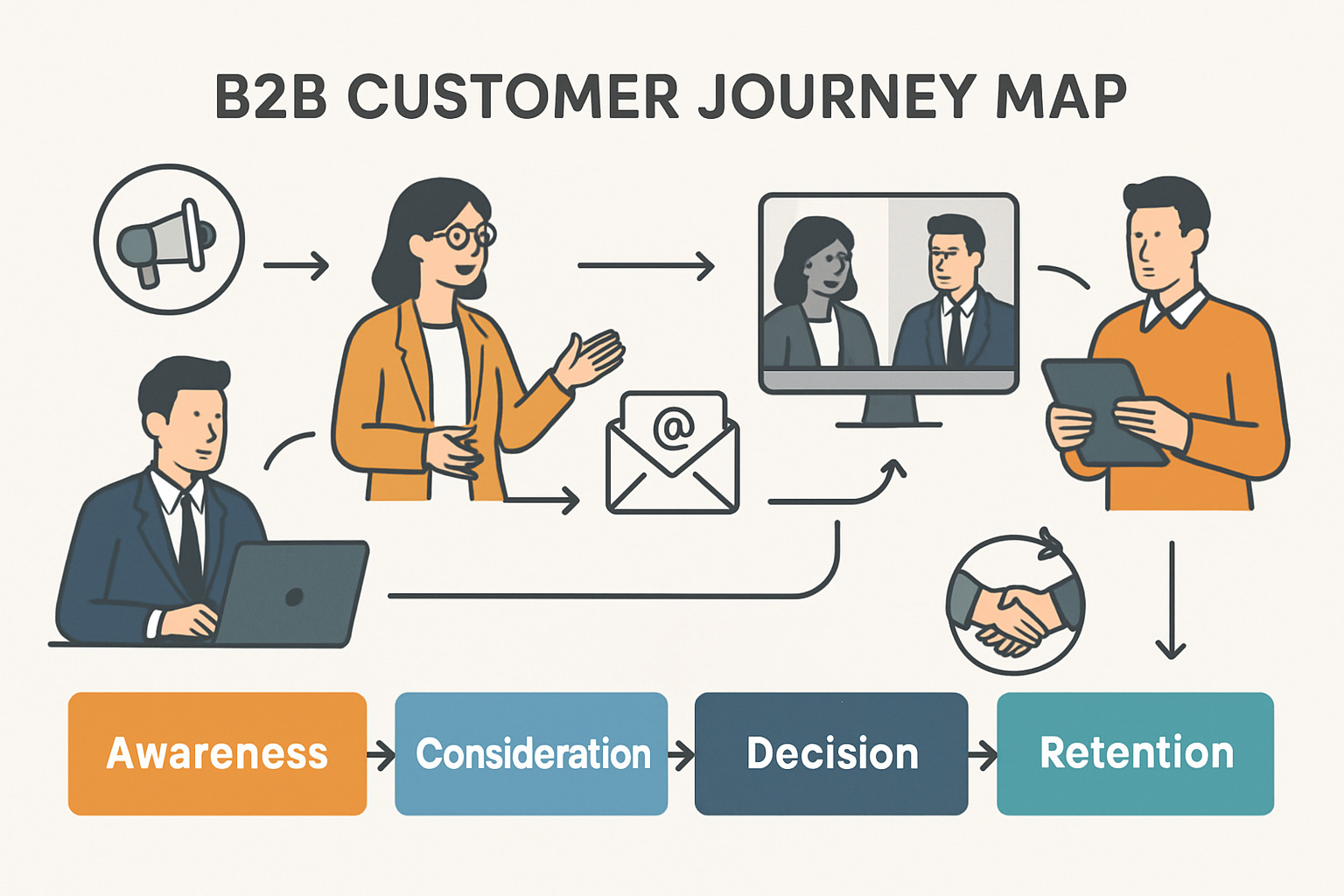
Understanding the customer journey is critical to improving how prospects and customers experience your brand at every stage.
What Is a Customer Journey? Quick Answer
A customer journey is the complete sequence of interactions a prospect or customer has with your brand across all touchpoints, from initial awareness through purchase, retention, and advocacy. It includes the actions people take, the channels they use, and the emotions they experience along the way.
How The B2B Mix thinks about customer journey strategy
At The B2B Mix, we use customer journey strategy to help B2B companies create a more connected path from first touch through retention and advocacy.
That does not mean we approach customer journey as a standalone exercise or a visual mapping project in isolation. We look at how the journey connects to lifecycle stages, content strategy, campaign execution, CRM structure, automation, and cross-functional handoffs.
In other words, we do not treat customer journey as a CX-only concept. We treat it as part of a broader revenue system that affects conversion, retention, and long-term growth
Customer journey strategy vs. customer journey mapping services
Some agencies focus primarily on customer journey mapping workshops, research exercises, or CX deliverables. Those can be useful, but they are only part of the picture.
The B2B Mix focuses on how customer journey insight translates into practical execution across marketing, sales, lifecycle stages, content, automation, and reporting.
That means the goal is not just to document the journey. The goal is to improve the systems, touchpoints, and messaging that shape it.
Key stages of the customer journey
- Awareness
- Consideration
- Decision
- Retention
- Advocacy
Why the customer journey matters
- Identifies friction points that cause drop-off
- Improves alignment between marketing, sales, and customer experience
- Enables more relevant, personalized interactions
- Supports retention, loyalty, and long-term revenue growth
>> Answer a few quick questions to receive your personalized score and recommendations.
Understanding today’s customer journey
Today’s customer journey is rarely linear. B2B buyers move across channels, revisit information, involve multiple stakeholders, and often make decisions over an extended period of time. A prospect may discover your brand through search or social media, compare solutions on your website, download resources, attend a webinar, read reviews, and request a demo before ever speaking to sales.
When you understand that journey clearly, you can create better content, improve conversion paths, reduce friction, and build stronger customer relationships. Instead of treating each interaction as a one-off event, you can optimize the full experience from first touch to long-term loyalty.
Key takeaways
- The customer journey involves all interactions a person has with a brand from awareness to advocacy.
- Understanding the customer journey helps businesses identify friction points and improve strategies across marketing, sales, and service.
- Customer journeys are non-linear and often influenced by both logic and emotion.
- Journey mapping helps visualize customer experiences and create more personalized strategies for different segments and personas.
- Measuring success includes tracking conversion, retention, and customer satisfaction metrics like NPS and CES.
Understanding the journey your customers take
For quick reference, here's what you need to know:
| Customer Journey Element | Description |
|---|---|
| Definition | The end-to-end process customers go through when interacting with your brand |
| Key Stages | Awareness, Consideration, Decision, Retention, Advocacy |
| Touchpoints | Website, emails, social media, customer service, product usage, etc. |
| Purpose | To understand and optimize how customers experience your brand |
Think of the customer journey as the roadmap that tells the story of your customer’s experience. It is not just about the transaction. It is about the full relationship.
When you understand your customer’s journey, you can:
- Identify friction points that cause prospects to drop off
- Align your marketing, sales, and service teams around the customer
- Deliver the right content at the right time
- Create experiences that build loyalty and advocacy
A customer journey is more than just a series of steps
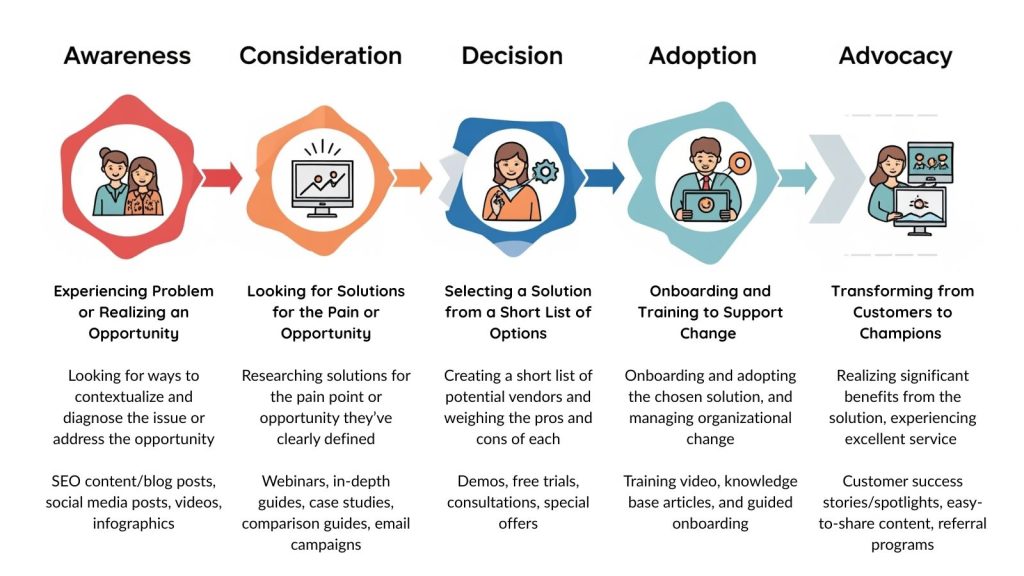
A customer journey is more than a series of steps. It reflects the full relationship a customer has with your brand over time.
At its core, the customer journey represents a shift away from isolated transactions and toward meaningful, long-term relationships. Instead of viewing each sale as a one-time event, it helps you understand how customers interact with your brand across multiple channels and touchpoints over time.
What makes customer journeys especially important in B2B is that they are shaped by both logic and emotion. While buying decisions may seem rational on the surface, factors like trust, confidence, uncertainty, and perceived risk all influence how decisions get made.
Perhaps most importantly, customer journeys rarely follow a straight line. Prospects may revisit earlier stages, pause the process, bring in additional stakeholders, or change direction entirely. Understanding that complexity helps businesses create better experiences and make smarter decisions across marketing, sales, and customer experience.
Customer journey stages at a glance
What is customer journey vs. buyer's journey?
| Aspect | Buyer's Journey | Customer Journey |
|---|---|---|
| Scope | Narrower - focuses on the path to purchase | Broader - encompasses the entire relationship |
| Timeline | Pre-purchase focus | Pre-purchase through post-purchase and beyond |
| Stages | Awareness, Consideration, Decision | Awareness, Consideration, Decision, Retention, Advocacy |
| Model | Traditional funnel | Flywheel (continuous) |
| Primary Goal | Conversion to sale | Long-term relationship and loyalty |
| Team Focus | Primarily marketing and sales | Marketing, sales, customer service, product |
While often used interchangeably, the customer journey and the buyer's journey represent different scopes and perspectives:
Think of the buyer's journey as a subset of the customer journey. It focuses specifically on the process leading up to a purchase decision. Once that purchase happens, the buyer's journey ends—but the customer journey continues onward.
This distinction becomes particularly important in B2B contexts where relationships often extend over years or even decades. The post-purchase experience—including onboarding, support, renewal, and expansion—represents a significant portion of customer lifetime value and deserves equal strategic attention.
What is customer journey vs. sales funnel?
While the terms are sometimes used interchangeably, the customer journey and the sales funnel are not the same thing.
The sales funnel focuses on how prospects move toward a purchase. It is typically used to track conversion from one stage to the next, such as awareness, lead, opportunity, and customer.
The customer journey is broader. It looks at the full experience a person has with your brand across every touchpoint, from first awareness through purchase, retention, and advocacy.
In simple terms:
- The sales funnel measures how people move toward conversion
- The customer journey helps you understand how people experience that sales & marketing process
Customer journey vs. sales funnel at a glance
| Aspect | Sales Funnel | Customer Journey |
|---|---|---|
| Main focus | Conversion | Experience |
| Perspective | Business-centered | Customer-centered |
| Scope | Usually ends at purchase | Extends beyond purchase into retention and advocacy |
| Structure | Often linear | Often non-linear |
| Primary use | Track pipeline and stage progression | Understand touchpoints, emotions, and friction points |
| Teams involved | Primarily marketing and sales | Marketing, sales, customer success, service, and product |
A sales funnel is useful for understanding how efficiently leads progress toward a deal. A customer journey is useful for understanding what prospects and customers are thinking, doing, and experiencing at each stage.
For example, a funnel may show that prospects are dropping off after a demo. A customer journey helps explain why that is happening by looking at the surrounding experience, such as unclear messaging, missing follow-up, inconsistent handoffs, or unanswered objections.
The two should work together. The funnel shows where performance issues exist, while the customer journey helps uncover the reasons behind them. When B2B companies look at both, they get a clearer picture of what is affecting conversion, retention, and long-term growth.
What is the difference between customer journey stages and lifecycle stages?
While customer journey stages describe the buyer’s experience across different touchpoints, lifecycle stages reflect how a business tracks and manages contacts internally within its CRM and go-to-market systems.
The two are closely connected, but they are not interchangeable. Customer journey stages focus on how prospects and customers move through awareness, consideration, decision-making, retention, and advocacy. Lifecycle stages are the internal structure a company uses to organize, manage, and measure that progression.
A lot of B2B companies understand the customer journey in theory but have a harder time putting it into practice. That disconnect often shows up in lifecycle stage definitions, CRM structure, automation logic, lead handoffs, reporting, and content alignment.
That is where customer journey strategy becomes especially valuable, not just as a diagram or planning exercise, but as a framework for improving how your revenue engine actually works.
Customer journey stages vs. lifecycle stages at a glance
| Aspect | Customer Journey Stages | Lifecycle Stages |
|---|---|---|
| Main focus | Customer experience | Internal tracking |
| Perspective | Customer-centered | Business-centered |
| Purpose | Understand needs, behaviors, and friction points | Organize contacts and manage progression in systems |
| Typical examples | Awareness, Consideration, Decision, Retention, Advocacy | Subscriber, Lead, MQL, SQL, Opportunity, Customer |
| Used by | Marketing, sales, service, customer experience teams | Marketing ops, sales ops, RevOps, CRM users |
| Primary value | Improves messaging, touchpoints, and experience | Improves reporting, automation, and handoffs |
The two should work together. A company may map a customer journey stage like Consideration, then align that stage to one or more internal lifecycle stages such as Lead or Marketing Qualified Lead, depending on how the business defines progression.
This is where many B2B companies run into problems. When journey stages and lifecycle stages are not aligned, teams may struggle with inconsistent handoffs, unclear reporting, and disconnected customer experiences.
The customer journey helps you understand what the customer needs. Lifecycle stages help your team track, automate, and manage that journey inside your systems. When both are aligned, it becomes easier to improve conversion, retention, and overall revenue performance.
How customer journey, lifecycle stages, and RevOps work together
Customer journey, lifecycle stages, and RevOps each help you understand and manage a different part of growth.
- The customer journey reflects the customer’s experience across touchpoints
- Lifecycle stages track progression inside your CRM and marketing systems
- RevOps aligns the teams, processes, and data that support that journey
Together, they help B2B companies create a more consistent experience from awareness through retention. The journey shows what the customer needs, lifecycle stages show how the business tracks progress, and RevOps helps ensure marketing, sales, and post-sale teams are working in sync.
When these elements are aligned, it becomes easier to improve handoffs, reporting, automation, and overall revenue performance.
Who This Is For
Customer journey strategy tends to matter most for B2B organizations that are dealing with a higher level of complexity.
That typically includes companies that:
- have longer or non-linear sales cycles
- involve multiple stakeholders in the buying process
- rely on CRM and marketing automation to manage lead progression
- need stronger alignment between marketing, sales, and customer teams
- are trying to connect content, campaigns, and lifecycle stages more effectively
If your team is already generating demand but struggling to move prospects smoothly from one stage to the next, it’s usually a sign that your customer journey and your internal systems aren’t fully aligned. This is also where lifecycle marketing and revenue operations start to play a much bigger role…
What is customer journey vs. customer experience?
Another important distinction exists between the customer journey and customer experience:
The customer journey is the process, the series of steps and interactions a customer has with your brand. It's the "what happens" along the path.
Customer experience (CX) is the perception—how the customer feels about those interactions. It's the "how it feels" aspect of the journey.
The journey provides a holistic lens through which to view the entire relationship, while customer experience metrics like Net Promoter Score (NPS), Customer Satisfaction (CSAT), and Customer Effort Score (CES) help quantify satisfaction at specific touchpoints or overall.
Think of it this way: the customer journey is the map, while customer experience is the terrain. Both are essential to understand if you want to guide your customers effectively and create lasting relationships that drive growth for your business.
Core stages & touchpoints to watch
Ever wonder why some customer relationships flourish while others fizzle out? The secret lies in understanding the journey your customers take with your brand. Let's explore the winding path they follow and the critical moments that can make or break their experience.
1. Awareness
This is where it all begins. Your potential customers have just realized they have a problem or opportunity, but they may not be aware of your brand yet. They're starting to dip their toes into the information pool.
Think about how you first find new solutions in your own life. Maybe you're scrolling through LinkedIn and spot an interesting post. Perhaps you're typing a problem into Google, hoping for answers. Or maybe a colleague mentions a tool that changed their workflow during a coffee break.
These search engines, social media posts, industry publications, word-of-mouth recommendations, and trade show encounters are the first touchpoints where your brand can make an impression. They're like the opening chapter of your shared story.
2. Consideration
Now your prospects are getting serious. They've acknowledged their need, and they're actively researching potential solutions. This is where they start comparing options and asking, "Could this be the answer to my problem?"
During this stage, your website solution pages become crucial territory. Prospects are also consuming your blog content, downloading resources, studying your case studies, and perhaps attending your webinars. They're looking for evidence that you understand their challenges and have successfully solved them for others.
3. Decision
The moment of truth approaches. Your prospects have narrowed down their options (hopefully with you still in the running) and are preparing to make their final choice. This is where they need reassurance that they're making the right decision.
Product demos, free trials, sales conversations, proposal documents, pricing pages, and customer references all play pivotal roles here. Each of these touchpoints either builds confidence or creates doubt. And remember, in B2B especially, your prospect is often making a decision they'll have to defend to their colleagues and superiors.
4. Retention
Many companies make the mistake of thinking the journey ends with the sale. It doesn't. In fact, the post-purchase experience often determines whether you've gained a long-term partner or a one-time customer.
Your onboarding process, training resources, support interactions, success check-ins, and the product experience itself all shape how customers feel about their decision to choose you. This is where you deliver on the promises made during the sales process—or fail to do so.
5. Advocacy
The ultimate destination in any customer journey is turning satisfied customers into vocal advocates. These champions don't just continue to buy from you—they bring others along for the ride.

Your referral programs, feedback surveys, social media engagement, community participation opportunities, and case study features can all help transform happy customers into brand ambassadors who expand your reach organically.
Throughout these stages, be mindful of the micro-moments—those small but mighty decision points where customers choose to continue forward or change direction. These might include comparing your features against a competitor's, reading reviews before booking a demo, or reaching out for help after encountering a roadblock.
Some touchpoints carry extraordinary influence. Review sites, direct messages on social media, and customer service calls often make or break relationships. Why? Because research shows that decision makers trust recommendations from friends, family, and colleagues over brand messaging. People trust people, not companies.
Mapping key touchpoints
To create an effective map of your customer touchpoints, you need to get real. Not what you think happens, but what actually happens when customers interact with your brand.
This means gathering authentic voice-of-customer data through surveys, interviews, support ticket analysis, and behavioral analytics. Look for both direct touchpoints (interactions you control, like your website) and indirect touchpoints (those you influence but don't control, like review sites).
The gold in this exercise is finding the pain points—those moments where customers feel confused, frustrated, or ready to give up. Look for:
- Confusion points where customers seem lost
- Unexpected delays that test patience
- Places where people abandon the process
- Topics that generate excessive support requests
- Patterns in negative feedback
For B2B companies especially, multiple stakeholders are involved in the buying process. As we've explored in our B2B Content Strategy guide, the CFO, CTO, and end users all have different concerns and information needs at each stage.
Emotions and motivations at each stage
Behind every B2B decision is a human being with feelings, fears, and hopes. The emotional journey is just as important as the logical one—perhaps even more so.
During the Awareness stage, prospects often feel frustration with their current situation, curiosity about possible solutions, and perhaps uncertainty about where to start. They might be overwhelmed by too many options and information.
In the Consideration stage, hope begins to build that a solution exists, though it's typically tempered with healthy skepticism about vendor claims. There's genuine interest in learning more, but also fear of making the wrong choice.
The Decision stage brings anxiety about justifying the investment to others, excitement about potential benefits, and hopefully growing trust in your company. There's often relief as options narrow and the end of the selection process approaches.
During Retention, customers might experience anticipation of results, occasional buyer's remorse, satisfaction with good experiences, and frustration with any implementation challenges. This emotional rollercoaster determines whether they stay or go.
Finally, in the Advocacy stage, positive emotions include pride in making a good decision, loyalty to brands that deliver value, and a desire to help peers make good choices. There's often happiness when their good judgment is recognized by others.
The loyalty loop happens when positive emotions in the retention and advocacy stages create a self-reinforcing cycle that keeps customers coming back and bringing others with them.
Data-backed empathy combines what customers tell you (qualitative data from interviews and surveys) with what they actually do (quantitative data from analytics). Together, these insights help you understand not just the what, but the why behind customer behaviors—allowing you to create journeys that truly resonate.
B2B customer journey example
A B2B customer journey often involves multiple touchpoints, multiple stakeholders, and a longer decision-making process than a typical consumer purchase.
For example, a marketing leader might first discover your company through a LinkedIn post or a Google search. From there, they visit your website, read a blog post, download a guide, and sign up for a webinar. As interest grows, they may review case studies, compare solutions, and request a demo.
At that point, the journey usually expands beyond a single person. A sales leader may want to understand reporting and pipeline impact, while an operations contact may focus on implementation details, integrations, or process fit. After internal discussions and a sales conversation, the company moves forward and becomes a customer.
But the journey does not stop there. Onboarding, support, adoption, and ongoing communication all shape whether that customer stays, grows, and eventually recommends your company to others.
This is what makes the B2B customer journey so important. It is not just about getting to the sale. It is about understanding the full experience across marketing, sales, and post-sale interactions so you can reduce friction and create better outcomes over time.
What is customer journey mapping really?
What is customer journey mapping in practice? It's like creating a storyboard of your customer's experience – but instead of planning a movie, you're visualizing their entire relationship with your brand. Journey mapping transforms abstract customer experiences into tangible visual stories that everyone in your organization can understand and empathize with.
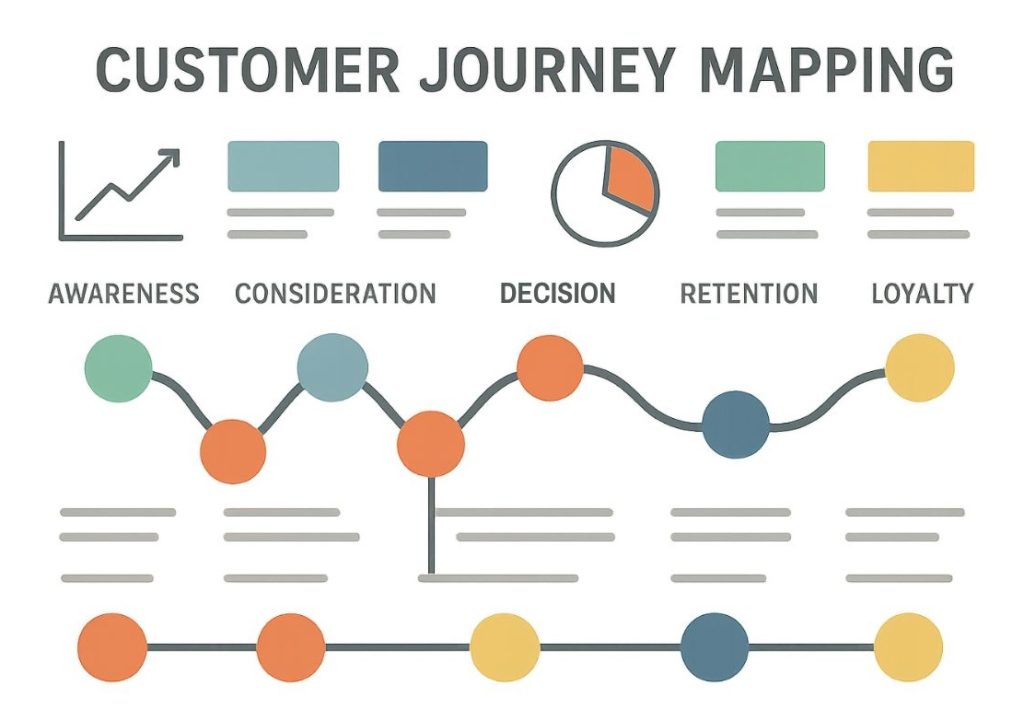
Think of your journey map as the ultimate "walk in their shoes" exercise. Good maps show not just what customers do, but how they feel along the way – capturing both the logical steps and the emotional ups and downs that drive decisions.
The best journey maps aren't one-size-fits-all documents. They require persona alignment – tailoring the map to specific customer types. A CEO exploring your solution will have vastly different concerns, touchpoints, and emotional triggers than a technical implementer, even when they're part of the same buying team.
Journey mapping isn't a "set it and forget it" project. Customer behaviors evolve, new channels emerge, and your offerings change. The most successful companies treat their journey maps as living documents that grow and adapt alongside their business and customers.
Steps to create a journey map
Creating a meaningful customer journey map doesn't have to be overwhelming. Here's how to break it down:
Set clear objectives first – know what you want to improve. Are you trying to smooth out the onboarding experience? Reduce churn? Increase cross-selling? Your goals will determine which aspects of the journey deserve the most attention.
Build detailed customer personas that feel like real people, not generic abstractions. For B2B especially, understand their role, influence level in purchasing decisions, and specific pain points they're trying to solve.
List all touchpoints where customers interact with your brand – both the obvious ones you control (your website, emails, sales calls) and the less obvious ones you influence indirectly (review sites, industry forums, word-of-mouth).
Walk in their shoes by experiencing your customer journey firsthand. Sign up for your service, call your support line, or steer your website as if you were a new prospect. This hands-on approach often reveals friction points that data alone might miss.
Map the emotional journey alongside the logical one. What is your customer thinking and feeling at each stage? Are they confused? Excited? Frustrated? Relieved? These emotional states often drive decisions more powerfully than pure logic.
Validate your map with real data and feedback to ensure it accurately reflects reality, not just your internal assumptions. Use analytics, surveys, customer interviews, and support conversations to ground your map in truth.
For a structured approach, resources like Qualtrics' Journey Map Template can provide a helpful framework to get started.
Tools & technology to simplify mapping
You don't need to create your journey maps with sticky notes and markers anymore (unless you want to!). Modern tools can make the process more collaborative, data-driven, and actionable:
HubSpot's journey analytics helps you track interactions across marketing, sales, and service touchpoints in one unified platform. You can see exactly how prospects move through their journey and identify where they get stuck or drop off.
Visual collaboration platforms like Miro provide digital workspaces where distributed teams can create journey maps together in real-time, utilizing specialized templates specifically designed for customer journey visualization.
Automation tools enable you to respond to customer behavior throughout their journey without manual intervention. When a prospect downloads your white paper but doesn't request a demo within a week, your system can automatically send them a helpful follow-up.
Feedback collection mechanisms embedded at critical touchpoints help gather real-time insights about how customers are experiencing their journey with you.
The real magic happens when these tools connect with your existing systems, particularly your CRM. This integration provides a comprehensive view of each customer's unique journey, enabling personalized experiences at scale – a core principle of the RevOps approach explored in our guide to RevOps for B2B Businesses.
The best journey mapping isn't about creating the prettiest visual – it's about generating actionable insights that help you deliver better customer experiences at every stage of the relationship.
Optimizing, Automating & Measuring the Journey
So you've mapped out your customer journey—incredible! Now comes the fun part: making it work better for both you and your customers. Let's discuss how to optimize those experiences, automate repetitive tasks, and measure what's actually working.
Marketing automation is your secret weapon here. Think of it as your tireless digital assistant, delivering the right message at the right time. When a prospect downloads your whitepaper, automation can kickstart a sequence of helpful follow-up resources over the next week, nurturing them along without you having to remember to hit "send" on each email.
The beauty of segmentation is that it recognizes that not all customers are the same. The IT director at a healthcare company has different concerns from the marketing manager at a manufacturing firm. By grouping your customers intelligently (by industry, role, company size, or behavior), you can create journeys that feel personally crafted for them.
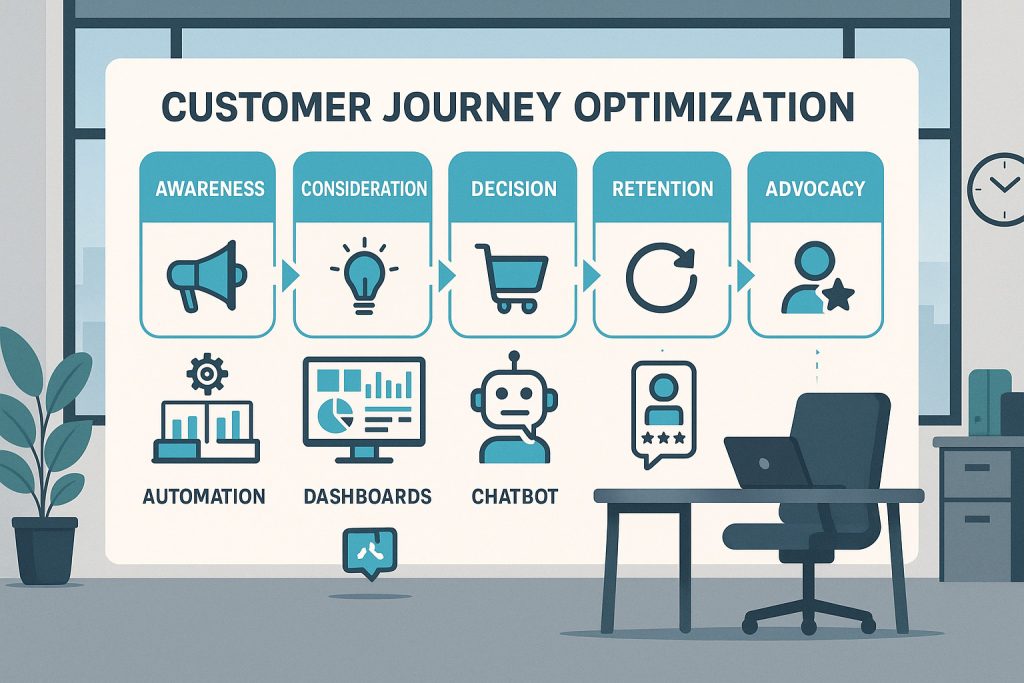
Trigger emails are particularly powerful touchpoints. These behavior-based messages arrive exactly when they're most relevant—after someone abandons their shopping cart, when their trial is about to expire, or on their one-year anniversary as your customer. They feel timely because they are.
Chatbots have evolved from annoying pop-ups to genuinely helpful guides. They can answer common questions instantly when your prospect is actively seeking information—like pricing details during the decision stage or troubleshooting help during onboarding. They're particularly valuable during those "I just need a quick answer" moments that might otherwise stall progress.
To know if your journey improvements are working, you need KPI dashboards that track performance across stages. Different metrics matter at different points:
- Awareness: Where's your traffic coming from? How are your search rankings? Is your social content getting engagement?
- Consideration: Are people engaging with your content? How long do they stay? Do they come back?
- Decision: Are they requesting demos? Starting trials? Accepting proposals?
- Retention: Are they actually using your product? How quickly are support tickets resolved? What's your renewal rate?
- Advocacy: Are they referring others? Providing testimonials? Mentioning you on social media?
Satisfaction metrics like NPS, CSAT, and CES provide the emotional temperature of your customer experience at different touchpoints. They tell you not just what happened, but how it felt.
A/B testing different journey paths can reveal surprising insights. Maybe your shorter onboarding sequence actually leads to better product adoption than your comprehensive one. Perhaps your technical whitepaper generates more qualified leads than your flashy interactive tool. Testing tells you what really works, not just what should work in theory.
Here's an eye-opener: acquiring a new customer is five times more expensive than keeping an existing one. That's why optimizing the retention and advocacy stages often delivers the highest ROI.
Challenges & common pitfalls
Even the best journey mapping efforts can hit roadblocks:
Data silos are the arch-nemesis of good journey management. When your marketing team uses one system, sales another, and customer service a third—with no data flowing between them—you'll never see the complete picture. Integration isn't just nice to have; it's essential.
Outdated personas can lead you astray. Your "ideal customer" from 2019 might have very different priorities in 2025. Personas should breathe and evolve as you gather new insights.
Channel overload happens when enthusiasm for "omnichannel" turns into "overwhelm-channel." Just because you can reach customers on eight different platforms doesn't mean you should. Respect their preferences and focus on quality interactions over quantity.
Attribution gaps make it hard to know which touchpoints really matter. When a customer finally converts, was it the webinar they attended, the case study they downloaded, or the sales call that sealed the deal? Multi-touch attribution models help you see the complete picture rather than just the last piece of the puzzle.
Other traps to avoid include obsessing over acquisition while neglecting retention, creating beautiful journey maps that never lead to action, and trying to fix everything at once instead of prioritizing improvements with the biggest impact.
Iterating for different personas & segments
Your enterprise clients don't experience your brand the same way your small business customers do. Different segments need journeys custom to their specific realities.
For B2B companies, Account-Based Marketing (ABM) recognizes that high-value accounts deserve special attention. Instead of treating all prospects the same, ABM creates customized journey strategies for specific target accounts. Our guide to Account-Based Marketing Explained dives deeper into this approach.
Vertical tailoring acknowledges industry differences. Healthcare companies have different regulatory concerns than manufacturing firms. Financial services have different security priorities than retail. While your core solution might be the same, the language, use cases, and decision criteria can vary significantly.
When adapting journeys for different segments, consider:
- Decision-making structures: Some industries have simple approval processes, others have committees of 12 people
- Regulatory considerations: Heavily regulated industries have additional compliance problems to clear
- Seasonal factors: Education buys differently in summer than during the school year
- Competitive landscape: Some verticals have more alternative solutions than others
You don't need to start from scratch for each segment. Use your primary journey map as the foundation, then adjust touchpoints, messaging, and channels to address segment-specific needs and pain points.
Tracking ROI of each stage
"How do we know this is working?" It's a fair question, and one you should be ready to answer:
Conversion lift shows how effectively prospects move from one stage to the next. If your journey optimization increases the percentage of consideration-stage prospects who reach decision stage from 25% to 35%, that's a 40% improvement in conversion efficiency.
Retention rate improvements directly impact your bottom line. Even small increases in retention can dramatically boost profitability since you're not constantly replacing lost customers with expensive new acquisitions.
Cost-to-serve reductions come from smoother journeys. When customers can easily find answers and solve problems themselves, your support team spends less time on basic issues and more time on complex ones that truly need human attention.
Referral revenue generated by happy advocates is perhaps the purest ROI of a well-optimized journey. When customers are so delighted they bring you new business, that's the ultimate validation.
Analytics loops connect your journey improvements to business outcomes. Measure baseline metrics before making changes, implement your improvements, then measure again to quantify the impact. This before-and-after approach clearly demonstrates the value of your optimization efforts.
For companies using HubSpot, the platform's attribution reporting helps connect marketing activities across the journey to actual revenue, providing clear evidence of which touchpoints and campaigns are driving the most value.
Frequently Asked Questions about What is Customer Journey
The fundamental concept might be similar, but B2B and B2C customer journeys are as different as corporate boardrooms and shopping malls.
In the B2B world, journeys typically involve multiple stakeholders working together (or sometimes at odds with each other). Your content might need to simultaneously convince a technical evaluator about functionality, reassure a CFO about ROI, and help a user visualize daily operation. This complexity creates not one journey, but several interwoven paths happening simultaneously.
Time moves differently in B2B too. While a consumer might impulse-buy a new phone in minutes, B2B purchases often unfold over months or even years. I recently worked with a client whose sales cycle lasted 18 months from first touch to signed contract!
B2B decisions tend to emphasize rational factors more heavily. That's not to say emotions don't matter—fear of making a poor choice that affects an entire organization can be paralyzing—but ROI calculations, implementation requirements, and technical specifications typically take center stage in the conversation.
The relationship also runs deeper in B2B contexts. After the sale, you're often just beginning the real journey together through implementation, training, account management, and strategic partnership discussions that might span years.
With higher contract values at stake (often 5-6 figures or more), each B2B customer journey represents a significant revenue opportunity that justifies more personalized attention and customization than most B2C experiences can afford.
Think of your customer journey map as a living document, not something you create once and file away. The most successful companies treat journey mapping as an ongoing practice rather than a one-time project.
We recommend quarterly reviews at minimum to ensure your maps still reflect reality. This doesn't mean rebuilding from scratch—just checking that the touchpoints, pain points, and emotions you've identified still ring true.
However, certain triggers should prompt immediate updates:
Major changes to your offering deserve journey map revisions. If you've launched a new product, redesigned your website, or changed your onboarding process, your customers' experience has fundamentally shifted.
Fresh customer insights might challenge your assumptions. When your support team notices a pattern of confusion at a certain stage, or your NPS survey reveals unexpected feedback, it's time to revisit your map.
Competitive shifts can alter customer expectations overnight. If your main competitor just launched a self-service portal that makes implementation twice as fast, your customers' perception of what's "normal" just changed.
We find an annual deep dive works well for most B2B companies, bringing together representatives from marketing, sales, product, and customer success to thoroughly reassess the entire journey. This cross-functional approach ensures you capture the full picture of how customers experience your brand.
Remember: an outdated journey map is worse than no map at all, as it can lead your teams down paths your customers no longer travel.
Measuring journey success requires both a microscope and a telescope—you need to track specific interactions while keeping sight of the big picture business impact.
For a comprehensive view, blend these three types of metrics:
Stage-specific indicators tell you how effectively customers move through each phase. In the awareness stage, track brand recall and search visibility. During consideration, monitor engagement rates with your content and how many prospects return for multiple visits. At the decision stage, conversion rates and sales cycle length reveal how smoothly prospects commit. For retention, customer health scores and product usage patterns signal satisfaction, while advocacy can be measured through Net Promoter Score and referral rates.
Cross-journey metrics connect these individual moments to business outcomes. Customer Lifetime Value (CLV) shows the total revenue generated over a relationship, while Customer Acquisition Cost (CAC) reveals what you spent to win that business. The ratio between these two figures (ideally 3:1 or better) demonstrates the efficiency of your entire journey. Time to Value—how quickly customers realize benefits from your solution—has become increasingly important in subscription businesses where quick wins drive renewals.
Experience metrics capture how it feels to move through your journey. Beyond the standard Net Promoter Score (NPS), consider tracking Customer Effort Score (CES) to identify friction points. Ask simple questions like "How easy was it to accomplish your goal today?" after key interactions.
The most compelling evidence of journey success comes when you can draw clear lines between improvements in these metrics and financial outcomes. When you can tell your leadership team, "Our journey optimization reduced our sales cycle by 15% and increased our average deal size by 12%," you've translated customer experience into the language of business impact.
Customer Journey Is More Than Just a Buzzword
The customer journey isn't just another marketing buzzword—it's the backbone of how your customers experience your brand from first touch to loyal advocate. When you truly understand this journey, you open up the power to create meaningful connections that drive sustainable growth.
After exploring the ins and outs of what a customer journey is, let's bring it all together with some key insights:
Your customer's journey tells a story about their relationship with your brand, not just their transactions. This relationship-centered approach recognizes that every interaction matters—from that first blog post they read to the support call three years into using your product.
Journey mapping creates a powerful shared vision across your organization. When marketing, sales, service, and product teams all understand the customer's path, they can work in harmony to create seamless experiences that delight at every stage.
Don't underestimate the role of emotions in B2B decisions. Behind every business purchase is a human being with hopes, fears, and career aspirations. Understanding the emotional journey alongside the logical one helps you connect on a deeper level, building lasting loyalty.
Personalization isn't optional anymore. Different personas and segments experience your brand in unique ways. By tailoring journeys to their specific needs, you create relevance that resonates and converts.
Your journey maps should breathe and evolve. As customer expectations shift and new channels emerge, continuous improvement ensures you stay aligned with what your customers truly need and want.
The best part? Journey improvements directly impact your bottom line. When you connect better experiences to business outcomes, such as higher conversion rates, stronger retention, and increased customer lifetime value, the ROI becomes crystal clear.
For B2B companies, especially, getting the journey right is mission-critical. With complex buying committees, lengthy sales cycles, and high-value relationships, a well-crafted journey can dramatically transform your results.
At The B2B Mix, we specialize in helping B2B companies optimize their customer journeys using HubSpot and other powerful tools. Our approach is hands-on and refreshingly jargon-free, focusing on creating seamless, personalized experiences that deliver real business impact—whether that's generating more qualified leads, shortening sales cycles, or boosting customer retention.
Ready to take your customer journey to the next level? Our B2B Lifecycle Marketing Guide offers deeper insights on nurturing customers throughout their entire journey with your brand.
Remember this: your customers are on a journey with or without your guidance. By understanding and optimizing that journey, you can ensure it leads to mutual success for both them and your business.