
What is B2B Content Strategy and Why Does It Matter?
Ever watched a team try to build a house without blueprints? That's what creating B2B content without a strategy feels like—chaotic, inefficient, and unlikely to stand the test of time.
A B2B content strategy is your marketing blueprint—a documented plan that maps out how you'll create, share, and measure content designed to attract, engage, and convert other businesses. It's not just a nice-to-have; it's the difference between random content creation and purposeful business growth.
Think of your strategy as the conductor that ensures every piece of content plays in harmony. It aligns your blog posts, white papers, videos, and social media to create a consistent customer experience that builds trust and drives decisions.
What makes B2B content unique? Unlike B2C content that often appeals to emotions and immediate gratification, B2B content strategy focuses on logic, demonstrable ROI, and solving complex business challenges. Your buyers aren't making quick, personal decisions—they're making calculated choices that affect their organization's success and potentially their own career trajectory.
Why a Documented Plan Beats "Random Acts of Content"
Despite years of preaching the importance of strategy, many B2B marketers still rely on ad-hoc efforts when it comes to content creation. In fact, according to the Content Marketing Institute’s annual B2B Content Marketing Benchmarks, Budgets, and Trends: Outlook for 2025, only 47% of the most successful B2B marketers have a documented content strategy. That means more than half of even the top performers are potentially winging it, leaving results up to chance. If your content marketing feels like a series of disconnected efforts rather than a focused journey, it might be time to put pen to paper and build a strategy that delivers consistent, measurable impact.
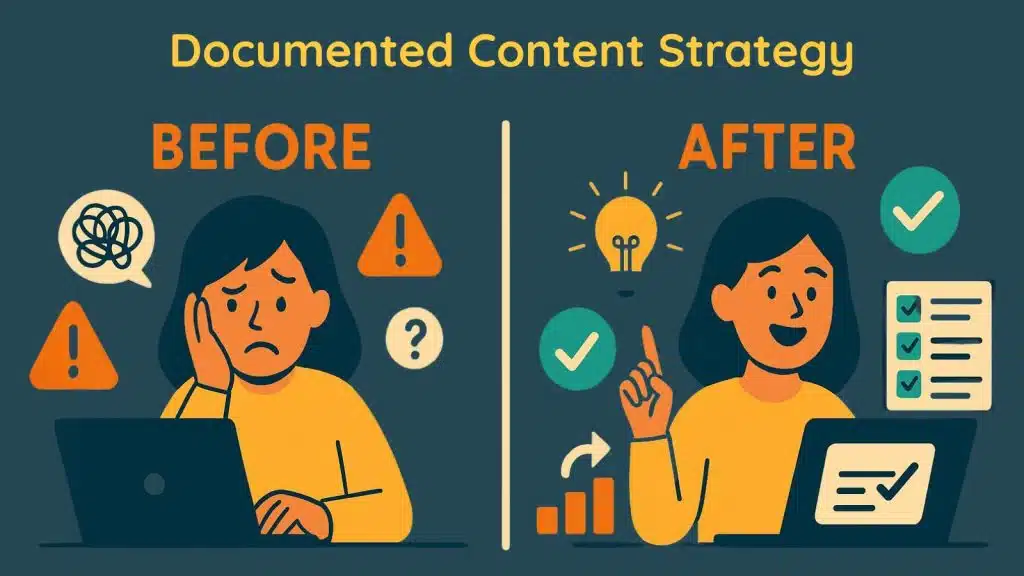
We've seen it time and again at The B2B Mix—companies producing content without a north star. Marketing creates blog posts that sales never uses. The social team develops campaigns that are disconnected from website messaging. The result? Scattered efforts that fail to move prospects through your funnel in a cohesive way.
Why does a documented B2B content strategy matter so much? Three big reasons.
Trust takes time in B2B. Research shows that 75% of B2B buyers prefer a "sales rep-free" purchase experience. They research independently, which means your content needs to consistently build credibility when you're not in the room.
B2B buying isn't a sprint—it's a marathon. Gartner research reveals, "Customers who perceived the information they received from suppliers to be helpful were 2.8 times more likely to experience a high degree of purchase ease, and three times more likely to buy a bigger deal with less regret." Strategic content guides prospects through complex, often months-long decisions.
The ROI is real. According to HubSpot, marketers who prioritize blogging are 13x more likely to see positive ROI than those who don't. Obviously, that's not just impressive—it's business-changing.
B2B purchases typically involve multiple stakeholders (6-10 decision-makers on average), each with different concerns and information needs. Your VP of Finance has different questions than your IT Director. A solid content strategy ensures you're addressing each stakeholder's priorities without creating redundant or conflicting materials.
The best part? You don't need a massive team or budget to implement an effective strategy. What you need is a thoughtful approach that aligns your content with business goals and buyer needs—which is exactly what we'll cover in the sections ahead.
Build a Rock-Solid B2B Content Strategy Foundation
Building a house on sand is a recipe for disaster—and the same goes for your B2B content strategy. Before you start churning out blog posts or filming videos, you need solid ground beneath your marketing feet.
Let's talk about what makes that foundation rock-solid.
Buyer Personas and Ideal Customer Profiles

Who exactly are you creating all this content for? This question sounds simple, but the answer rarely is, especially in B2B, where multiple decision-makers influence purchases.
Your buyer personas need to go deeper than "Director of IT, age 45-55." You need to understand what keeps them up at night, what makes their job harder, and how they evaluate solutions. When we work with clients at The B2B Mix, we dig into:
Job responsibilities shape their daily challenges. Does your persona spend their day putting out fires or planning strategic initiatives?
Career aspirations that motivate decisions. Someone gunning for promotion might evaluate your solution differently than someone focused on stability.
Information habits that determine where and how they consume content. Some executives still print lengthy reports; others want everything digestible on mobile.
Decision authority within the buying committee. Are they the final signer, a technical evaluator, or an influencer?
The best personas come from real conversations, not assumptions. Talk to your sales team, interview customers, and analyze your most successful accounts to build accurate profiles that will guide your content creation.
Map the Buyer's Journey to Your B2B Content Strategy
With personas in hand, it's time to map their journey from "we have a problem" to "we're signing with you." The B2B buyer's journey typically includes six key stages:
Awareness: They realize something isn't working. Your content should help them name and understand their problem.
Interest: They start exploring possible solutions. Educational content that frames approaches (not specific products) works best here.
Consideration: They're evaluating different solution categories. Compare approaches without being overly salesy.
Intent: They're building a shortlist of vendors. Now's the time for product-specific content.
Evaluation: They're conducting a detailed assessment. Case studies, demos, and implementation guides shine here.
Decision: They're making the final call. ROI calculators, proposals, and onboarding materials help close the deal.
For each stage, ask: What questions do our buyers have? What objections arise? What information do they need to move forward? Then create content that specifically addresses these needs.
B2B purchases aren't made by companies—they're made by people working at companies. Even the most logical business decision has human elements.
Set Measurable Goals & KPIs
"We want more content engagement" isn't a strategy—it's a wish. Your B2B content strategy needs specific, measurable goals tied to business outcomes.
This means moving beyond vanity metrics to focus on results that actually matter:
| Vanity Metrics (Avoid) | Outcome Metrics (Focus Here) |
|---|---|
| Page views | Marketing qualified leads |
| Social media followers | Sales qualified opportunities |
| Email list size | Pipeline contribution |
| Content volume produced | Conversion rates by stage |
| Time on page | Revenue influenced |
| Social shares | Customer acquisition cost |
| Raw traffic numbers | Customer lifetime value |
A good content goal might be: "Increase MQLs from educational webinars by 30% by Q3" or "Reduce sales cycle length by 15% through targeted middle-funnel content."
When you tie content directly to business outcomes, it becomes much easier to secure budget and demonstrate the value of your strategy.
Establish Standards, Guidelines & Workflows

Even brilliant strategies fail without operational excellence. Your B2B content strategy needs clear processes that turn ideas into consistent, high-quality content.
Think of this as building your content factory:
Content standards ensure quality and consistency. This includes your brand voice (are you authoritative, conversational, or technical?), style guidelines, and quality benchmarks.
Governance processes clarify who's responsible for what.
- Who approves content?
- Who ensures compliance?
- Who measures performance?
Production workflows make creation efficient. From content briefs to review cycles, documented processes prevent bottlenecks.
Technology stack powers your operations. From planning to distribution to measurement, the right tools make everything smoother.
Many of our clients at The B2B Mix use HubSpot as their content hub because it connects creation, distribution, and measurement in one place. Whatever tools you choose, make sure they talk to each other.
As unsexy as it sounds, good governance is often what separates successful content programs from struggling ones. For a deeper dive into building your operational framework, check out our Content Operations Framework Guide.
With these foundational elements in place, you'll have a B2B content strategy built to withstand shifting priorities, market changes, and the inevitable pressures of business. Now you're ready to execute with confidence.
Execute & Distribute High-Impact Content: 22 Tactics in Action
Now that your foundation is in place, it's time to roll up your sleeves and bring your B2B content strategy to life with tactics that actually move the needle. I'm not talking about creating content for content's sake – I'm talking about strategic assets that drive real business results.
Create Content That Converts (12 Core Formats)
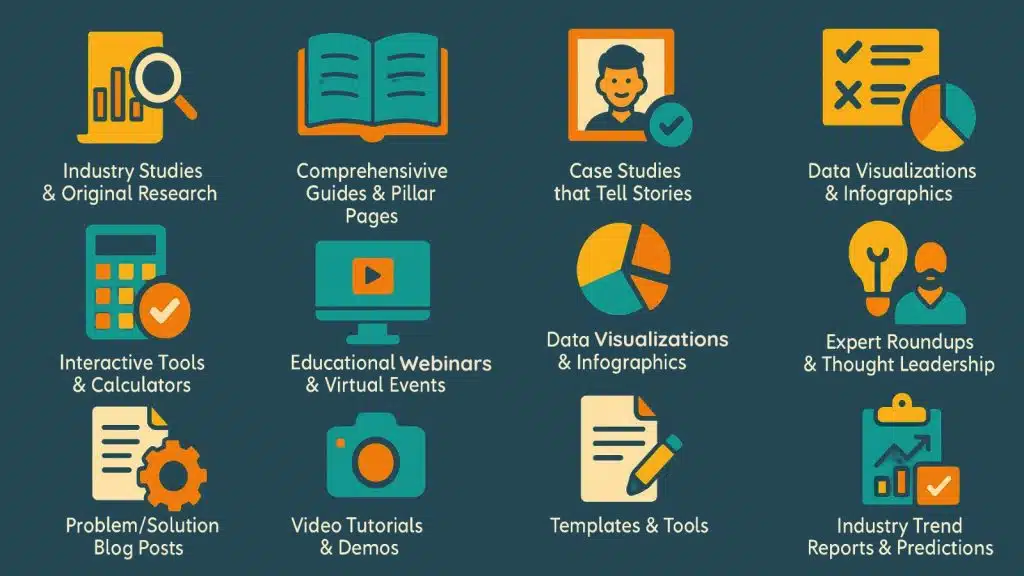
Let's be honest – not all content formats are created equal when it comes to B2B. Here are twelve proven formats that our clients consistently see results with:
Industry Studies & Original Research
Studies and research shine in the B2B space because they give your audience something they can't get anywhere else. Look at Databox. They generate tons of original reports that result in >300,000 views per month and >6,000 sign-ups for their free product. Why? Because it offers genuine insights, not just opinions.
Comprehensive Guides & Pillar Pages
Guides and pillar pages might take 5-10 times more effort to create, but they're absolutely worth the effort for their SEO benefit. Think of these as your content flagships—substantial resources that demonstrate your expertise while answering the big questions your prospects are asking.
Case Studies that Tell Stories
Case studies that tell stories transform what could be dry success metrics into compelling narratives. And please, don't gate these behind forms. You're trying to earn trust with potential customers. Let them see the proof without filling out a form." Also, structure your case studies simply: Problem → Solution → Results with specific metrics.
Comparison Pages & "Alternative To" Content
Comparison pages and "alternative to" content directly address buyers who are actively evaluating solutions. These pages meet prospects exactly where they are in the decision process. We've seen how HubSpot's comparison pages consistently rank and convert for competitive search terms.
Interactive Tools & Calculators
Interactive tools and calculators do double duty—they generate leads while demonstrating value. ROI calculators, assessment tools, or interactive decision guides provide immediate value while showcasing your expertise.
Educational Webinars & Virtual Events
Webinars and virtual events continue to be powerhouses for B2B lead generation. According to CMI research, 52% of enterprise marketers say webinars are among their most effective distribution channels. The beauty of webinars is their versatility—afterward, you can slice and dice them into blog posts, short videos, and social snippets.
Data Visualizations & Infographics
Visualizations and infographics make complex information digestible at a glance. In a world of information overload, the ability to "explain your solution like to a 7-year-old via infographics" is surprisingly valuable.
Expert Roundups & Thought Leadership
Expert roundups and thought leadership pieces leverage the expertise and networks of industry leaders. This approach not only creates valuable content but also builds relationships that can lead to future collaborations.
Problem/Solution Blog Posts
Problem/solution blog posts that address specific pain points remain a cornerstone of effective B2B content. These SEO-optimized articles draw in prospects actively searching for answers.
Video Tutorials & Demos
Video tutorials and demos have become essential, with 70% of B2B buyers watching videos during their research process. Additionally, posting optimized videos to YouTube can help drive significant traffic to your site.
Templates & Tools
Templates and tools provide practical value while showcasing your expertise. HubSpot's free templates and tools strategy has been driving tons of leads annually—a tactic we've helped many clients adapt to their own industries.
Industry Trend Reports & Predictions
Industry trends and predictions position your brand as a forward-thinking leader. These annual resources often become highly anticipated publications that generate leads throughout the year.
For more on creating high-impact content, check out our post, Embrace Big Rock Content To Maximize Content Marketing.
Omnichannel Distribution Playbook (10 Key Moves)
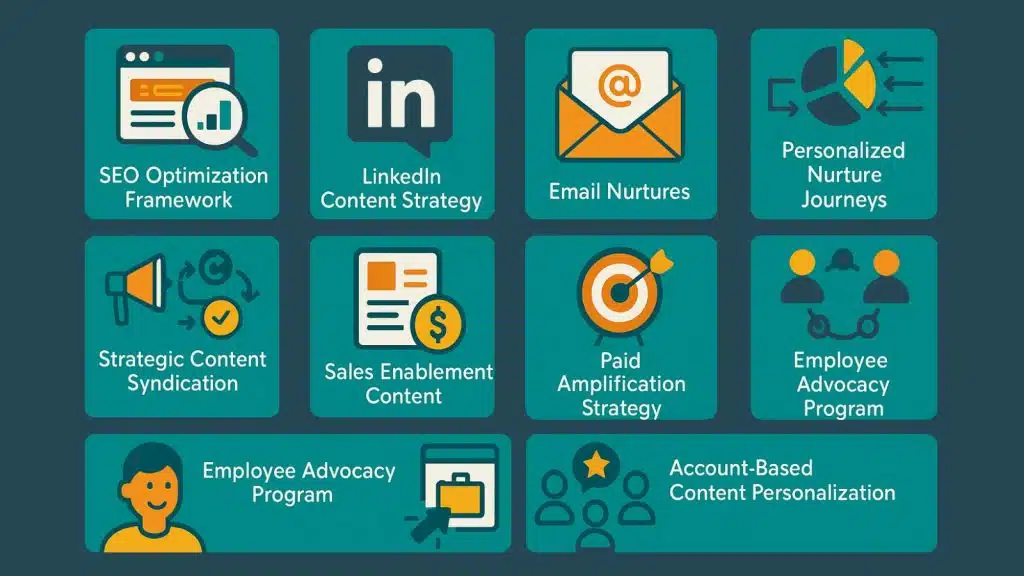
Even the most brilliant content won't drive results if nobody sees it. Your B2B content strategy must include a thoughtful distribution plan. Here are ten approaches we've found most effective:
SEO Optimization Framework
An SEO optimization framework forms the backbone of organic search visibility. This isn't just about sprinkling keywords – it's about building a comprehensive approach that includes keyword research aligned with buyer journey stages, on-page optimization, strategic internal linking, and technical SEO best practices. As content strategist Andy Crestodina advises, "Some phrases, when people search for them, they mean business. They want to buy something, or they’re ready to become a lead. These are the ‘commercial intent’ keyphrases. If you can rank for a few of these, you’ll build a steady stream of qualified visitors."
LinkedIn Content Strategy
Your LinkedIn content strategy deserves special attention in B2B, with 84% of marketers rating it their most valuable social platform. A comprehensive LinkedIn approach includes thought leadership posts from executives, regular company updates, an employee advocacy program, LinkedIn Live sessions, and strategically targeted sponsored content.
Email Nurtures
Email nurturing remains incredibly effective, and many B2B marketers report that email newsletters deliver their best email nurture results. We typically help clients structure these as progressive journeys: Welcome series → Educational content → Solution positioning → Case studies → Decision support.
Personalized Nurture Journeys
Personalized nurture journeys take standard email sequences to the next level by adapting based on prospect engagement. Using HubSpot's smart content features, we help clients create dynamic content paths that respond to user actions and interests.
Strategic Content Syndication
Content syndication extends your reach beyond owned channels. Developing relationships with industry publications, partner websites, and syndication platforms can amplify your content's impact without requiring constant new creation.
Sales Enablement Content
Sales enablement content bridges the gap between marketing and sales. Comparison sheets, ROI calculators, competitive battlecards, and customer success stories arm your sales team to address common questions and objections.
Paid Amplification Strategy
Paid amplification accelerates results for high-value content. This includes LinkedIn Sponsored Content targeting decision-makers, Google Search ads for high-intent keywords, retargeting campaigns based on content engagement, and paid syndication for lead generation.
Community Engagement
Community engagement puts your expertise where your audience already gathers. By participating in industry forums, LinkedIn groups, and online communities, you can establish credibility while driving interested prospects back to your content.
Employee Advocacy Program
Employee advocacy multiplies your reach by leveraging your team's networks. The key is making it easy—provide pre-written social copy, create a content calendar for team sharing, recognize top advocates, and offer training on personal branding.
Account-Based Content Personalization
Account-based content personalization delivers custom experiences for high-value target accounts. This might include customized landing pages, industry-specific case studies, custom research, or personalized ROI calculators – all designed to address the specific needs of priority accounts.
For a deeper dive into account-based approaches, explore our guide to Elevating B2B Marketing with Account-Based Content Marketing Strategies.
Optimize, Measure, and Scale with AI & Repurposing

Creating content is just half the battle in a B2B content strategy. The real magic happens when you continuously refine, measure, and scale your efforts. Think of your strategy as a living organism that needs regular care and feeding—not a "set it and forget it" proposition.
Using AI Without Losing Your Brand Voice
We've all read those AI-generated articles that feel like they were written by a robot trying to pass a Turing test. Not exactly the warm, engaging experience your prospects crave, right?
The good news is that AI can be an incredible ally when used thoughtfully. According to Content Marketing Institute research, 81% of B2B marketers now use generative AI tools in their content processes. The concerning part? Only 38% have established guidelines for their use, leaving a significant "governance gap" that could put brand reputation at risk.
At The B2B Mix, we help clients find that sweet spot where AI boosts productivity without sacrificing authenticity. Think of AI as your brainstorming partner and first-draft assistant, not your replacement. Use it to analyze trending topics, identify keyword opportunities, and generate initial drafts—but always have human experts refine the content to inject your unique perspective and brand voice.
The most effective approach combines AI efficiency with human creativity. For example, use AI to suggest improvements for readability and SEO best practices, then let your team add the distinctive insights and storytelling that only humans can provide.
Remember to develop clear guidelines around AI usage—including appropriate use cases, required human oversight, fact-checking protocols, and disclosure policies. This ensures your content remains authentic even as you scale production.
Conduct Regular Content Audits & Refreshes
Would you believe that updating existing content often delivers faster results than creating new pieces? It's true—and yet so many B2B marketers neglect this golden opportunity.
A systematic content audit isn't the most glamorous marketing activity, but it might be the most valuable. Start by cataloging all your existing content assets with relevant metadata (publish date, author, topic, format). Then analyze performance based on traffic, engagement, conversion rates, lead quality, and SEO metrics.
The insights from your audit will reveal content gaps—missing topics, formats, or journey stages—while highlighting opportunities to refresh outdated pieces, consolidate redundant content, or expand thin articles.
This process also uncovers your highest-performing assets—prime candidates for repurposing across different formats and channels. That comprehensive guide might transform into a webinar, infographic, social media series, and email campaign—maximizing your return on the initial investment.
For a step-by-step approach to content audits, download our Content Inventory & Audit Checklist. It'll save you hours of head-scratching and ensure you don't miss critical opportunities.
Measure What Matters to Prove B2B Content Strategy ROI
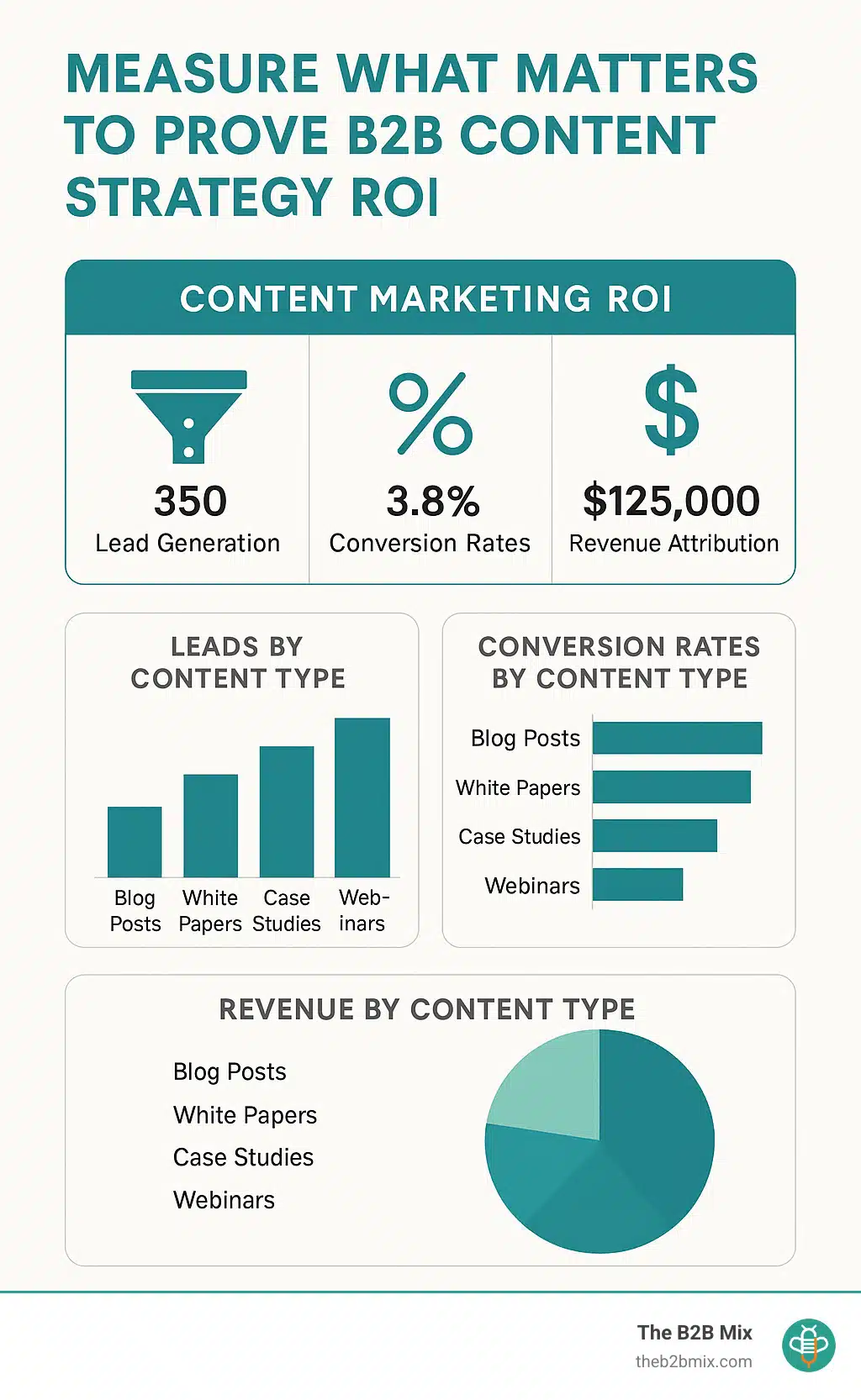
"What's the ROI of our content marketing?" If this question makes you break into a cold sweat, you're not alone. According to CMI research, only 53% of B2B marketers say their organization effectively measures content performance.
The challenge isn't a lack of data—it's focusing on the right metrics. While vanity metrics like page views and social followers are easy to track, they don't tell you whether your content is driving business results.
Instead, implement a measurement framework that connects content directly to revenue. Start with content performance metrics like engagement and conversion rates by piece. Then track lead generation metrics including MQLs by content source and cost per lead by content type.
The real game-changers are revenue impact metrics that show influenced pipeline and content ROI. At The B2B Mix, we help clients implement HubSpot's attribution reporting to draw a clear line from content investments to revenue generated. We also track customer journey metrics to understand which content pieces are most influential at each buying stage.
By implementing these optimization, measurement, and scaling approaches, you'll transform your B2B content strategy from a cost center into a predictable revenue driver. And isn't that what gets executive buy-in for continued investment?
Frequently Asked Questions about B2B Content Strategy
How does a B2B content strategy differ from B2C?
When we talk with clients about content strategy, one of the first questions they ask is how B2B differs from B2C. While both aim to engage audiences and drive conversions, they're as different as chess and checkers.
| Aspect | B2B Content Strategy | B2C Content Strategy |
|---|---|---|
| Decision Process | Longer sales cycles (weeks/months) | Shorter sales cycles (minutes/days) |
| Decision Makers | Multiple stakeholders (6-10 people) | Individual or small group |
| Content Focus | Educational, ROI-focused, logical | Emotional, lifestyle, entertainment |
| Content Depth | In-depth, comprehensive resources | Often shorter, more visual content |
| Distribution Channels | LinkedIn, email, industry publications | Social media, influencers, retail |
| Tone | Professional, authoritative, consultative | Conversational, emotional, personal |
Think of it this way: B2B content is like the trusted advisor who helps build a rock-solid business case, while B2C content is more like the enthusiastic friend recommending their favorite new product.
Which content formats work best for each journey stage?
Not all content formats are created equal, especially when you consider where your buyer is in their journey. We've found these formats tend to shine at specific stages:
For the Awareness Stage, when prospects are just realizing they have a problem, focus on eye-opening content like thought leadership articles, industry research reports, and educational blog posts that address pain points. Infographics and social content work well here, too, making complex ideas digestible.
During the Consideration Stage, your prospects are actively researching solutions. This is prime territory for comprehensive guides, webinars, case studies, and comparison content. We've seen great results with expert interviews that dive deep into how to solve specific challenges.
By the Decision Stage, your prospects need reassurance that they're making the right choice. Product demos, ROI calculators, and detailed implementation guides shine here. Customer testimonials and free trials or assessments help overcome that final hesitation.
According to Content Marketing Institute research, "53% of B2B marketers cite case studies and videos as delivering some of their best results." We're not surprised—these formats build credibility when it matters most.
How is generative AI changing B2B content planning?
AI is reshaping B2B content strategy in ways we couldn't have imagined even a few years ago. It's not about replacing human creativity—it's about amplifying it.
First, there's the efficiency factor. According to recent research, 51% of marketers use AI to brainstorm topics, 45% to research headlines and keywords, and 45% to write initial drafts. This frees up human creators to focus on strategy and adding unique insights.
Personalization at scale is another game-changer. AI helps tailor content to individual users based on their behavior and preferences—something that would be impossible to do manually across thousands of contacts.
For content optimization, AI tools can analyze readability, suggest improvements, and help ensure you're truly matching search intent.
Content repurposing becomes much easier with AI. That webinar can quickly become a blog post, social snippets, and an email series without starting from scratch each time.
But there's a challenge: governance. A surprising 45% of organizations still lack guidelines for AI usage in content creation, according to CMI's B2B Content Marketing Benchmarks, Budgets, and Trends: Outlook for 2025 report.
At The B2B Mix, we understand that the key to using AI in marketing is finding that sweet spot where AI handles the repetitive tasks while humans add the strategic thinking, creativity, and emotional intelligence that technology can't replicate.
Your Path to B2B Content Success

Let's face it – creating random content without a plan is like throwing darts blindfolded. You might hit something occasionally, but you're mostly just making noise and wasting effort.
A thoughtful B2B content strategy isn't just another marketing checkbox – it's the engine that powers meaningful connections with your prospects throughout their buying journey. As we've seen, the most successful B2B marketers are more likely to have a documented strategy, according to the Content Marketing Institute. That's not a coincidence—that's cause and effect.
Think of your content strategy as your single source of truth – the north star that guides all your marketing efforts. When everyone on your team understands who you're creating content for, why you're creating it, and how success will be measured, magic happens. Silos break down. Efficiency improves. Results follow.
Remember what we learned about the B2B buying process? Many B2B prospects prefer a self-service, rep-free purchase. They research independently, forming opinions about your company based on the content they find. That content needs to tell a coherent story—one that builds trust, demonstrates expertise, and guides them toward a confident decision.
Your Path Forward
Your path forward should focus on quality over quantity. As content marketing expert Ann Handley often says, "Good content isn't about good storytelling. It's about telling a true story well." Create fewer pieces if needed, but make each one count by deeply understanding your audience's needs and thoughtfully addressing them.
Most importantly, treat your content strategy as a living document that evolves based on performance data and market changes. Regular content audits, performance analysis, and optimization should become routine habits, not occasional projects.
Ready to transform your approach to B2B content strategy? Learn more about our digital marketing services or reach out to discuss how we can help you build a content engine that consistently delivers measurable business results. At The B2B Mix, we're passionate about helping B2B companies cut through the noise with practical, jargon-free content approaches that actually work.
The journey to content marketing excellence isn't a sprint – it's a marathon that builds momentum over time. But with the right roadmap, you won't just finish the race – you'll lead the pack.