
Quick answer:
- What it is: Aligning marketing, sales, and customer success around shared data, shared definitions, and shared processes across the customer lifecycle.
- Why it matters: Fewer dropped handoffs, cleaner forecasting, and a customer experience that doesn't fall apart between departments.
- Who needs it: Any B2B company where sales and marketing argue about lead quality, or where nobody can produce the same pipeline number twice.
- When to start: Most companies see the need somewhere between 25 and 100 employees. However, the real trigger is friction, not headcount.
- How to start: Fix the data and definitions before you buy tools or hire a title.
Are you the person inside your company who's noticed all of this? Can't get anyone else to see it yet? Then, this guide is for you. We'll walk through what RevOps is, how it's different in B2B, how to figure out if you need a full department or something smaller, and what it costs to get right.
The Problem RevOps Is Actually Solving

Have you seen this play out in your company? Marketing closes out the month with a strong number of new leads. Sales, in the same meeting, says the leads are junk. Nobody can point to a shared definition of what a "qualified" lead even means. So, both teams are technically right, and the argument repeats next month.
This isn't a personality problem. It's a structural one. Marketing Operations owns campaign execution and lead flow. Sales Operations owns deal process and forecasting. Customer Success owns renewals and expansion. Each function optimizes its own piece and reports its own numbers. Therefore, none of them are required to agree with each other. The company as a whole doesn't have one version of the truth. It has three.
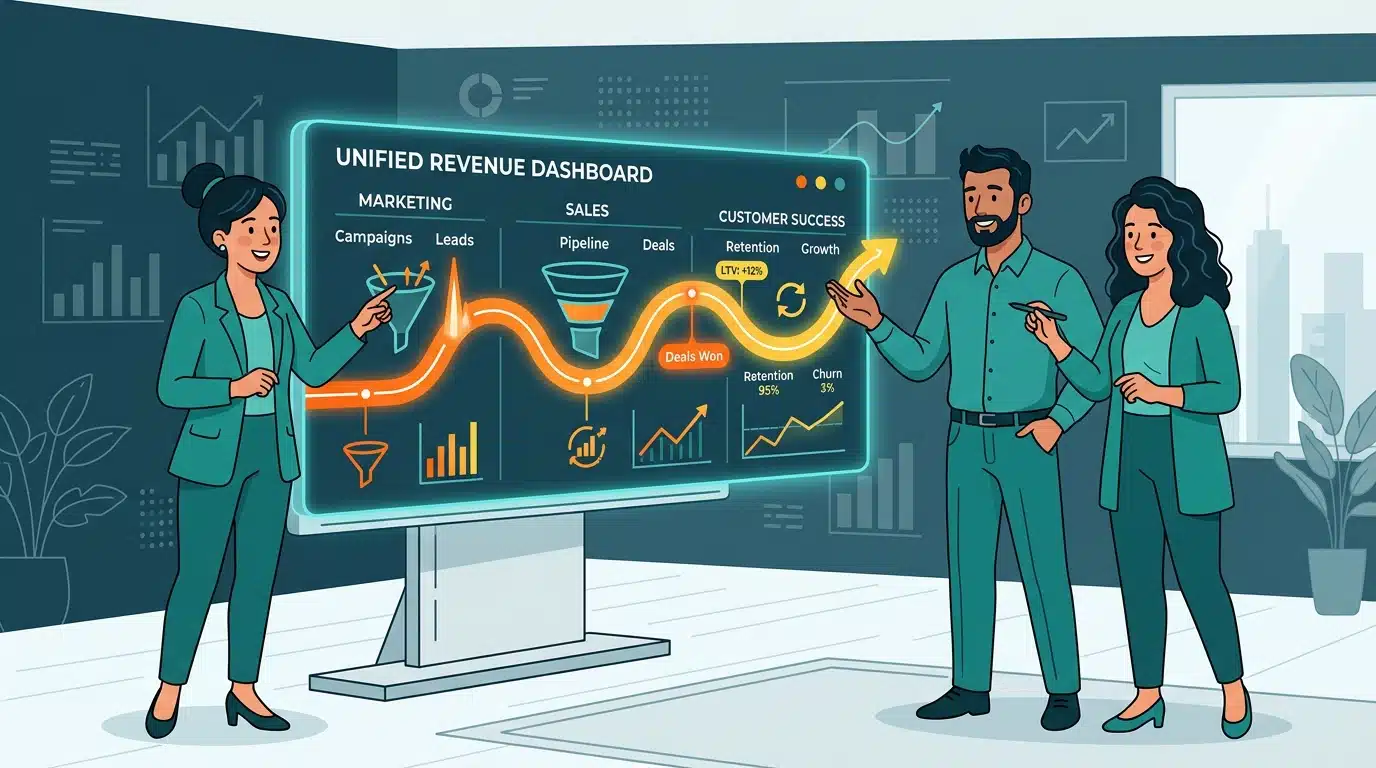
RevOps exists to close that gap. After all, RevOps is a shared operating layer across marketing, sales, and customer success. One data model, one set of lifecycle definitions, and one place where the whole revenue picture actually reconciles. RevOps is tied to how you think about customer journey and B2B lifecycle marketing. Marketing Ops, Sales Ops, and Customer Success Ops don't disappear. They stop working in isolation.
How B2B RevOps Is Different From B2C RevOps
RevOps applies to any business with a revenue funnel. But the shape of the work changes a lot depending on who's buying.
B2C RevOps is built around volume: short sales cycles, one decision-maker, standardized pricing, and a lot of transactions moving fast. The system is optimized for acquisition efficiency at scale.
B2B RevOps is built around complexity. Deals take longer (often three to twelve months or more), and multiple people participate in the purchase decision. That means your system has to track relationships and buying committees, not just individual transactions. And because B2B revenue often comes from renewing and expanding existing accounts, the post-sale experience isn't an afterthought. It's a real revenue driver in its own right.
If your company sells to other businesses, the frameworks and tools built for B2C RevOps (heavy on identity resolution, real-time personalization, and high-volume experimentation) may not map cleanly onto how your buyers actually decide. Look for RevOps guidance built around account-based tracking and multi-stakeholder deals instead.
The RevOps Maturity Model: Crawl, Walk, Run
RevOps maturity follows a fairly predictable path. Skipping ahead usually just means redoing the work later, so it's worth being honest about which phase you're actually in.
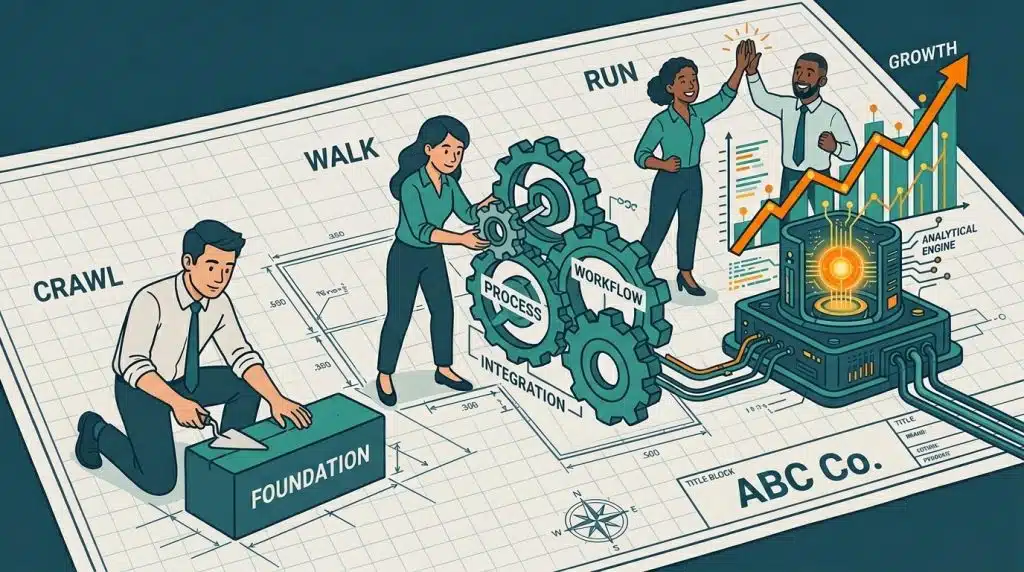
Crawl. This phase is about getting your house in order. You're establishing basic data hygiene and agreeing on what actually counts as a qualified lead. Your organization works to make sure marketing and sales talk to each other on a regular cadence. None of this is exciting. All of it is the foundation everything else depends on. You can't build reliable reporting on top of shaky data, no matter how good your dashboards look.
Walk. Here's where it starts paying off. You're connecting tools so they talk to each other. Additionally, you're building workflows instead of manual handoffs, and creating enablement that works across departments. This is usually the phase where people outside the RevOps function start noticing the difference.
Run. RevOps becomes genuinely strategic. You're using forecasting and predictive analytics instead of gut feel, optimizing for customer lifetime value instead of just new bookings, and treating your processes as something to keep improving rather than something you finished once.
Most companies we work with are somewhere between crawl and walk. That's normal. The mistake isn't being early in the process. It's trying to run reports and build predictive models on top of data nobody's cleaned up yet.
Choosing a Deployment Model: Service Provider, Enforcer, or Partner
Not every company should stand up RevOps the same way. Your current maturity should decide which model you deploy, not the other way around.
Service provider. This is the right starting point for most companies early in the journey. Your RevOps function (whether that's a person, a small team, or an outside partner) handles the foundational work: data cleanup, standard reporting, and day-to-day requests from sales and marketing. Think of it as the team that keeps your CRM organized and makes sure everyone can actually find their leads.
Enforcer. As you mature, RevOps starts setting and holding standards instead of just executing requests. This function makes sure the sales process actually gets followed, the data stays clean, and the tools your company already paid for actually get used the way they were meant to.
Partner. This is full maturity. RevOps sits at the table for strategic decisions, not just operational ones. Its recommendations shape where the business invests next.
We see a lot of companies try to jump straight to the partner model before the foundational work is done. It doesn't work. You can't skip crawl and walk and land on run.
Not Ready for a Full Department? Start With a RevOps Squad
If a dedicated RevOps department feels like a stretch for where you are right now, you don't have to wait. A cross-functional task force, sometimes called a RevOps squad, can drive real change without dedicated headcount.
The pattern that works: pull together representatives from marketing, sales, customer success, finance, and IT, people who understand both their own function and the bigger picture. Give the group a clear charter with specific objectives and enough authority to actually make decisions, not just recommend them. Meet weekly. Pick a small, visible win first (streamlining a lead handoff, standardizing one opportunity definition) and document what changes and why.
Even a single dedicated RevOps champion running this kind of squad can drive meaningful progress. They just need executive sponsorship and the authority to make changes that cross departmental lines. The squad model is often the right fit for leaner mid-market teams that need the outcomes of RevOps without the org-chart commitment of a full department yet.
What RevOps Costs, and When to Hire
The honest answer to "when should we hire for this" depends on your situation, but there are real signals to watch for.
Consider bringing on dedicated RevOps help once you have roughly 25 or more employees with distinct sales and marketing teams, once the friction between departments is causing real revenue loss (not just annoyance), and once you have the budget for a senior-level hire rather than a junior one stretched too thin. You'll also want someone in-house if the role needs to be embedded in day-to-day decisions rather than checking in periodically.
For a company around $10 million in ARR, team size typically breaks down into three bands:
- Lean (1–2 people): Works for companies with a relatively simple sales model and reasonably clean systems already. Often paired with part-time support from existing operations staff.
- Standard (3–5 people): Enough specialization to cover CRM administration, marketing operations, sales operations, and analytics as distinct responsibilities.
- Comprehensive (5–8 people): Fits more complex organizations, with dedicated roles for customer success operations and data management in addition to the core functions above.
Many companies at this stage land on a hybrid: building core capability in-house while partnering with outside specialists for specific work like HubSpot optimization or marketing operations analytics. That gives you flexibility to scale without committing to full-time headcount before you're ready. If your team is also stretched thin on execution, not just systems, a fractional marketing team is worth a look too.
The Metrics That Actually Matter
A working RevOps function should tie directly to numbers leadership already cares about, not a new set of vanity metrics nobody asked for.
Revenue health: Annual Recurring Revenue (ARR) for subscription value, Net Revenue Retention (NRR) for how well you're growing existing accounts after accounting for churn, and overall Revenue Growth Rate for momentum.
Efficiency: Customer Acquisition Cost (CAC) and CAC Payback Period, plus your LTV:CAC ratio. A commonly cited target is 3:1 or better, though the right number depends on your business model and margins.
Speed: Sales Cycle Length. Shortening it, even modestly, tends to have an outsized effect on cash flow for B2B companies with longer buying processes.
Which of these matter most depends on your growth stage. A company chasing its first $1 million in ARR should watch different things than one scaling from $10 million to $50 million. Pick the handful that map to your current stage and build from there, rather than trying to track everything at once.
According to Gartner's own research on revenue operations, companies with advanced-maturity RevOps functions are about twice as likely to exceed their revenue goals, and 2.3 times as likely to exceed their profit goals, compared to companies with intermediate or developing maturity. That gap is the whole argument for doing this work in the right order.
Frequently Asked Questions
RevOps for B2B is the practice of aligning marketing, sales, and customer success around shared data, shared definitions, and shared processes across the full customer lifecycle, so the whole company works from one version of the truth instead of three.
B2B RevOps is built around longer, multi-stakeholder deals and account-based tracking, with post-sale renewal and expansion treated as a core revenue driver. B2C RevOps is built around high transaction volume, single decision-makers, and acquisition efficiency at scale.
Most companies start to feel real need somewhere around 25 or more employees with dedicated sales and marketing teams, once cross-team friction is costing measurable revenue and the budget exists for a senior hire. The trigger is friction, not a specific headcount number.
At roughly $10 million in ARR, a lean team is 1 to 2 people, a standard team is 3 to 5 people covering CRM administration, marketing ops, sales ops, and analytics separately, and a comprehensive team is 5 to 8 people with dedicated customer success operations and data management roles.
It depends on how embedded the function needs to be in daily decisions. Many companies at the $10 million ARR stage use a hybrid: core capability in-house, paired with an outside partner for specialized work like HubSpot optimization or marketing operations analytics.
A RevOps squad is a cross-functional task force, pulling representatives from marketing, sales, customer success, finance, and IT, that drives RevOps outcomes without a dedicated department. If you're not ready to build a formal RevOps function, it's a strong option. Just make sure the squad has a clear charter and real decision-making authority.
Service provider fits companies early in the RevOps journey and focuses on foundational work like data cleanup and standard reporting. Enforcer fits companies that need RevOps to set and hold standards across teams. Partner fits companies with full maturity, where RevOps has a real seat in strategic decisions. Your current maturity should decide the model, not the other way around.
Watch ARR, Net Revenue Retention, and Revenue Growth Rate for overall health; CAC, CAC Payback Period, and LTV:CAC ratio for efficiency; and Sales Cycle Length for speed. Which of these matter most shifts by growth stage, so pick a handful tied to where your company is right now.
Where to Go From Here
If any of this sounds like your Monday morning, you're not behind. Most established B2B companies are somewhere in the crawl or walk phase. And that's exactly where this work is supposed to start. The fastest path forward is usually the least exciting one: clean data, shared definitions, and a system that actually connects marketing, sales, and customer success instead of three tools pretending to.
If you want a second set of eyes on where your systems actually stand, book a call with us.