

Why more B2B companies are hiring fractional marketing teams
A fractional marketing team for B2B and SaaS companies offers specialized marketing expertise on a part-time, flexible basis, eliminating the overhead of full-time hires.
What is a fractional marketing team?
- A team of senior marketing specialists who work part-time for your SaaS company
- Led by a fractional CMO who provides strategic direction
- Includes specialists in growth, content, product marketing, and demand generation
- Typically costs 40% less than equivalent full-time marketing staff
- Delivers specialized expertise without long-term commitments
For B2B and SaaS companies, a fractional marketing team offers a powerful solution.
With growth capital on the line and subscription revenue models requiring constant attention to both acquisition and retention, many founders find themselves unable to afford mistakes in building their marketing function from scratch.
As the B2B and SaaS landscapes becomes increasingly competitive, companies need marketing expertise that can deliver results quickly. Traditional options—hiring a full in-house team or working with multiple specialized agencies—often create challenges around cost, coordination, and accountability.
The fractional model bridges this gap by providing senior marketing leadership and specialized execution in a flexible, scalable format.
Whether you're a funded startup aiming for product-market fit, a growth-stage company looking to optimize your marketing engine, or an established player seeking specialized expertise for a specific initiative, the fractional approach offers agility without sacrificing quality.
What Is a fractional marketing team?
A fractional marketing team brings together experienced marketing professionals who work with your company on a part-time basis. They deliver specialized expertise exactly when you need it—without the hefty commitment and overhead costs of full-time employees.
This approach is tailor-made for software-as-a-service companies, where marketing requires both deep technical product understanding and subscription-focused growth strategies.
At the heart of this model is typically a fractional Chief Marketing Officer (CMO). The CMO provides strategic direction and hands-on leadership. Unlike consultants who might drop off recommendations and leave you to figure out implementation, a fractional CMO actively leads your marketing initiatives. The fractional CMO is like an in-house executive would, but with greater flexibility and at a fraction of the cost.
Supporting your fractional CMO is a team of specialists who scale up or down based on your specific needs. These professionals bring deep expertise in areas critical to success. Growth marketing specialists who optimize your acquisition funnel. Product marketers who translate complex features into compelling customer value propositions. You'll also benefit from content strategists driving organic traffic, demand generation experts building predictable pipeline, and marketing operations pros managing your tech stack and data flows.
What truly sets the fractional marketing team for B2B model apart is the laser focus on subscription metrics. Fractional marketing teams for B2B and SaaS understand the unique KPIs that drive software business success, such as:
- Customer acquisition cost (CAC)
- Customer lifetime value (CLTV)
- Activation rates
- Churn metrics
- Expansion revenue opportunities
- And more
Traditional vs fractional marketing team for B2B and SaaS: cost & agility
When weighing your options, two factors stand out as particularly crucial for B2B companies: cost efficiency and agility.
Cost Efficiency
The financial reality is stark: a full-time CMO typically commands a salary exceeding $250,000 annually, not including bonuses and equity. When you add specialized roles like content creators, SEO experts, paid media specialists, and product marketers, you're looking at an annual investment between $500,000 to $1 million for even a modest in-house team.
By contrast, working with a fractional marketing team for B2B significantly reduces this financial burden while maintaining access to senior-level talent. For a comprehensive engagement including strategic leadership and tactical execution across multiple channels, your investment remains substantially lower than building an equivalent in-house team.
Agility and Speed
Time-to-market can make or break your growth trajectory. Building a full marketing team often takes 3-6 months of recruiting, plus additional time for new hires to fully ramp up. Traditional agencies might move faster but frequently lack the deep product understanding and cross-functional integration needed for B2B success.

A fractional team can deploy in as little as 1-2 weeks, typically reaching full productivity within 30 days. This rapid deployment happens because fractional teams:
- Come equipped with battle-tested B2B marketing playbooks
- Have experience working across diverse tech stacks and tools
- Excel at quickly learning new products and markets
- Use agile sprint methodologies to deliver measurable value in short cycles
How does a fractional marketing team integrate with Product, Sales, and CS?
A common misconception is that fractional teams operate in isolation. In reality, effective fractional marketing teams for B2B and SaaS become deeply embedded within your existing organizational structure, working hand-in-hand with your product, sales, and customer success functions.
Cross-Functional Pods
Rather than creating yet another silo, fractional teams typically organize around cross-functional pods focused on specific customer journey stages. This might look like an acquisition pod bringing together marketing, sales, and product teams (especially for product-led growth motions), or an activation pod where marketing collaborates with product and customer success to optimize user onboarding.
Shared OKRs and metrics
True alignment happens through shared objectives and key results (OKRs). Your fractional CMO will work closely with your leadership team to establish metrics that directly connect marketing activities to business outcomes. This means tracking how marketing and sales collaborate on pipeline generation and deal velocity, how marketing and product teams drive feature adoption and user activation, and how marketing supports customer success in improving retention and expansion opportunities.
Communication cadences
The secret sauce to successful integration is establishing regular communication rhythms. Weekly stand-ups with stakeholders across departments keep everyone aligned, while bi-weekly strategy sessions provide space to review metrics and adjust tactics as needed. Monthly business reviews ensure everyone stays focused on company-wide goals, while shared Slack channels and access to common tools create transparency in day-to-day operations.
This seamless integration is often facilitated through RevOps alignment, where marketing, sales, and customer success operations work together to ensure smooth data flow and consistent customer experiences throughout the journey.
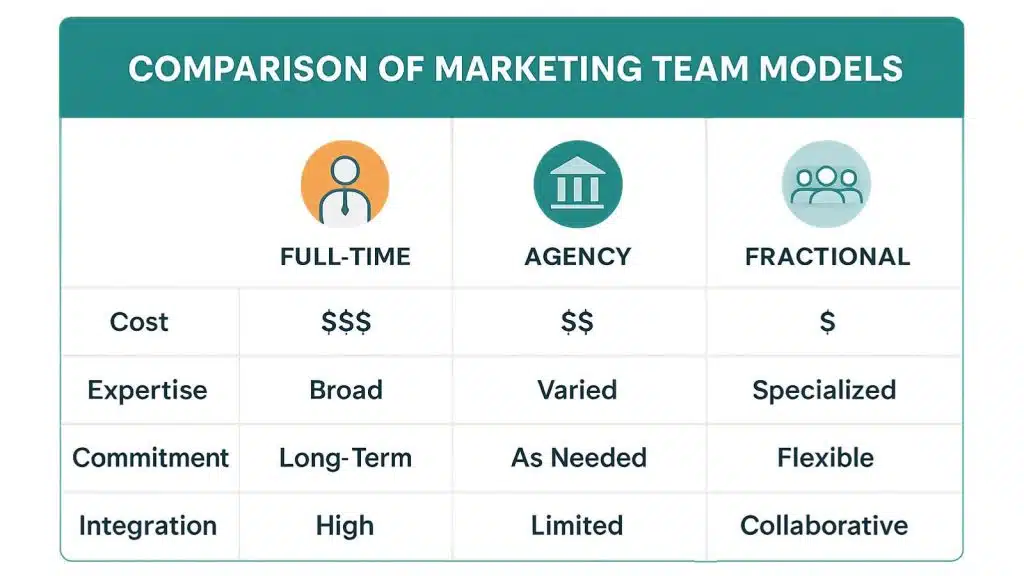
Fractional vs. agency vs. in-house: which marketing model is right for your B2B company?
When it comes to growing your B2B business, the marketing team you choose can make or break your success. More and more companies are turning to a fractional marketing team for B2B or SaaS instead of building an in-house department or hiring traditional agencies. Let's explore why this approach has become so popular.
Think about the financial reality first. While you may be able to save around 40% on marketing costs with fractional services compared to hiring full-time employees, that's not the only benefit. This move isn't just about pinching pennies and smart resource allocation.
Instead of spending your entire budget on one full-time CMO and maybe a junior marketer, you could access a fractional CMO plus content, SEO, paid media, marketing automation, and analytics specialists. You get a whole team of experts for the price of one or two full-time salaries. Maybe you already have a marketing executive with a brand vision, but they need a team of fractional marketing specialists to execute. A fractional marketing team can support you there, too.
Speed matters
Speed matters in business. The flexible, scalable nature of fractional teams also perfectly matches the uneven growth patterns typical of SaaS companies. Need to ramp up marketing for a funding round? Scale back during a product development sprint? Add specialized expertise for an international expansion? A fractional marketing team for SaaS can adjust to your changing needs without the pain of hiring and firing full-time staff.
The specialized expertise that fractional teams bring is particularly valuable in the complex SaaS landscape. From product-led growth strategies to subscription analytics and technical SEO for product documentation, you can access niche skills on demand without the full-time overhead.
Many fractional teams also offer performance-based compensation models, where part of their fees is tied to achieving specific outcomes. This creates more substantial alignment between your marketing investments and business results – a critical consideration when focusing on capital efficiency.
Key challenges B2B companies face without fractional Help
Without the specialized expertise of a fractional marketing team for B2B and SaaS, companies often struggle with several common challenges that can significantly hamper growth.
First, there's the tech stack nightmare. companies tend to accumulate numerous marketing tools over time, creating disconnected data silos that make it impossible to track the full customer journey or correctly attribute marketing activities to revenue. A good fractional team brings marketing operations expertise to audit your tech stack, eliminate redundancies, and create a unified view of marketing performance.
Then there's the agency juggling act. Working with multiple specialized agencies—one for SEO, another for paid media, and a third for content—creates coordination headaches, inconsistent messaging, and gaps in the customer journey. A fractional team provides a central strategic layer that can either replace these disparate agencies or coordinate their efforts under a unified strategy.
The slow experiment problem also plagues many B2B companies. Without dedicated resources and expertise, teams run too few experiments, fail to measure results correctly, and stick with underperforming tactics due to sunk cost fallacy. Fractional teams bring a culture of rapid experimentation with structured frameworks for testing hypotheses and quickly scaling what works.
Perhaps most painful is when growth stalls despite significant marketing investments. High customer acquisition costs, poor conversion rates, and high churn due to misalignment between marketing promises and product reality are all symptoms that fractional teams specialize in diagnosing and fixing to get your key metrics moving in the right direction again.
Research on agile marketing
The effectiveness of the fractional approach isn't just anecdotal—it's supported by emerging research on agile marketing organizational structures. Studies show that modern marketing organizations are shifting from rigid hierarchies to more flexible, cross-functional teams that can rapidly respond to market changes.
Research indicates that the most successful marketing organizations today blend centralized strategic leadership with specialized execution teams that can be deployed flexibly, while emphasizing cross-functional collaboration and rapid experimentation cycles.
This model aligns perfectly with how fractional marketing teams for B2B or SaaS operate. Rather than getting stuck in the "generalist vs. specialist" debate, the fractional approach gives you both – strategic generalists who can see the big picture, supported by specialists who excel in specific channels or disciplines.
For more insights on this approach, check out this informative video on agile marketing research that explores how modern marketing teams evolve.
If you're curious about whether a full-time or fractional approach might be better for your specific situation, our article on Full-Time vs Fractional Marketing Teams: Which One Fits Your B2B Growth Goals? can help you make that decision.
What roles roes a fractional marketing team include?
When you bring on a fractional marketing team, you get an entire marketing department in a flexible package. Think of it as assembling your dream team of marketing all-stars—but without the hefty price tag of hiring them all full-time.
Let's peek behind the curtain at who's typically part of this specialized squad:
Fractional CMO
If you don't have a marketing executive on staff, you may opt for a Fractional CMO—the strategic captain who charts your marketing course. A fractional CMO is responsible for aligning your marketing strategy with business goals, managing budgets, coordinating with your sales and product teams, and reporting results to leadership. They bring the high-level thinking you'd expect from a six-figure executive, but at a fraction of the commitment.
Growth marketing specialist
You'll find other fractional marketing team specialists working alongside your in-house executive or fractional CMO. One is a Growth Marketing Specialist who lives and breathes user acquisition. These data-driven experimenters are constantly tweaking your conversion funnel, running A/B tests, and finding clever ways to activate new users. They're the ones who can tell you why your sign-up flow is leaking prospects and how to fix it.
Product marketing manager
Need product marketing assistance? Your fractional marketing team package may offer a fractional Product Marketing Manager who serves as the crucial bridge between your amazing product and the market. They craft your messaging, keep tabs on competitors, develop customer personas, and ensure your features are launched with maximum impact. When your sales team needs help explaining complex features to prospects, this is who they turn to.
Demand generation specialist
Need a consistent pipeline? That's where a Demand Generation Specialist shines. They orchestrate multi-channel campaigns, nurture leads, and develop targeted approaches for different segments—whether that's crafting ABM strategies for enterprise accounts or coordinating virtual events that actually generate qualified leads.
Content marketing strategist
A fractional Content Marketing Strategist can build your organic presence and thought leadership. They're not just creating blog posts—they're developing SEO-driven content strategies, editorial calendars, and distribution plans that position your solution as the industry authority. They're considering how today's blog post becomes tomorrow's lead magnet and next month's sales enablement tool.
RevOps/marketing operations specialist
Behind the scenes, the RevOps/Marketing Operations Specialist ensures your marketing machinery runs smoothly. They manage your tech stack, keep your data clean, build automated workflows, and develop attribution models that show what's actually driving revenue. The unsung heroes ensure your HubSpot instance isn't a mess of disconnected data.
Digital advertising specialist
Rounding out potential team members is the Digital Advertising Specialist, who manages your paid acquisition channels with precision. From Google Ads to LinkedIn campaigns, they optimize bids, test creative, and stretch your ad budget to deliver qualified leads at the lowest possible cost.
Building the right mix for each growth stage
The beauty of a fractional marketing team is how it evolves with your company's journey. You wouldn't use the same marketing playbook at the seed stage and Series C, right?
For SaaS companies, growth stages typically map to MVP, PMF, T2D3, and enterprise expansion. For manufacturers, distributors, and founder-led services businesses, the equivalent stages tend to be: founder-led growth, repeatable sales motion, multi-channel scale, and regional or national expansion. The fractional model flexes to either trajectory — what changes is the mix of specialists, not the underlying logic.
Stage 1 — Validation
SaaS (MVP Stage): You're still finding product-market fit and need a lean team focused on validation. A strategic fractional CMO (10–15 hours weekly) paired with some product marketing muscle to refine positioning and initial content is often enough — you're figuring out who your customers are and why they care, not scaling acquisition yet. Non-SaaS (Founder-Led Growth): The founder is still personally closing most deals, and marketing is mostly a website and a LinkedIn presence. The right support is light but strategic — a fractional CMO (10–15 hours weekly) to sharpen positioning, document the messaging the founder is already using in sales conversations, and build the first real lead capture system. The goal isn't volume yet; it's making the founder's pitch repeatable.
Stage 2 — Early Traction
SaaS (PMF Stage): Your fractional CMO increases to 15–20 hours weekly, you add dedicated growth marketing support to optimize the funnel, content marketing ramps up to build your SEO foundation, and you might add controlled digital advertising to test acquisition channels without burning cash. Non-SaaS (Repeatable Sales Motion): You've got proof the business works and a sales process that closes more often than not. The CMO scales to 15–20 hours, and you typically add a content strategist to rank for the technical and buying-intent terms your prospects search, plus a marketing operations specialist to wire up your CRM so you can actually see which activity is producing pipeline. Paid media can come in — but only after the organic foundation is in place.
Stage 3 — Scale
SaaS (T2D3 Stage): Triple, triple, double, double, double — the classic SaaS growth trajectory. Your fractional team expands to full capacity: CMO at 20+ hours weekly, specialists across all functions, and marketing operations becomes crucial because you need systems that scale without breaking. You might also bring in specialized expertise for initiatives like account-based marketing. Non-SaaS (Multi-Channel Scale): You're hiring sales reps, opening new territories or product lines, maybe acquiring smaller competitors, and marketing has to support all of it. Same full-capacity team — CMO at 20+ hours, plus demand generation, content, paid media, and a dedicated marketing ops lead. ABM matters here too, but it's usually framed as "key account marketing" — coordinated outreach to your top 50 or 100 named distributors, dealers, or strategic accounts.
Stage 4 — Maturity
SaaS (Enterprise Expansion): Your fractional CMO shifts toward an advisory role as you build out in-house capabilities. You'll likely need specialized help with enterprise marketing, field strategies, and customer advocacy programs to support larger deals and reduce churn. Non-SaaS (Regional or National Expansion): You're entering new geographies, supporting a national dealer or distributor network, or scaling a services firm across multiple offices. The CMO often shifts to a board-level advisory cadence as you bring on a VP of Marketing in-house, but specialized fractional support stays useful — trade show and field marketing coordination, channel marketing for partners and dealers, and customer marketing programs to drive retention and referrals, which is where most of your compounding revenue actually comes from in a non-subscription business.
What makes this approach so powerful is its flexibility — you can bring in an ABM specialist for three months while targeting enterprise accounts, then reallocate those hours to customer marketing when focusing on expansion revenue. Try doing that with full-time hires.
Tool & data expertise that comes standard
One of the biggest perks of working with a fractional marketing team for B2B and SaaS is gaining instant access to people who already know how to use the complex tools that power modern marketing.
Instead of spending months figuring out HubSpot or struggling with proper Salesforce integration, you get experts who have done it dozens of times before. Your fractional team typically brings deep expertise with marketing automation platforms (HubSpot, Marketo, Pardot), CRM systems, and customer data platforms, with the certifications and battle scars to prove it.
On the analytics front, they'll help you move beyond vanity metrics to truly understand what's working. From proper Google Analytics 4 implementation to multi-touch attribution modeling, they can connect the dots between marketing activities and revenue outcomes. When your CEO asks, "What's our CAC by channel?" or "Which content actually drives conversions?"—you'll have answers, not excuses.
Your fractional team also brings experience with specialized tools across every marketing function—SEO platforms like SEMrush or Ahrefs, conversion optimization tools, social media management systems, webinar platforms, and much more. This means you won't waste money on unnecessary tools or struggle with poor implementations.
Perhaps most valuable is their expertise in proper data management. They'll help establish clean data flows between systems, create meaningful segmentation, implement lead scoring that works, and ensure you comply with privacy regulations. This foundation ensures you make decisions based on reliable data, not guesswork.
At The B2B Mix, our fractional teams are particularly strong with HubSpot implementation and optimization—we've seen (and fixed) almost every marketing operations challenge you can imagine. We believe good marketing runs on good data, and we've helped B2B companies turn their marketing tech stack from a frustrating mess into a powerful revenue engine.
When should a B2B company hire a fractional marketing team?
Knowing when to bring in a fractional marketing team for B2B and SaaS is just as important as understanding what they do. Several inflection points in a company's journey make it particularly valuable to engage fractional expertise:
Post-Funding Acceleration
After raising Series A or B funding, investors expect accelerated growth. This is an ideal time to engage a fractional team because:
- You need to show results quickly to justify the investment
- Building an in-house team would take too long
- You need expertise across multiple marketing disciplines
- Capital efficiency is critical to extending your runway
Growth Plateau
If your growth has stalled despite having a solid product, a fractional team can help diagnose and address the underlying issues:
- Identifying leaky funnel stages
- Refreshing positioning and messaging
- Optimizing underperforming channels
- Implementing new growth experiments
Major Product Launch or Market Expansion
When preparing to launch a significant new feature or enter a new market segment, fractional expertise can provide the specialized skills needed for success:
- Go-to-market strategy development
- Launch campaign planning and execution
- New audience targeting and messaging
- Channel strategy for new segments
Pre-Exit Preparation
If you're preparing for an acquisition or IPO, a fractional team can help optimize key metrics and marketing infrastructure:
- Improving growth metrics attractive to acquirers
- Documenting marketing processes and playbooks
- Cleaning up attribution and reporting
- Establishing scalable marketing operations
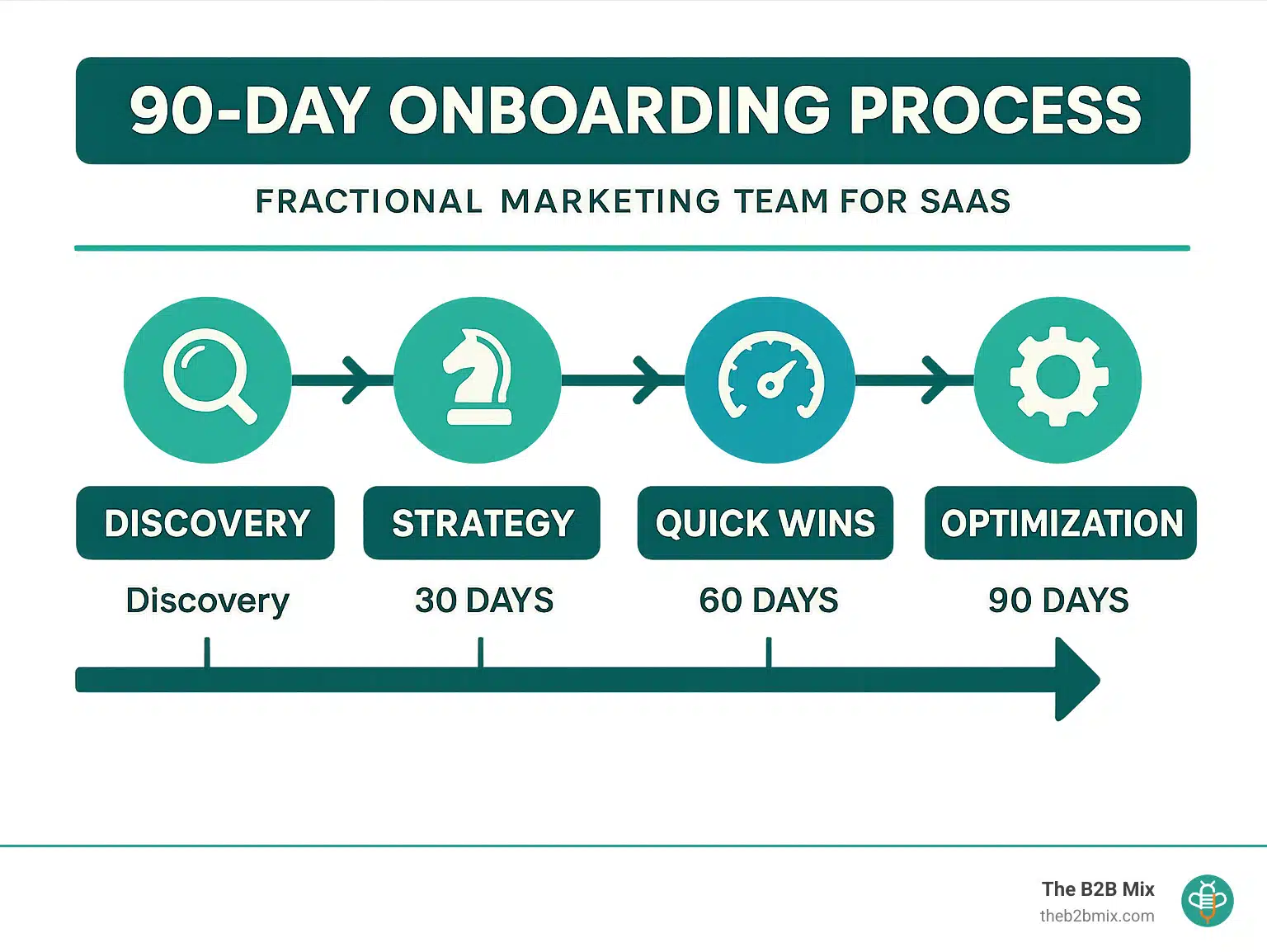
Onboarding Workflow & First-90-Day Deliverables
Once you decide to engage a fractional marketing team, a structured onboarding process typically unfolds over 90 days:
Weeks 1-2: Discovery & Audit
The fractional team begins with a comprehensive assessment:
- Marketing audit across all channels and assets
- Technology stack and data review
- Competitive analysis
- Customer and stakeholder interviews
- Current metrics and performance baseline
This phase culminates in a kickoff workshop to align on goals, priorities, and working processes.
Weeks 3-4: Strategy & Foundation
With discovery insights in hand, the team develops:
- Refined ideal customer profile (ICP) and buyer personas
- Messaging and positioning framework
- Channel strategy and budget allocation
- OKRs and success metrics
- 90-day execution roadmap
This phase establishes the strategic foundation for all tactical execution.
Weeks 5-8: Quick Wins & Infrastructure
The team begins implementing high-impact initiatives:
- Website optimization for conversion
- Marketing automation setup or refinement
- Content audit and gap analysis
- Initial campaign launches
- Analytics and reporting setup
These efforts focus on generating early results while building the infrastructure for sustainable growth.
Weeks 9-12: Scale & Optimization
In the final phase of initial onboarding, the team:
- Scales successful channel initiatives
- Implements systematic testing frameworks
- Refines messaging based on market feedback
- Establishes regular reporting cadences
- Plans for the next 90-day sprint
Pricing models & budgeting tips
Fractional marketing teams for B2B or SaaS typically offer several engagement models to fit different needs and budgets:
Hourly retainers
- Flexible allocation of hours across team members
- Typically ranges from $150-350 per hour, depending on seniority
- Best for companies needing variable support or specific expertise
- Often requires minimum monthly commitments (e.g., 20-40 hours)
Package tiers
- Pre-defined service bundles at fixed monthly rates
- Typically range from $6,500/month for advisory to $45,000/month for full-service
- Provides predictable costs and clearly defined deliverables
- Often scales based on company size or growth goals
When budgeting for a fractional team, consider these tips:
Start with outcomes, not hours: Define what success looks like, then work backward to determine the level of support needed.
Consider the alternative costs: Compare fractional team costs to the fully-loaded costs of hiring equivalent in-house talent (salary, benefits, recruiting, training, etc.).
Budget for tools and media: Beyond team costs, allocate budget for marketing technology, content production, and paid media.
Plan for evolution: Your needs will likely change as you grow. Budget for potential increases in support during critical periods (product launches, fundraising, etc.).
Track ROI rigorously: Establish clear attribution models to measure the return on your fractional team investment.
How do you measure ROI from a fractional marketing team?
Let's talk about what really matters when you invest in a fractional marketing team for B2B or SaaS—the return on that investment. After all, as a B2B leader, you need to know your marketing dollars are driving actual business growth, not just vanity metrics. Your fractional team should be laser-focused on metrics that directly impact your valuation and growth trajectory:
ARR growth
ARR Growth stands as the north star metric for B2B business. A good fractional team will help you track exactly how much new annual recurring revenue comes from marketing-sourced or marketing-influenced opportunities. This direct line from marketing activity to revenue is essential for proving ROI.
CAC payback period
Your CAC Payback Period tells you how quickly you recover customer acquisition costs. One of the immediate benefits you should see from an effective fractional team is a gradual reduction in this metric as they optimize your channels and messaging.
Net revenue retention
Net Revenue Retention might seem like a CS metric, but marketing plays a crucial role here through strategic upsell and cross-sell campaigns. Your fractional team should be helping drive expansion revenue, not just new customer acquisition.
Marketing-influenced pipeline
When reviewing pipeline metrics, pay special attention to Marketing-Influenced Pipeline - the total value of opportunities where marketing touched the buyer's journey, even if they weren't the original source. This broader view gives you a more accurate picture of marketing's total impact.
Conversion rates by funnel stage
Finally, Conversion Rates by Funnel Stage help you understand exactly where your growth engine is getting stronger. Improvements in visitor-to-trial, trial-to-paid, and other key conversion points are clear indicators that your fractional team is making an impact.
A good fractional partner will establish clear reporting rhythms that keep everyone aligned without creating unnecessary meeting overhead. Look for weekly metrics updates, bi-weekly channel performance reviews, monthly executive dashboards, and quarterly strategic planning sessions.
For more information about how companies are leveraging fractional executive talent across various functions, check out Go Fractional's resources on hiring fractional executives.
Common myths about fractional marketing teams
Let's clear up some persistent myths about working with fractional teams:
"Fractional means hands-off" couldn't be further from the truth. A good fractional marketing team for B2B and SaaS becomes deeply embedded in your business, often feeling more like an extension of your internal team than an external vendor. They'll be in your Slack channels, participating in your meetings, and taking genuine ownership of results.
Some believe "they can't own strategy," but strategy development is typically where fractional teams shine brightest, especially those led by experienced CMOs. Their exposure to multiple companies and markets often gives them a broader strategic perspective than many in-house marketers who've only seen one or two playbooks.
"It's just another agency relationship" misses the fundamental difference in approach. Unlike traditional agencies that typically focus on specific channels or deliverables, fractional teams take holistic ownership of marketing outcomes and align their success metrics directly with your business goals.
Many founders worry, "we'll outgrow them quickly," but the reality is that fractional teams can scale with your business, adjusting their composition and focus as your needs evolve. Many companies maintain fractional relationships for years, even as they build internal teams, leveraging the fractional experts for specialized skills or strategic guidance.
And finally, the concern that "they won't understand our specific industry" overlooks that many fractional teams specialize in sectors or have team members with relevant industry experience. Their ability to apply proven frameworks while adapting to your specific market is actually a key strength.
Ensuring alignment & accountability with your fractional partner
The success of your partnership with a fractional marketing team for B2B and SaaS depends largely on how well you establish alignment and accountability from day one.
Start with structured communication - weekly stand-ups to review priorities and progress, a dedicated Slack channel for day-to-day communication, regular stakeholder updates, and documented meeting notes that capture action items and decisions.
Transparent reporting is non-negotiable. Look for real-time dashboards accessible to all stakeholders, regular reporting on agreed KPIs, clear attribution of results to specific initiatives, and honest assessment of what's working and what's not. Your fractional team should be the first to tell you when something isn't delivering as expected.
The best fractional teams accept continuous experimentation with documented hypotheses for major initiatives, clear success criteria defined in advance, structured review of results, and rapid scaling of what works (while quickly abandoning what doesn't).
Finally, establish shared tools and workflows by giving your fractional team appropriate access to your key systems, using shared project management tools for visibility, documenting processes for approvals and feedback, and clearly defining roles for each team member.
When these practices are established from the beginning, your fractional team truly functions as a seamless extension of your company, bringing specialized expertise and fresh perspective while maintaining complete alignment with your business goals.
Frequently asked questions
How much time will leadership need to invest?
One of the most common questions we hear is about the time commitment required when working with a fractional marketing team. Good news: it's significantly less than managing an in-house department, while still ensuring you stay connected to your marketing efforts.
During the initial onboarding phase, expect to invest 8-10 hours in the first two weeks. This time is well spent in discovery sessions, strategy alignment meetings, and kickoff workshops that set the foundation for success. Think of it as an investment that pays dividends through better execution down the line.
Once you're up and running, most executives find they spend just 2-4 hours per week in regular check-ins, reviewing results, and providing feedback. Your fractional team handles the heavy lifting of day-to-day execution, campaign management, and tactical decisions—freeing you to focus on product development and business strategy while maintaining clear visibility into marketing performance.
Quarterly, you'll want to block 4-6 hours for strategic review sessions with key stakeholders. These deeper dives ensure your marketing efforts stay aligned with evolving business priorities and provide opportunities to reset direction if needed.
At what ARR or headcount should we consider going fractional?
The truth is, the decision to engage a fractional marketing team depends more on your growth goals and specific challenges than rigid ARR or headcount thresholds. That said, we can offer some helpful guidelines based on what we've seen work well:
A fractional CMO plus minimal specialist support often makes perfect sense for early-stage companies ($0-1M ARR). At this stage, you're focused on nailing your positioning, creating initial content, and building foundational marketing elements. Typically, 10-20 hours per week of fractional support is the sweet spot.
Growth-stage companies ($1-10M ARR) benefit from a more comprehensive fractional team spanning multiple disciplines. Your focus shifts to scaling acquisition channels and optimizing conversion paths. Most companies at this stage find 40-80 hours per week of combined fractional support delivers the right balance of expertise and execution.
At the scale-up stage ($10 M+ ARR), many companies transition to a hybrid model with some in-house marketing roles complemented by fractional specialists. Your marketing challenges now include new market expansion and enterprise customer acquisition. The fractional hours vary widely based on your in-house capabilities.
Interestingly, many B2B and SaaS companies maintain some level of fractional support even as they build internal teams—using fractional experts to fill specialized skill gaps or provide ongoing strategic guidance.
Conclusion
When it comes to changing your company's growth trajectory, a fractional marketing team offers a powerful solution that works at any stage of your journey. This approach isn't just another option—it's a strategic advantage that combines seasoned CMO leadership with specialized expertise, all wrapped in a flexible package that aligns perfectly with the unique challenges of subscription-based software businesses.
The numbers tell a compelling story: companies implementing this model typically experience cost savings compared to building equivalent in-house capabilities, while enjoying faster time-to-market for new initiatives. But beyond these impressive statistics lies the real value—access to specialized expertise across multiple disciplines, the agility to pivot as market conditions change, and true accountability through performance-based engagement models.
At The B2B Mix, we've seen how companies face the complex marketing challenges inherent to subscription-based businesses. Our hands-on, jargon-free approach focuses on delivering tangible results through optimized HubSpot implementations, streamlined marketing operations, and data-driven digital strategies that actually move the needle on your key metrics.
Next Steps Checklist
If you're considering whether a fractional marketing approach might be right for your company, we recommend taking these practical steps:
First, take an honest look at your current marketing gaps and identify where specialized expertise would create the biggest impact. Then, define clear, measurable objectives for what you want a fractional team to accomplish—whether that's increasing qualified leads, reducing CAC, or launching into new markets.
When evaluating potential partners, focus on their specific experience, team composition, and cultural alignment with your organization. It often makes sense to start with a focused engagement to build momentum and demonstrate value before expanding the relationship.
Most importantly, establish clear metrics from day one to measure the impact of your fractional partnership. The right metrics will keep everyone aligned and focused on outcomes, not just activities.
The B2B landscape evolves with speed, with rising customer expectations and increasingly sophisticated competition. A fractional marketing team provides the expertise, agility, and accountability needed to successfully steer these challenges, without the overhead and commitment that come with building a full in-house department.
Whether you're aiming to accelerate growth, enter new markets, optimize your marketing engine, or prepare for a funding round or exit, the fractional model gives you strategic leadership paired with tactical execution in a package that scales with your needs.
Ready to explore how a fractional marketing approach could boost your growth? We're here to help you steer the options and find the right fit for your specific situation. Let's have a conversation about how The B2B Mix can help you achieve your growth goals with our practical, results-focused approach to marketing.
Learn how we've served in a fractional marketing capacity with a B2B client for 14+ years.