

The New Growth Engine for Tech Companies
A fractional marketing team for tech is a specialized group of part-time marketing experts who work with technology companies on a flexible basis to provide strategic leadership and execution without the overhead of full-time hires.
Quick Answer: Fractional Marketing Teams for Tech Companies
| What is it? | Who is it for? | Key Benefits |
|---|---|---|
| A part-time team of senior marketing specialists who work on a contract basis | Tech startups, SaaS companies, and established tech firms needing specialized expertise | Specialized tech expertise, flexibility |
The digital landscape has become so complex that no single marketer can master every channel and tool. This reality, combined with the unique challenges of tech companies—rapid product cycles, specialized audiences, and growth pressure—has fueled the rise of fractional marketing teams.
Unlike traditional agencies that offer bundled packages or in-house teams requiring significant overhead, fractional marketing provides tech companies with on-demand access to specialized talent. These experts can deploy quickly, allowing tech companies to move at the speed their market demands.
The model is particularly well-suited for funded startups that need to quickly prove product-market fit, growth-stage SaaS companies optimizing their acquisition channels, tech firms navigating market shifts, and B2B technology vendors requiring specialized expertise.
Fractional marketing team for tech terms at a glance:
Fractional vs In-House vs Agency: Which Model Fits Tech Growth?
When it comes to powering your tech company's marketing engine, you've got three main options: building an in-house team, partnering with an agency, or bringing on a fractional marketing team for tech companies. Each approach has its merits, but which one truly aligns with the unique challenges tech businesses face?
Let's have an honest conversation about how these models stack up in the real world:
| Factor | In-House Team | Traditional Agency | Fractional Team |
|---|---|---|---|
| Cost Structure | High fixed costs (salaries, benefits, office space) | High retainers, often with bundled services you don't use | Variable costs based on actual needs |
| Time-to-Deploy | 3-6 months to recruit, hire, and onboard | 1-2 months for onboarding and strategy development | 1-2 weeks to deploy, productive within 30 days |
| Expertise Level | Limited by budget and talent availability | Agency generalists with some specialization | Senior specialists with deep tech industry experience |
| Flexibility | Fixed team size, difficult to scale up/down | Rigid contracts, typically 6-12 months | Month-to-month contracts, adjustable hours |
| Tech Industry Knowledge | Deep company knowledge but limited cross-industry exposure | Varies widely, often surface-level tech understanding | Cross-pollination of ideas from multiple tech clients |
The reality for many tech companies is that talent gaps, operational overhead, and the need for speed to market create significant challenges when building marketing capabilities. While in-house teams offer deep company knowledge, they often lack specialized expertise in critical areas, such as account-based marketing (ABM) or technical content creation.
Key Differentiators
What truly makes the fractional marketing team for tech model stand out? Three things that really matter:
Part-time leadership with full-time impact. A fractional CMO gives you executive-level strategy for 10-20 hours per week. You get the brain power without the hefty salary and benefits package.
On-demand specialists across the marketing spectrum. Instead of hiring jack-of-all-trades marketers who are mediocre at everything, you get access to true specialists in the areas that matter most: product marketing experts who understand how to position complex tech solutions. These content strategists can translate technical jargon into compelling stories, and analytics pros who can turn data into actionable insights.
Month-to-month contracts with performance incentives. Unlike agencies that lock you into year-long commitments, fractional teams typically work on flexible arrangements that align with your business goals. Many companies even tie their compensation directly to performance metrics, such as lead generation or customer acquisition.

The beauty of the fractional model is its inherent flexibility and autonomy. You maintain control of your marketing strategy while gaining access to specialized expertise exactly when and where you need it.
>>> More info about full-time vs fractional marketing teams
Why Tech Companies Are Turning to Fractional Marketing Teams
In today's tech landscape, speed isn't just a competitive advantage—it's a survival requirement. Tech companies face shorter product lifecycles, intense competition, and market conditions that shift overnight. These unique pressures have made fractional marketing teams for tech companies not just attractive but essential for many growing businesses.
Let's explore why tech leaders are embracing this flexible approach:
Market Volatility and Compressed Timelines
Fractional marketing teams for tech companies deliver impressive speed advantages. While building an in-house team typically takes months, fractional teams can deploy in weeks and reach full productivity much faster.
For a tech startup racing to establish category leadership or a mature company responding to a disruptive competitor, this speed difference isn't just convenient—it's existential.
Capital Efficiency and Investor Expectations
The pressure from investors, particularly for Series A and B companies, creates a challenging balancing act: show impressive growth while maintaining a reasonable burn rate.
Fractional marketing teams for tech companies deliver on both fronts. When you consider that a modest marketing team can easily cost more than $100,000 annually, the fractional approach offers savings that can be redirected to product development and other core functions.
Access to Specialized Tech Marketing Expertise
The tech marketing landscape has become incredibly specialized. Finding people who understand both marketing fundamentals and the nuances of your technology is challenging enough—seeing them for every specialized role is nearly impossible.
Fractional marketing teams for tech companies solve this problem by providing access to rare specialists:
- Technical content creators who can explain complex products clearly
- Product marketers who translate features into compelling benefits
- Demand generation specialists with B2B tech experience
- Marketing technologists who build and optimize your martech stack

Cross-Functional Agility and Experimentation
Tech companies thrive on rapid experimentation and cross-functional collaboration. Fractional marketing teams for tech are built for this environment, typically organizing into cross-functional pods focused on specific customer journey stages and adopting agile sprint methodologies for rapid value delivery.
Core Benefits for Tech & SaaS
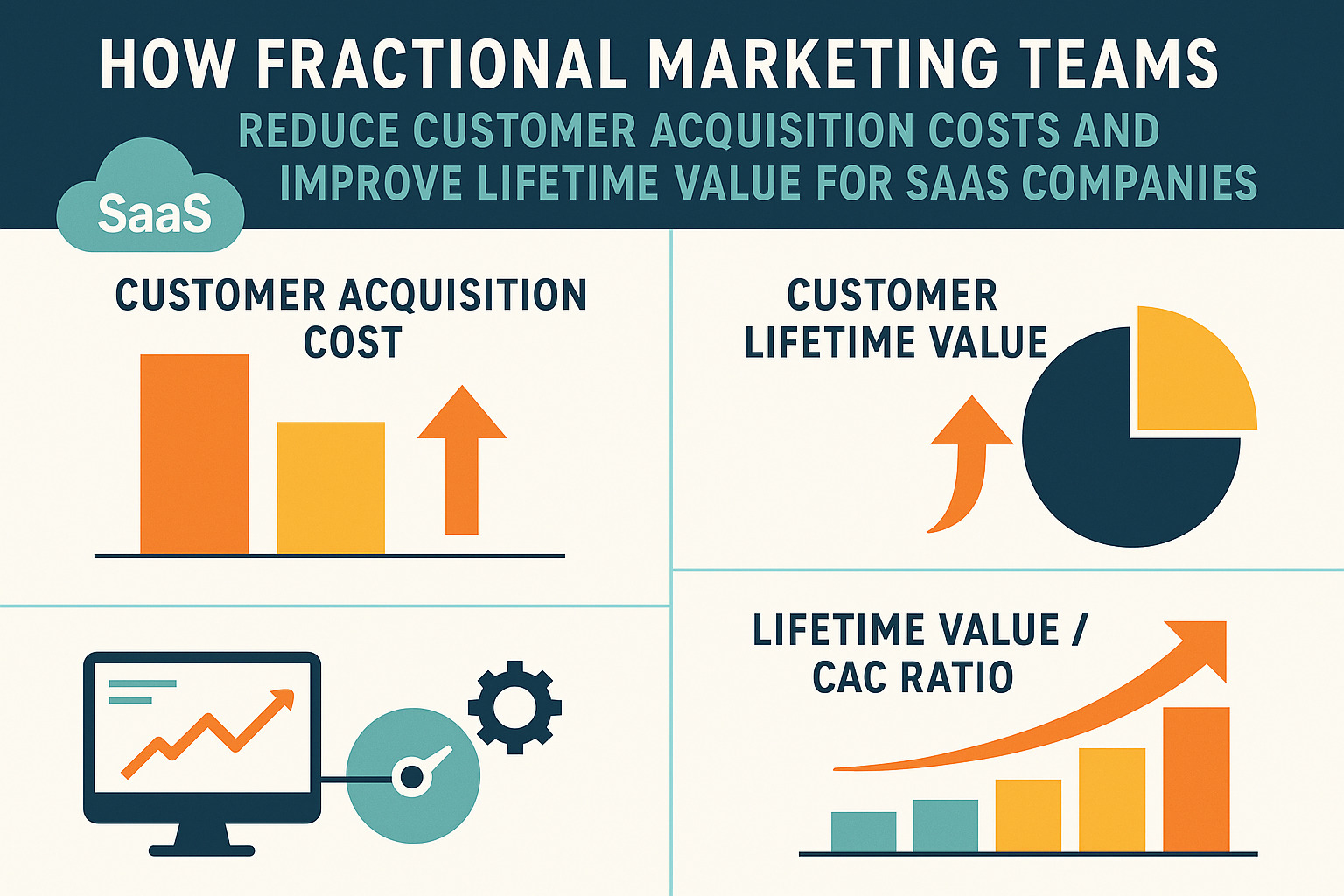
CAC Reduction becomes possible when fractional specialists bring expertise in optimizing customer acquisition costs—critical for SaaS unit economics.
CLTV Focus helps SaaS companies maximize expansion revenue and reduce churn through specialized customer marketing and retention strategies.
Data-driven experimentation thrives with fractional teams who bring scientific approaches to marketing, including multivariate testing and cohort analysis.
Remote-Ready Collaboration aligns perfectly with the comfort of SaaS companies in managing distributed teams.
Building & Integrating a High-Impact Fractional Marketing Team for Tech
Creating an effective fractional marketing team for tech companies requires thoughtful planning around who you need, how they'll work with your existing teams, and what workflows will drive results.
Fractional Marketing Team for Tech: Core Roles & Skills
Your dream fractional marketing team for tech will likely include several key specialists, though the exact mix should match your growth stage and specific challenges:
A Fractional CMO or Marketing Director typically serves as your strategic compass, working 10-20 hours weekly to align marketing efforts with business goals while coordinating the rest of your team.
Your Growth Marketing Specialist becomes your acquisition expert, focusing on channel optimization and running experiments to accelerate user growth.
The Product Marketing Manager translates your complex tech features into compelling customer benefits, crafting positioning that resonates and arming your sales team with materials that actually close deals.
For B2B tech companies with longer sales cycles, a Demand Generation Specialist develops multi-channel campaigns that sustain a steady pipeline of qualified opportunities.
A Content Marketing Strategist creates the technical content, thought leadership, and educational resources that demonstrate your expertise.
As marketing becomes increasingly technical, a Marketing Operations/Marketing Technologist manages your tech stack, ensures data flows properly, and builds the automation that lets your team focus on strategy.
>>> More info about marketing technologist
Your company's stage typically dictates how many fractional hours you'll need:
- At early-stage ($0-1M ARR), you might need just 10-20 hours weekly
- During growth stage ($1-10M ARR), you'll benefit from 40-80 hours across multiple specialists
- At scale-up ($10 M+ ARR), you'll likely use a hybrid model with some in-house leadership and fractional specialists
Collaborating Across Product, Sales & CS
In tech companies, marketing can't operate in isolation. The most effective fractional marketing teams for tech use these integration approaches to break down silos:
Shared OKRs and Metrics create alignment across departments. Establish common objectives that matter to both teams, such as pipeline generation targets that marketing and sales share ownership of.
Regular communication becomes the glue holding everything together. Weekly stand-ups handle tactical coordination, bi-weekly strategy sessions allow for deeper planning, and monthly reviews provide space to analyze what's working.
Many successful tech companies organize around cross-functional pods focused on customer journey stages rather than traditional departments.
RevOps dashboards create a single source of truth for customer data, eliminating the "my numbers don't match your numbers" debates.
Tool & Data Stack Essentials
A high-performing fractional marketing team for tech needs the right tools to drive results efficiently:
Marketing automation and CRM platforms, such as HubSpot, provide the foundation for campaign execution and lead management.
Attribution & Analytics tools track customer journeys across channels and accurately attribute conversions—crucial intelligence for optimizing your marketing spend.
Content Operations systems streamline the planning, creation, and distribution of technical content.
>>> More info about content operations framework
Business Intelligence dashboards offer real-time visibility into marketing performance, enabling you to identify trends and make informed, data-driven decisions.
At The B2B Mix, we specialize in HubSpot implementation and optimization, helping tech companies build efficient marketing operations that scale with their growth.
Cost, ROI & Onboarding: Making the Case
Let's talk dollars and sense. For tech leaders eyeing the bottom line, the business case for a fractional marketing team for tech boils down to three essentials: the cost, the return on investment, and the speed of implementation.
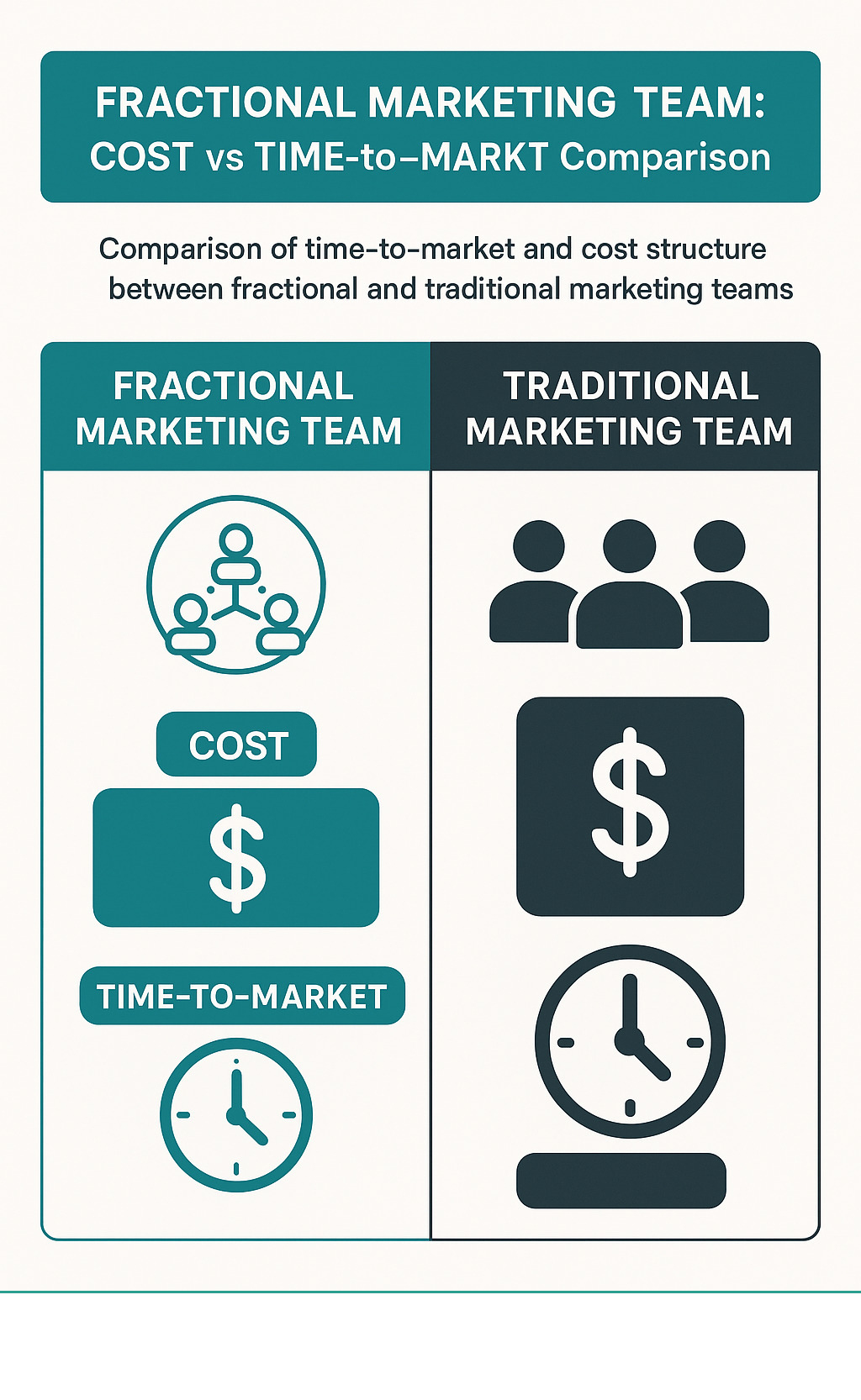
Fractional Marketing Team for Tech: Cost vs Time-to-Market Comparison
The numbers tell a compelling story when you compare fractional teams to traditional approaches:
| Resource | Approximate Annual Cost | Time to Deploy | Time to Full Productivity |
|---|---|---|---|
| Full-time CMO | $250,000+ (plus benefits, equity) | 3-4 months | 6-12 months |
| In-house Marketing Team (5 people) | $500,000-$1,000,000 | 4-6 months | 6-12 months |
| Traditional Agency | $180,000-$360,000 | 1-2 months | 3-6 months |
| Fractional Marketing Team | $180,000-$300,000 | 1-2 weeks | 30 days |
Most fractional arrangements follow straightforward pricing approaches: hourly retainers typically range from $150-$350, depending on expertise level, while monthly packages can start around $6,500 for fractional CMO guidance and scale up for comprehensive team support.
Potential Drawbacks & Mitigation
Let's be real – no solution is perfect. Here are the common concerns tech leaders have about fractional teams, and how we address them:
Cultural integration can be challenging when team members aren't physically present. We bridge this gap with regular video meetings, shared collaboration tools, and periodic in-person workshops.
Time zone differences might seem daunting when working with global talent. The fix? Clear communication protocols and established overlap hours ensure everyone stays in sync.
Intellectual property security naturally raises concerns when sharing sensitive information. We implement proper non-disclosure agreements (NDAs), strict data access protocols, and thorough security training to protect your valuable intellectual property.
Continuity worries are valid. That's why we structure our teams with built-in redundancy and robust knowledge management systems that preserve institutional memory.
3-Step Onboarding Checklist
Getting started with a fractional marketing team for tech is refreshingly straightforward:
Kickoff Workshop (Weeks 1-2)
We'll audit your current marketing channels, tech stack, and performance baselines. Together, we'll define your ideal customer profiles, refine messaging guidelines, and align marketing efforts with your business objectives.90-Day Roadmap Development (Weeks 3-4)
With clear OKRs and success metrics in place, we'll create a tactical execution plan with specific deliverables and establish your reporting cadence and tools.Execution & Optimization (Weeks 5-12)
We implement quick-win initiatives, such as website optimization and initial campaigns, establish robust analytics systems, and begin scaling successful channels.
Frequently Asked Questions
1. How many hours do we need?
This depends on your growth stage:
- Early-stage ($0-1M ARR) companies typically need 10-20 hours weekly
- Growth-stage ($1-10M ARR) businesses usually benefit from 40-80 hours weekly
- Scale-up ($10M+ ARR) organizations often require 80+ hours or a hybrid model
2. At what ARR should we switch from fractional to in-house?
Most tech companies begin building in-house teams around $5-10M ARR, but many successful companies maintain a hybrid model indefinitely.
3. How do we measure ROI?
We focus on metrics that matter:
- Marketing-influenced pipeline and revenue growth
- Customer acquisition cost (CAC) and trends
- CAC payback period improvements
- Conversion rates by funnel stage
>>>Research on CMO salaries
Finding, Vetting & Onboarding Your Fractional Partner
Finding the perfect fractional marketing team for tech shouldn't feel like searching for a unicorn. With the right approach to sourcing, evaluation, and onboarding, you can build a partnership that delivers impressive results.

Sourcing Channels & Evaluation Criteria
The best fractional marketing talent doesn't always advertise in the most obvious places. Here's where tech leaders are finding their fractional partners:
Specialized Fractional Agencies often provide the most seamless experience, as they've already vetted talent and built systems for collaboration. These firms typically focus on specific industries, such as technology or SaaS.
LinkedIn Communities have become vibrant hubs for fractional talent. Groups dedicated to tech marketing, growth hacking, or specific niches, such as SaaS marketing, can be goldmines for finding experienced professionals.
The power of founder and investor networks shouldn't be underestimated. Your fellow entrepreneurs and investors can often connect you with fractional resources who have already proven themselves in similar contexts.
For those who prefer a more structured approach, Executive Freelance Marketplaces offer pre-vetted senior marketing talent specifically for fractional engagements.
When evaluating potential partners, look beyond the polished pitch. Tech industry experience is non-negotiable—a fractional CMO who built their career in consumer packaged goods will struggle with the nuances of SaaS go-to-market strategy.
Always ask for measurable results from previous engagements. A strong fractional partner should be able to share specific metrics they've influenced, whether that's reducing CAC by 30% or increasing trial conversions by 45%.
Don't underestimate the importance of cultural fit and communication style. The most brilliant marketing mind won't deliver results if their work pace and communication approach clash with those of your team.
>>> More info about SaaS fractional teams
Contracting & Governance
Once you've found your ideal fractional marketing team for tech, setting clear expectations and governance will maximize your chances of success.
Most fractional engagements work best with month-to-month retainers that include a 30-day cancellation clause. This structure provides maximum flexibility while offering sufficient stability for the fractional team to invest in understanding your business.
Consider adding performance-based incentives to further align interests. We've seen great success with variable compensation tied to specific OKRs, where the fractional team can earn between 0% and 125% of a bonus portion based on performance.
Tech companies should prioritize data access and security from the outset. Establish clear protocols for system access, handling sensitive information, and maintaining security.
A well-defined communication cadence prevents misalignments and ensures everyone stays on the same page. Successful engagements typically include weekly stand-ups (30 minutes), bi-weekly strategy sessions (60 minutes), monthly performance reviews (90 minutes), and quarterly planning workshops (half-day).
For companies new to the fractional model, starting with a trial engagement of 60-90 days provides a low-risk way to test the waters. Set clear goals for this initial period and schedule regular progress reviews to determine if the relationship is delivering the expected value.
Conclusion
The rise of fractional marketing teams for tech companies isn't just another fleeting trend—it represents a fundamental shift in how technology businesses approach their marketing challenges. When agility and specialized expertise matter more than ever, this model offers a refreshing alternative that aligns perfectly with the unique needs of tech companies.
Throughout this guide, we've seen how fractional marketing teams for tech deliver compelling advantages that traditional approaches simply can't match:
Cost Efficiency: Tech companies save an average of 40% compared to building an in-house team, freeing up capital for product development and other core investments.
Speed to Market: While traditional hiring can take months, fractional teams deploy in just 1-2 weeks and reach full productivity in 30 days—a game-changer in fast-moving tech markets.
Specialized Expertise: Rather than settling for generalists, you gain access to senior-level specialists across the full marketing spectrum—from technical content creators to marketing technologists.
Flexibility: As your needs evolve, you can easily scale resources up during product launches or down during quieter periods, without the painful process of hiring and layoffs.
Whether you're leading a seed-stage startup racing to validate product-market fit, scaling a Series A SaaS company optimizing your acquisition funnel, or guiding an established tech firm through a market pivot, the fractional model provides exactly what you need without the overhead you don't.
At The B2B Mix, we specialize in providing hands-on, results-focused fractional marketing support that's specifically custom for B2B tech companies. Our team brings deep expertise in HubSpot optimization, marketing operations, and digital strategy execution—all delivered with a jargon-free, human approach that emphasizes real results.
Ready to explore how a fractional marketing team for tech could accelerate your company's growth? Let's have a conversation about your specific challenges and goals—no sales pitch, just honest dialogue about whether this approach is right for you.