
The Essential Connection Between Marketing Tech and Customer Data
Blending your CRM with your marketing tech tools isn’t just smart—it’s essential. When you connect the systems that manage your customer relationships with the tools that power your campaigns, you get a clear, complete view of your buyers from first click to closed deal.
For B2B marketing managers looking to understand this concept quickly:
| What It Means | Why It's Important | What it Includes |
|---|---|---|
| Integration of marketing technology and customer relationship management systems | Creates a single source of truth for customer data across marketing and sales | CRM platform, marketing automation, analytics, content management, and integration tools |
| Enables data-driven marketing decisions based on customer behavior | Improves personalization, efficiency, and ROI measurement | |
| Streamlines the entire customer journey from awareness to advocacy | Reduces siloed operations and data fragmentation |
In today's digital landscape, marketing teams are drowning in technology options.
The disconnect is apparent: Powerful tools don't automatically translate to powerful results.
For B2B marketing managers, the challenge isn't just selecting the right tools—creating a cohesive ecosystem where your marketing technology and customer data work together seamlessly. When your martech stack and CRM system are properly integrated, you gain the ability to:
- Track the complete customer journey
- Deliver personalized experiences at scale
- Align sales and marketing efforts around shared data
- Automate repetitive tasks and workflows
- Measure true marketing ROI across channels
This guide will show you how to transform your disconnected tools into a unified martech CRM powerhouse that drives real business results—without the technical headaches or implementation nightmares.
Why CRM and Marketing Tech Work Better Together
It’s not about having more tools—it’s about making them talk to each other. When your CRM and marketing tech are connected, you’re not just gathering data—you’re putting it to work in real time to engage leads, personalize experiences, and close deals faster.
The Single Source of Truth
One of the biggest headaches B2B companies face is data scattered across different systems. It's like trying to complete a puzzle when pieces are spread across different rooms - customer contacts live in the CRM, email engagement hides in your marketing automation platform, and website behavior lurks in analytics tools. This fragmentation makes it nearly impossible to see the complete customer journey.
Syncing your CRM with your marketing tools creates a central hub where all customer interactions are recorded, updated, and easily accessible. No more contradictory information, reduced manual data entry, and everyone in your organization works with accurate, up-to-date customer data.
How CRM and Martech Fuel Personalization
Despite pouring resources into technology, 63% of digital marketing leaders still struggle to deliver personalized experiences with their digital tools, according to Gartner. This gap exists because true personalization needs both robust customer data (typically living in CRM) and effective delivery mechanisms (found in martech tools).
When properly connected, your martech customer relationship management ecosystem enables powerful personalization capabilities:
Advanced Segmentation: Move beyond basic demographics to create dynamic groups based on behavior, engagement level, purchase history, and buyer journey position.
Behavioral Triggers: Launch targeted campaigns automatically when contacts take specific actions, like visiting your pricing page or downloading a whitepaper.
Predictive Analytics: Use your historical data to anticipate customer needs and proactively deliver relevant content before they even ask.
Journey Orchestration: Create seamless, personalized experiences across multiple channels that adapt based on how customers interact with your brand.
Sales and Marketing Alignment
The age-old divide between sales and marketing teams has been a thorn in the side of B2B organizations for too long. Sales complains about poor-quality leads; marketing argues that sales doesn't follow up properly. This misalignment costs businesses dearly in missed opportunities and wasted resources.
Integrating CRM with your martech stack bridges this gap by creating shared definitions of qualified leads, providing visibility into the complete lead journey, and enabling smooth handoffs between teams. It also supports closed-loop reporting on marketing influence and facilitates collaborative account-based marketing initiatives.
Automation That Drives Efficiency
Another beautiful benefit of connecting CRM with martech is the ability to automate repetitive tasks across the entire customer lifecycle. This goes way beyond basic email sequences to include lead routing based on complex criteria, progressive profiling to gather additional contact information over time, and automated lead scoring to help prioritize follow-ups.
You can also automate deal stage progression based on engagement signals, customer onboarding workflows, and even identify renewal and upsell opportunities automatically.
By letting technology handle these processes, your marketing and sales teams can focus on what humans do best - building relationships, being creative, and adding that personal touch that technology can't replicate.
Overcoming Common CRM and Martech Integration Challenges
While the benefits are clear as day, successfully bringing together CRM and martech tools isn't always a walk in the park. Here are the most common roadblocks and how to steer around them:
Data Quality Issues: Even the best integration will falter with poor data. Implement validation rules, regular cleaning processes, and mandatory fields to maintain clean and accurate data.
User Adoption Resistance: Many CRM implementations fail because people don't use the system. Focus on user-friendly interfaces, provide thorough training, and clearly show the "what's in it for me" to drive adoption.
Integration Complexity: With hundreds of potential tools to connect, the process can become technically challenging. Start with your most critical connections, use middleware when needed, and consider single-vendor solutions for core functionality.
Change Management Problems: Any significant technology change requires thoughtful change management. Bring stakeholders in early, communicate your vision clearly, celebrate quick wins, and provide ongoing support to ensure a smoother transition.
At The B2B Mix, we've helped numerous B2B companies optimize their HubSpot CRM to overcome these challenges and create truly integrated marketing and sales systems that feel less like technology and more like a natural extension of how you work.
Core Components of a Modern Martech Stack & Where CRM Fits
Understanding how CRM fits within the broader martech ecosystem is crucial for developing an effective, integrated strategy. Let's examine the core components of a modern martech stack and how they interact with your CRM system.
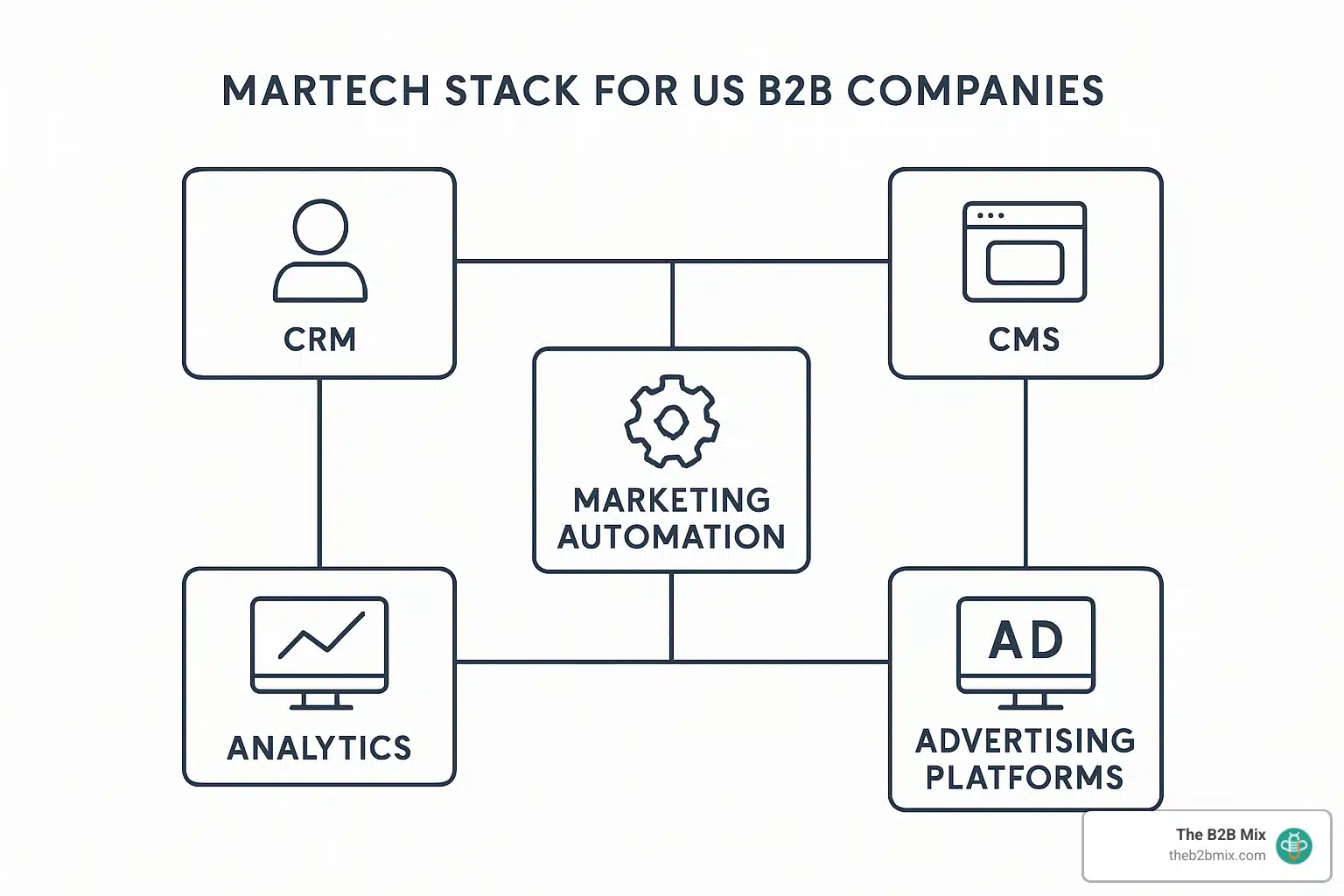
Essential Martech Components
Your CRM-connected marketing ecosystem is like a community center. Everything connects there, but each platform is like a business that serves a unique purpose in the community.
Your Content Management System (CMS) is like your storefront—it's what customers see first. When connected to your CRM, your website can become smarter. Thanks to dynamic content features, you could show visitors content based on what you already know about them. That prospect who's been looking at enterprise solutions? You can show them enterprise-focused case studies when they return to your site.
Behind the scenes, your Marketing Automation Platform (MAP) is working tirelessly, nurturing leads and moving them through campaigns without manual intervention. When your MAP and CRM talk to each other, magic happens—leads flow smoothly between marketing and sales, with complete history intact.
Those email campaigns you're sending? When your Email Marketing Tools connect with your CRM, you're not just blasting messages into the void. You can have conversations based on each contact's history, preferences, and behaviors. With thoughtful segmentation and good copywriting, you can send one-to-many campaigns that feel like one-to-one messages. Additionally, every open, click, and response is recorded, building a richer picture over time.
Wondering how people find you in the first place? Your MAP or other analytics tools can help answer that question. Connect them to your CRM, and you can see which sources and campaigns generate customers, not just clicks.
Your MAP or Analytics Platform tells you what's happening on your website. But in isolation, they can't tell you if that anonymous visitor who spent 20 minutes on your pricing page eventually became your biggest customer. CRM integration connects those dots.
The Customer Data Platform (CDP) serves as your data unification engine, pulling information from every interaction your customers have with you. While it might sound similar to a CRM, your CDP focuses more on building comprehensive profiles (including anonymous visitors). At the same time, your CRM excels at managing relationships once those visitors become known contacts.
When your phone rings, Voice over IP (VoIP) Systems integrated with your CRM can automatically log every call, so your sales team would love not to have to manually enter call notes. And you'll love having complete conversation records tied to each contact. VoIP-CRM integration creates a seamless experience for both your team and your customers.
For B2B companies focused on landing big accounts, Account-Based Marketing (ABM) Platforms are game-changers. These tools help you target and engage specific high-value accounts with personalized approaches. The CRM provides the foundation for ABM success, supplying the account data needed to fuel targeted campaigns.
Your CRM system is the central hub that connects customer data across your entire tech ecosystem, and it is at the heart of all these specialized tools.
CRM vs CDP vs MAP: Clearing the Confusion
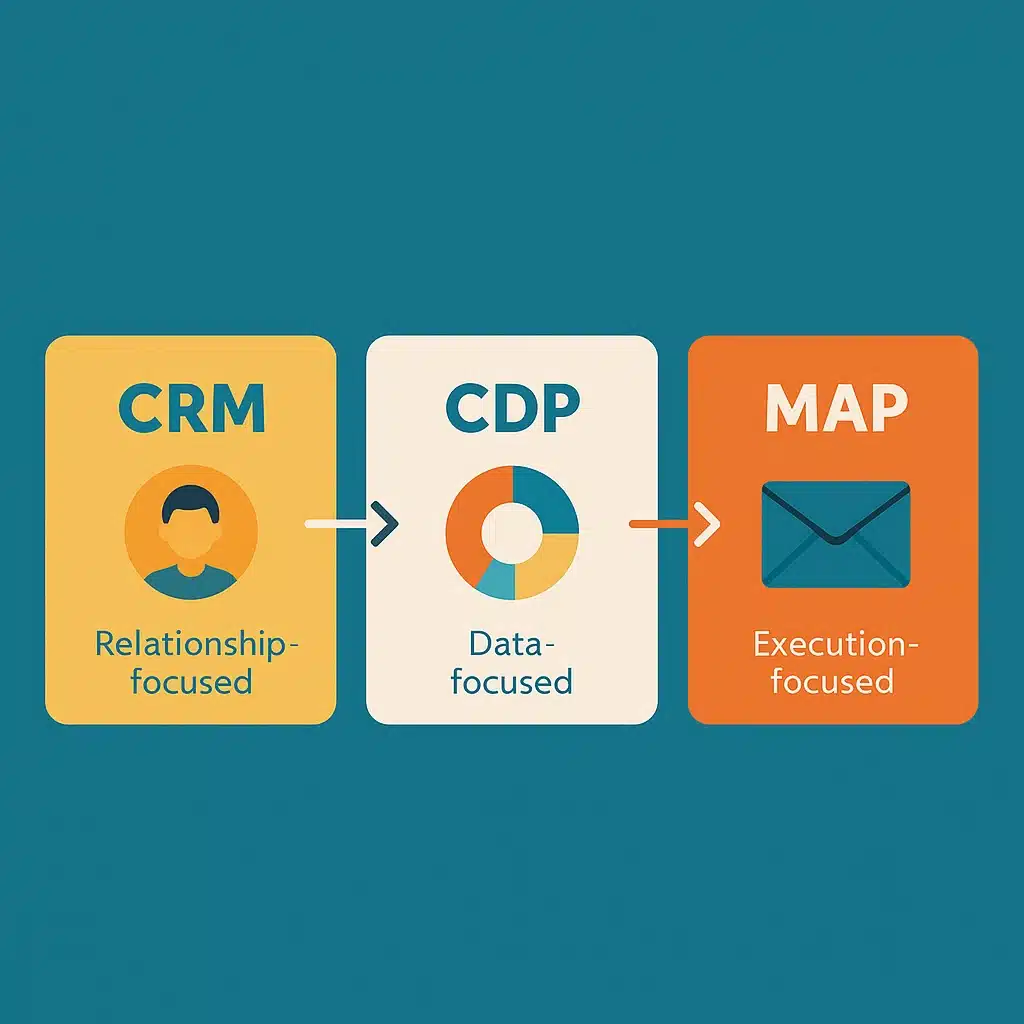
"Wait, don't these tools all do the same thing?" It's a question many people have, especially regarding CRMs, CDPs, and MAPs. Let's break down the differences in plain language:
Your CRM is relationship-focused. It's where your sales team lives, tracking deals, contacts, and customer interactions. Think of it as your system of record for customer relationships.
Your CDP is data-focused. It pulls information from various sources (websites, product usage, support tickets, etc.) to build unified customer profiles. It works with known contacts and anonymous visitors, making it valuable earlier in the customer journey.
Your MAP is execution-focused. It automates marketing tasks, such as email campaigns, lead scoring, and nurture sequences. It's the tool that puts your strategy into action based on triggers and rules.
Most B2B companies need all three working in harmony:
- Your CDP gathers and unifies data from everywhere
- Your CRM manages relationships and sales processes
- Your MAP executes and automates marketing campaigns
If you're using HubSpot, you're in luck—the platform offers capabilities spanning all three areas, providing specialized functionality for each need. For more on how these pieces fit together in your marketing operations, check out our article on Marketing Operations & Technology: What's the Difference?
Integrating CRM with Your Martech Toolkit
Connecting your CRM with other marketing technology tools doesn't have to be a headache. With the right approach, you can create a seamless flow of customer data that powers your entire marketing and sales operation.
Integration Approaches
When it comes to connecting your CRM with the rest of your marketing tech, you have several options, each with its own strengths:
Native Integrations are the simplest way to connect systems. These pre-built connectors come ready to use between popular platforms. They're like plug-and-play solutions – easy to set up and maintain, though sometimes limited in what they can do.
API Connections offer the most flexibility for complex needs. Think of APIs as direct communication channels between different software. While they require some technical know-how, they let you customize exactly how your systems talk to each other.
Middleware and iPaaS solutions, such as Zapier, Tray.io, or Workato, serve as friendly intermediaries between your tools. They're perfect when you need something more potent than native integrations but don't have developer resources for custom API work.
Single-vendor suites, such as HubSpot, bring multiple tools under one roof, eliminating many integration challenges. When your CRM, marketing automation, and website tools all come from the same company, they're designed to work together from the start.
Best Practices for Seamless Data Flow
Creating smooth connections between your CRM and martech systems isn't just about the technical setup. These best practices will help ensure your data flows precisely where it needs to go:
Start by defining clear objectives for your integration. Not every piece of data needs to travel between systems. Ask yourself: "What information do my teams actually need to do their jobs better?" This focus prevents data overload, keeping things running smoothly.
Careful data mapping makes a world of difference. Take time to match fields between systems properly, including details like data types and field lengths. This attention to detail prevents the frustrating data corruption issues that can plague poorly planned integrations.
Establish strong data governance from the start. Decide which system "owns" each piece of information and how you'll handle conflicts when they arise. Without these rules, you risk creating data chaos rather than clarity.
Consider using incremental syncing rather than constantly transferring all data between systems. By moving only changed records, you'll improve performance and reduce unnecessary data traffic.
Always test thoroughly before going live. Run your integration through its paces with sample data to ensure everything flows correctly in all scenarios. A little testing upfront can save major headaches down the road.
Finally, document everything about your integration. Future you (and your team) will thank you when troubleshooting is needed or when it's time to make changes.
If you're using HubSpot and need help, try our On-Demand HubSpot Help (QuickAssist) service. We can provide guidance without the long-term commitment.
Real-World Wins with Integrated CRM

When your CRM and marketing tools work together seamlessly, amazing things happen. Here are some real-world examples that show the power of integration:
Automated Lead Nurturing becomes truly effective when your website, forms, and CRM share data seamlessly. Imagine a prospect downloads your industry report, triggering a series of personalized follow-up emails tailored to their specific interests and level of engagement. As they interact with your content, their lead score adjusts automatically, and when they reach qualification thresholds, sales is notified at precisely the right moment.
Lookalike Audience Creation transforms your advertising effectiveness. By exporting your best customer profiles from your CRM to advertising platforms, you can find more prospects who match the characteristics of your most successful clients. This targeting precision dramatically improves campaign performance compared to broad demographic targeting.
Multi-touch revenue attribution finally becomes possible when your CRM opportunity data connects with marketing campaign tracking. Instead of guessing which marketing efforts drive revenue, you can see the entire customer journey – from first touch to closed deal – and understand exactly which combination of touchpoints influences purchases.
Optimized Campaign Timing uses CRM engagement data to time your marketing perfectly. You can schedule emails, calls, and other outreach for maximum impact by analyzing when prospects are most responsive. Some companies have doubled response rates by adjusting their timing based on CRM data.
Measuring ROI & Driving Continuous Improvement
The true value of integrating CRM with your martech stack comes from the ability to measure, analyze, and continuously improve your marketing and sales efforts.
Key Performance Indicators
With an integrated system, you can track more meaningful KPIs that span the entire customer journey:
Lead-to-Customer Conversion Rate: Measure the effectiveness of your marketing efforts in generating qualified leads that convert into customers.
Customer Acquisition Cost (CAC): Calculate the true cost of acquiring customers across all marketing and sales activities.
Customer Lifetime Value (CLV): Measures the total value customers generate over their relationship with your company.
Pipeline Velocity: Understand how quickly leads move through your sales process and identify bottlenecks.
Marketing Influence: Determine which marketing touchpoints have the most significant impact on closed deals.
Return on Marketing Investment (ROMI): Calculate the actual revenue generated from specific marketing investments.
Data-Driven Decisions for Success
With these metrics in hand, you can make more informed decisions about your marketing strategy:
Pipeline Velocity Optimization: Identify and eliminate bottlenecks in your sales process by analyzing where leads get stuck or drop out.
Churn Reduction: Use engagement data to identify at-risk customers before they cancel and trigger proactive retention campaigns.
Forecast Accuracy: Combine historical conversion data with current pipeline information to create more accurate revenue forecasts.
Budget Allocation: Shift marketing spend toward channels and campaigns that demonstrably influence revenue based on attribution data.
Iterative Improvement: Use A/B testing combined with CRM conversion data to continuously refine messaging, offers, and targeting.
For B2B companies looking to improve their digital marketing measurement, our B2B SEO & SEM Services can help establish proper tracking and attribution.
Frequently Asked Questions about Martech & CRM
Let's answer some common questions we hear from marketing teams about the relationship between marketing technology and customer relationship management systems.
What are the main types of CRM systems?
When shopping for a CRM, you'll typically encounter three main flavors, each with its own special focus:
Operational CRM systems are the workhorses of day-to-day customer interactions. They streamline and automate your sales, marketing, and service processes—think of them as the systems that help your team efficiently manage customer-facing activities. If you're looking to automate your sales pipeline or customer service workflows, an operational CRM is your go-to solution.
Analytical CRM systems are the data detectives of the bunch. They dig deep into your customer information to uncover patterns and insights you might otherwise miss. These systems excel at customer segmentation, helping you understand profitability across different customer groups, and even predicting future behaviors. If data-driven decision making is your priority, analytical capabilities are essential.
Collaborative CRM systems are the bridge-builders. They focus on improving communication and breaking down silos between different departments. The goal is to ensure your customers receive a consistent experience whether they're talking to sales, marketing, or support. If your teams struggle with coordination, this type of CRM can help everyone stay on the same page.
Most modern platforms like HubSpot blend elements from all three types, though they might have particular strengths in certain areas. The best choice depends on your specific business needs and priorities.
How does CRM differ from a CDP?
This is one of the most common sources of confusion in the martech customer relationship management space! While there's definitely some overlap, CRMs and Customer Data Platforms (CDPs) serve fundamentally different purposes:
A CRM system is primarily designed to manage relationships with known customers and prospects. It's the tool your sales and service teams rely on daily to track contacts, manage opportunities, and record interaction history. Think of your CRM as your system of record for people you already know.
A CDP, on the other hand, focuses on creating unified customer profiles from all your data sources—including anonymous visitors. CDPs excel at collecting, cleaning, and connecting customer data from various touchpoints, then activating that data across your marketing channels. It's like having a central nervous system for all your customer information.
In an ideal setup, these systems work together: your CDP feeds enriched customer data to your CRM, while your CRM sends sales and service interactions back to the CDP to maintain a complete customer view.
What's the first step to integrate CRM with marketing automation?
Before you dive into the technical aspects of connecting your systems, take a step back and define your data strategy. This strategic groundwork is absolutely essential for a successful integration.
Start by clearly identifying which customer data points need to flow between systems. Not everything needs to be shared—focus on the information that drives meaningful actions.
Next, determine which system will be the "source of truth" for each data point. For example, your CRM might own contact information while your marketing automation platform owns engagement data.
Establish consistent naming conventions and data standards across both systems. This seemingly small detail prevents major headaches down the road.
Map out the complete customer journey across both systems, paying special attention to the handoff points between marketing and sales.
Finally, define exactly how leads will be qualified and transferred between teams. This includes agreeing on scoring models, lead status definitions, and notification processes.
Only after completing this strategic work should you move on to the technical implementation of connecting your CRM and marketing automation platform. Taking the time to get your strategy right first will save countless hours of frustration later.
If you're struggling with this process, our marketing operations consulting team at The B2B Mix can help you create a roadmap for seamless integration between your marketing technology and CRM systems.
Conclusion: Building Your Martech and CRM Powerhouse
The integration of CRM and martech represents far more than a technical exercise—it's a strategic imperative for B2B companies looking to deliver personalized experiences at scale while maximizing marketing ROI.
As we've seen throughout this guide, when your marketing technology and customer relationship management systems work in harmony, you create a powerful engine for growth that:
- Provides a complete view of the customer journey
- Enables truly personalized marketing at scale
- Aligns sales and marketing around shared data and goals
- Automates repetitive tasks to improve efficiency
- Delivers accurate measurement of marketing's impact on revenue
Building this integrated ecosystem isn't a one-time project but an ongoing journey of continuous improvement. As new marketing channels emerge and customer expectations evolve, your martech and CRM integration must evolve as well.
At The B2B Mix, we specialize in helping B2B companies optimize their HubSpot implementation, streamline marketing operations, and execute digital strategies that drive real business results. Our hands-on, jargon-free approach ensures you get the most from your marketing technology investments without the headaches that often come with complex implementations.
If you're looking to transform your disconnected tools into a unified martech and CRM powerhouse, our marketing operations consulting services can help you develop and implement a strategy custom to your specific business needs.
The most sophisticated technology is only as good as the strategy behind it and the people who use it. By focusing on clear objectives, clean data, and cross-team collaboration, you can create a martech and CRM ecosystem that truly becomes your competitive advantage in the crowded B2B marketplace.