

The Evolution of Marketing Operations Technology
Marketing operations technology is the unified system of tools, platforms and processes that enables marketing teams to plan, execute, measure and optimize their efforts at scale. It's the backbone that connects data, people, and workflows to drive efficient, consistent marketing outcomes.
"Marketing operations is like the pit crew, and sales and marketing are the race car drivers. When MOps works flawlessly, its impact is invisible; mistakes surface immediately." - Darrell Alfonso, Marketing Operations Expert
For those seeking to understand marketing operations technology quickly:
| Core Components | Primary Functions | Business Benefits |
|---|---|---|
| Marketing Automation | Campaign execution, lead nurturing | Accelerated revenue growth through faster lead conversion |
| Data Management | Customer profiles, segmentation | Single view of customer journey |
| Planning & Workflow | Project management, resource allocation | Improved team efficiency |
| Analytics & Reporting | Performance measurement, attribution | Data-driven decision making |
| Integration Layer | Cross-system data flow | Breaking down silos |
Marketing operations technology has evolved over the past several years into a sophisticated ecosystem of interconnected platforms that manage everything from customer data to campaign automation.
The explosive growth of marketing technology—from fewer than 400 vendors a decade ago to over 15,384 today—reflects the critical role MOps now plays. As marketing has shifted from primarily creative work to a blend of art and science, technology has become essential for managing complexity.
Why does this matter? In today's digital landscape, marketing teams face unprecedented challenges:
- Managing vast amounts of customer data
- Coordinating campaigns across multiple channels
- Proving marketing's contribution to revenue
- Maintaining compliance with regulations
- Scaling personalized experiences
Without robust operations technology, these challenges quickly become overwhelming. In fact, many marketing leaders now view marketing operations as essential for driving digital change and business growth.
For marketing leaders, understanding this technology isn't optional—it's the difference between chaotic execution and strategic impact.
What Is Marketing Operations Technology?
Marketing operations technology is far more than just a collection of software tools—it's the vital foundation that powers modern marketing success. Think of it as the essential infrastructure that connects everything together, much like roads and bridges enable cities to function.
As Luque Wang states in his ChiefMartec guest post: "Marketing operations empowers marketing to efficiently scale with quality and consistency. Imagine an organization as a country, marketing operations is like the roads and bridges that connect its cities, plants, people and resources within the country, and transport all sorts of assets inside and outside the country." When built properly, this infrastructure almost disappears into the background – you only notice it when something isn't working right.
Today's marketing operations technology encompasses everything from planning tools to sophisticated analytics platforms. It's the engine room where strategic planning happens, campaigns come to life, data becomes meaningful, teams collaborate seamlessly, and compliance stays on track.
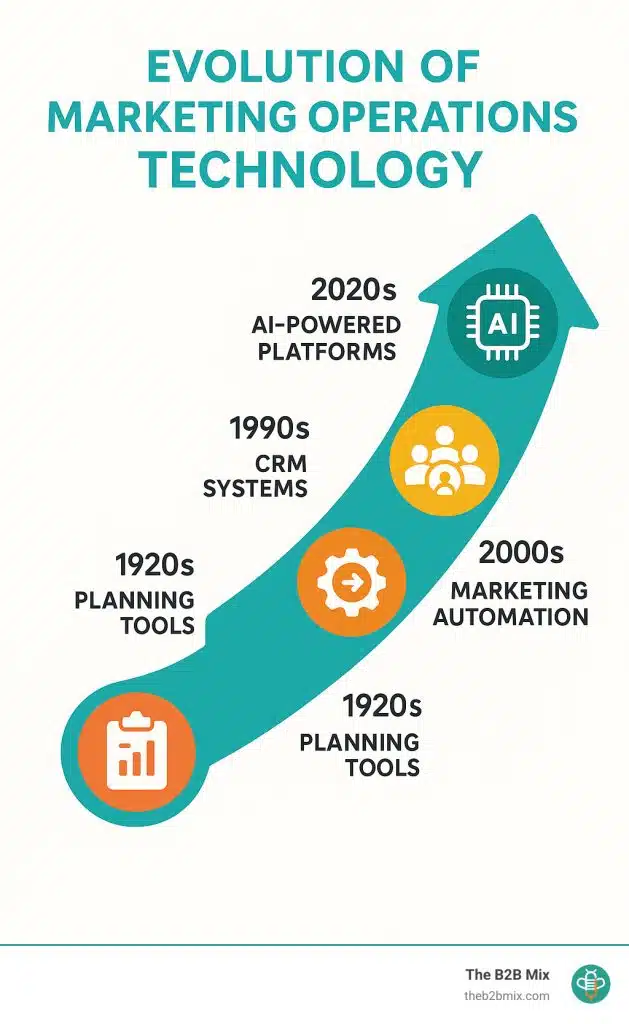
What's truly remarkable is the journey this technology has taken. What began as basic spreadsheets and simple email platforms has evolved into AI-powered systems that can predict what your customers want before they even know themselves.
The Rise of Marketing Operations Technology
Remember when marketing success was measured by whether the phone rang after you sent out an ad? Those days are long gone. In today's digital landscape, marketing operations technology lets you track, measure, and optimize virtually every customer interaction.
Over the past several years, marketing operations (MOps) has evolved from a behind-the-scenes function to a central pillar of modern marketing strategy. As organizations faced growing complexity in marketing technology, data management, and cross-functional coordination, the demand for skilled MOps professionals surged.

So what sparked this remarkable change? Several powerful forces converged at once:
The digital revolution moved customer journeys online, creating an urgent need for tools that could track and optimize these new touchpoints. Meanwhile, the explosion of customer data across channels demanded systems that could make sense of all this information. Leadership started demanding clear ROI from marketing investments, driving adoption of sophisticated measurement tools. And as customers began expecting personalized experiences, marketers needed technology that could deliver the right message to the right person at the right time.
According to McKinsey research, effective marketing operations can boost marketing effectiveness by 15% to 25% as measured by ROI and engagement. With results like these, it's no wonder marketing operations has evolved from a nice-to-have support function into an absolute strategic necessity.
Marketing Operations Technology & Data-Driven Decision Making
Perhaps the most powerful change marketing operations technology has delivered is the shift to truly data-driven decision making. Before comprehensive MOps platforms existed, marketing decisions often came down to gut instinct, past experience, or limited data points.
Today's robust marketing operations technology changes that equation completely by providing:
Unified customer views that integrate data from multiple sources, creating a complete picture of who your customers are and what they need. Real-time analytics dashboards that show you performance metrics as they happen, not weeks later. Predictive insights powered by AI that recommend your next best actions. And multi-touch attribution that accurately measures how each marketing touchpoint contributes to your bottom line.
According to Harvard’s research on marketing analytics, organizations that effectively leverage data-driven insights are better positioned to improve customer relationships and make smarter business decisions. Marketing operations technology provides the essential infrastructure for collecting, analyzing, and acting on this data, turning information into real business outcomes.
The single customer view is particularly valuable. When marketing, sales, and service all work from the same information, your customer experience becomes seamless and consistent. Without integrated marketing operations technology, this alignment is nearly impossible to achieve.
For B2B companies especially, where buying cycles involve multiple stakeholders and complex decision processes, the ability to track engagement across accounts and individuals is absolutely invaluable. At The B2B Mix, we've witnessed how connecting these systems transforms not just marketing efficiency but also sales effectiveness and overall customer satisfaction.
The Core Pillars of a Modern MOps Tech Stack
Building an effective marketing operations technology stack requires understanding the core pillars that support modern marketing functions. While specific tools may vary based on company size, industry, and maturity, these fundamental components remain consistent.
Pillar 1 – Data & Analytics
At the foundation of any marketing operations technology stack is data management and analytics. Without clean, accessible data, even the most sophisticated automation tools will fail to deliver results.
Key components include:
Customer Data Platforms (CDPs): These systems create unified customer profiles by collecting and integrating data from multiple sources. Unlike traditional CRMs, CDPs are designed specifically to handle the volume and variety of marketing data.
Customer data often lives in multiple disconnected systems—think CRM, email, web analytics, and more. A Customer Data Platform (CDP) acts as the central hub, unifying these sources to create a single, actionable view of each customer.
Attribution Systems: These tools track the customer journey across touchpoints to determine which marketing activities drive conversions. Advanced attribution models go beyond simple "last-click" measurement to provide a more accurate picture of marketing impact.
KPI Dashboards: Visualization tools that translate complex data into actionable insights. Effective dashboards align marketing metrics with broader business objectives, helping marketers demonstrate their value to the organization.
Business Intelligence Platforms: These systems enable deeper data exploration and custom reporting beyond what's available in standard marketing platforms.
Data quality is critical. Inaccurate or inconsistent data can lead to wasted budget, missed opportunities, and poor decision-making. Effective marketing operations technology should always include robust data hygiene practices to ensure your information stays clean, reliable, and actionable.
Pillar 2 – Automation & Orchestration
Automation transforms marketing operations from manual, error-prone processes to scalable, consistent execution. This pillar focuses on the tools that streamline campaign delivery and customer communications.
Marketing Automation Platforms: These systems automate repetitive tasks like email sends, social posting, and lead nurturing. They typically include features for segmentation, content personalization, and campaign management.
Workflow Engines: Tools that automate internal processes such as content approvals, campaign setup, and resource allocation. These systems ensure consistency and reduce the time required to execute marketing activities.
AI-Powered Triggers: Advanced automation tools that use artificial intelligence to determine optimal timing, content, and channels for customer communications.
Pillar 3 – Planning & Collaboration
Marketing doesn't happen in isolation. This pillar encompasses the tools that enable teams to plan, collaborate, and coordinate their efforts across departments and channels.
Project Management Systems: Platforms that organize tasks, deadlines, and resources to ensure campaigns launch on time and within budget.
Marketing Resource Management: Tools that help allocate budget, track spending, and manage digital assets across the organization.
Campaign Calendars: Centralized scheduling tools that provide visibility into all marketing activities to prevent conflicts and ensure consistent messaging.
Collaboration Platforms: Systems that facilitate communication and document sharing among team members, agencies, and stakeholders. Industry data shows that 85% of teams report improved communication after adopting tools like Slack.
Effective collaboration is particularly important for B2B marketing, where campaigns often involve multiple stakeholders and longer timelines. An integrated tech stack is crucial for maintaining alignment throughout complex marketing initiatives, as we explore in our article on why an integrated tech stack is key to your B2B success.
Pillar 4 – Governance, Compliance & Security
As marketing becomes more data-driven, governance and compliance have become essential components of marketing operations technology. This pillar focuses on the systems that ensure responsible data management and regulatory compliance.
Consent Management: Tools that capture, store, and manage customer consent in accordance with regulations like GDPR and CCPA.
Data Governance Frameworks: Systems that establish rules for data quality, access, and usage across the organization.
Security Controls: Technologies that protect sensitive customer information from unauthorized access or breaches.
Audit Trails: Features that document all system changes and data access for compliance reporting.
For B2B marketers, governance is not just about avoiding penalties—it's about building trust. Customers are increasingly concerned about how their data is used, and demonstrating responsible practices can be a competitive advantage.
Selecting, Integrating & Optimizing Your MOps Stack
Building an effective marketing operations technology stack isn't something you do once and forget about. It's more like tending a garden – requiring careful selection, thoughtful integration, and ongoing nurturing to truly flourish.

Evaluating Marketing Operations Technology Vendors
With the marketing technology landscape now sprawling to over 15,000 vendors, finding the right tools can feel like searching for a needle in a digital haystack. That's why a structured approach is essential.
Start by creating a requirements matrix that captures your specific needs. What functionality is non-negotiable? How important is scalability for your growing business? What about ease of use for your team? Document these requirements and prioritize them based on their potential business impact.
Sometimes the question of build vs. buy comes up, especially for unique needs that off-the-shelf solutions don't quite address. When making this decision, look beyond the initial price tag to consider the total cost of ownership, including maintenance, updates, and internal resources needed.
Integration capabilities should be near the top of your evaluation criteria. Even the most powerful tool becomes significantly less valuable when it can't communicate with your existing systems. Look for robust APIs and pre-built connectors that will allow data to flow seamlessly between platforms.
Don't forget to assess the vendor ecosystem surrounding each tool. A healthy partner network, active community forums, and evidence of ongoing product development indicate that you're investing in a platform with staying power.
One of your biggest decisions is whether to pursue a suite approach (multiple products from one vendor) or a best-of-breed strategy (top tool in each category). Here's how they compare:
| Suite Approach | Best-of-Breed Approach |
|---|---|
| Simpler integration between components | Superior functionality in specific areas |
| Consistent user interface | More flexibility to change individual components |
| Single vendor relationship | Ability to leverage innovation across vendors |
| Often lower total cost | Can start small and scale gradually |
At The B2B Mix, we often recommend HubSpot as a core platform for B2B companies. It provides integrated marketing, sales, and service capabilities while maintaining an open ecosystem for specialized integrations when needed – giving you the best of both worlds.
Integration Best Practices
Even the most sophisticated marketing technology will fall flat if it's not properly connected to your overall ecosystem. Successful integration is as much about people and process as it is about technical connections.
Clean your data first – this might not be the most exciting part of a technology implementation, but it's arguably the most important. Before migrating to new systems, invest time in cleaning and standardizing your existing data. As the saying goes: garbage in, garbage out.
Rather than attempting a "big bang" implementation, implement in phases that deliver incremental value while giving your team time to adapt. This approach reduces risk and allows you to build on early wins.
Always test thoroughly in sandboxes before deploying to production. This extra step reduces the risk of disrupting your ongoing marketing activities and gives your team confidence in the new systems.
Perhaps most importantly, invest in stakeholder training. The best technology in the world won't deliver results if your team doesn't use it effectively. Comprehensive training and support dramatically increase the likelihood of successful adoption.
We recently worked with a client who was struggling with disconnected marketing and sales systems. By implementing HubSpot as their central platform and carefully integrating their existing tools, we helped create a seamless flow of information from initial prospect engagement through to closed deals. Our approach to HubSpot CRM optimization ensured they maximized the value of their technology investment.
When planning integrations, remember to consider both the technical architecture and the business processes that will be affected. As we outline in our guide on inbound marketing lead management tool integration, successful implementation requires alignment between marketing, sales, IT, and executive stakeholders.
Ongoing Optimization & Reporting
Implementing marketing operations technology is just the first chapter of the story. The real value comes from continuous optimization that adapts to your evolving business needs.
Start by establishing clear Service Level Agreements (SLAs) that define expectations for system performance, data quality, and support response times. These agreements create accountability and help ensure your technology continues to serve the business effectively.
Make regular testing part of your routine – not just for marketing content, but also for workflows and processes. Small improvements can compound over time to deliver significant results.
Don't set and forget your analytics. Refresh dashboards and reports regularly to ensure they continue to provide actionable insights aligned with current business objectives. What you needed to measure last year might not be what matters most today.
Schedule quarterly tech stack reviews to evaluate the usage, performance, and cost of each component in your stack. This practice helps identify opportunities for consolidation or improvement before problems arise.
Maintain a governance checklist for regular audits of your systems. This ensures ongoing compliance with internal policies and external regulations – an increasingly important consideration in today's privacy-focused environment.

At The B2B Mix, we work with clients to establish optimization rhythms that balance innovation with stability. This includes regular health checks on their marketing operations technology, performance reviews, and roadmap planning for future improvements.
When it comes to reporting, look beyond standard marketing metrics to track operational KPIs that demonstrate the value of your technology investments. These might include time saved through automation, error reduction in campaign execution, improved data quality, faster time-to-market for campaigns, and cost savings from system consolidation.
These operational metrics help justify continued investment in marketing operations technology and identify areas where further optimization could deliver even greater returns. After all, the most successful technology implementations are never truly "finished" – they evolve alongside your business, continuously adapting to new challenges and opportunities.
Frequently Asked Questions about Marketing Operations Technology
What features are essential in marketing operations technology?
When building your marketing operations tech stack, certain capabilities stand out as must-haves regardless of your company size or industry. Think of these as the foundation that everything else builds upon.
Customer data management sits at the heart of effective marketing operations. Without a system that creates unified customer profiles from multiple sources, you're essentially flying blind. This single source of truth enables the personalized experiences customers now expect.
Campaign automation tools free your team from repetitive tasks while enabling scaled personalization. As one client told us, "We used to spend days setting up email campaigns manually—now it happens with a few clicks, and our results have improved."
Analytics and attribution systems connect your marketing activities to business outcomes, which are crucial for proving ROI and guiding strategy. Without solid measurement, you're just guessing at what works.
Integration capabilities might not sound exciting, but they're the glue that holds everything together. APIs and connectors ensure smooth data flow between systems, preventing the dreaded "data silos" that fragment your customer view.
Collaboration tools facilitate coordination across teams and departments, which are increasingly important as marketing touches more parts of the organization than ever before.
Governance and compliance functions have moved from nice-to-have to essential as privacy regulations tighten globally. These features ensure responsible data management while protecting your organization from risk.
The most effective marketing operations technology balances sophisticated capabilities with usability. The perfect system on paper becomes worthless if your team finds it too complex to use effectively in their daily work.
How does marketing operations technology enable sales-marketing alignment?
The legendary friction between sales and marketing teams ("They send us bad leads!" "They never follow up!") often dissolves when the right technology connects these departments. This alignment—sometimes called "Smarketing"—happens through several key mechanisms:
When marketing and sales work from shared data in a unified platform, they develop a common view of the buyer's journey. No more disputes about lead quality when everyone sees the same information.
Lead management workflows create consistent, automated handoffs between marketing and sales. This reduces friction and prevents promising prospects from falling through the cracks—something we've helped numerous clients solve with HubSpot's workflow tools.
Closed-loop reporting tracks prospects from first touch through to closed business, showing exactly which marketing activities generate qualified leads and revenue. This visibility helps both teams focus on what actually works.
For B2B companies, account-based marketing support enables coordinated outreach to target accounts across both functions. When marketing and sales collaborate on the same target accounts with consistent messaging, conversion rates typically improve dramatically.
The technology itself matters less than how it enables these connections. We've seen teams transform their relationship after implementing connected systems that create transparency and accountability on both sides.
What skills are needed to manage a MOps stack effectively?
The explosion of marketing operations technology has created demand for professionals with a unique blend of skills that didn't exist a decade ago. Today's effective MOps teams typically include people with capabilities that bridge traditional marketing and IT departments:
Technical proficiency with databases, APIs, and system architecture helps teams make smart technology decisions and solve integration challenges. While deep coding skills aren't always necessary, comfort with technology certainly is.
Data analysis capabilities transform raw numbers into actionable insights. The best MOps professionals can not only pull reports but interpret what the data means for marketing strategy.
Process design skills enable teams to map, optimize, and document operational workflows—turning marketing ideas into executable, repeatable processes.
Project management experience helps coordinate complex initiatives across multiple stakeholders, keeping technology implementations and campaigns on track.
Change management capabilities drive adoption of new systems and processes. Even perfect technology fails without user acceptance.
Marketing knowledge ensures technology serves strategic objectives rather than becoming an end in itself. Understanding marketing principles and channels keeps technology investments aligned with business goals.

As the field matures, we're seeing increasing specialization within MOps teams. Roles like Marketing Automation Specialist, Marketing Data Analyst, and Marketing Technology Manager reflect the growing complexity of the landscape.
Many organizations struggle to build all these capabilities internally, especially smaller companies. That's why partners like The B2B Mix exist—to supplement internal teams and accelerate marketing operations maturity without requiring massive hiring investments.
The most successful MOps professionals combine technical capabilities with strategic thinking and excellent communication skills. They serve as translators between marketing vision and technical reality, helping organizations open up the full potential of their marketing technology investments.
Conclusion
Marketing operations technology has transformed from a collection of helpful tools into the essential backbone of modern marketing success. Throughout this guide, we've explored how this technology empowers teams to think strategically, work efficiently, measure precisely, and continuously improve their efforts.
When you build a well-designed marketing operations technology stack, the benefits ripple throughout your organization:
Through streamlined workflows and intelligent automation, your marketing team accomplishes more with less effort. Your campaigns deliver better results because decisions are guided by data rather than hunches. Your sales and marketing teams finally speak the same language and work toward shared goals. And perhaps most importantly, you can clearly demonstrate how marketing activities contribute to your company's bottom line.
Beyond these immediate benefits, effective marketing operations technology gives your organization the agility to pivot quickly when market conditions change and the confidence that you're meeting regulatory requirements consistently.
But here's the truth that many technology vendors won't tell you: even the most sophisticated technology stack won't deliver results on its own. Success requires thoughtful integration of your systems, ongoing optimization of your processes, and people with the right blend of skills to leverage these tools effectively.
At The B2B Mix, we've built our business around helping B2B companies steer the complex world of marketing operations technology without getting lost in unnecessary complexity. We combine practical HubSpot expertise with real-world campaign execution skills, delivering tangible results without the jargon that plagues so many marketing technology discussions.
Whether you're just beginning to build your marketing operations capabilities or looking to optimize systems you've already invested in, we provide both strategic guidance and hands-on support to help you succeed.
Ready to streamline your marketing operations and drive better results? Learn more about our Marketing Operations Consulting services or explore our Content Operations Framework Guide for additional insights.
The future belongs to organizations that effectively harness data, technology, and process to create exceptional customer experiences. With the right marketing operations technology and expertise by your side, your team can lead the way.