

Understanding the Customer Retention Advantage
What is customer retention? Customer retention refers to a company's ability to keep its customers over time and prevent them from switching to competitors. It measures how successful a business is at maintaining long-term relationships with customers who make repeat purchases or renew subscriptions.
Customer retention is the ability of a company or product to retain its customers over a specified period.
For quick reference, here's what customer retention encompasses:
| Customer Retention Element | Description |
|---|---|
| Definition | The percentage of customers who remain active over a given time period |
| Formula | Retention Rate = ((Customers at end - New customers) ÷ Customers at start) × 100 |
| Importance | A 5% increase in retention can boost profits by 25-95% |
| Cost Benefit | Acquiring a new customer costs 5-25× more than retaining an existing one |
| Key Focus | Customer experience, satisfaction, loyalty, and relationship building |
Think of customer retention as the foundation of sustainable business growth. While attracting new customers gets much of the spotlight, keeping your existing customers happy and coming back is often where the real profit lies.
The retention advantage is clear: studies show that acquiring a new customer can be up to 25 times more expensive than retaining an existing one. And it's not just about saving money—nearly 65% of a company's business comes from repeat customers.
For B2B companies especially, retention is critical. Your existing customers already know your value, and when properly nurtured, they become your most reliable revenue source and strongest advocates.
In this guide, we'll explore exactly what customer retention means, why it matters for your bottom line, how to measure it effectively, and the proven strategies that actually work to keep customers coming back.
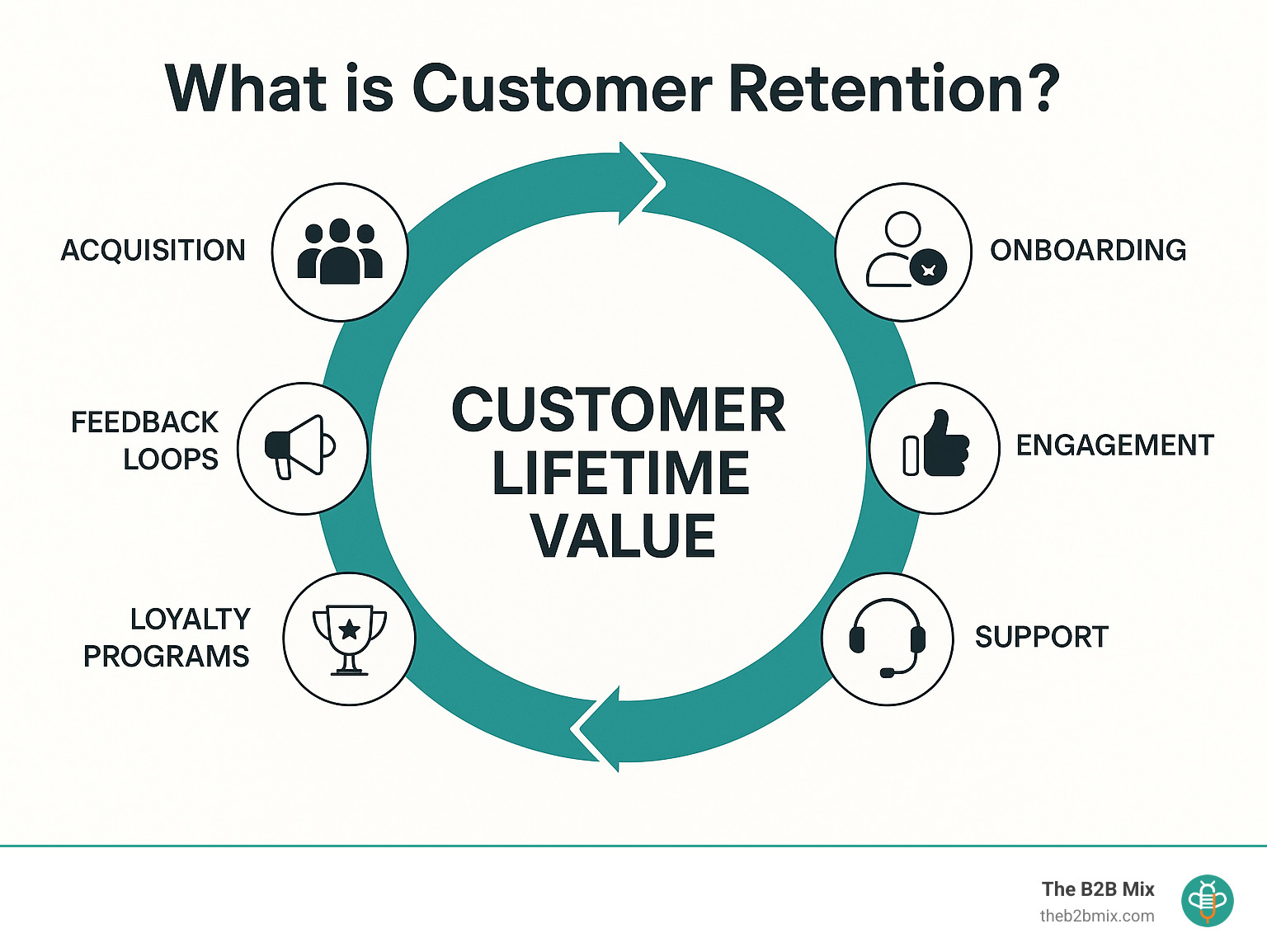
What is Customer Retention?
Customer retention isn't just another business metric—it's the heartbeat of sustainable growth. At its essence, retention measures how successfully your business builds lasting relationships that keep customers coming back time after time.
Think of retention as the art of nurturing customer relationships from the very first "hello" through every interaction that follows. It's not something that happens by accident—it requires thoughtful strategy and consistent execution at every touchpoint.
While customer churn focuses on those who leave, retention celebrates those who stay. This shift in perspective transforms how we approach customer relationships—instead of simply plugging leaks, we're actively building bridges that strengthen connections over time.
The emotional dimension of retention is just as important as the transactional one. When customers feel genuinely valued and understood, they develop loyalty that withstands competitive offers and occasional hiccups. As Wikipedia's article on customer retention puts it, retention is "the ability of a company or product to retain its customers over some specified period"—but this simple definition barely scratches the surface of the complex factors that influence customer loyalty.
Understanding What is Customer Retention in B2B vs B2C
Customer retention takes different forms depending on whether you're in B2B or B2C, though the core principles remain constant across both worlds:
In B2B environments, retention often revolves around longer contract cycles—typically annual or multi-year agreements that create natural retention periods. Decision-making involves multiple stakeholders and higher transaction values, making relationships particularly crucial. Account "stickiness" develops when your solution becomes integrated with your customer's systems and processes, creating significant switching barriers.
By contrast, B2C retention typically features shorter, more frequent purchase cycles and more impulsive buying decisions. While individual transactions might be smaller, the volume can be much higher. Here, brand affinity and emotional connections drive loyalty, supported by experience-focused loyalty programs that reward repeat business.
In our B2B work, we've found that retention often hinges on becoming an essential part of a client's operations. When we implement HubSpot for clients, for instance, we focus beyond the technical setup to make the platform truly indispensable to their daily workflow—creating natural incentives to continue the relationship.
What is Customer Retention vs Customer Acquisition
Acquisition and retention represent two sides of the business growth coin—both essential, but very different in approach and impact:
Customer acquisition focuses on attracting new business through marketing, advertising, and sales efforts. It's measured by metrics like Cost Per Acquisition and typically comes with a hefty price tag—research shows acquiring a new customer can cost anywhere from 5 to 25 times more than retaining an existing one.
Customer retention, meanwhile, centers on nurturing existing relationships to increase customer lifetime value. It's dramatically more cost-effective, leveraging customer success, support, and relationship management to keep customers happy and coming back.
The smart approach is balancing both strategies. New customer acquisition provides the growth fuel, while strong retention converts that fuel into sustainable revenue and profitability. Together, they create what we call the "advocacy flywheel"—where satisfied, loyal customers become your most effective (and cost-efficient) acquisition channel by referring new business your way.

Why Customer Retention Matters for Revenue & Growth
The financial impact of customer retention cannot be overstated. Research from Bain & Company found that a mere 5% increase in customer retention can boost profits by 25% to 95%. This remarkable profit lift comes from several compounding benefits:
- Reduced acquisition costs: You're not constantly replacing lost customers with expensive new ones.
- Increased purchase frequency: Loyal customers buy more often.
- Higher average order values: Existing customers typically spend more per transaction.
- Greater Customer Lifetime Value (CLV): The longer customers stay, the more total revenue they generate.
- Lower service costs: Existing customers are more familiar with your products and require less support.
The landmark research published in The Loyalty Effect by Frederick Reichheld demonstrated that loyal customers are not only more profitable but also less price-sensitive. They're willing to pay premium prices for products and services they trust, further enhancing profit margins.
Beyond direct financial benefits, strong retention creates powerful word-of-mouth marketing. Satisfied, loyal customers become brand advocates who refer new business. This referral effect is particularly valuable in B2B contexts, where recommendations from trusted peers heavily influence purchase decisions.
According to one study, engaged customers generate 1.7 times more revenue than average customers. Even more impressively, Gallup found that when both employees and customers are highly engaged, companies see revenue gains.
Customer retention also provides a buffer against market volatility. When economic conditions tighten, businesses with strong customer retention fare better than those constantly chasing new business. This resilience is crucial for sustainable scaling and long-term business health.
For B2B companies specifically, high retention rates signal strong product-market fit and create predictable revenue streams that make planning and investment easier. This predictability is highly valued by stakeholders and investors alike.
Strong retention also correlates with positive online reputation, as satisfied customers are more likely to leave favorable reviews and testimonials. This positive sentiment creates a virtuous cycle that supports both retention and acquisition efforts.
Measuring Customer Retention: Metrics, Formulas & Benchmarks
You can't improve what you don't measure. That's especially true for customer retention, where the right metrics reveal not just who's staying, but why they're staying (or not). Let's break down the essential metrics to give you a crystal-clear picture of your retention health.
Customer Retention Rate (CRR)
This is your north star metric for retention. Customer Retention Rate measures the percentage of customers who stick around during a specific timeframe:
CRR Formula:
Retention Rate = ((Customers at end of period - New customers acquired during period) ÷ Customers at start of period) × 100
Let's make this real: If you start Q1 with 200 customers, gain 50 new ones, and finish with 230 customers, your retention rate would be:
((230 - 50) ÷ 200) × 100 = 90%
This tells you that you kept 90% of your original customers during that quarter.
Customer Churn Rate
The flip side of retention is churn, the percentage of customers who wave goodbye during a specific period.
Churn Rate Formula:
Churn Rate = (Number of customers lost during period ÷ Number of customers at start of period) × 100
Using our previous example, if you lost 20 customers from your original 200:
(20 ÷ 200) × 100 = 10%
A 10% churn rate means you're losing one in ten customers – which sounds much more concerning than a 90% retention rate, even though they're measuring the same thing from different angles.
Net Dollar Retention (NDR)
For subscription businesses, NDR is pure gold. It measures not just whether customers stay, but whether they're spending more or less over time:
NDR Formula:
NDR = ((End of period revenue from existing customers - Start of period revenue from same customers) ÷ Start of period revenue) × 100
When your NDR exceeds 100%, you're growing revenue from existing customers faster than you're losing it—the holy grail of sustainable growth. Your expansion revenue (from upsells and cross-sells) is outpacing any losses from downgrades or cancellations.
Net Promoter Score (NPS)
While not directly measuring retention, NPS is like an early-warning system for retention problems. It asks customers: "On a scale of 0-10, how likely are you to recommend our company to a friend or colleague?"
Based on their answers, customers fall into three camps:
- Promoters (9-10): Your raving fans who'll stick around and bring friends
- Passives (7-8): Satisfied but susceptible to competitor offers
- Detractors (0-6): Unhappy customers likely planning their exit
Your NPS score is simply the percentage of Promoters minus the percentage of Detractors. A positive score is good; 70 - 100 is excellent.
Customer Lifetime Value (CLV)
CLV helps you understand the long-term value of keeping customers. It estimates the total revenue a customer will generate throughout their relationship with you:
Simple CLV Formula:
CLV = Average Purchase Value × Average Purchase Frequency × Average Customer Lifespan
For subscription businesses, you might use:
CLV = Average Monthly Recurring Revenue per customer × Gross Margin × (1 ÷ Monthly Churn Rate)
This metric is particularly powerful when paired with your customer acquisition cost – if it costs you $1,000 to acquire a customer with a $5,000 lifetime value, that's a healthy 5:1 ratio.
Industry Benchmarks
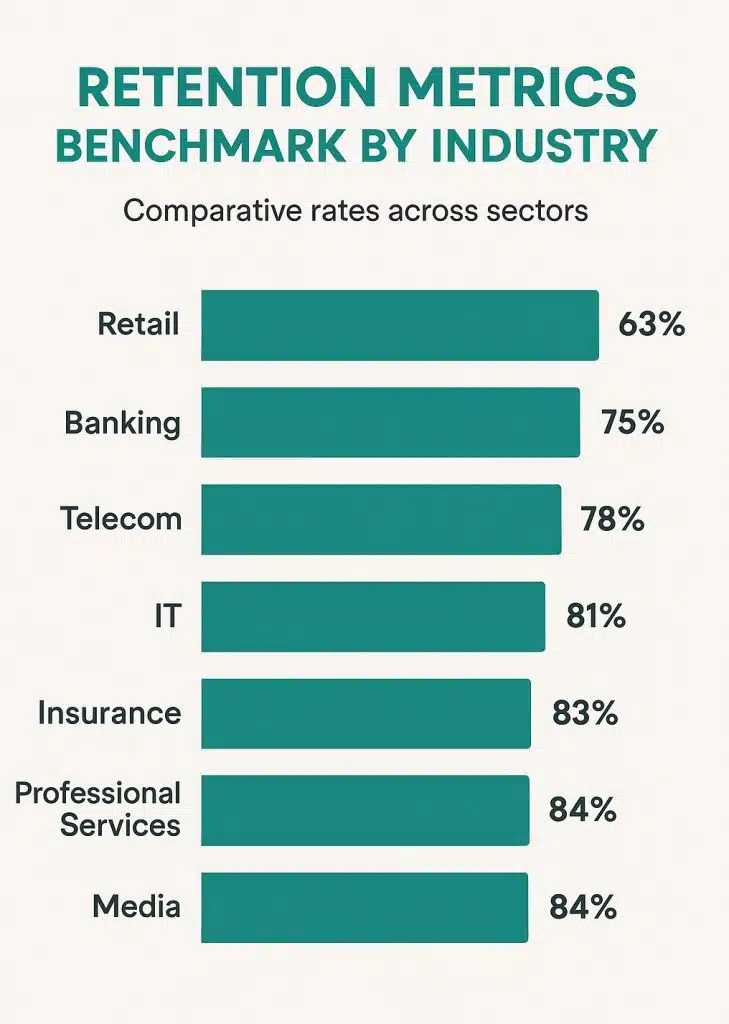
Wondering how you stack up? Retention rates vary widely by industry. According to 2020 Statista data, here's what "good" looks like:
- Retail: 63%
- Banking: 75%
- Telecom: 78%
- IT: 81%
- Insurance: 83%
- Professional Services: 84%
- Media: 84%
In the B2B SaaS world, annual retention rates typically need to hit 90% or higher, with the best performers exceeding 95%. As noted in scientific research on customer metrics, these numbers should be viewed alongside other indicators for a complete picture of customer health.
If email is part of your retention toolkit, check out our guide on B2B Email Marketing Best Practices for keeping customers engaged through effective communication.
Segment-Based Retention Tracking
Looking at overall retention is like checking your car's average speed – useful, but missing the nuance. Segment-based tracking gives you the detailed dashboard view:
Cohort Analysis groups customers by when they joined you. If you notice newer cohorts have better retention than older ones, your recent improvements are working. If they're worse, something's changed – and not for the better.
RFM Segmentation looks at Recency, Frequency, and Monetary value to identify your VIPs and at-risk customers. Those high-value, frequent purchasers who haven't bought recently? They need your immediate attention.
Usage Intervals matter tremendously. A CRM platform might expect daily logins, while tax software might only see quarterly usage. Define what "active" means for your specific business.
Critical Events are the actions that signal a customer is getting real value. For HubSpot users, this might be creating their first automated workflow or publishing their first blog post. Track these moments religiously.
Predicting Churn Before It Happens
The best time to save a customer is before they've decided to leave. Early-warning indicators can help you spot trouble brewing:
Declining usage is often the first red flag. When a customer logs in less frequently or uses fewer features, they're telling you something's wrong.
Support ticket patterns reveal a lot. A sudden spike in tickets, or tickets with negative sentiment, can signal frustration.
Engagement drops with your communications—lower email open rates or webinar attendance – often precede churn.
Many of our B2B clients implement a simple but effective traffic-light system:
- Green customers: Healthy engagement, regular usage, no concerns
- Yellow customers: Showing early warning signs that need attention
- Red customers: Multiple danger signals requiring immediate intervention
By systematically tracking these signals, you can trigger proactive retention campaigns before customers mentally check out. It's much easier to rekindle a fading relationship than to restart one that's already ended.
Key Drivers of Retention & Common Causes of Churn
Ever wonder why some customers stick around for years while others vanish after a few months? The psychology behind customer loyalty isn't random – it's driven by specific factors that either pull customers closer or push them away. Let's explore what really makes the difference between loyal advocates and one-time buyers.
Drivers of Strong Retention:
What keeps customers coming back isn't magic – it's a combination of deliberate strategies and genuine value. Customer satisfaction serves as the foundation, but it's just the starting point. When you consistently meet or exceed expectations, customers have no reason to look elsewhere.
Going a step further, customer delight transforms satisfied customers into loyal fans. These memorable, positive experiences create emotional connections that transcend purely transactional relationships.
Onboarding quality plays a surprisingly crucial role too. Those first few weeks set the tone for the entire relationship – when customers quickly realize value, they're more likely to stick around. We've seen this with our HubSpot implementations, where a smooth onboarding process dramatically increases long-term retention rates.
The power of personalization can't be overstated. When customers feel understood and valued as individuals rather than account numbers, their loyalty deepens. This personal touch makes them feel invested in the relationship, as we've explored in our guide on 5 Marketing Personalization Ideas Every B2B Marketer Should Consider.
Support quality and speed often separates the companies people love from those they merely tolerate. When issues arise (and they always do), how quickly and effectively you resolve them speaks volumes about your commitment to customer success.
Finally, never underestimate the importance of product-market fit and relationship strength. The best retention happens when your solution genuinely solves customer problems better than alternatives, and when there are strong interpersonal connections between your team and customer stakeholders.
Common Causes of Churn:
On the flip side, understanding why customers leave gives us powerful insights for prevention. The most common culprit? Poor customer experience. Frustrating interactions, complicated processes, or unresolved issues create friction that eventually drives customers away.
Failure to demonstrate value ranks close behind. If customers don't perceive the ROI of continuing the relationship, budget discussions quickly turn to cutting costs – with your service on the chopping block.
In today's competitive landscape, competitive pressure constantly threatens retention. Better, cheaper, or more innovative alternatives emerge regularly, making it essential to continuously improve your offering.
Other common churn triggers include changes in customer needs as their business evolves, significant service failures, the departure of an internal champion who advocated for your solution, budget constraints forcing cost-cutting, and misaligned expectations when sales promises don't match implementation realities.
By identifying which factors affect your specific customer base, you can develop targeted retention strategies that address your unique challenges.
Psychological & Emotional Loyalty Triggers
The rational benefits of your product matter, but emotional connections often prove even more powerful for long-term retention.
Brand values alignment creates a deeper bond than features ever could. When customers feel your company shares their values and mission, they develop a sense of shared identity that transcends transactional relationships.
Similarly, social impact initiatives resonate with customers who care about making a difference. Supporting causes your customers value strengthens emotional connections that make them proud to be associated with your brand.
Community building works wonders for retention by creating spaces where customers connect with each other. These communities foster a sense of belonging and increase switching costs as customers build relationships within your ecosystem.
Don't underestimate the power of recognition and status. Acknowledging loyal customers through exclusive benefits or VIP treatment satisfies psychological needs for esteem and belonging that keep them coming back.
The principle of reciprocity is hardwired into human psychology – when customers receive unexpected benefits or special treatment, they naturally feel compelled to reciprocate through continued loyalty.
Structural & Financial Switching Barriers
Smart retention strategies often include creating positive barriers that make switching less attractive without trapping customers.
Contract structures with multi-year agreements and favorable renewal terms encourage long-term commitment while providing stability for both parties. In the B2B world, data integration creates technical dependencies that make switching disruptive and costly.
Well-designed reward programs with points, tiers, and accumulated benefits create tangible value that would be lost upon switching. The learning investment customers make in understanding your platform similarly becomes a sunk cost they're reluctant to duplicate elsewhere.
Customization creates another powerful retention lever – custom solutions custom to specific needs are difficult to replicate with another provider. Finally, solutions with network effects become more valuable as more people use them, making alternatives inherently less attractive.
In B2B contexts especially, these structural barriers work best when aligned with genuine value delivery. The goal isn't to "trap" customers in a relationship they don't want, but to create situations where staying is genuinely more beneficial than leaving – a win-win for everyone involved.
Proven Strategies to Improve Customer Retention
Let's face it—knowing what is customer retention is only half the battle. Now comes the fun part: actually keeping those customers around! Based on our work with dozens of B2B clients and extensive research, we've developed a playbook of retention strategies that actually deliver results.
Think of these strategies as your retention toolkit—each one addresses different aspects of the customer experience that influence their decision to stay or go. The beauty is that you don't have to implement all of them at once. Start with the ones most relevant to your specific retention challenges, then expand your approach as you build momentum.
What makes these strategies particularly effective is how they work together to create multiple layers of value and connection. When customers experience seamless onboarding, personalized interactions, and responsive support all at once, the combined effect is far greater than any single tactic alone.
In our experience at The B2B Mix, the most successful retention programs blend both emotional connections and structural benefits. Your customers need to both feel valued and see tangible value from continuing their relationship with you.
As you review these strategies, consider how they might apply to your specific business context. A SaaS company might focus heavily on onboarding and usage-based pricing, while a professional services firm might emphasize relationship management and proactive communication. The key is adapting these proven approaches to your unique customer needs.
Retention isn't a "set it and forget it" initiative—it requires ongoing attention, measurement, and refinement. The most successful companies treat customer retention as a core business function with dedicated resources and executive sponsorship.
In the following sections, we'll dive deeper into each strategy with practical implementation tips and real-world examples. Whether you're just starting to focus on retention or looking to take your existing program to the next level, these approaches provide a roadmap for success.
1. Nail Seamless Onboarding
That magical first impression can make or break your customer relationship. Think about it — when a customer first comes on board, they're full of hope and expectations. This is your golden opportunity to show them they made the right choice.
The first 90 days are critical. Our experience shows that customers who achieve early wins are dramatically more likely to stick around long-term. It's not just about teaching them how to use your product — it's about helping them experience genuine value as quickly as possible.
What does great onboarding look like in practice? Start by minimizing the time to first value. This means identifying the quickest path to that "aha moment" where customers first experience the benefit they purchased your product for. For our HubSpot implementation clients, we often focus on setting up one high-impact automation flow before tackling the entire platform.
Next, co-create a clear success roadmap with your customer. This isn't just a generic implementation plan — it should directly connect to their specific business goals. When we kick off new projects, we always establish:
- Mutually agreed-upon milestones that matter to their business
- Clear responsibilities for both teams
- Realistic timelines based on similar implementations
- Concrete definitions of what success looks like
Structured, role-specific training makes a world of difference. Rather than overwhelming users with every feature, focus on the capabilities most relevant to each person's job function. Your marketing director needs different knowledge than your data analyst.
Keep the momentum going with progress tracking that celebrates small wins. Email drips or in-app notifications that acknowledge completed steps create a sense of achievement and progress. Grammarly does this beautifully, sending encouraging emails that recognize milestones while nudging users toward the next step.
Finally, set clear expectations from day one. Let customers know what results they can realistically expect, when they'll start seeing those results, and what's required from them to make it happen. This transparency builds trust and prevents the disappointment that leads to churn.
Onboarding isn't just a technical process — it's an emotional one too. Customers need to feel supported, confident, and reassured that they've made the right decision in choosing your solution. When you nail this critical phase, you're laying the foundation for a long-lasting, profitable relationship.
2. Personalize Every Touchpoint
In today's world of endless options, personalization isn't just nice to have—it's expected. And the numbers back this up: personalized experiences can reduce customer churn by up to 25%. When customers feel like you truly understand their unique needs, they're much more likely to stick around.
Think about your own experiences as a customer. Don't you appreciate when a company remembers your preferences or anticipates what you might need next? Your customers feel exactly the same way.
Behavioral segmentation forms the foundation of effective personalization. By grouping customers based on how they actually use your product—not just who they are—you can deliver far more relevant communications. For instance, power users might receive advanced tips while occasional users get reminders about core features they haven't explored yet.
We've seen remarkable results when our clients implement dynamic content across their customer touchpoints. Whether it's emails that highlight different benefits based on industry, portal experiences that prioritize frequently-used features, or help documentation that reflects the customer's implementation setup—these personalized touches make customers feel valued.
One approach we love implementing in HubSpot is setting up intelligent workflows that respond to customer behaviors in real-time. Imagine a customer hasn't logged in for 30 days—an automated (but personalized) check-in email with relevant usage tips can gently bring them back into the fold before they drift away completely.
Milestone recognition also creates powerful moments of connection. Celebrating a customer's anniversary with your company, acknowledging when they hit usage milestones, or simply recognizing their birthday can transform a transactional relationship into something more meaningful. These small gestures show that you see customers as people, not just accounts.
Perhaps most importantly, personalized success plans demonstrate your commitment to each customer's specific goals. When you tailor your check-ins, reporting, and recommendations to what actually matters to them, you're proving that their success—not just your revenue—drives your actions.
The beauty of modern marketing platforms like HubSpot is that this level of personalization doesn't require an army of account managers manually crafting individual messages. With the right setup, you can deliver deeply personalized experiences at scale, making every customer feel like your only customer.
For more detailed guidance on implementing personalization strategies, check out our article on How to Personalize Content Marketing Efforts, where we dive deeper into practical approaches that work especially well in B2B contexts.
3. Deliver Lightning-Fast, Human Support
In today's high-speed world, nothing kills customer loyalty faster than slow, impersonal support. A remarkable 73% of customers identify speedy resolutions as a critical factor in their experience with a brand. When problems arise (and they always do), how quickly and empathetically you respond can make the difference between a customer who stays for years and one who's already shopping around for alternatives.
Great support isn't just about fixing problems—it's about making customers feel valued. While automation has its place, the human touch remains irreplaceable when customers are frustrated or confused.
The most effective support approach combines efficiency with genuine human connection:
Omnichannel availability ensures customers can reach you however they prefer—whether through email, live chat, phone, or social media. This flexibility acknowledges that different issues and different customers require different communication channels.
Clear response time standards set proper expectations from the start. When a customer submits a ticket, knowing they'll hear back within hours rather than days provides immediate reassurance. At The B2B Mix, we've found that even if an issue can't be solved immediately, a quick acknowledgment that says "we're on it" goes a long way.
The best support teams don't just wait for problems to appear—they practice proactive support by monitoring usage patterns and reaching out when they spot potential issues. For example, if a customer hasn't logged into their HubSpot portal for several weeks, a friendly check-in can both prevent problems and demonstrate attentiveness.
Support teams need more than just good intentions—they need authority to solve problems without endless escalations. Nothing frustrates customers more than being transferred repeatedly or hearing "I'll need to check with my manager" for every decision.
A comprehensive self-service knowledge base complements human support perfectly. Many customers actually prefer finding answers themselves for simple questions, saving live support interactions for more complex issues. Well-organized FAQs, video tutorials, and troubleshooting guides empower customers while reducing support volume.
After resolving an issue, implementing consistent follow-up protocols shows customers you care about their ongoing success, not just closing tickets. A simple "Is everything still working well?" email a few days later can catch lingering problems and demonstrates your commitment to their satisfaction.
For B2B relationships especially, we recommend implementing a tiered support model with designated points of contact for strategic accounts. This approach ensures that high-value customers receive priority attention while maintaining quality service across your entire customer base. When a customer's dedicated contact person knows their business context, history, and goals, support interactions become more efficient and personalized.
Remember: while customers might initially buy your product for its features, they often stay because of how you make them feel when things go wrong. Exceptional support turns potential churn moments into relationship-strengthening opportunities.
4. Implement Feedback Loops & Act on Insights
Ever notice how the best relationships involve both talking and listening? The same applies to your customer relationships. Implementing systematic feedback loops isn't just about collecting data—it's about showing customers you genuinely care about their experience.
Regular NPS surveys serve as your relationship pulse check. By simply asking "How likely are you to recommend us to a colleague?" you gain powerful insights into customer loyalty. But the magic happens when you follow up with detractors to understand their concerns and with promoters to harness their enthusiasm.
Think of post-interaction surveys as little temperature checks after important moments—like after an onboarding session or support ticket resolution. These timely check-ins catch issues while they're still small and fixable.
When it comes to product development, your customers often have the best ideas. A structured feature request tracking system transforms scattered suggestions into your product roadmap. At The B2B Mix, we help clients organize these insights in HubSpot to identify patterns and prioritize improvements that will have the greatest impact on retention.
For deeper strategic insights, nothing beats Customer Advisory Boards. These forums bring together your most engaged customers to provide direction on product evolution and market trends. The collaborative atmosphere builds stronger relationships while delivering invaluable guidance.
The most critical element? Closing the feedback loop. When customers see their input translated into actual improvements, their investment in your success deepens dramatically. One approach we recommend is creating a dedicated "You Asked, We Delivered" section in your customer communications that highlights changes made based on feedback.
For B2B companies specifically, Quarterly Business Reviews (QBRs) provide the perfect structured opportunity to address feedback. Include a specific section that recaps what you heard since the last review and what actions you've taken in response. This demonstrates that you're not just listening—you're acting.
Feedback channels should match your customers' preferences. Some will happily complete a survey, while others prefer a phone conversation or in-app feedback mechanism. Providing multiple avenues ensures you hear from your entire customer base, not just the most vocal segment.
The beauty of well-implemented feedback loops is that they create a virtuous cycle: customers feel valued when their input matters, which increases their loyalty, which makes them more willing to provide additional feedback, which helps you improve further... and the wheel keeps turning.
5. Create Tiered Loyalty & Referral Programs
Let's face it, everyone loves to feel special. That's why loyalty and referral programs work so well for customer retention. They tap into our natural desire for recognition while creating a win-win situation for both you and your customers.
Effective loyalty programs don't need to be complicated. In fact, the simpler they are to understand and participate in, the better they perform. The key is making customers feel valued while encouraging behaviors that benefit your business.
Tiered benefits create a compelling "climb the ladder" effect. When customers see what perks await at higher levels, they're naturally motivated to increase their engagement. For B2B companies, these tiers might include access to strategy sessions, priority support hours, or exclusive educational content rather than traditional points-based rewards.
The power of exclusive access shouldn't be underestimated either. Giving loyal customers first look at new features or products makes them feel like insiders and strengthens their connection to your brand.
Recognition costs little but delivers tremendous value. Spotlighting customer success stories or featuring them in your content shows appreciation while subtly encouraging others to strive for similar recognition. Just be sure to get proper permissions before sharing their stories!
Adding gamification elements can transform ordinary business interactions into engaging experiences. Progress bars, achievement badges, or friendly competitions tap into our innate love of games and mastery.
For referral programs, the most successful approach is offering two-sided incentives that reward both the referrer and the new customer. This approach acknowledges the referrer's advocacy while giving the new customer an immediate positive experience.
Keep your referral process simple and transparent. We've seen too many well-intentioned programs fail because the submission process was cumbersome or the reward criteria unclear. A clean, easy-to-use form with clear tracking and prompt reward delivery shows respect for your customers' time and effort.
For B2B companies specifically, loyalty programs often work best when they focus on value-added benefits rather than monetary rewards. Executive roundtables, advanced training opportunities, or priority feature requests tend to resonate more strongly with B2B decision-makers who are looking for strategic advantages rather than small discounts.
Loyalty programs aren't just about keeping customers—they're about changing satisfied customers into enthusiastic advocates who bring new business to your door.
6. Proactively Re-engage At-Risk Accounts
Let's face it – it's much easier to keep a customer than to win back one who's already left. That's why proactive re-engagement is such a powerful retention strategy. By identifying warning signs early, you can address concerns before they lead to cancellation.
Risk scoring forms the foundation of effective re-engagement. By analyzing behavioral data like declining login frequency, reduced feature usage, or support ticket sentiment, you can create an early warning system that flags at-risk accounts before they reach the critical point.
We've found that implementing a simple "traffic light" system works wonders for our B2B clients. Accounts are categorized as green (healthy), yellow (showing risk signals), or red (severe risk), with each color triggering specific interventions from the account team.
For yellow-flagged accounts, a friendly check-in call and satisfaction survey often uncover minor issues that can be easily addressed. Red accounts, however, warrant more direct intervention – typically an executive-level meeting to have an honest conversation about challenges and solutions.
Well-designed intervention playbooks ensure consistency in your re-engagement efforts. These playbooks outline specific actions for different risk scenarios, ensuring nothing falls through the cracks when accounts show warning signs.
When specific users within an account become inactive, targeted dormant user campaigns can reignite engagement. These might include personalized emails highlighting unused features that align with their role, or invitations to training sessions designed to overcome adoption problems.
For accounts on the brink of cancellation, strategic win-back offers can provide compelling reasons to stay. These might include implementation reviews, strategic consulting sessions, or temporary discounts tied to specific success metrics.
Even when customers do leave, the relationship isn't necessarily over. Exit interviews provide invaluable insights that can help prevent similar losses in the future. Many of our clients have successfully won back former customers months or even years later by addressing the specific issues that originally led to their departure.
Re-engagement isn't just about saving accounts; it's about understanding what's not working and making meaningful improvements. Each rescued relationship provides a blueprint for strengthening your overall retention approach.
7. Surprise & Delight for Emotional Stickiness
When it comes to keeping customers around for the long haul, there's something magical about creating unexpected moments of joy. We're not just talking about meeting expectations—we're talking about exceeding them in ways that forge genuine emotional connections.
Think about the last time a company did something unexpectedly wonderful for you. Remember how that made you feel? That's exactly the kind of emotional stickiness we're aiming for with surprise and delight tactics.
Handwritten notes stand out in our digital world. In an age of automated emails and chatbots, receiving a personal, handwritten thank-you card feels refreshingly human.
Celebrating relationship milestones shows customers you value the journey you've taken together. Acknowledging anniversaries of your partnership—whether it's been one year or five—demonstrates that you see them as more than just another account number.
Unexpected upgrades create moments of delight that customers love to share. Surprising a client with a complimentary service improvement or temporary access to premium features can turn a satisfied customer into an enthusiastic advocate.
Thoughtful, personalized gifts that reflect a customer's interests show you're paying attention to who they are as people, not just as business partners. The key word here is "thoughtful"—it's not about the price tag but about the personal touch.
Once we gave a pack of "cool" socks to a VP of Sales & Marketing, whom we worked with, after he told us he didn't have fun, cool design socks like all the other people at the trade shows he'd been attending. Sometimes, it's about listening and acting on the small things that can often make you more memorable.
Supporting causes your customers care about creates a deeper bond based on shared values. Making charitable donations aligned with your customers' social commitments demonstrates that you understand what matters to them beyond business.
What makes these approaches effective is their authenticity. Customers can spot a transactional "loyalty program" disguised as genuine care from a mile away. True surprise and delight moments feel spontaneous and personal, not like checkboxes on a retention strategy list.
Emotional stickiness isn't built through grand gestures alone—it's often the accumulation of small, thoughtful actions that demonstrate genuine care for your customers as people, not just as sources of revenue. When customers feel that authentic connection to your brand, they're much less likely to consider alternatives, even when competitors come knocking with attractive offers.
In customer retention, these emotional bonds often prove stronger than rational considerations like price or features alone.
8. Align Pricing & Value Continuously
Ever notice how the best relationships are those where both sides feel they're getting a fair deal? The same principle applies to your customer relationships. When customers consistently feel they're receiving more value than what they're paying, they stick around for the long haul.
Value-aligned pricing isn't just about what you charge—it's about creating a pricing structure that grows and evolves alongside your customer's success. This creates a win-win scenario where your revenue increases as your customers achieve greater outcomes.
Usage-based models work beautifully for this purpose, especially in B2B SaaS. Rather than flat fees that feel disconnected from actual benefit, usage pricing directly ties cost to value received. When customers use more, they pay more – but only because they're getting proportionally greater value.
Tiered structures give customers the flexibility they need while providing clear upgrade paths. Each tier should deliver distinct value that's immediately apparent, not just "more of the same." This makes the decision to move up a tier feel like a natural progression rather than an upsell.
ROI calculators have proven remarkably effective for our clients. By helping customers quantify their return on investment in concrete terms, you transform abstract benefits into tangible financial outcomes. This not only justifies current spending but makes future price increases more palatable when supported by demonstrated value.
When approaching upsells, frame the conversation around specific business outcomes rather than features. Instead of "Would you like to add this feature?" try "This upgrade would help you achieve X goal you mentioned last quarter." This value-based approach feels consultative rather than sales-driven.
Many companies overlook the importance of transparent billing. Clear, easy-to-understand invoices that help customers understand what they are paying for build trust and prevent billing-related frustration, a common cause of churn.
Consider creating a "value ladder"—a visual representation showing how services progress in both features and corresponding business benefits. This visual helps customers understand their journey with you and makes future growth discussions feel like a natural part of the relationship.
Don't forget to periodically review pricing alignment with long-term customers. Markets change, your product evolves, and customer needs shift. Regular value check-ins ensure that even your most loyal customers continue to see your relationship as fair and mutually beneficial, preventing price-driven churn down the road.
The goal isn't to extract maximum revenue in the short term—it's to create pricing structures that feel fair and aligned with the actual value delivered, building sustainable relationships that benefit both parties for years to come.
9. Leverage Data-Driven Automation Tools
Let's face it – keeping up with hundreds or thousands of customer relationships manually is practically impossible. That's where smart automation comes in, not to replace the human touch, but to improve and scale it.
Modern retention requires the right tech stack, and we've seen how the right tools can transform customer relationships. Rather than cold, impersonal automation, today's tools actually enable more personalized experiences by ensuring the right message reaches the right customer at the perfect moment.
HubSpot workflows have been game-changers for our clients' retention efforts. Imagine automatically triggering a helpful check-in email when a customer hasn't logged in for 15 days, or sending a congratulatory message when they hit a usage milestone. These timely touchpoints feel personal to the customer but don't require your team to manually monitor every account.
Customer health scoring tools like Gainsight or ChurnZero help identify at-risk accounts before they're in crisis mode. These platforms aggregate usage data, support interactions, and engagement metrics to create an early warning system for potential churn. The best part? They suggest specific interventions based on what's worked in similar situations.
Analytics platforms like Amplitude or Mixpanel dive deep into user behavior, revealing exactly how customers interact with your product. These insights help you understand which features drive retention and which create friction. When you know that customers who use Feature X in their first week are 80% more likely to renew, you can prioritize getting every new customer to that "aha moment" quickly.
Feedback management systems centralize customer input from various channels, changing scattered comments into actionable insights. Tools like Delighted or SurveyMonkey Enterprise don't just collect feedback – they help you close the loop by tracking which suggestions have been implemented and communicating those improvements back to customers.
Community platforms like Discourse or Tribe create spaces where customers can connect with each other, not just with your company. These peer-to-peer interactions build powerful network effects that increase switching costs and foster a sense of belonging.
The magic happens when these tools work together in an integrated ecosystem. For example, when a customer success platform flags an at-risk account, it can trigger specific workflows in HubSpot while alerting the appropriate team member to schedule a personal check-in.
For more ideas on using technology to keep customers engaged across channels, check out our article on Engaging Social Media Followers.
Remember that automation is meant to improve human relationships, not replace them. The best retention strategies use technology to identify when and where the human touch is most needed, then free up your team to focus on those high-impact moments.
10. Champion Customer Education & Communities

Knowledge is power, especially when it comes to customer retention. We've found that customers who truly understand how to use your product don't just stick around longer—they become your biggest advocates.
Educational content transforms casual users into power users who are deeply invested in your solution. When customers master your product, they integrate it more thoroughly into their workflows, making it increasingly difficult to switch to alternatives.
Regular live training sessions not only educate customers about features and best practices, but they also create touchpoints that strengthen your relationship. The Q\&A portions of these sessions can be particularly valuable, giving customers direct access to your expertise while providing you with insights into their challenges.
Certification programs take education a step further by formally recognizing customer expertise. HubSpot's Academy is the gold standard here—their certifications have become industry-recognized credentials that users proudly display on LinkedIn profiles. This creates a powerful retention hook: customers who've invested time earning certifications are naturally reluctant to abandon that investment.
But education alone isn't enough. Community building creates a web of connections that dramatically increases stickiness. When we help clients establish user groups or customer forums, we're essentially creating environments where customers support each other, share ideas, and build relationships.
These communities become incredibly valuable retention tools because they add a social switching cost. Leaving your product means leaving behind not just a tool, but a community of peers and the social capital built within it.
One approach that works particularly well is combining education with community through peer forums where advanced users can share their expertise. This type of forum creates a cycle where your most knowledgeable customers help onboard and support newer ones, reducing your support burden while strengthening community bonds.
A robust knowledge base remains essential as the foundation of your educational efforts. Make it searchable, comprehensive, and regularly updated. The best knowledge bases anticipate customer questions rather than just reacting to them.
Education isn't just about product features—it's about helping customers achieve their broader business goals. Webinars on industry trends, best practices, and strategy show that you're invested in their overall success, not just in selling your solution.
By championing customer education and fostering vibrant communities, you create an ecosystem that delivers ongoing value beyond your core product. This multidimensional approach to retention makes your solution not just useful, but truly indispensable.
Conclusion
Customer retention isn't just another business metric to track—it's a powerful growth engine that delivers compounding benefits over time. Throughout this guide, we've seen how focusing on keeping your existing customers happy creates a foundation for sustainable business success.
The numbers don't lie: that 5% improvement in retention can boost your profits by an impressive 25-95%. But retention's impact goes far beyond just the bottom line. When you prioritize keeping customers, you're also building a more stable business with predictable revenue, stronger word-of-mouth marketing, and greater resilience during market fluctuations.
Think about it—your existing customers already know, like, and trust you. They've already gone through the expensive and time-consuming acquisition process. By nurturing these relationships, you're maximizing the return on that initial investment while creating advocates who bring in new business at a fraction of the cost.
At The B2B Mix, we've seen how thoughtful retention strategies transform our clients' businesses. We help them leverage HubSpot and other marketing technologies to build meaningful customer connections that last. Our approach blends data-driven insights with genuine relationship building—because while the numbers matter, the human connection is what truly drives loyalty.
Retention isn't a "set it and forget it" initiative. Even companies with industry-leading retention rates continuously refine their approaches based on customer feedback and evolving market conditions. The most successful B2B companies make retention a core part of their culture, not just a departmental responsibility.
Ready to improve your own retention? Start by establishing your baseline metrics so you can track progress. Then choose one or two strategies from this guide that address your specific challenges. The key is to begin, measure your results, and keep refining your approach.
By giving retention the attention it deserves, you'll build a more profitable, sustainable business with loyal customers who fuel your growth for years to come. After all, keeping the customers you already have is just as important as finding new ones—and usually a lot more cost-effective!
For more information about how lifecycle marketing can improve your customer retention, check out our B2B Lifecycle Marketing Guide.