
The Real Story Behind Account-Based Marketing
Account-based marketing is a strategic B2B approach that treats individual target accounts as markets of one. It focuses personalized marketing and sales efforts on high-value opportunities rather than casting a wide net. It's about quality over quantity.
Here's what account-based marketing is in simple terms:
| ABM Core Elements | What It Means |
|---|---|
| Targeted | Focuses on specific high-value accounts instead of broad audiences |
| Personalized | Creates customized account-based content marketing and experiences for each account |
| Aligned | Unites sales and marketing teams around the same target accounts |
| Data-Driven | Uses intelligence to identify and prioritize the right accounts |
| Multi-Channel | Engages accounts across various touchpoints and platforms |
Roughly 20 years since its inception, account-based marketing (ABM) is more relevant than ever as B2B marketers strive to prove ROI. The results speak for themselves: Organizations running ABM programs report that ABM delivers a higher ROI than other marketing activities. Additionally, ABM can see an increase in:
- pipeline conversion rates by 14%,
- overall account engagement by 28%
- marketing-qualified lead (MQL) by 25%.
Traditional marketing is like setting up a big buffet open to everyone. You make a bunch of dishes and hope everyone finds something they like. Account-based marketing, on the other hand, is like a chef’s tasting menu—curated, personalized, and designed specifically for a guest’s taste and preferences.
What makes ABM different is its fundamental flip of the traditional funnel. Instead of generating a large volume of leads and filtering down, ABM starts by identifying ideal target accounts and then works to engage multiple stakeholders within those organizations.
This approach makes perfect sense when you consider that the average B2B buying committee now includes six to 10 individuals, according to Gartner. Reaching and influencing this entire group requires a coordinated, account-centric strategy rather than disjointed lead-based tactics.
Why is ABM surging in popularity? Simple: it works. When B2B marketers report higher ROI from ABM than any other marketing strategy, people notice. Plus, as customer acquisition costs continue to rise, focusing resources on accounts with the highest potential value becomes not just smart but necessary.
Account-Based Marketing Explained: The 60-Second Definition
Account-based marketing explained is beautifully simple: It's treating each target account as a "market of one." Born in the early 2000s thanks to ITSMA, this approach flips traditional marketing on its head.
Think about it – instead of tossing out a giant net and hoping to catch whatever swims by, ABM identifies those prize fish you want to catch, creating a custom strategy just for them. It acknowledges what we all know but sometimes forget: some accounts simply have way more potential value than others.
At its heart, ABM is about personalization, which actually matters. Not just slapping a company name in an email subject line and calling it a day. It's diving deep into account intelligence and crafting messages that speak directly to what keeps each stakeholder up at night, based on their specific role and priorities.
The magic happens when marketing and sales teams truly align. Gone are the days of marketing generating leads and tossing them over to sales like hot potatoes. ABM brings both teams together from day one to identify target accounts, develop shared plans, and coordinate outreach that feels seamless to the potential buyer.
This approach is particularly relevant today due to the growing size of B2B buying committees. With six or more individuals typically involved in purchase decisions, a strategy that addresses the whole account simply makes more sense.
Account-Based Marketing Explained vs "Spray and Pray"
Traditional "spray and pray" marketing is volume-obsessed. More ads, more emails, more clicks, and more leads. Unfortunately, not all of those leads are necessarily qualified, and the majority don't convert. That's a lot of wasted effort.
Account-based marketing explained offers a refreshing alternative:
Instead of chasing everyone with a pulse, ABM concentrates your precious resources on specific accounts with genuine high-value potential. Your team focuses where it matters most, delivering precisely targeted content to actual decision-makers.
The beauty of this approach is efficiency—marketing and sales finally row in the same direction, targeting the same accounts, eliminating the frustration of misalignment. By focusing exclusively on accounts that match your ideal customer profile, you stop burning budget on prospects who were unlikely to convert anyway.
When done right, ABM creates the feeling that you truly understand a prospect's business. It's the difference between shouting into a crowd and having a meaningful conversation with someone who needs your help.
Flipping the Funnel: ABM vs Traditional Lead Generation
Think of the traditional B2B marketing funnel as a massive fishing net: cast it wide enough, and you'll eventually catch something worthwhile. You generate tons of leads at the top, qualify the promising ones in the middle, and convert a small fraction at the bottom. It's all about volume and playing the percentages.
Account-based marketing (ABM) turns this approach completely upside down. Instead of starting with a crowded pool of leads that you gradually filter down, ABM begins by identifying your dream customers and then strategically engaging multiple decision-makers within those target companies.
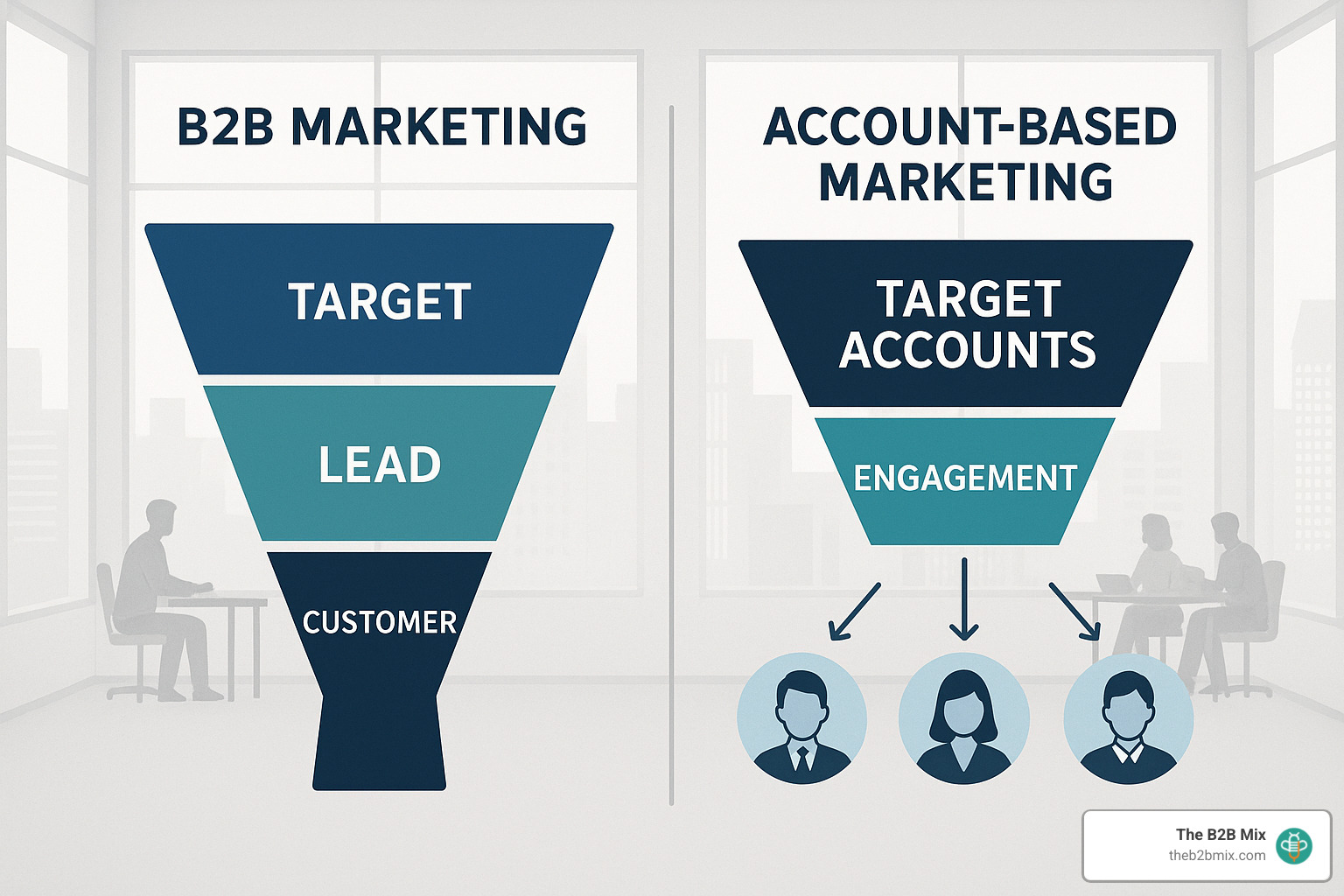
This flipped funnel perfectly aligns with the Pareto Principle (that famous 80/20 rule), which tells us that roughly 80% of your revenue likely comes from just 20% of your customers. ABM simply acknowledges this reality and focuses your precious resources where they'll make the biggest impact.
Here's how these two approaches stack up against each other:
| Traditional Lead Gen | Account Based Marketing |
|---|---|
| Starts with many leads | Starts with target accounts |
| Broad messaging | Personalized messaging |
| Individual lead focus | Account-level focus |
| Marketing hands off to sales | Marketing and sales alignment |
| Measures lead volume | Measures account engagement |
| Long sales cycles | Accelerated sales velocity |
| Hit-or-miss relevance | High relevance to target accounts |
With ABM, you're not just speeding up your sales cycle – you're fundamentally changing how your teams work together. By concentrating efforts on accounts with the highest potential value, both marketing and sales can develop deeper relationships with key stakeholders at target companies. No more spreading resources thin across thousands of lukewarm leads that go nowhere.
Account Based Marketing Explained in Numbers
The proof is in the pudding – and the numbers for ABM are downright mouthwatering:
Forrester's 2024 data shows that 23% of all global respondents said that, compared to other initiatives, ROI for ABM was 51% to 200% higher. This isn't just a tiny improvement: It's a complete change of marketing effectiveness.
7 Reasons ABM Delivers Bigger, Faster Revenue
Let's discuss why account-based marketing isn't just a trendy approach—it's a revenue-generating powerhouse. When you focus your efforts on the accounts that matter most, magic happens. Here's why ABM consistently outperforms traditional marketing approaches:
Higher ROI is perhaps the most compelling reason to adopt ABM. By concentrating your resources where they'll have the most significant impact, you're essentially investing smarter, not harder.
Larger deal sizes naturally follow when you engage multiple stakeholders within an account with personalized messaging. When everyone in the buying committee feels understood and valued, you build the kind of deep relationships that lead to bigger commitments. According to data from Forrester, companies reported seeing an 11 - 20% increase in deal size with ABM.
Sales and marketing alignment isn't just a nice-to-have with ABM—it's essential. When these traditionally siloed teams work together from day one, the results speak for themselves. Companies with aligned teams grow revenue faster and enjoy higher win rates. ABM essentially forces this alignment in the most productive way possible.
Improved customer retention is another often-overlooked benefit of ABM. While many think of it as purely an acquisition strategy, many marketers report that ABM delivers significant benefits for retaining and expanding existing client relationships. The personalized attention that won the account continues to work its magic long after the initial sale.
Fewer wasted resources means more bang for your buck. Instead of the traditional approach of spreading your budget thin across thousands of leads (most of which never convert), ABM concentrates your efforts on accounts most likely to become valuable customers. It's the difference between precision targeting and hoping for the best.
Customer acquisition cost control becomes increasingly important as CAC continues to rise yearly. ABM helps rein in these costs by focusing on accounts with higher conversion likelihood and greater lifetime value, when every marketing dollar is directed toward high-potential accounts, efficiency skyrockets.
Meeting personalization demands is perhaps the most timely reason to accept ABM. Today's buyers don't just prefer personalization—they expect it. According to McKinsey research, 71% of consumers expect personalized interactions, and 76% get frustrated when that doesn't happen. ABM delivers precisely the kind of custom experiences buyers demand.
The ROI Math
Companies implementing ABM consistently report faster revenue growth than their counterparts. Moreover, organizations using ABM say their sales and marketing teams are mostly or completely aligned. This alignment alone can drive significant performance improvements.
The benefits multiply over time as your ABM program matures. You'll see more efficient marketing campaigns that meet your ideal customers' needs. Your sales processes become optimized around accounts most likely to close. Customer retention improves as accounts receive consistent, personalized attention. The collaboration between marketing and sales creates a more effective go-to-market strategy. Perhaps most impressively, Salesforce reports that ABM can shorten sales cycles and improve conversions.
With ABM, marketing's impact on revenue becomes crystal clear. No more fuzzy attribution or questioning whether marketing activities are driving bottom-line results. When you focus on specific accounts and track their journey from first touch to closed deal, the value becomes undeniable.
Is ABM Right for You? Ideal Customer Profiles & Target Account Selection
Let's be honest—account-based marketing explained sounds fantastic on paper, but it's not a magic wand for every B2B company. Before diving in headfirst, let's figure out if ABM is a good fit for your business.
ABM tends to work best when you have a decent number of high-value accounts to target, your product has a healthy price tag, and your sales typically involve navigating multiple decision-makers. You'll also need good data about your target accounts and sales and marketing teams that can actually work together (I know, concept!).
The secret sauce of successful ABM is developing a crystal-clear Ideal Customer Profile (ICP). Think of your ICP as a detailed portrait of your perfect customer – not who you wish would buy from you, but who actually gets the most value from your solution and sticks around.
Your ICP should incorporate several key dimensions:
Firmographics tell you the basic facts about a company – their industry, size, revenue, growth trajectory, and location. Technographics reveal what tech stack they're currently using and what integration requirements they might have. Behavioral signals show you who's actively looking for solutions like yours right now, while understanding their business challenges helps you speak directly to their pain points. Finally, knowing their organizational structure gives you insight into how decisions actually get made there.
With a well-crafted ICP, you can identify and prioritize accounts that are most likely to become not just customers but your best customers.
Building Your ICP
Creating an effective ICP isn't about wishful thinking but data and observation. Start by analyzing your current best customers. What patterns emerge? Which industries consistently see the most success with your solution? Which company sizes are the sweet spot?
Your sales and customer success teams are goldmines of information here. They're in the trenches every day and know exactly what makes a good-fit customer versus one that will be a constant headache.
Look at your deal history, too—both wins and losses. What characteristics do your successful conversions share? And just as importantly, which accounts tend to deliver the highest lifetime value, not just the biggest initial contract?
The magic happens when you combine fit data (who matches your ideal profile) and intent data (who's actively looking for solutions like yours).
Once your ICP is defined, you can use it to score potential target accounts based on how closely they match your criteria. For a deeper dive into selecting the right accounts, check out this guide to selecting target accounts.
Tiering and Segmentation for Scale
Not all target accounts deserve the royal treatment. Tiering helps you decide how much time, effort, and budget to invest in different accounts.
Strategic ABM (1:1) is the white-glove approach. You're creating completely customized ABM campaigns for a small number (usually 5-10) of your absolute most valuable potential accounts. We're talking personalized content, custom events, and dedicated resources. This is high-touch, high-investment, and (hopefully) high-return.
ABM Lite (1:Few) strikes a balance with moderately customized campaigns for clusters of similar accounts. Instead of creating completely unique content for each account, you create custom materials for groups of 10-100 accounts that share characteristics like industry challenges or use cases.
Programmatic ABM (1:Many) lets you scale your ABM efforts to hundreds or thousands of accounts using technology to customize elements at scale. It's a lighter-touch but still far more targeted than traditional marketing.
Your segmentation might consider factors like industry vertical, company size, geographic location, tech stack, specific business challenges, buying stage, or your existing relationship status. This tiered approach lets you be strategic about where you're investing your resources while still maintaining the account-focused principles that make ABM effective.
Want to learn more about how your content strategy fits into your ABM approach? Check out our guide to B2B Content Strategy for practical insights.
Building Your ABM Engine: 8 Practical Steps
Ready to roll up your sleeves and build your own ABM program? Let's break down the journey into manageable steps. Think of this as your practical roadmap to account-based marketing explained in action—no fancy jargon, just straightforward guidance.
Establish sales and marketing alignment: This isn't just a nice-to-have—it's essential. Create clear service-level agreements (SLAs) that spell out how your teams will work together, share information, and measure success. Those morning stand-ups and shared dashboards aren't just meetings—they're the glue that holds your ABM strategy together.
Define your ideal customer profile: Remember all those ICP criteria we discussed earlier? Now's the time to put them to work. Get specific about who your perfect-fit customers really are—the more detailed, the better.
Build and enrich your target account list: This is where the rubber meets the road. Identify the accounts matching your ICP and gather rich data about each one. Who are the key players? What's their organizational structure? The more you know, the more effectively you can engage.
Develop account insights: Become a student of your target accounts. What challenges keep them up at night? What strategic initiatives are they pursuing? Understanding their world helps you speak their language.
Create personalized content and messaging: Generic content won't cut it in ABM. Develop materials that speak directly to each account's specific needs and pain points—and tailor them for different roles within the buying committee.
Orchestrate multi-channel campaigns: The magic happens when your channels work in harmony. Coordinate your outreach across email, social, advertising, direct mail, and events to create a seamless experience surrounding your target accounts.
Enable sales with account intelligence: Your sales team needs ammunition for meaningful conversations. Equip them with insights, content, and talking points specific to each target account.
Measure, learn, and optimize: ABM is a continuous improvement journey. Track your account-level metrics, determine what's working (and what's not), and refine your approach accordingly.
Step-by-Step Playbook
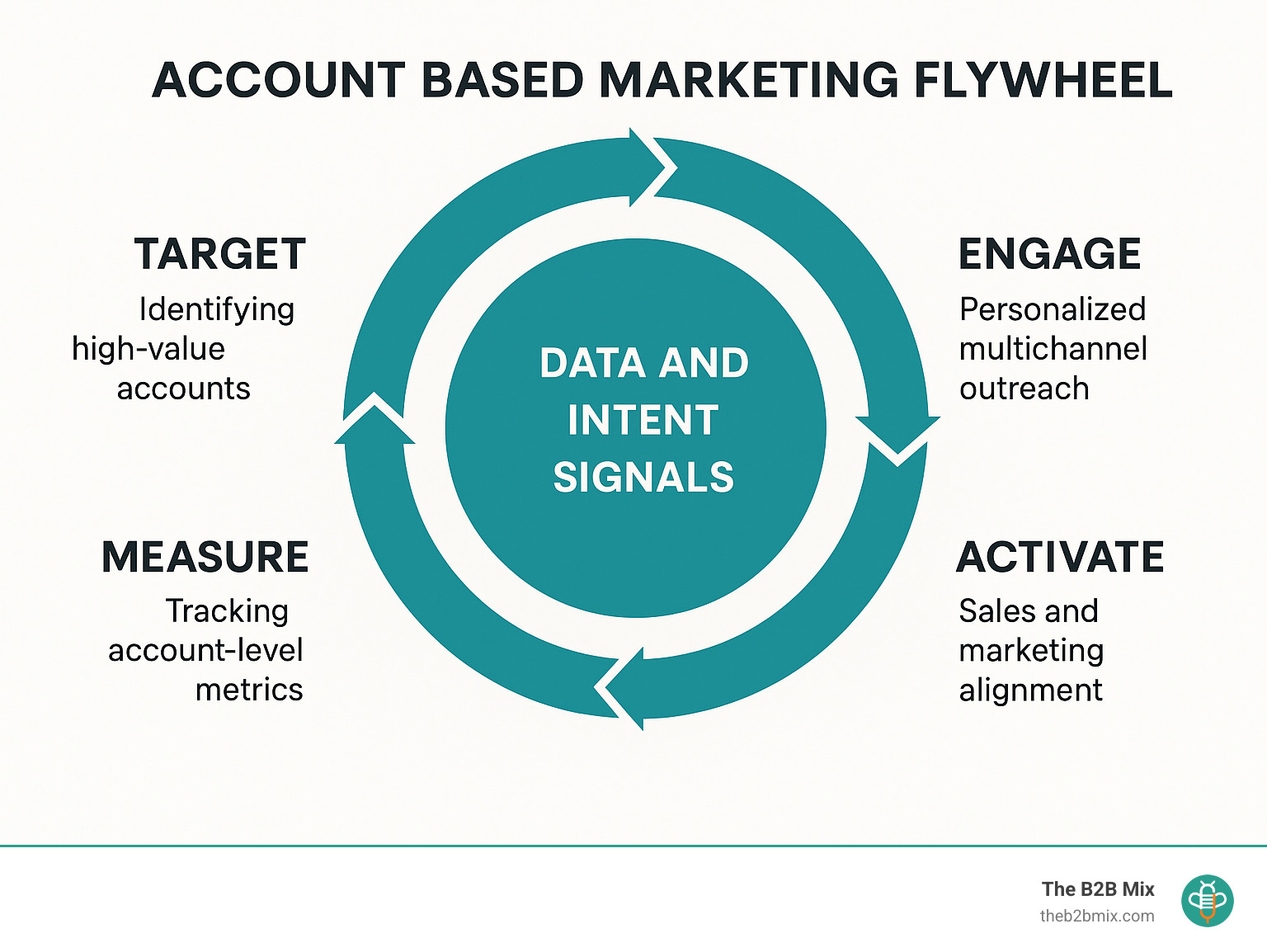
Let's simplify things even further with the T.E.A.M. Framework—a straightforward structure for executing your ABM strategy:
Target: Start by identifying and prioritizing high-value accounts based on your ICP. Create your target list using fit data, identify which accounts are actively in the market using intent signals, and ensure coverage across all key stakeholders within each account.
Engage: This is where you develop and deliver personalized messaging across channels. Let intent data guide your content strategy, deploy campaigns through multiple channels, and personalize website experiences for visitors from your target accounts.
Activate: Here's where alignment really shines. Get sales and marketing working in lockstep around coordinated account outreach. Establish regular communication rhythms, create account-specific playbooks, and define clear handoff processes.
Measure: What gets measured gets improved. Track engagement at the account level, monitor pipeline influence and velocity, and measure ROI so you can continuously refine your approach.
Strong governance is critical throughout this process. Establish clear roles and responsibilities, implement regular reporting cadences, and ensure accountability for continuous improvement.
Account-Based Marketing Explained for Small Teams
Don't have a marketing army at your disposal? No problem! Account-based marketing explained works beautifully for small teams, too—you just need to be more focused:
Start with your top 10 accounts rather than trying to boil the ocean. Focus your limited resources on a handful of high-value opportunities to make a real impact.
You don't need fancy tools to get started. Begin with what you already have—platforms like HubSpot offer target account capabilities that can form the foundation of your ABM strategy without breaking the bank.
Take a phased approach to your rollout. Start with a pilot program to prove the concept, then gradually expand as you demonstrate success. This builds momentum and helps secure buy-in for additional resources.
Your sales development reps (SDRs) can be ABM superstars. They're perfectly positioned to conduct account research and personalized outreach that makes target accounts feel special.
Don't reinvent the wheel with content. Look at what you've already created and adapt it to address account-specific pain points. A few thoughtful tweaks can transform generic content into personalized gold.
It's better to do ABM extremely well for a small number of accounts than to do it poorly for many. Quality trumps quantity whenever it comes to account-based approaches.
Need help getting your integrated tech stack aligned for ABM success? That's exactly the kind of challenge we love tackling at The B2B Mix.
Channels & Tactics That Move the Needle
Regarding account-based marketing, as explained in practice, success depends on your ability to engage target accounts across multiple touchpoints. It's not about blasting the same message everywhere—it's about creating a cohesive, personalized experience that meets your buyers wherever they are.
Let's explore the channels and tactics that truly move the needle:
Events and Webinars create powerful opportunities for face-to-face connections with target accounts. Think beyond generic webinars—imagine hosting an exclusive executive dinner at an industry conference where your CEO can mingle with decision-makers from your top accounts. Or consider crafting a custom webinar that addresses the specific challenges facing a cluster of accounts in the same industry.
LinkedIn Advertising feels almost tailor-made for ABM. The platform's targeting capabilities let you upload your target account list and deliver ads specifically to people at those companies, even filtering by role, seniority, or department. When a VP of Operations at your dream account sees content that speaks directly to their pain points, they notice.
Personalized Email Sequences remain incredibly effective when done right. For your tier-one accounts, this might mean emails referencing specific initiatives you found through research: "I noticed your recent expansion into the European market and thought this case study about compliance challenges might help..."
Direct Mail has made a remarkable comeback in our digital-first world. When everyone's inbox is overflowing, a thoughtful physical package stands out. The key word is thoughtful—skip the branded stress ball and send something that connects to your value proposition or the account's specific challenges.
Website Personalization turns your website from a static brochure into a dynamic experience. When someone from a target account visits, they should see content custom to their industry, role, and challenges. This might include custom welcome messages, industry-specific case studies, or personalized calls-to-action.
Sales Development Outreach bridges the gap between marketing efforts and closed deals. When SDRs are armed with account insights and aligned messaging, they can conduct personalized, multi-touch outreach that resonates with key stakeholders.
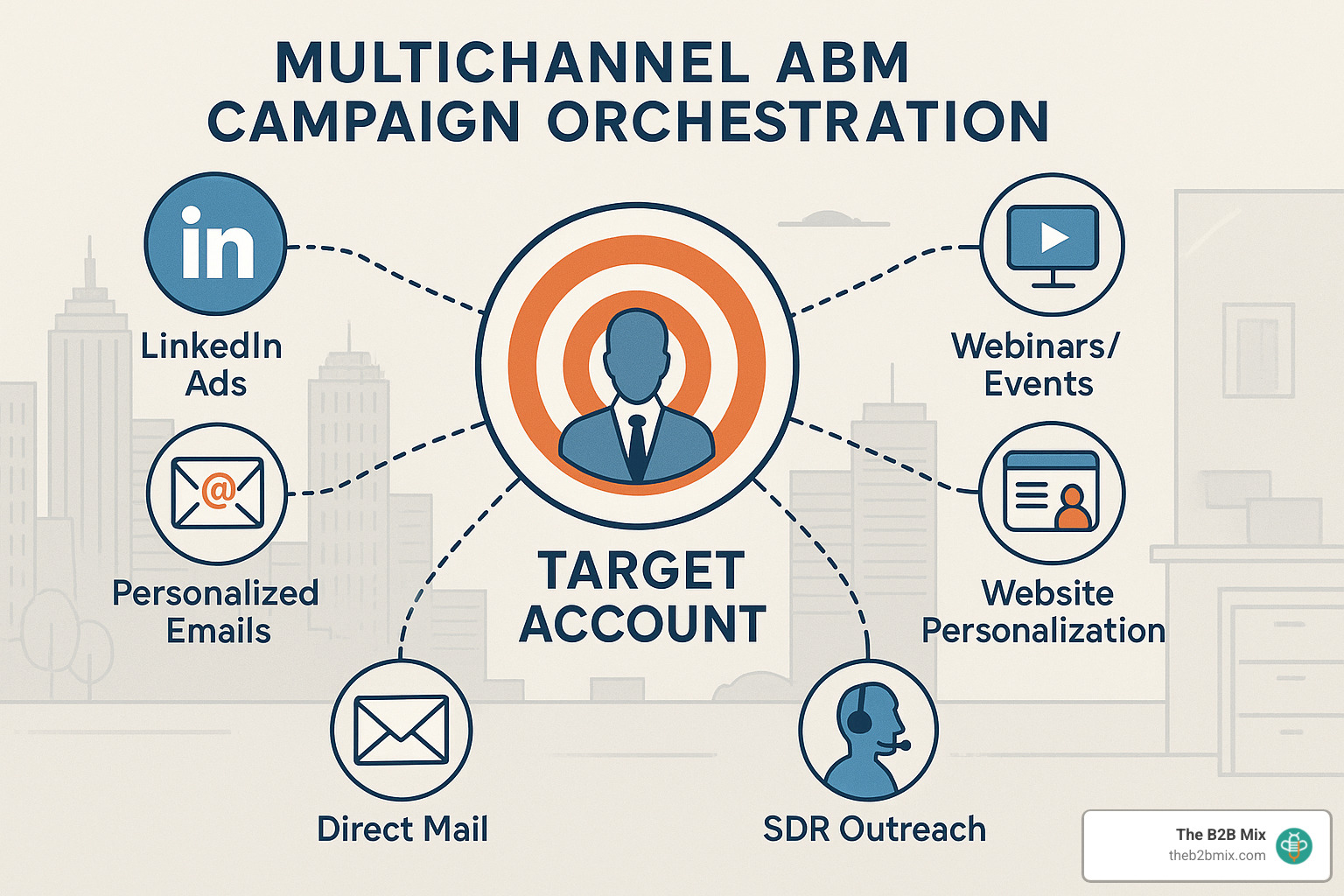
The magic happens when these channels work in concert. A well-orchestrated ABM campaign creates multiple touchpoints reinforcing your message and value proposition. Imagine a target account experiencing your brand through coordinated LinkedIn ads, receiving a thoughtful direct mail piece, getting a personalized follow-up email referencing that package, then visiting your website to find content specifically relevant to their industry challenges—all before your SDR reaches out to schedule a meeting.
That's the difference between random acts of marketing and a strategic ABM approach. Learn more about effective B2B digital marketing ideas to improve your campaigns.
Personalization in Action
True personalization isn't just slapping a company name into your standard email template. Account-based marketing explained properly requires a deeper approach to customization:
Dynamic Content allows you to create flexible content modules that adapt automatically based on who's viewing them. This might mean showing different case studies, value propositions, or imagery depending on the account's industry, size, or challenge—all without creating entirely new assets for each account.
Role-Based Messaging acknowledges that different stakeholders care about different things. Your message to the CFO should emphasize ROI and cost reduction, while the CIO needs to hear about integration capabilities and security protocols. The end users? They care about how your solution makes their daily work easier and more efficient.
Timing with Intent Data might be the most powerful personalization lever of all. According to Gartner's research on intent data, understanding when accounts actively research solutions lets you time your outreach for maximum impact. When you reach out just as a target account is researching solutions to the exact problem you solve, that's ABM gold.
I once heard about a company that created a custom comic book featuring the CEO of a target account as the hero who saved their industry using the vendor's solution. While this ultra-high-touch approach isn't scalable for all accounts, it demonstrates the creative potential when you truly understand your target's challenges and culture.
Remember: personalization isn't just about what you say, but when and how you say it. The perfect message delivered to the wrong person—or at the wrong time—won't drive results. Effective ABM requires both precision and timing.
Measuring and Optimizing ABM Performance
Let's face it, if you can't measure it, you can't improve it. And when it comes to account-based marketing, traditional lead-based metrics just won't cut it anymore.
Instead of celebrating how many leads you've generated (most of which might never convert), ABM focuses on meaningful engagement with the accounts that actually matter to your business. It's like the difference between counting how many people walked into your store versus tracking how many serious shoppers spent time looking at your premium products.
The metrics that truly matter in ABM tell a more nuanced story:
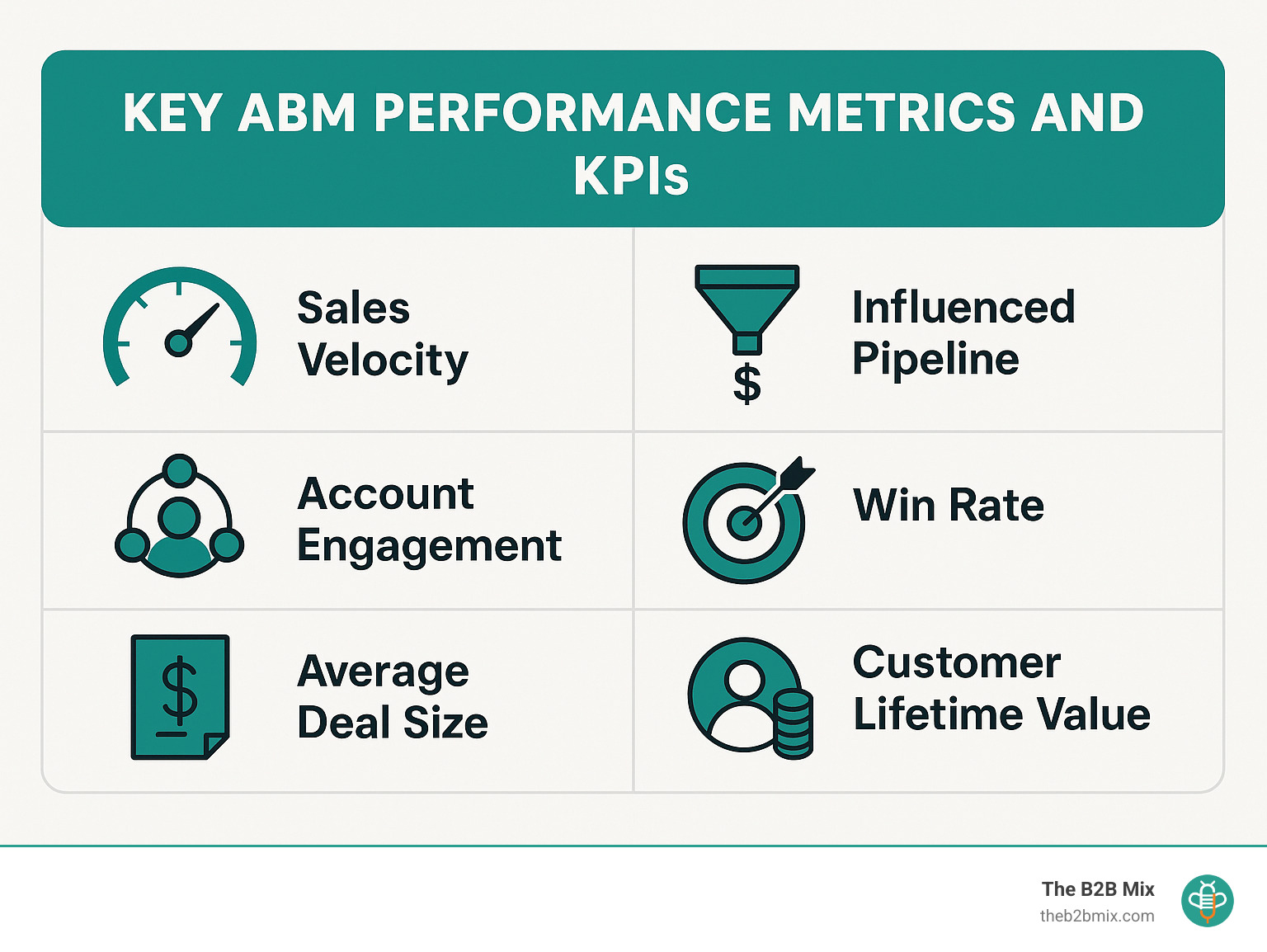
Sales Velocity shows how quickly target accounts move through your pipeline. This combines three critical factors: deal size, win rate, and sales cycle length. When ABM works, you'll see accounts moving faster toward purchase decisions.
Influenced Pipeline reveals the total pipeline value that your ABM campaigns have touched. This gives you a clearer picture of marketing's impact on revenue opportunities.
Account Engagement measures both depth and breadth: Are multiple stakeholders at your target accounts engaging with your content? Are they spending time on high-value activities like attending your webinars or downloading your thought leadership pieces?
Win Rate compares how many target accounts convert to customers versus non-ABM approaches. This is where you often see dramatic improvements – that 38% higher win rate we mentioned earlier isn't uncommon.
Average Deal Size typically increases with ABM because you're addressing the needs of the entire buying committee rather than individual leads. When everyone sees value, bigger deals follow.
Customer Lifetime Value tracks the total expected revenue from an account over your entire relationship. ABM often shines here because the deeper relationships you build lead to greater expansion opportunities.
The most powerful ABM measurement frameworks don't just track activity – they connect marketing directly to revenue outcomes. This requires your marketing automation platform and CRM to work together seamlessly, giving you visibility into the complete customer journey from first touch to closed deal.
Dashboards & Attribution
To get a clear picture of your ABM performance, you'll need:
CRM-Based Reporting that tracks engagement, opportunities, and revenue at the account level. If you're using HubSpot, the Target Accounts Index is fantastic for this – it shows you key metrics like account engagement scores, open deals, and how completely you've identified the buying roles within each account.
Multi-Touch Attribution Models that give credit where it's due. The buyer's journey isn't linear, and your attribution model shouldn't be either. By recognizing all the touchpoints that influenced a deal (not just first or last touch), you'll understand which activities truly drive results.
Benchmarking between ABM and non-ABM accounts provides the comparison you need to demonstrate the value of your program. This is particularly helpful when making the case for expanding your ABM investment.
Continuous Improvement Loops use your performance data to refine everything from account selection to messaging to channel strategy. Remember: ABM isn't a "set it and forget it" tactic. You need to conduct ongoing analysis and adjustments if you want to maximize results.
ABM is fundamentally iterative. The insights you gather from your metrics should constantly feed back into your strategy, helping you refine your approach over time. This creates a virtuous cycle where each campaign becomes more effective than the last.
When reviewing your ABM metrics, look beyond the numbers to understand their story. Are certain industries engaging more deeply? Are specific content pieces resonating with C-suite executives? These insights help you double down on what's working and pivot away from what isn't.
For a deeper dive into structuring your measurement approach, our Content Operations Framework Guide can help you build the processes needed to consistently capture and act on these insights.
Common Pitfalls and How to Avoid Them
Let's face it—even the most carefully planned account-based marketing (ABM) strategies can hit some bumps in the road. After helping dozens of B2B companies implement ABM, we've seen the same obstacles trip up teams repeatedly.
Data gaps are perhaps the most common culprit. You can't personalize effectively when you're working with incomplete or outdated account information. The solution isn't complicated, but it does require commitment: invest in quality data enrichment services and establish regular data hygiene practices. Your ABM campaign is only as good as the data that powers it.
Those pesky siloed teams can derail even the most promising ABM initiatives. Nobody wins when marketing crafts beautiful account-specific campaigns while sales pursue completely different targets. Break down these walls by establishing shared goals and metrics from day one. We've found that weekly account review meetings with both teams present can work wonders for alignment.
Many organizations stumble by setting unrealistic goals, expecting ABM to deliver dramatic results overnight. ABM is more marathon than sprint – it requires patience and persistence. Start small with a focused pilot targeting 5-10 high-value accounts to demonstrate value before scaling up. This crawl-walk-run approach builds confidence and momentum.
Personalization at scale challenges even sophisticated marketing teams. Creating highly customized campaigns for a handful of accounts is relatively easy, but what happens when you need to personalize for 50 or 500? The key is developing modular content that can be efficiently customized and using technology to automate personalization where appropriate. Think of it as mass customization rather than one-off creation.
Without executive buy-in, your ABM program may struggle to obtain the resources it needs to succeed. Leadership often wants to see results before fully committing. The solution? Start with a tightly focused pilot demonstrating clear ROI, then use those results to make the case for broader implementation.
I've seen too many teams fall into the trap of over-reliance on technology. They invest in sophisticated ABM platforms but neglect the strategy and content that make those tools effective. Technology enables ABM but doesn't replace thoughtful strategy and compelling messaging. The human element remains essential.
Finally, many teams continue to measure success using misaligned metrics from their lead generation days. Tracking lead volume when you're focused on account engagement is like measuring rainfall with a thermometer – it's the wrong tool for the job. Develop account-based KPIs that align with business outcomes and revenue impact.
Quick Fixes
If your ABM program needs a boost, here are some rapid improvements you can implement:
Clean your data first and foremost. This isn't sexy work, but it's foundational. Remove accounts that don't fit your ICP, fill in missing information about key stakeholders, and verify contact details. Good data hygiene pays immediate dividends.
Implement regular stand-ups between marketing and sales teams. Even a 15-minute weekly check-in can dramatically improve coordination around target accounts. Use this time to share insights, align on next steps, and celebrate wins together.
Develop simple account playbooks – one-pagers that outline key contacts, challenges, messaging approaches, and next steps for each target account. These become invaluable reference tools for anyone engaging with the account.
If you're struggling to build support for ABM, start a focused pilot with your most promising accounts. Nothing convinces skeptics like results, and a small-scale success story can open doors for broader implementation.
Don't wait for perfect content before launching your ABM program. Leverage your existing materials by adapting them to address account-specific pain points. You can develop more customized content as you go.
ABM is a journey of continuous improvement. The most successful programs evolve based on results and feedback, becoming more refined and effective. As one client told us after their first ABM campaign: "We learned more about our target accounts in three months of ABM than in three years of traditional marketing."
Frequently Asked Questions about Account-Based Marketing
What metrics show ABM is working?
When clients ask me how they'll know if their account-based marketing explained strategy is working, I always tell them to look beyond traditional lead metrics. The real story of ABM success is told through:
Account engagement is your first indicator – are multiple stakeholders at your target accounts interacting with your content and salespeople? The depth and breadth of engagement across the buying committee tells you you're making inroads.
Pipeline velocity shows whether your targeted approach is accelerating deals. When ABM works well, target accounts typically move through your sales process more quickly than non-ABM accounts.
Win rates, average deal sizes, and customer lifetime values should all trend upward compared to your traditional marketing approaches. These are the gold standard metrics that prove ABM's business impact.
Finally, marketing-influenced pipeline and revenue metrics connect your ABM activities directly to bottom-line results – the language executives understand best.
Focus on improvement trends rather than absolute numbers early in your ABM journey. Seeing these metrics gradually climb upward is your sign that ABM is gaining traction.
How many accounts should we start with?
I often see companies paralyzed by the idea of building the "perfect" ABM program right out of the gate. My advice? Start small and focused—for most organizations, 10-20 accounts is the sweet spot for your initial ABM efforts.
This modest scope gives you enough data to demonstrate meaningful results while remaining manageable for teams who are finding their ABM footing. Your specific number should align with your resources and the tier of ABM you're implementing:
Strategic ABM (1:1): If you're doing highly customized, white-glove treatment, five to ten accounts are typically all you can handle effectively.
ABM Lite (1:Few): For industry or segment-focused campaigns, ten to 50 accounts work well.
Programmatic ABM (1:Many): When using technology to scale light personalization, you can expand to 50+ accounts.
The golden rule of ABM? It's better to do it exceptionally well for a smaller number of accounts than poorly for many. Quality trumps quantity every time.
Do I need fancy software to begin?
Good news – you don't need to invest in specialized ABM platforms to get started! Many of our clients successfully launch ABM programs using tools they already have in their tech stack:
Your CRM system (like HubSpot) can handle account tracking and reporting fundamentals. Marketing automation tools you already use can power email personalization and workflows. LinkedIn's advertising platform offers excellent account targeting capabilities without additional investment. Even your existing content management system likely has some personalization features you can leverage.
As your ABM program matures and proves its value, you might consider more specialized tools for intent data, advanced account selection, and multi-channel orchestration. But don't let technology be a barrier to getting started.
HubSpot users have a particular advantage here—its built-in target account capabilities can form the foundation of your ABM strategy. You can identify, track, and engage key accounts without additional tools, making it an excellent launchpad for your ABM journey.
The most successful ABM programs start with strategy and process first, then add technology as needed to scale what's already working. Focus on getting the fundamentals right, and you can add the fancy tools later when you've proven the concept.
Conclusion
Account-based marketing isn't just another flashy marketing term competing for your attention—it's a fundamental shift in how B2B companies approach growth. By treating high-value accounts as markets of one, you're essentially flipping the traditional funnel on its head, and for good reason.
But let's be real, success with ABM doesn't happen overnight. Start small with a pilot program targeting just a handful of your highest-value accounts. Set clear, measurable goals that both sales and marketing can rally behind. The magic happens when these teams truly align around the same target accounts with a shared vision of success.
The beauty of ABM is that it gets better with time. As you gather more data, gain experience, and continuously fine-tune your approach, you can scale your efforts to additional accounts while maintaining that personal touch that makes ABM so effective.
At The B2B Mix, we're passionate about helping B2B companies implement ABM programs that deliver tangible results. Our approach is hands-on and refreshingly jargon-free—we believe in practical strategies that bridge the gap between marketing vision and sales execution.
Whether you're just dipping your toes into the ABM waters or looking to boost your existing program, we can help you develop the strategy, content, and campaigns that transform target accounts into loyal customers who stick around for the long haul.
Ready to reimagine your B2B marketing approach with account-based marketing? Let's talk about how we can help you identify, engage, and win the accounts that will drive your business forward. After all, not all prospects are created equal—isn't it time your marketing reflected that reality?