

The Evolution of B2B Digital Marketing

Remember when B2B sales and marketing meant cold calls, trade shows, and mass emails? Those days feel like ancient history now. Today's B2B landscape has transformed dramatically, with buyers who research, evaluate, and often decide before they ever speak to your sales team.
Let's talk about B2B digital marketing ideas that actually move the needle in 2025. If you're looking to refresh your strategy, here are six approaches we've seen drive real results:
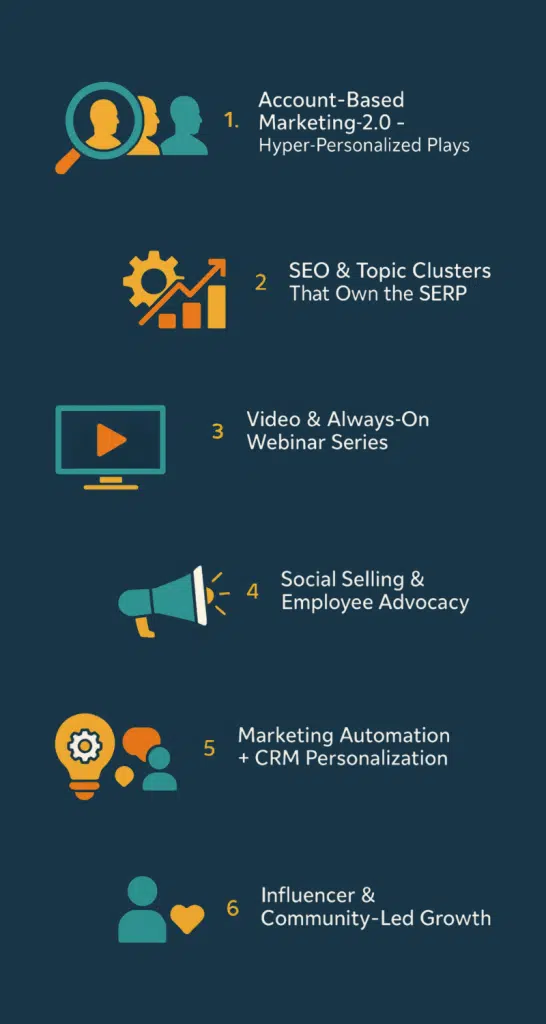
Account-Based Marketing has evolved beyond basic targeting to become truly personalized experiences for high-value prospects. SEO & Topic Clusters help you own search results for your industry's most valuable questions. Video & Webinar Series create always-on education that builds trust while you sleep. Social Selling & Employee Advocacy turns your team into authentic brand ambassadors. Marketing Automation + CRM Personalization delivers the right message at exactly the right moment. And Influencer & Community-Led Growth leverages trusted voices to amplify your message.
The shift is undeniable – today's B2B buyers complete nearly 70% of their journey digitally before even considering a conversation with sales. And a remarkable 75% use social channels to research solutions before making decisions. The days of "spray and pray" marketing are firmly behind us.
What's driving this change? For one, millennials now represent the largest segment of B2B decision-makers, with 73% involved in purchase decisions and 30% serving as sole decision-makers. These digital natives expect seamless, informative experiences across channels.
While email marketing still delivers impressive ROI (with an ROI of $36 for every dollar spent), relying solely on inbox campaigns means missing countless touchpoints. The most successful B2B companies understand this: They "... devote about 50% more budget and 80% more staff hours to digital marketing experimentation” than their less successful competitors.
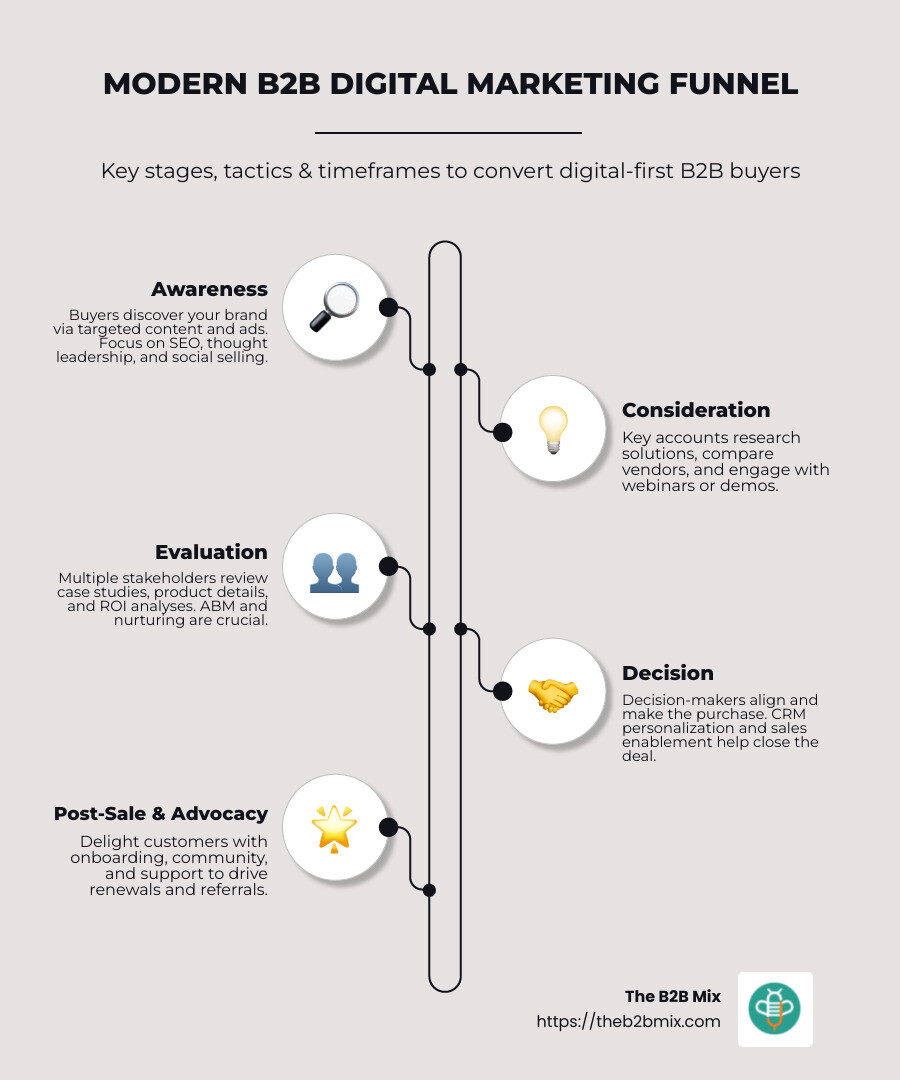
B2B marketing comes with unique challenges—multiple stakeholders with different priorities, sales cycles averaging 120 days (and sometimes much longer), and decisions driven primarily by logic and ROI rather than emotion. Your marketing strategy needs to account for this complexity.
Why You Need New B2B Digital Marketing Ideas
If your marketing feels a bit stale lately, you're not alone. Three major challenges are pushing even the most innovative B2B marketers to rethink their approach:
First, market saturation has reached deafening levels. Research shows that 68% of B2B buyers feel that brands all sound the same. The irony? 71% of marketers believe their value proposition stands out. The reality is that most messaging blends together in a sea of sameness, making differentiation harder than ever.
Second, buying cycles keep stretching longer. According to Outreach, the median B2B sales cycle now spans 120 days, with mid-market deals taking 150 days and enterprise deals an eye-watering 408 days. That's over a year of keeping prospects engaged! Your marketing needs to maintain momentum and relevance throughout this extended journey.
Third, data privacy shifts have upended traditional targeting approaches. With browser privacy updates and concerns about third-party cookies, marketers must adapt their strategies. First-party data and alternative targeting methods aren't just nice-to-haves anymore—they're essential. (Of course, Google just pulled a cookie u-turn in April 2025. So who knows what's next?)
Bad marketing can be worse than no marketing at all. With only about 5% of your potential B2B buyers actively in-market at any given time, you need thoughtful approaches that build awareness with the 95% while capturing the 5% who are ready to buy now.
The good news? Fresh B2B digital marketing ideas can help you steer through these challenges. Let's explore strategies that actually convert in today's complex landscape.
6 B2B Digital Marketing Ideas That Actually Convert
Let's cut to the chase—you don't need more flashy marketing tactics that pump up vanity metrics but leave your sales team wondering where the quality leads are. What you really need are B2B digital marketing ideas that translate into actual business opportunities and revenue.
Each strategy I'm about to share is designed with real-world results in mind. No fluff, no "just do it because everyone else is"—just practical approaches that work in today's complex B2B landscape.
These ideas are built around three critical pillars of successful B2B marketing:
Demand Generation that creates genuine interest among your target accounts. We're talking about being on their radar before they even realize they need you.
Lead Quality that prioritizes the right fit, demonstrated intent, and meaningful engagement. Because 100 lukewarm leads aren't worth as much as 10 hot prospects who match your ideal customer profile.
ROI Focus that ensures every dollar and hour you invest delivers measurable returns. Your marketing should be a profit center, not a cost center.
What makes these strategies particularly effective is how they map to different stages of the buyer journey. The reality is that only about 5% of your potential customers are actively looking to buy right now. The other 95%? They're in various stages of awareness and consideration—and if you're only capturing that 5%, you're leaving enormous opportunity on the table.
The ideas below help you build relationships with tomorrow's buyers while still capturing today's opportunities. They're flexible enough to adapt to your specific industry and budget, but proven enough that you won't be gambling with your marketing resources.
Let's explore the strategies that are actually moving the needle for B2B companies in 2025.
1. Account-Based Marketing 2.0 – Hyper-Personalized Plays
Remember when everyone got excited about ABM a few years ago? Well, Account-Based Marketing has grown since then. Today's ABM isn't just about targeting a list of companies—it's about creating genuine connections with the people who actually make decisions.
The secret sauce? Hyper-personalization. When everyone else blasts generic emails, the personal touch becomes your superpower. And the numbers back this up—while mass emails might get you a 1% response rate, thoughtful personalized outreach can boost that to over 30%.
Here's what modern ABM looks like in action:
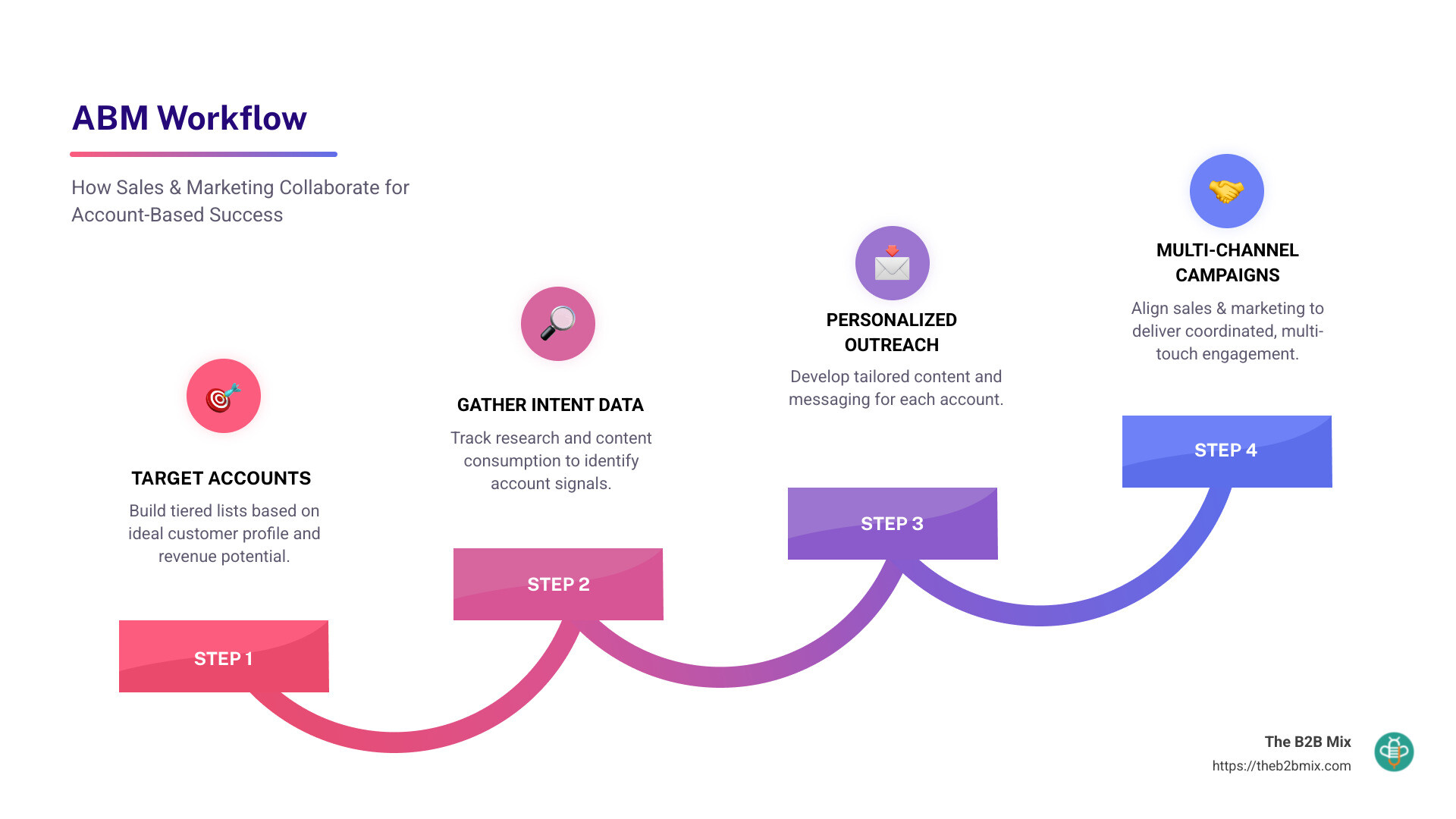
First, create tiered target lists based on how well companies match your ideal customer profile and their potential value. Not all accounts deserve the same investment of your time and resources.
Next, gather intent signals using tools that show you when target accounts are actively researching solutions like yours. This timing insight is pure gold.
Then, develop account-specific messaging that speaks directly to their unique challenges, not generic pain points. Your prospects can smell a template from a mile away.
The magic happens when you align sales and marketing teams around the same priority accounts. When both teams are rowing in the same direction, your efficiency skyrockets.
Finally, deploy multi-channel campaigns that reach decision-makers wherever they spend their digital time, because relying on just email or LinkedIn alone leaves opportunities on the table.
How These B2B Digital Marketing Ideas Beat Spray-and-Pray
Let's be honest – blasting generic messages to thousands of contacts feels productive, but the results usually disappoint. That's why precision ABM is winning the day. Vertical or even company-specific content and landing pages can drive bigger deals.
Higher conversion rates aren't the only benefit. By focusing your resources on accounts already showing buying signals, you'll see shorter sales cycles too.
The ROI difference is striking. Research shows that ABM programs deliver 21% to 50% higher ROI compared to non-ABM initiatives. Why? Because you're not wasting resources on poor-fit prospects who will never buy.
The real game-changer is multi-threading – connecting with multiple stakeholders at each target account instead of hanging your hopes on a single contact. This approach acknowledges the reality that B2B purchases typically involve 6-10 decision-makers, not a lone ranger making calls.
When everyone else is doing more of the same, sometimes doing the opposite is exactly what cuts through the noise.
2. SEO & Topic Clusters That Own the SERP

Search engine optimization isn't just surviving in the B2B digital marketing world—it's thriving. In fact, in a survey by Databox, 35% of survey respondents reported that SEO was their best source of highly scored leads is their top lead generator. But gone are the days when you could simply sprinkle keywords throughout your website and call it a day.
Today's winning strategy revolves around topic clusters—organizing your content like a solar system with powerful "pillar" pages at the center and related content orbiting around them. This approach helps you dominate search results for important industry topics rather than just ranking for isolated keywords.
Building effective topic clusters isn't rocket science, but it does require a thoughtful approach. Start by identifying core topics that matter to your audience and align with your business offerings. Then, create comprehensive pillar content (think 3,000+ words) that covers the topic broadly—like the ultimate guide to your industry's biggest challenges.
From there, develop cluster content that dives deeper into specific questions and long-tail keywords. Think of these as the specialized chapters that support your main book. The magic happens when you add content upgrades like worksheets, templates, or checklists that transform passive readers into active leads.
Finally, interlink everything with a deliberate structure that points back to your pillar content, creating a web of value that both readers and search engines appreciate.
What makes this approach so powerful? A well-executed blog with strategic content upgrades can convert around 5% of visitors into leads—significantly higher than the industry average of 1-2%. That's the difference between just getting traffic and actually generating business.
B2B Digital Marketing Ideas for Ranking & Converting
Want to take your SEO game to the next level? Here are some proven tactics that help you both climb the rankings and turn visitors into leads:
Schema markup might sound technical, but it's really just a way to help search engines understand your content better. Adding this structured data can create those eye-catching rich snippets in search results—the ones with star ratings, event details, or FAQ answers that make your listing stand out from the sea of blue links.
Free tools and calculators are the Swiss Army knives of B2B digital marketing ideas. They solve specific problems for your audience while naturally capturing lead information. Think ROI calculators, assessment tools, or industry benchmarking quizzes that provide immediate value while opening the door to conversation.
Long-tail keyword targeting focuses on specific, high-intent phrases that might have lower search volume but much higher conversion potential. Rather than competing for "marketing automation," you might target "marketing automation for manufacturing companies under 500 employees," reaching fewer people but the right people.
HubSpot exemplifies this approach perfectly. They've built their empire on comprehensive resource hubs around topics like inbound marketing, sales enablement, and customer service. The result? Over 13 million organic visitors monthly that fuel their growth engine.
As Brian Dean of Backlinko wisely notes, "Industry studies are THE best type of B2B content that you can create." Publishing transparent, data-driven research not only attracts backlinks like a magnet but positions your brand as a thought leader who shapes industry conversations rather than just joining them.
3. Video & Always-On Webinar Series
Let's be honest – most B2B marketing still leans heavily on text-based content while video remains "super untapped in the B2B marketing world." This is a massive opportunity for forward-thinking marketers. With attention spans shrinking and information consumption habits evolving, video offers a refreshingly engaging way to explain complex B2B solutions that might put people to sleep in a white paper.
Always-on webinar series – those pre-recorded gems that viewers can access whenever they want – are particularly powerful. They keep working for you 24/7, continuously generating leads long after you've recorded them. The stats back this up too: recent research shows a remarkable 56% increase in demo requests following webinars when they're properly executed and followed up.
Here's the beauty of an effective video and webinar strategy: it creates multiple touchpoints throughout the buyer journey. Your B2B digital marketing ideas should include signature webinars addressing industry pain points, supported by a growing library of on-demand replays that only require a simple registration to access. This creates a perpetual lead generation machine.
Short-form demo videos highlighting specific features complement these longer-format webinars, giving busy prospects quick insights when they're not ready for a full demo. Quarterly virtual events featuring guest speakers can then expand your reach while positioning your brand alongside industry thought leaders.

The real magic happens when you connect this content to your marketing automation platform, building nurturing sequences triggered by specific viewing behaviors. Did someone watch your pricing overview video twice? That's a buying signal worth acting on!
Don't get hung up on production quality at the expense of authenticity. While professional lighting helps, viewers respond more to genuine expertise than Hollywood production values. As one marketing leader notes, "Video emails can increase click-through rates by up to 300%," making them incredibly effective for sales outreach too. Worried about resources? Start small. Many of our clients begin by simply repurposing existing written content into video formats, which rapidly scales their B2B digital marketing ideas without reinventing the wheel. That comprehensive guide you wrote last year? Transform it into a series of short videos explaining each section, and suddenly you've got weeks of social content plus lead generation assets.
The key is consistency – establishing a regular cadence of video content that your audience comes to expect and look forward to, rather than one-off productions that fizzle out after the initial excitement.
4. Social Selling & Employee Advocacy

With 75% of B2B buyers using social media before making purchase decisions, having a strategic social presence isn't just nice-to-have—it's essential. The magic happens when you blend corporate brand building with personal thought leadership through your team's authentic voices.
LinkedIn is the undisputed champion for B2B, with 96% of content marketers using it for organic traffic. But here's the thing: your company page can only take you so far. The real power lies in your employees' networks, which offer dramatically greater reach and authenticity.
The numbers tell the story: content shared by employees receives 8x more engagement than content shared through brand channels. Even more impressive? Leads developed through employee social marketing convert 7x more frequently than other leads. That's not just incremental improvement—it's transformative.
Want to harness this potential? Here's how to build an effective social selling and employee advocacy program:
- Develop thought leadership content that positions your executives and subject matter experts as industry voices worth following
- Create bite-sized "micro-content" that's easy for team members to share (think compelling quotes, surprising stats, or quick tips)
- Build supportive engagement pods where colleagues boost each other's content, creating momentum in the algorithm
- Provide clear guidelines and training so everyone feels confident about what to post (and what not to)
- Celebrate and recognize participation to keep enthusiasm high and sustain the program
According to LinkedIn, "Social selling leaders create 45% more opportunities than peers with lower SSI." When your team becomes visible experts, they're not just sharing content but opening doors to conversations that traditional marketing can't access.
B2B Digital Marketing Ideas Your Team Can Post Today
Looking for quick wins to jumpstart your social strategy? Your team already has valuable insights that your audience would love. Try these approachable content types:
Behind-the-scenes glimpses of your product development or client work show the human side of your business. These authentic peeks into your company culture build trust and relatability far better than polished marketing materials.
"Ask Me Anything" sessions give your subject matter experts a platform to shine while addressing real questions from your community. These and other types of interactive posts can improve engagement and conversions.
Celebrating client successes (with permission, of course) showcases real results while giving your clients a boost, too. These stories resonate because they're grounded in authentic experiences, not hypothetical benefits.
Sharing industry news with expert commentary positions your team as informed guides, not just information passers. Your perspective on trends and changes is what transforms mere sharing into thought leadership.
Repurposing internal knowledge into helpful tips and how-tos lets you extract value from expertise that might otherwise stay hidden in team meetings or project documents.
Social media isn't about broadcasting—it's about building relationships. As research from Gartner on the B2B buying journey confirms, today's buyers value suppliers who provide information that genuinely helps them steer purchase decisions. When your team shows up consistently with helpful insights, they become trusted advisors long before formal sales conversations begin.
5. Marketing Automation + CRM Personalization
Picture this: delivering exactly what your prospects need, exactly when they need it, without having to manually press "send" on thousands of emails. That's the magic of marketing automation paired with smart CRM personalization.
This powerful combination isn't about replacing the human touch; it's about enhancing it. Even though you can't tailor a website to every company, dynamic content lets you personalize by channel, behavior, or referral source.
At The B2B Mix, we've seen how proper HubSpot implementation transforms disjointed marketing efforts into seamless, personalized journeys. Here's the real deal on making automation work for your B2B company:
Lead scoring becomes your secret weapon when you build it around both demographic fit and actual engagement. Those prospects who repeatedly visit your pricing page? They're telling you something important without saying a word.
Dynamic email content changes based on who's reading it—whether they're a CEO or a technical implementer, a first-time visitor or a long-time prospect. When content speaks directly to someone's role and challenges, open rates soar.
Workflow triggers are like attentive salespeople who never sleep. When a prospect downloads that case study at 2 AM, your workflow ensures they receive the perfect follow-up the next morning, not three days later when someone checks the lead queue.
Lifecycle-mapped content ensures you're not pitching marriage on the first date. Early-stage prospects receive educational content while those further along get more solution-focused materials. This natural progression builds trust while moving deals forward.
Sales-marketing integration creates a single source of truth about each account. Conversations become dramatically more relevant when sales can see which webinars a prospect watched or which emails they clicked.
Turning These B2B Digital Marketing Ideas Into Revenue
Converting marketing automation from a fancy tool into a revenue generator requires thoughtful implementation. Here are the approaches we've seen work best:
Progressive profiling gathers information gradually, like a good conversation. Instead of overwhelming new contacts with 15-field forms, you learn more with each interaction. Your third-time visitors might happily tell you their budget and timeline when they wouldn't on first contact.
Multi-channel nurture streams coordinate your outreach across email, ads, and sales touches. When someone receives a nurture email about a specific topic, they might also see related ads on LinkedIn, creating a consistent experience that reinforces your message.
Behavior-based workflows create magical moments of relevance. When someone spends five minutes on your case studies page, an automated email sharing additional success stories feels helpful rather than promotional. These timely touches keep prospects engaged throughout long B2B buying cycles.
Account-based scoring looks at the bigger picture by aggregating individual activities at the company level. When three people from the same organization view similar resources, that signals more buying intent than three random visitors—and your automation can alert sales accordingly.
The beauty of these approaches is that they don't replace your team's expertise—they amplify it. By handling routine nurturing automatically, your sales and marketing people can focus their energy where human connection matters most: high-value conversations with qualified prospects.
Learn more about our HubSpot optimization services
6. Influencer & Community-Led Growth
Did you know that B2B influencer marketing is projected to become nearly a $24 billion industry by 2025? That's right—but forget what you know about B2C influencers with their product unboxings and lifestyle posts. The B2B world plays by different rules.
Unlike consumer brands chasing celebrities with millions of followers, B2B influencer marketing thrives on respected voices who genuinely understand your industry's complexities. The numbers tell an interesting story: 61% of B2B marketers report their greatest success comes from working with micro-influencers (those with 10,000-99,000 followers), while only 18% see strong results from mega-influencers.
Why? Because in B2B, credibility trumps fame every time.
These industry experts might have smaller audiences, but they bring something far more valuable—deep trust and significantly higher engagement rates. When someone respected in your field recommends a solution, decision-makers listen.

Community-led growth takes this concept even further. Instead of just leveraging individual influencers, you're creating vibrant spaces where prospects, customers, and industry peers can connect naturally. These communities become powerful engines that drive multiple business objectives simultaneously: word-of-mouth marketing, product feedback, and customer retention all flourish in well-cultivated community spaces.
Here's how smart B2B companies are implementing these digital marketing ideas:
First, identify the right micro-influencers in your industry. Look beyond follower counts to engagement quality and relevance. The perfect partner might be a respected consultant with 15,000 highly engaged followers rather than a general business influencer with 500,000 passive ones.
Next, focus on co-creating valuable content rather than paying for simple endorsements. The most effective B2B influencer relationships involve genuine collaboration—think co-hosted webinars, joint research projects, or podcast interviews that provide real value to audiences.
Many forward-thinking companies are also launching dedicated online communities on platforms like Slack or Discord. These spaces give customers and prospects a place to connect, share challenges, and find solutions together. When managed well, these communities become invaluable resources that prospects are reluctant to leave.
Brand ambassador programs for enthusiastic customers represent another powerful approach. Your happiest clients often make your most convincing advocates—and formalizing this relationship benefits everyone involved.
Don't overlook user-generated content either. Authentic case studies, testimonials, and implementation stories from real users carry immense credibility that polished marketing materials simply can't match.
IBM exemplifies this holistic approach with its influencer and employee advocacy program. By amplifying the company's message through authentic voices both inside and outside the organization, IBM builds trust that traditional advertising could never achieve.
As research on B2B influencer growth demonstrates, this strategy delivers benefits far beyond immediate lead generation. While traditional marketing tactics might drive short-term results, influencer and community approaches build long-term brand equity and trust that compound over time.
At The B2B Mix, we've seen how these community-building efforts transform not just marketing results but entire business trajectories. The most successful B2B companies today aren't just selling products—they're cultivating ecosystems where their solutions naturally thrive.
Frequently Asked Questions about B2B Digital Strategy
What's the #1 mistake in B2B digital marketing?
If there's one thing we've seen time and again, it's companies spreading their resources too thin across too many channels. It's the marketing equivalent of trying to be everywhere at once – and ending up nowhere special.
Most businesses fail because they spread resources across too many strategies instead of focusing in on the ones that matter most.
The solution is refreshingly simple: choose one primary strategy that aligns with your business goals and buyer journey, then commit to it for at least six months before expanding. Set clear KPIs to measure progress and let the data guide your optimization efforts.
Another pitfall we frequently help clients overcome is creating generic content that sounds like everyone else. It's no wonder 68% of buyers say B2B brands all sound the same! To stand out in the sea of sameness, focus on solving specific problems for your audience and don't be afraid to showcase your unique perspective. Your distinct voice matters more than you might think.
How long before these ideas show ROI?
"When will we see results?" It's the million-dollar question, and the answer varies by strategy:
Account-Based Marketing typically shows initial results in 1-3 months, with full program ROI becoming visible within 6-9 months. Those personalized touches take time to resonate, but when they do, the impact is substantial.
SEO & Topic Clusters require patience – expect 3-6 months for meaningful organic traffic growth, with lead generation following as your rankings improve. You're building a content asset that will deliver value for years.
Video & Webinar Series often generate leads immediately, with compounding returns as your content library grows. Each new webinar adds to your lead-generation engine.
Social Selling & Employee Advocacy typically need 2-4 months to build momentum, followed by consistent growth as your team's networks engage and expand.
Marketing Automation can deliver quick wins within weeks, while more sophisticated programs show full ROI in 3-6 months as your nurture sequences mature.
Influencer & Community strategies are marathon, not sprint investments – allow 6-12 months for community building, though influencer collaborations can drive faster results.
The key is setting realistic expectations and measuring leading indicators (engagement, traffic) before fixating on lagging indicators (revenue, ROI). Good things come to those who track, measure, and optimize.
Which channel should a small team start with?
When resources are limited (and when aren't they?), we recommend small teams start with LinkedIn-focused social selling and employee advocacy. This approach leverages your team's existing networks and expertise without requiring significant content production or technical setup.
Begin by helping your subject matter experts share insights and engage with their connections. The beauty of this approach is that it builds on relationships your team already has. As momentum builds, you can gradually expand into more structured content creation and lead generation efforts.
Another excellent starting point is marketing automation, particularly if you already have some website traffic and leads but struggle with follow-up and nurturing. A well-designed automation program can multiply your team's effectiveness without requiring additional headcount – it's like adding virtual team members who work 24/7.
We've seen small teams achieve remarkable results by focusing their energy on one or two channels rather than trying to maintain a presence everywhere. The key is consistency and quality over quantity – better to show up meaningfully in one place than superficially everywhere.
Conclusion: Measuring Success and Scaling Your B2B Digital Marketing
The journey doesn't end after implementing these B2B digital marketing ideas. In fact, this is where the real magic begins—in the measuring, learning, and optimizing that comes next.
Start with establishing clear baseline metrics for each strategy you've implemented. What's your current conversion rate? How many qualified leads are you generating monthly? What's your average sales cycle? Having these numbers at hand gives you a starting point to measure progress against.
Rather than getting lost in vanity metrics like impressions or social media likes, focus on what truly matters—pipeline contribution and revenue impact. As one marketing leader puts it, "Not everything that can be counted counts, and not everything that counts can be counted."
The most successful B2B companies we work with review their metrics regularly—weekly for tactical measures and monthly for strategic evaluation. They're constantly asking: What's working? What isn't? Where should we double down?
When you find what works, don't be afraid to gradually increase your investment there. At the same time, maintain a healthy appetite for experimentation. A balanced strategy ensures you're maximizing current returns while finding tomorrow's winning channels.
At The B2B Mix, we're passionate about helping companies like yours make sense of marketing data and turn insights into action. We specialize in optimizing HubSpot implementations, streamlining marketing operations, and executing digital strategies that deliver tangible results. Our approach cuts through the complexity—we're hands-on, jargon-free, and focused on what actually works.
Whether you need a complete digital strategy overhaul or help implementing just one of these tactics, we provide the expertise you need with the responsive, human support you deserve. We understand that behind every marketing challenge is a real person trying to make an impact at their company.
Ready to think outside the inbox and transform your B2B marketing? Learn more about our HubSpot optimization services or reach out for a conversation about implementing these strategies for your specific business challenges.
The B2B landscape will continue to evolve—new platforms will emerge, algorithms will change, and buyer behaviors will shift. But the fundamentals remain timeless: understand your buyers deeply, meet them where they are with relevant content, and provide value at every stage of their journey.
With these six strategies in your toolkit and a commitment to measuring what matters, you'll be well-positioned to drive sustainable growth in 2025 and beyond. And remember—you don't have to do it alone.