

You opened Slack on a Monday morning, ready to ship the new homepage hero copy you spent two weeks crafting. Instead, you found fourteen reactions, eight comments, and three "quick thoughts" from leadership, sales, the founder's brother-in-law, and someone in operations who once worked at a marketing agency in 2007.
By Wednesday, your sharp, strategic message has been smoothed into a paragraph that says nothing and offends no one. By Friday, you've launched a homepage that no one loves and no prospect remembers.
Welcome to marketing by committee: the slow, polite death of B2B messaging.
What is marketing by committee? Marketing by committee is a decision-making pattern where every campaign, message, or asset gets input from multiple stakeholders — leadership, sales, operations, even the founder's brother-in-law — until the output is diluted, delayed, or both. It's especially common in mid-market B2B companies where the marketing function is small or relatively new.
If you're the marketing department of one (or two), this scene hits a nerve. You're not paranoid, and you're not bad at your job. However, you are stuck in one of the messiest dynamics in B2B: doing strategic work inside a culture that treats every campaign decision like a group project.
Here's how to name what's happening, defend the work that matters, and bring your team along without losing your mind.
What marketing by committee actually costs
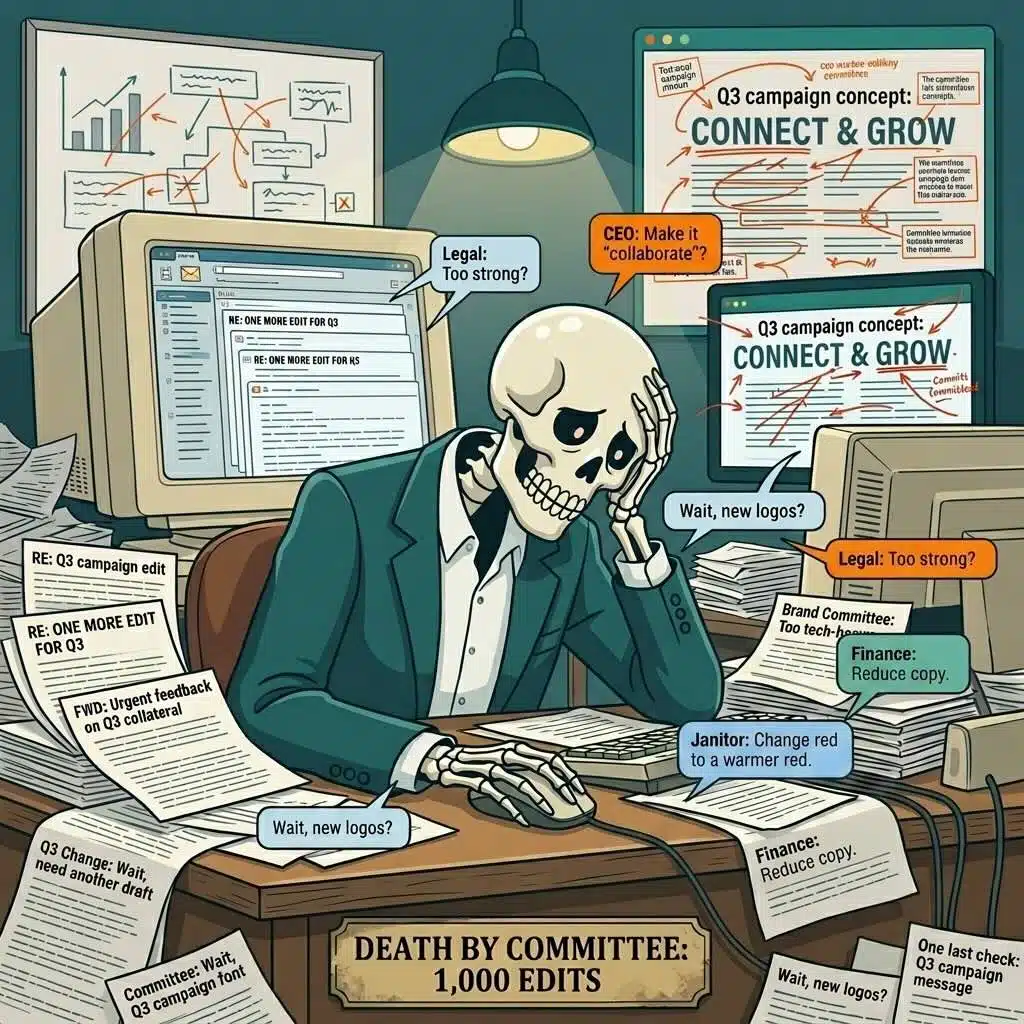
In theory, getting input from sales, leadership, and operations sounds like cross-functional alignment. In practice, it looks like death by a thousand edits.
A few things tend to go sideways.
Messaging gets diluted. A bold positioning line becomes a generic value statement. A specific buyer pain becomes "businesses today face many challenges." Ultimately, every stakeholder smooths off another edge until what's left is technically correct and totally forgettable. Translation: clarity wins, mush loses.
Execution slows to a crawl. Harvard Business Review recently argued that decision-making by consensus is structurally too slow for the modern era. It takes forever, and it distorts information. For a one-person marketing team trying to ship campaigns against a real revenue target, that's not a leadership theory problem. It's a Tuesday afternoon problem.
Strategy gets replaced by personal preference. When everyone weighs in equally, the loudest voice wins, regardless of who actually has the marketing context. The CFO doesn't like the color. Also, the founder thinks the homepage should mention every service. Suddenly your buyer journey is a stakeholder appeasement journey.
Your reputation takes the hit. And here's the real kicker: When the campaign underperforms, no one remembers the seventeen people who edited it. However, they remember whose name was on the brief.
Leadership coach Rebecca Shambaugh, in a recent HBR conversation, put it cleanly: over-collaboration can read as indecision or failure to prioritize, even when the intent is inclusive. For lone marketers, that risk is amplified. You're already battling the perception that you're "just" the marketing person. Looking like you can't make a call makes it worse.
Why this happens (especially in legacy and family-owned B2B)
Consensus-driven cultures don't show up randomly. Actually, they show up because of how the business grew.
In a lot of mid-market B2B companies, relationships built the business. After all, the founder knows every long-time customer. Sales has opinions because sales has been here since 1998. Operations has opinions because every campaign creates work for them. Everyone has skin in the game, and almost no one has formal marketing training.
So when a marketing decision lands on the table, the instinct is to circulate it. That's not malicious. That's culture.
Pair that with a few other realities:
- The founder built the company on instinct, and instinct still feels like the safest decision-making tool.
- The next-gen leader is trying to modernize without alienating anyone.
- Sales has been promised more leads, so they're scrutinizing every touchpoint.
- You inherited a martech stack, a brand voice, and a backlog from someone who left.
You're not just defending a campaign. You're navigating real organizational dynamics. So no, "just push back harder" isn't the answer. The answer is positioning yourself as a strategic partner instead of a gatekeeper.
The shift: stop seeking consensus. Start bringing clarity.
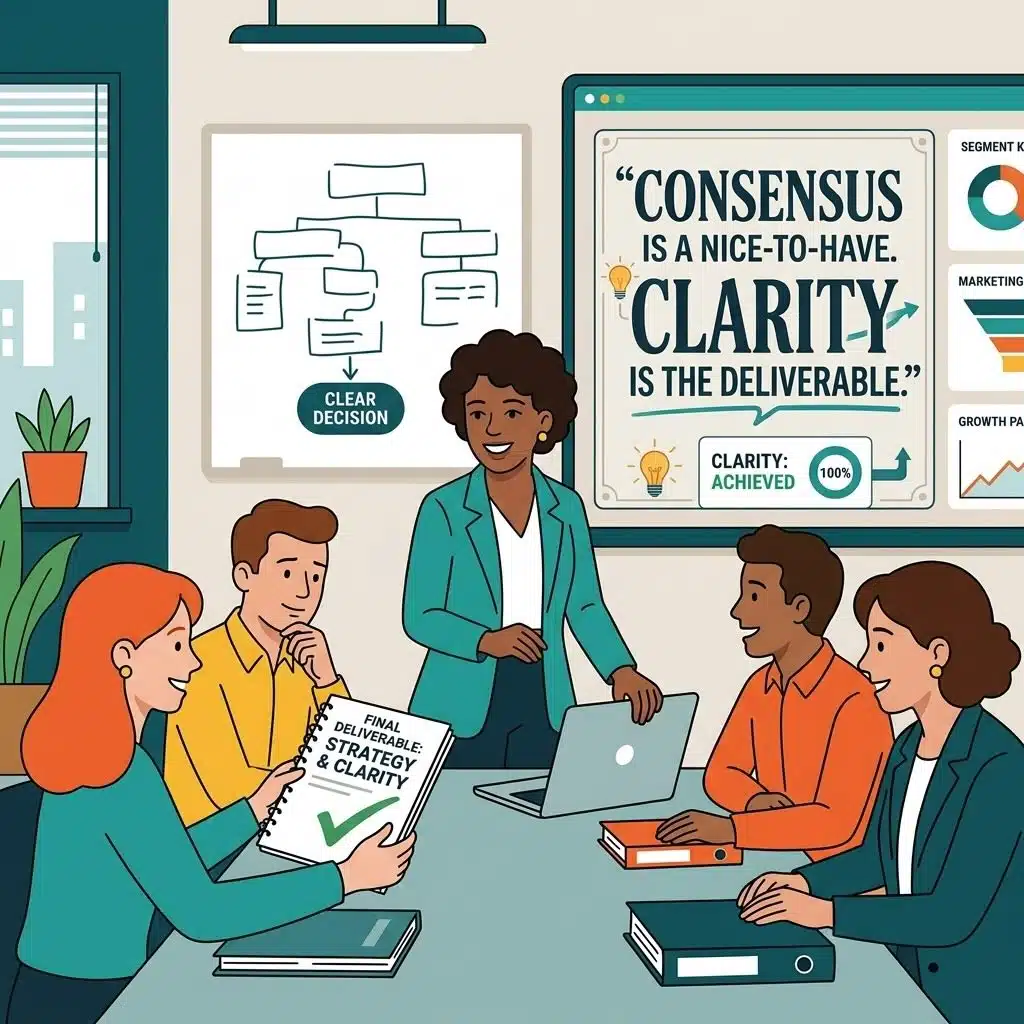
OK… here's the mental reframe that changes everything: your job isn't to get everyone to agree. Your job is to bring strategy to a decision and help leadership make a confident call.
Consensus is a nice-to-have. Clarity is the deliverable.
That doesn't mean ignoring input or steamrolling stakeholders. It means setting up the conversation so the right input shows up at the right time, and one person makes the final call. Decision-making researchers have argued for years that a clear decision process matters more than a clean consensus. Your team needs to know, before the conversation starts, who decides if people disagree.
This is also where the most innovative companies tend to land: they accept that big creative bets will rarely have unanimous support, and they protect the work anyway.
The frameworks below help you do that without becoming the marketing villain in your own company.
Five frameworks (and the language to make them stick)
How do you stop marketing by committee?"
1. Lead with a one-page Strategic Brief
Before any homepage, campaign, or launch hits a draft, write a one-pager that locks down the parts that aren't up for debate:
- Audience: Who this is for, with one named persona.
- Objective: The measurable outcome it needs to drive.
- Core message: The one thing the audience should remember.
- Proof points: Three, max.
- What this is not: The scope you're explicitly cutting.
Get sign-off on the brief, not on every comma. Once the brief is approved, every later "what if we also said…" gets weighed against it. The brief becomes your shield.
This is the same logic we apply to our B2B marketing process at every stage: strategy first, execution second, opinions third.
2. Use a DACI-style decision frame for each project
Borrowed from product teams, DACI assigns four roles per decision:
- Driver: Owns the project and moves it forward (you).
- Approver: Has final sign-off; usually one person. Founder, CEO, or VP.
- Contributors: Provide expertise (sales for messaging, ops for feasibility).
- Informed: Just need to know the outcome.
The most important word here is one. One Approver. Not five. Not "leadership as a group." When stakeholders weigh in, you can ask the question every lone marketer needs in their toolkit: "Are you weighing in as a Contributor or an Approver?" That single phrase reroutes 90% of the chaos.
3. Sort strategic feedback from stylistic feedback
Not all input is created equal. Build the muscle of sorting it in real time.
- Strategic is about audience, message, or measurable outcome. Always discuss.
- Stylistic is about word choice, color, font, comma placement. Capture, don't debate.
| Strategic feedback (always discuss) | Stylistic feedback (capture, don't debate) |
|---|---|
| "This doesn't speak to our actual buyer." | "Can we make the headline blue?" |
| "The CTA contradicts the campaign goal." | "I'd use a comma here, not a dash." |
| "We're targeting the wrong stage of the funnel." | "Can the button say 'Get started' instead?" |
Try a phrase like: "That's helpful style input, let me note it. For the strategic piece, here's where I landed and why." You're not dismissing the comment. Rather, you're putting it in the right bucket.
4. Name the tradeoff out loud
Most committee edits are well-meaning additions. The problem is, additions cost something, usually clarity. When someone wants to "also mention" another service or audience or shiny new feature (yes, even when it's the founder asking), surface the tradeoff:
"We can add that, but it'll dilute the message for our primary audience. Are we okay with the tradeoff, or do we want a separate page for that audience?"
This is also where Entrepreneur's recent guidance on consensus decision-making lands: make tradeoffs visible, and the conversation gets smarter fast.
5. The "Park It" reframe
Some battles aren't worth fighting in the moment. Some ideas are good, just not for this campaign. Use a parking-lot phrase:
"Great point, let's park it for the next campaign so we don't lose focus on this one's goal."
You're validating the idea, holding the strategy, and signaling that you're thinking ahead. That's the energy of a strategic operator, not a gatekeeper.
Phrases to keep in your back pocket
When the meeting heats up and you need a one-liner, try these:
- "Let's check that against the brief."
- "Is that strategic feedback or stylistic feedback?"
- "Who's the Approver on this one?"
- "We can add it, but here's what it costs us."
- "Let's ship the test version, then iterate based on data, not opinions."
- "I'd rather be specific and slightly wrong than generic and totally safe."
Print them. Tape them to your monitor. Use them.
When to flex (and when to hold the line)
Not every fight is worth it. Use this quick filter:
- Hold the line when the change breaks the strategy, contradicts the buyer persona, or guts a measurable objective.
- Flex on word choice, visual style preferences (within brand), and additions that don't dilute the core message.
- Escalate when the Approver hasn't actually weighed in and a Contributor is acting like one.
If you're holding the line, do it warmly. You're not refusing input. Instead, you're protecting the work the team agreed to.
You're not the gatekeeper of taste. You're the steward of strategy.
Marketing by committee isn't a personality problem. It's a process problem. And process problems can be fixed by the person closest to the work, even when that person is a department of one.
The marketers who break out of the cycle aren't the loudest. They're the ones who consistently bring structure to fuzzy conversations, name tradeoffs out loud, and make leadership's job easier. That's the work that gets noticed, the work that gets you promoted. That's also the work that makes the marketing perform, because clear messages outperform safe ones, every single time.
If you're the lone marketer in the building and you've been quietly absorbing the chaos because pushing back felt "unprofessional," I get it. Here's permission to stop. Bring a brief. Name the Approver. Park the noise. Ship the work.
And if you'd like a thought partner who's been in the room for these conversations more times than we can count, someone who can help you build the systems, language, and reporting that turn marketing-by-committee into marketing-by-strategy: that's literally why The B2B Mix® exists. We help in-house marketers look like the smartest person in the room, not the most outvoted one.
You can also dig into more practical playbooks here:
- The B2B marketing process, end to end
- How to set operational marketing objectives that actually move the needle
- Building a B2B content strategy with a north star
- Marketing operations technology, demystified
- Content operations: the behind-the-scenes hero of content marketing
You don't need more opinions. Instead, you need a brief, an Approver, and a quiet hour to ship the thing.
Marketing by committee is what happens when every campaign, message, or asset gets edited by multiple stakeholders until the output is too vague for any buyer to remember. It usually shows up in mid-market B2B companies where the marketing function is small and "everyone has an opinion" feels like collaboration. The intent is alignment. The result is mush.
It fails because it confuses input with strategy. When everyone weighs in equally, the loudest voice wins, not the one with the most marketing context. Messages get smoothed into safe, generic statements no buyer remembers. Gartner found that overly individualized messaging actually hurts buying-group alignment by 59%. Translation: more voices doesn't mean better marketing.
Stop seeking consensus and start bringing structure. Lead with a one-page strategic brief that locks down audience, objective, and core message before the work starts. Assign one Approver per project (not "leadership as a group"). Sort feedback into strategic versus stylistic, and name tradeoffs out loud. You're not refusing input. You're making it useful.
DACI is a decision framework borrowed from product teams that assigns four roles per project: Driver (owns the project), Approver (final sign-off, one person), Contributors (provide expertise), and Informed (need to know the outcome). For marketing, it ends the "everyone weighs in equally" problem. Before a campaign starts, name the Approver in writing. That single move kills 90% of the chaos.
Push back by asking better questions, not by saying no. Try "Are you weighing in as a Contributor or an Approver?" or "Is that strategic feedback or stylistic feedback?" Both reframe the conversation without dismissing the person. The goal isn't to refuse input. It's to make sure the right input lands at the right time, and the right person makes the call.