

What Are Operational Marketing Objectives and Why Do They Matter?
Operational marketing objectives are the specific, actionable, short-term goals that turn your big marketing strategy into daily wins. Unlike strategic marketing (which asks "What markets should we target?" and "What's our 5-year vision?"), operational marketing focuses on when and how you'll execute tactics to achieve measurable results: this quarter, this month, even this week.
Quick Answer: Operational Marketing Objectives Defined
- Specific, measurable goals that guide day-to-day marketing activities
- Short to medium-term (typically daily, weekly, monthly, or quarterly)
- Action-oriented, focusing on concrete tasks like launching campaigns, generating leads, or optimizing channels
- Bridge the gap between strategic vision and tactical execution
- Must be SMART: Specific, Measurable, Achievable, Relevant, and Time-bound
- Examples: "Increase lead generation by 20% in Q2," "Reduce campaign launch time by 30%," "Improve lead-to-opportunity conversion rate by 15% this year," "Increase organic website traffic by 25% in the next six months."
If you're a B2B marketing manager drowning in disconnected tools and underperforming campaigns, you're not alone. Many teams struggle to translate ambitious strategic plans into the concrete actions that actually move the needle.
That's where operational marketing comes in. It's the engine that powers your marketing machine. These are the practical, measurable activities that generate leads, drive conversions, and prove ROI. Strategic marketing tells you where to go. Operational marketing gets you there.
Without operational objectives, even the most innovative strategy can lead to "random acts of marketing"—scattered efforts that waste resources and confuse your team. With clear goals, you get focus, direction, and the ability to adapt quickly when things change.
In this guide, we'll show you how to set operational marketing objectives that actually work, the tools and tactics you need to execute them, and how to measure success so you can keep getting better.
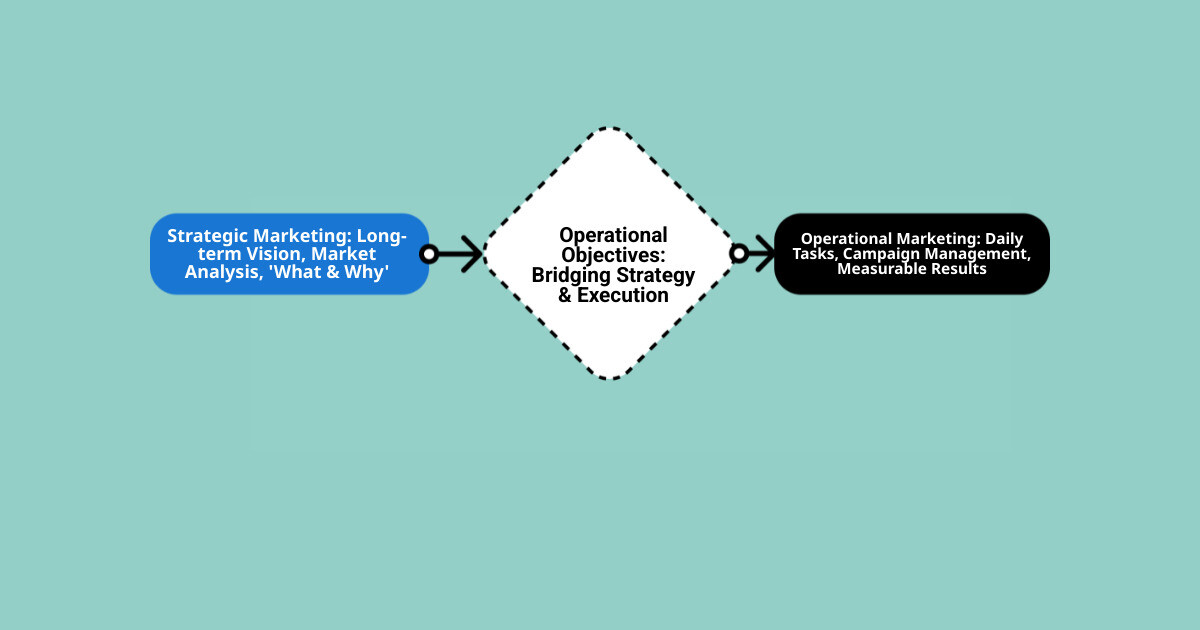
Operational marketing objectives terms to remember:
From Grand Strategy to Daily Wins: The "What" and "Why"
Every successful journey starts with a destination, but it's the map and the daily miles that get you there. In marketing, our grand strategy sets the long-term vision (where we want to be years down the line). But without a clear path, that vision remains a dream. This is where operational marketing objectives come into play. They are the practical, action-oriented, short-term goals that organizations set to achieve larger, long-term objectives. Think of them as the daily, weekly, or monthly tasks that, when executed together, contribute to a successful broader goal.
The primary role of operational marketing is to translate that strategic vision into tangible, day-to-day execution. It focuses on tactical actions that deliver measurable results in the short term, addressing the current market and immediate opportunities. We continuously monitor these actions, allowing us to make immediate adjustments if we're not getting the expected results.
The advantages of having a well-defined operational marketing plan are numerous. It helps us focus on our goals, provides clear direction for execution, and allows us to adapt to changes in the business landscape. Without it, our efforts can become scattered, disconnected activities that don't contribute to the larger picture. With a robust plan, we guide our teams to execute marketing activities more effectively through campaign collaboration and budget optimization. It's all about bridging the gap between strategic marketing and execution.
Strategic vs. Operational Marketing
To truly grasp the power of operational marketing objectives, it's crucial to understand how they differ from their strategic counterparts. While both are essential, they serve distinct purposes.
| Feature | Strategic Marketing | Operational Marketing |
|---|---|---|
| Time Horizon | Long-term (1-5+ years) | Short to medium-term (daily, weekly, monthly, quarterly) |
| Focus | "Why?" and "What?": Overall vision, direction, goals | "How?" and "When?": Execution, tactics, action plan |
| Scope | Market analysis, competitive landscape, target audience, positioning, brand identity | Campaign management, content creation, ad placement, sales promotions, customer service |
| Nature | Analytical, conceptual, visionary | Tactical, action-oriented, hands-on |
| Outcome | Defines market segments, product/service offerings, unique value proposition | Generates leads, drives conversions, builds engagement, optimizes spend |
| Flexibility | Less frequent changes, foundational | Continuous monitoring, immediate adjustments, agile |
| Measurement | Market share, brand perception, long-term profitability | Conversion rates, ROI, traffic, engagement, sales volume |
Strategic marketing sets the overarching direction. It's the "what" and "why." It defines our target audience, our unique value proposition, and our long-term market position. Operational marketing, on the other hand, is the "how" and "when." It's about taking those strategic decisions and putting them into action. For example, if our strategic objective is to "become the market leader in enterprise AI solutions," our operational marketing objectives might include "launch a targeted lead generation campaign for AI solutions by Q3" or "increase qualified demo requests by 20% this quarter."
The Primary Role of Operational Marketing in Achieving Strategic Goals
The primary role of operational marketing is to serve as the engine of execution for our strategic goals. It's where the rubber meets the road. Without strong operational marketing, even the most brilliant strategy can falter.
Here's how it plays out:
- Translating Vision into Action: Operational marketing takes the broad strokes of strategic planning and breaks them down into concrete, executable tasks. It's the difference between saying, "We want to improve lead generation," and specifying, "We will launch a new eBook promotion on LinkedIn targeting IT decision-makers in Q2 to generate 500 MQLs."
- Supporting Sales: Our operational marketing activities directly feed the sales pipeline. From generating qualified leads to nurturing prospects with relevant content, we empower our sales team with the tools and information they need to close deals. This tight alignment is critical for revenue growth. For more insights, check out our guide on B2B marketing process.
- Driving Immediate Opportunities: Operational marketing is inherently action-oriented. It allows us to capitalize on current market trends, run timely promotions, and respond to immediate customer needs. This agility can be a significant competitive advantage.
- Ensuring Accountability: Because operational marketing objectives are specific and measurable, they create a clear framework for accountability. Everyone on the team understands their role and how their efforts contribute to the overall success. Accountability fosters a sense of ownership and drives performance.
Operational marketing ensures that our strategic goals don't just sit on a shelf. It ensures they are actively pursued, measured, and achieved, one tactical step at a time.
Crafting Your Action Plan: How to Set Effective Operational Marketing Objectives

Setting practical operational marketing objectives means translating high-level aspirations into granular, actionable tasks. This process requires careful prioritization, alignment with business goals, team buy-in, and thoughtful resource allocation. The key is to make your goals smart, clear, and actionable.
Using Frameworks like SMART and OKRs for Your Operational Marketing Objectives
When setting operational marketing objectives, two frameworks stand out for their effectiveness: SMART goals and OKRs (Objectives and Key Results). These frameworks provide the structure to ensure our objectives are not just ambitious but also achievable and trackable.
SMART Goals:
We've all heard of them, but applying them consistently is where the magic happens. SMART stands for:
- Specific: Our objectives must be clear and well-defined. Instead of "increase website traffic," think "increase organic website traffic from search engines."
- Measurable: We need quantifiable metrics to track progress. How will we know if we've succeeded? "Increase organic website traffic by 25%."
- Achievable: While challenging, the objective must be realistic given our resources and timeline. "Is a 25% increase feasible in this market?"
- Relevant: The objective should align with our broader strategic marketing and business goals. "Does more organic traffic contribute to our lead generation targets?"
- Time-bound: Every objective needs a deadline. "Increase organic website traffic by 25% in the next six months."
OKRs (Objectives and Key Results):
OKRs provide a robust framework for goal-setting, especially for marketing operations. They help us align our efforts and measure impact effectively.
- Objectives: These are our ambitious, qualitative goals (what we want to achieve). They should be inspiring and directional. For example, "Improve marketing automation efficiency."
- Key Results: These are the measurable, quantitative outcomes that indicate whether we've achieved our objective. They should be challenging but achievable.
- KR1: Evaluate and select a new marketing automation platform by the end of Q1.
- KR2: Reduce manual data entry time by 30% within six months of implementation.
- KR3: Increase lead nurturing email open rates by 15% by the end of Q3.
By leveraging OKRs, we can encompass a range of objectives and key results, including improving marketing efficiency, optimizing marketing processes, enhancing cross-functional collaboration, driving revenue growth, and ensuring a seamless customer experience.
Aligning Your Plan with Big-Picture Business Strategy
Operational marketing objectives are useless if they don't serve the overarching business strategy. Every objective must contribute to the company's revenue goals, requiring constant alignment and collaboration.
- Connecting to Revenue Goals: Every marketing activity should ultimately trace back to its impact on the bottom line. Whether it's lead generation, customer retention, or brand awareness, we need to articulate the financial impact of our objectives. For instance, "Generate 30% more leads through the website" directly feeds the sales pipeline and potential revenue.
- Sales and Marketing Alignment: This is non-negotiable. Our marketing objectives must be in lockstep with sales targets. Clear communication and shared goals prevent the classic "sales blames marketing" and "marketing blames sales" dynamic. We work together to define what a qualified lead looks like, what content supports the sales cycle, and how to hand off prospects seamlessly. If you're struggling with this, our insights on biggest sales & marketing alignment challenges can help.
- Cross-Functional Collaboration: Marketing doesn't operate in a vacuum. We need to collaborate with product development, customer service, and even finance. For example, if an objective is to "improve customer satisfaction score (CSAT) by 10%," it involves more than just marketing; it requires input and action from customer-facing teams.
- Securing Leadership Buy-in: Our operational plans need the backing of senior leadership. This means clearly articulating our objectives, demonstrating their alignment with business strategy, and presenting measurable outcomes. When everyone is committed to achieving the set objectives, success is far more likely.
Common Examples of Operational Marketing Objectives
Let's look at some tangible examples of operational marketing objectives across different functions. These are specific, measurable, achievable, relevant, and time-bound!
- Lead Generation:
- Increase qualified lead volume by 20% through content marketing efforts by the end of Q2.
- Generate 30% more inbound leads via website forms within the next six months.
- Achieve a 15% increase in MQL-to-SQL conversion rate by optimizing lead nurturing workflows by Q4.
- Campaign Management & Efficiency:
- Reduce average campaign launch time by 25% by implementing a new project management tool within the next quarter.
- Streamline the content approval process to decrease review cycles by 30% in the next three months.
- Optimize marketing budget allocation to reduce cost per lead (CPL) by 10% by year-end.
- Website & Digital Presence:
- Increase organic website traffic by 25% through SEO improvements and new blog content by the end of the fiscal year.
- Improve website conversion rate for key landing pages from 5% to 8% by optimizing calls-to-action and forms within two months.
- Achieve a 15% increase in social media engagement metrics (likes, shares, comments) across LinkedIn and Twitter by Q3.
- Customer Experience & Retention:
- Increase customer lifetime value (CLV) by 10% through targeted email marketing campaigns and loyalty programs in the next 12 months.
- Increase the customer satisfaction score (CSAT) by 5 points by implementing a new feedback collection system and addressing common pain points.
- Product Marketing:
- Host 5 product demonstrations for our new SaaS feature in the next quarter, aiming for 50 attendees per session.
- Increase product awareness among our target audience by 20% through targeted advertising and PR in the next quarter.
These examples illustrate how specific objectives provide a clear roadmap for daily tasks and tactical execution.
The Modern Marketer's Toolkit: Tech and Tactics for Execution

Achieving today's operational marketing objectives requires a robust toolkit. The shift to digital has moved marketing from manual processes to integrated, data-driven systems. With an explosion of software offerings, a clear operational plan is essential to leverage the right technology and tactics. For a deeper dive into these tools, explore our insights on marketing operations technology.
At its core, operational marketing manages the traditional marketing mix, often called the "4 Ps":
- Product: Adapting product features to market needs, launching new products, and managing the product lifecycle. For example, modifying a product to appeal to a new market segment.
- Price: Implementing pricing strategies, such as offering discounts or using premium pricing to position a product.
- Place (Distribution): Selecting distribution channels, managing logistics, and handling inventory. For instance, an e-commerce store expanding to international shipping.
- Promotion: Executing advertising campaigns, PR, sales promotions, and loyalty programs, like using social media ads to drive traffic.
Key Levers: Content, SEO, Social Media, and Personalization
To hit our operational marketing objectives, we pull several key levers that directly impact our audience and drive engagement.
- Market Segmentation and Personalization: Understanding our audience is paramount. By dividing the market into smaller, specific segments, we can personalize messages and offers, making our campaigns far more effective. Messages can be grounded in the buyer's needs rather than in product capabilities. An online retailer, for example, might send product recommendations based on a customer's purchase history. This approach is vital for B2B, where custom solutions resonate deeply. Learn more about how to personalize content marketing efforts.
- tContent Marketing's Role: Creating and distributing relevant, valuable content (like blog articles, whitepapers, and case studies) is essential to attract and engage our target audience. It positions us as thought leaders and helps nurture leads through the sales funnel. Relevant marketing data is a cornerstone of any B2B content strategy.
- SEO Optimization: To ensure our valuable content is found, we optimize our website structure and use relevant keywords to drive qualified organic traffic. SEO is a continuous operational effort that directly impacts our visibility and lead generation objectives.
- Social Media Significance: Social media platforms are crucial for direct audience interaction, building communities, and amplifying our message. We create engaging content, actively respond to followers, and use paid advertising strategically to reach new prospects. The choice of platform matters; LinkedIn, for example, is ideal for B2B content and professional networking.
Essential Tools and Technologies for Success
Achieving our operational marketing objectives efficiently and effectively relies heavily on the right tech stack. These tools streamline processes, automate tasks, and provide invaluable insights.
- Marketing Automation Platforms: These are central to our operations, automating tasks like email campaigns, lead nurturing, and lead scoring. Platforms like HubSpot enable us to set up complex workflows, ensuring timely, personalized communication without manual intervention. Find how to get effective & efficient marketing automation.
- CRM Systems: Customer Relationship Management systems, such as HubSpot CRM, are vital for managing customer data, tracking interactions, and ensuring a holistic view of each prospect and customer. Optimizing our HubSpot CRM optimization helps align sales and marketing efforts seamlessly.
- Content management systems (CMS): A robust CMS allows us to create, manage, and distribute content efficiently. Evaluating and selecting the proper CMS can enable streamlined content creation and distribution, essential for meeting content objectives.
- Project Management Tools: Help us organize tasks, assign responsibilities, track deadlines, and manage campaign workflows. They are critical for reducing campaign launch times and ensuring smooth execution.
- Analytics Software: Analytics software, alongside built-in marketing platform analytics, provides the data we need to measure performance, understand user behavior, and make data-driven decisions.
These technologies aren't just about automation; they enable us to scale our efforts, personalize experiences, and gain deeper insights into what works, all of which contribute to achieving our operational marketing objectives.
Are We Winning? Measuring Success and Future-Proofing Your Plan
Setting operational marketing objectives is only half the battle; measuring them is the other half. Continuous monitoring is non-negotiable to prove marketing's contribution to revenue and business growth. Leveraging data-driven insights is key to understanding our performance and making informed decisions.
Operational marketing requires continuous monitoring to make immediate adjustments. We use financial metrics like ROI and cost per outcome to measure performance at every level, which helps communicate value to non-marketing stakeholders.
Measuring the Effectiveness of Operational Marketing Objectives with KPIs
Key Performance Indicators (KPIs) are our compass for navigating the success of our operational marketing objectives. They provide quantitative insights into what's working, what's not, and where we need to course-correct.
Here are some essential KPIs we track:
- Conversion Rate: The percentage of users who complete a desired action, like filling out a form.
- Customer Acquisition Cost (CAC): The total cost to acquire a new customer, used to measure spending efficiency.
- Customer Lifetime Value (CLV): The total predicted revenue from a single customer account.
- Website Traffic: Key metrics like sessions and unique visitors that show the reach of our online presence.
- Engagement Rate: How users interact with your content on social media or your website.
- Churn Rate: The percentage of customers who cancel or don't renew their subscriptions.
- Return on Investment (ROI): The profit generated from marketing activities relative to their cost.
- Cost Per Acquisition (CPA): The cost to acquire something specific, like a lead or a click.
- Customer Retention Rate: The percentage of existing customers who remain customers over time.
- Click-Through Rate (CTR): The percentage of people who click on a link or ad.
- Reach and Impressions: The total number of unique people who see your content and the total number of times it's displayed.
- CSAT and NPS: Scores that measure customer satisfaction and brand loyalty.
- Sales Volume: The total sales generated from marketing campaigns.
By regularly analyzing these KPIs, we gain clear visibility into the effectiveness of our operational marketing objectives. For a deeper dive into how we analyze these metrics, explore our guide on marketing operations analytics.
What's Next? Future Trends and Agility
The marketing landscape is constantly evolving, so our operational marketing objectives must be agile enough to adapt to new technologies and consumer behaviors.
- Scenario Planning: Anticipate various outcomes, both good and bad (e.g., a campaign underperforming or generating too many leads for sales). Being ready for any scenario improves agility and allows you to pivot quickly.
- Agility: Be ready to reallocate resources and launch new initiatives swiftly to capitalize on emerging trends or respond to competitor actions.
- AI in Marketing: AI and Machine Learning are here now, helping with predictive analytics, personalization, and ad optimization. Integrating AI can significantly improve marketing efficiency. Learn more about AI content marketing.
- Hyper-Personalization: Use AI and data analytics to deliver individualized experiences that anticipate customer needs with relevant content and offers.
- Data Privacy: Prioritize ethical marketing and data privacy to comply with regulations like GDPR and build customer trust.
- Sustainability: Incorporate purpose-driven marketing into your objectives to resonate with values-driven consumers and build brand loyalty.
By staying abreast of these trends and building agility into our plans, we ensure our operational marketing remains effective and future-proof.
Conclusion: Turning Your Blueprint into a Reality
We've covered how to define, execute, and measure operational marketing objectives, and how to adapt them for the future.
Let's recap the key takeaways:
- Operational marketing objectives are the specific, short-term goals that turn strategy into daily action.
- They bridge the gap between strategy and execution, ensuring all efforts contribute to business growth.
- Frameworks like SMART and OKRs help set clear, measurable objectives aligned with business strategy.
- A modern tech stack (marketing automation, CRM, etc.) is essential for efficient, data-driven execution.
- Measuring success with KPIs is crucial for monitoring, proving ROI, and making agile adjustments.
- Staying ahead of trends like AI and hyper-personalization keeps your marketing effective.
Operational marketing is the engine that drives results. It's about taking intentional steps, measuring their impact, and continuously optimizing.
If you're ready to transform your marketing strategy into consistent, measurable wins, we're here to help. Our expertise in B2B marketing operations, HubSpot optimization, and digital strategy can help you streamline your processes and achieve your goals. Don't let your strategic vision remain a dream. Let's make it a reality together. Streamline your strategy with marketing operations consulting.