
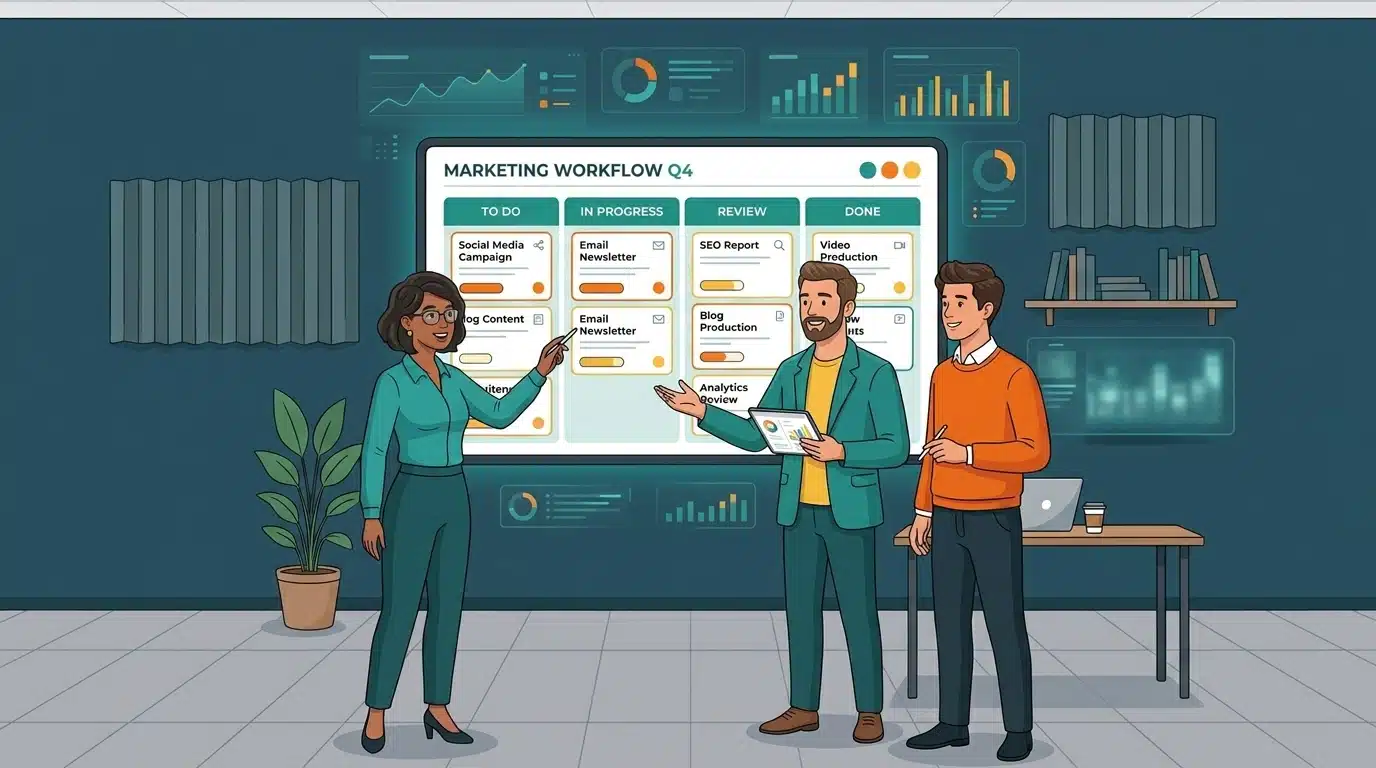
You know how everyone's got a content strategy document somewhere? A slide deck from 2023, maybe, or a Notion page nobody's opened since the person who built it left. That's not the problem. The problem is what happens the Tuesday after you write it — when the blog post is due, the social calendar's a mess, and nobody remembers whether the last three posts went through anyone for approval before they went live.
That gap between "we have a strategy" and "the strategy actually happens, consistently, without you personally holding it together with duct tape and sheer will" — that's content operations. And if you're the entire marketing function at your company (hi, I see you), it's probably the thing eating your week without you having a name for it.
Quick answer, since I know some of you are skimming: Content operations is the system of people, processes, and tools that turns a content strategy into content that actually ships — on time, at a consistent quality bar, without reinventing the process every single time. It's the plumbing behind the strategy. Nobody notices it when it works. Everybody notices when it doesn't.
Let's get into it.
What is content operations, anyway?
Content operations (you'll also see it shortened to "content ops," same thing) is the operational layer that sits underneath your content strategy. Your strategy answers what you're creating and why. Content operations defines the content production process: who owns which step, what tools you use, what "good" looks like before something publishes, and how you catch mistakes before prospects do.
Here's a distinction that trips a lot of people up, and it's worth being precise about: a content strategy is a plan. Content operations is the system that executes the plan, over and over, without you having to reinvent the wheel every time someone asks for a new blog post or a LinkedIn carousel. You can have a brilliant strategy and still watch it fall apart in execution — missed deadlines, unclear ownership, a review process that adds three days for no good reason. Content ops is the thing that closes that gap.
According to Content Marketing Institute's most recent B2B research, 45% of B2B marketers say they don't have a scalable model for content creation. Only 35% do. The rest aren't sure. (That "aren't sure" group is doing some heavy lifting in that stat, and I suspect a lot of them are exactly the person reading this post right now.) That's not a strategy problem. That's an operations problem — and it's an extremely common one, so if this is you, you're in very good company.
Content operations vs. content strategy vs. "just doing the work"
“Content operations” might feel like a fuzzy term. People aren’t confusing it with content strategy. Rather, it’s less common than other marketing jargon. “Marketing operations” gets said out loud in job titles and org charts all the time. “Content strategy” shows up in nearly every marketing plan. “Content operations” is the quiet middle sibling nobody introduced you to, even though you’ve probably been doing pieces of it for years without a name for it.
So, let's actually name the pieces:
- Content strategy is the plan: your audience, your topics, your goals, and the why behind your editorial calendar.
- Content operations is the execution system: workflows, roles, tools, and quality controls that turn the plan into published work.
- “Just doing the work” is what most under-resourced teams default to when there’s no ops layer. Small teams create every piece of content from scratch, ad hoc, with no repeatable process. That’s exhausting, and it’s the reason good content ideas die on the vine.
If you've ever sat in a meeting where someone said "we already made something like this last quarter, didn't we?" — that's a content operations gap talking. Not a strategy gap. You knew what to make. You just didn't have a system that remembered you'd already made it.
Why this matters more when you're a team of one (or two)
Here's where I want to push back a little: Most content ops advice out there, including some of our own older posts on this, assumes you've got a content ops manager, a handful of writers, a DAM system, and a governance committee. If that's you, great, skip ahead. If your team consists of just you (or maybe you and a couple of other people), most content ops advice you see isn't going to serve you well. Trying to implement it will just make you feel further behind.
The good news: content operations scales down. The core principles — clear ownership, a repeatable process, the right (small) toolset, and a feedback loop — work whether you're a team of twelve or a team of one wearing twelve hats. You just build a lighter version.
The other good news: getting even a basic version of this in place is one of the highest-leverage things a solo or two-person marketing team can do. It's the difference between "I'm constantly firefighting" and "I have a system, and leadership can actually see what I'm doing and why it's working."
The content operations framework: five pillars, right-sized
Here's the framework. I'm going to give you the full version and then tell you, pillar by pillar, what the lightweight version looks like when you don't have a team to spread this across.
1. Strategy and goals: know what you're actually trying to do.
Before you build any process, you need a real (if simple) answer to "what does success look like?" Traffic, leads, pipeline influence, brand awareness — pick the two or three that actually matter to your business, and resist the urge to track everything. A content audit is the natural starting point here; if you haven't done one recently, our guide to building a content inventory walks through how to take stock of what you've already got before you plan what's next.
2. People and roles: someone owns each step, even if it's you.
In a bigger org, this means a RACI chart. For a team of one, it means writing down, in plain language, who does what — even if every box says your name. Why bother if it's all you? Because it forces you to see the actual steps in your process, and it's the first thing you can hand off when you finally get help (a freelancer, a contractor, an intern, a new hire).
3. Process and governance: the rules that keep quality consistent.
This is your style guide, your review checklist, your "does this need legal or compliance eyes before it goes live" rule. It sounds bureaucratic. It's the opposite of bureaucratic when it's sized right — a one-page checklist beats a 40-page governance doc every time, and it's the thing that keeps your content from sounding like five different people wrote it (even when, in your case, one person did). If your industry has real compliance stakes, this pillar carries more weight; we've written separately about content governance if you want the deeper version.
4. Technology and tools: pick the smallest stack that solves your actual bottleneck.
This is the pillar where most content ops advice goes off the rails for smaller teams, because it starts recommending a CMS, a DAM, a PIM, and three integration layers before you've even identified what's actually broken. Don't do that. Look at where your process breaks down most often — is it version control? Approval bottlenecks? Content getting lost across seventeen Google Docs? — and fix that one thing first. If you're already on HubSpot, you likely have more content tooling available to you than you're using (this is, not coincidentally, most of what we do for a living — cleaning up the 10% of HubSpot people are actually using). The tool should serve the process. Not the other way around.
5. Measurement and feedback loops: build in a regular "is this working" check.
Doesn't need to be daily. Doesn't need to be a dashboard with forty widgets. A monthly fifteen-minute look at what published, what performed, and what you'd change is enough to keep the system honest. Smart tools can automate a lot of this reporting, but the habit of actually looking at it matters more than the sophistication of the tool doing the pulling.
Do you need a content operations manager?
Short answer: If you're reading this post, you may already be one. You just don't have the title, the budget, or (most importantly) the bandwidth that a dedicated content operations manager role is supposed to come with.
The distinction that matters here: a project manager runs one initiative, a campaign, a launch, a whitepaper, start to finish. A content operations manager builds the repeatable system that makes every project run more smoothly: the templates, the workflows, the governance, the tooling. If you're doing both jobs simultaneously with none of the structure, that's exactly why it feels unsustainable. You're not bad at your job. You're doing two jobs, and only one of them has ever been named out loud.
You don't need to hire a dedicated content operations manager to get the benefit of the role. You need to carve out time (even an hour a week) to do that job for yourself — building the lightweight version of the five pillars above — instead of only ever doing the content-making part of the job.
A pattern we see
Across the established B2B companies we work with, the pattern is remarkably consistent. The company hires a smart, motivated individual to run marketing (by themselves). That person starts producing content faster than the business has ever seen. And then it plateaus, not because the ideas ran out, but because there's no operational layer underneath the production. Even with a couple of hires, that level of output can be hard to maintain.
- Every piece starts from zero.
- Every review cycle is improvised.
- Every quarter, they're rebuilding a wheel they already built the quarter before.
The teams that break out of that pattern almost never do it by producing more. They do it by building a small, boring, repeatable system underneath what they're already doing. Boring is the point. Boring is what frees up the hours you're currently spending on reinvention.
Start this week
You don't need to build all five pillars in one sitting. Here's a lightweight sequence that works for a team of one:
- Week 1: Audit what you have. What's published, what's actually performing, what's outdated. (Yes, this takes real time. Block it off like a meeting you can't skip.)
- Week 2: Write your one-page process doc. Who does what, in what order, before something goes live.
- Week 3: Pick one tool fix for your biggest bottleneck. Just one. Resist the urge to solve everything at once.
- Week 4: Set a recurring 15-minute monthly check-in with yourself (or your manager) to look at what's working.
That's it. That's the whole on-ramp. It won't feel like much in week one. By month three, it's the difference between drowning and having a system that quietly runs itself.
The bottom line
A content operations framework isn't about adding more process for its own sake — the goal was never bureaucracy, it's bandwidth. Done right, it gives you back the hours you're currently spending reinventing things you've already figured out once. Whether you're using HubSpot, a spreadsheet, or a shoebox of sticky notes (no judgment — most of the businesses we work with started there), the principles scale. Strategy, people, process, tools, and a feedback loop. Build the lightweight version first. You can always add more structure later, once it's actually earned its place.
If you want a second set of eyes on what a right-sized content operations setup looks like for your specific team, that's a conversation we're always happy to have.
Frequently Asked Questions
Content operations is the system of people, processes, and tools that turns a content strategy into content that actually gets published — consistently, at a defined quality level, without starting from scratch every time.
Content strategy defines what you're creating and why. Content operations is the execution layer underneath it — the workflows, ownership, tools, and quality checks that make the strategy actually happen.
Not necessarily a dedicated hire. If you're a marketing team of one or two, you're likely already doing this role informally. The goal is to carve out time to build the system deliberately, rather than only ever doing the content-production part of the job.
Start with the smallest toolset that fixes your biggest bottleneck — version control, approvals, or content getting lost across documents are common starting points. Avoid building a full tech stack (CMS, DAM, PIM) before you've identified what's actually broken.
Start with a content audit, write a simple one-page process document, fix your single biggest tooling bottleneck, and set a monthly check-in to review what's working. Build the lightweight version first.