
A lot of founder-led B2B companies buy HubSpot for the right reason.
They want cleaner systems. Better visibility. Better follow-up. Better alignment between marketing and sales. A setup that helps the business scale without adding more chaos.
Then HubSpot onboarding starts, and instead of making things simpler, the system creates more work.
That usually is not a platform issue. It is a HubSpot implementation issue.
The short answer
The most common founder-led HubSpot implementation mistakes are not technical. They are operational. Companies run into trouble when they treat CRM implementation like software setup, skip sales process and customer journey mapping, move messy data into HubSpot CRM, automate too early, and assume the platform will fix team misalignment on its own.
If the business is unclear before implementation, HubSpot will reflect that confusion at scale.
Mistake 1: Treating HubSpot implementation like software setup
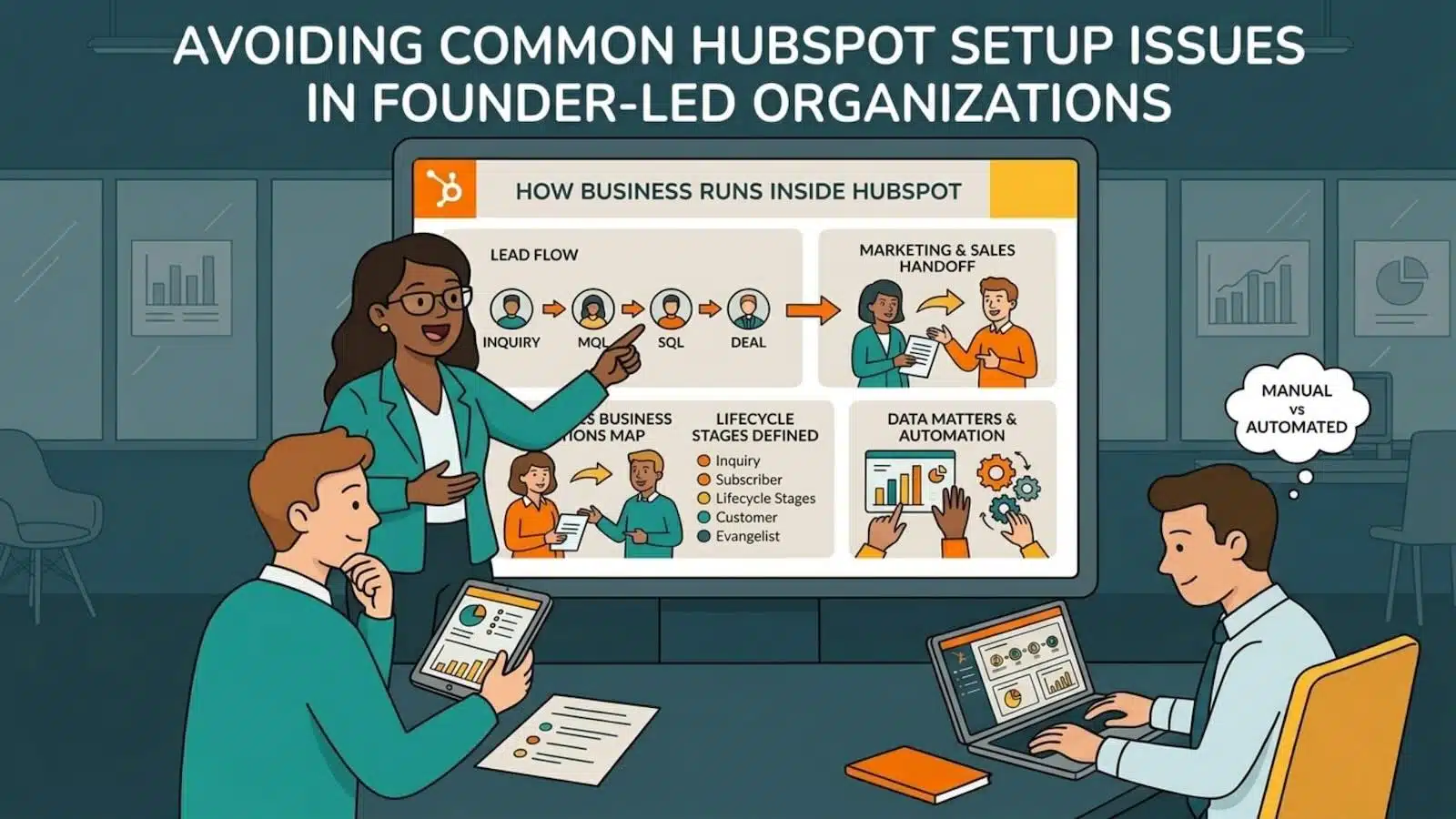
HubSpot implementation is not just about turning features on. It is about deciding how your business should run inside the platform. That includes how leads move from inquiry to deal, how handoffs happen between marketing and sales, how lifecycle stages are defined, what data matters, and what should be automated versus handled manually.
When implementation is treated like a fast setup project, teams end up recreating old problems in a new system.
Mistake 2: Skipping sales process and customer journey mapping
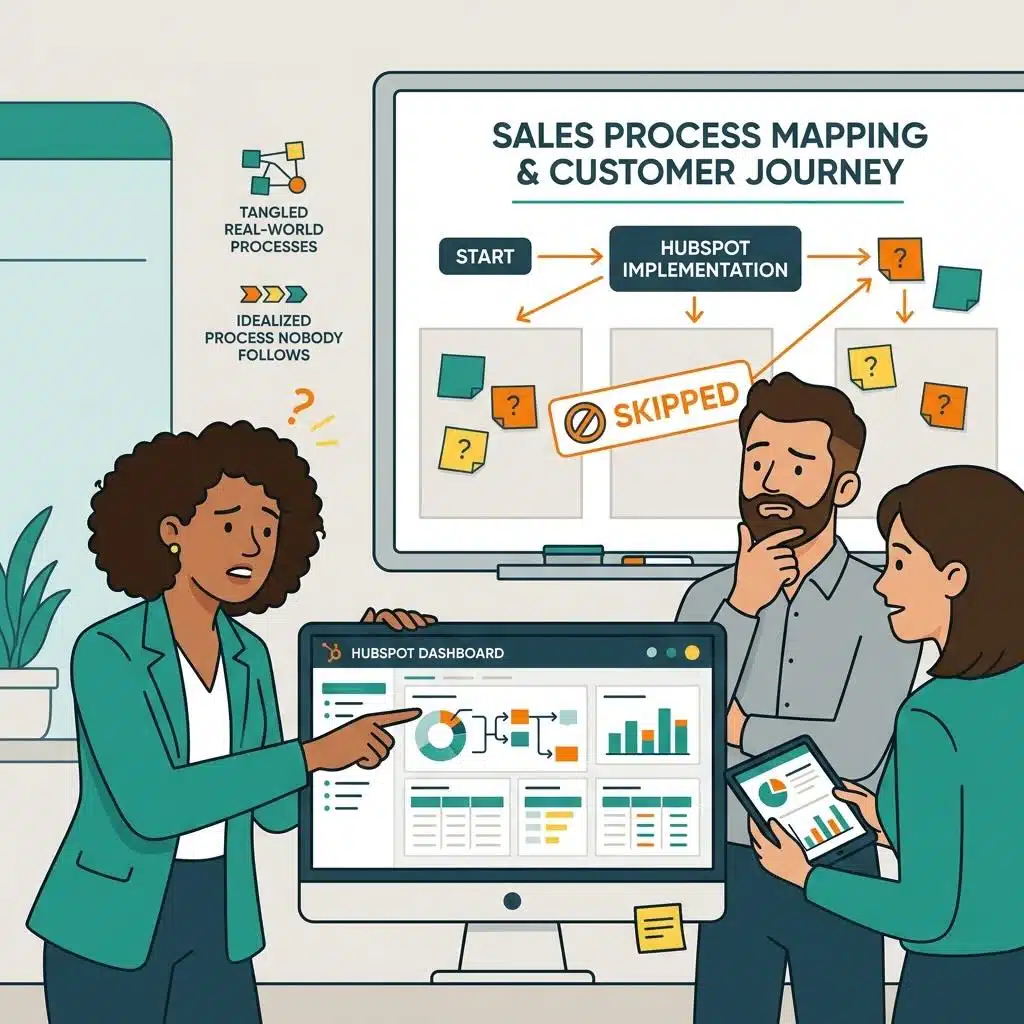
A lot of founder-led companies know their business well, but the process lives in people's heads. That works for a while. Then growth adds more team members, more handoffs, more campaigns, and more exceptions.
If you implement HubSpot before mapping the real sales process and customer journey, the system either reflects an idealized process nobody follows or a messy real-world process that should have been cleaned up first.
Before buildout, you need clarity on questions like:
- What counts as a qualified lead?
- When should sales engage?
- What should lead management look like from inquiry to opportunity?
- Which deal stages actually reflect the pipeline?
- What happens when a lead is not ready?
- What should happen after a deal closes?
Mistake 3: Using unclear lifecycle stages, lead scoring, and deal stages
HubSpot can only report clearly if your definitions are clear.
Many founder-led teams set up lifecycle stages quickly, then realize later that marketing, sales, and leadership all mean something different by lead, MQL, SQL, opportunity, or customer. The same thing happens with lead scoring. It gets added because it sounds mature, but without shared qualification rules it creates more noise than insight.
If your lifecycle model, deal stages, and scoring rules are fuzzy, your dashboards will look cleaner than your operations actually are.

Mistake 4: Migrating bad data and weak lead management rules
HubSpot is not a data-cleansing miracle.
If the old system has duplicates, inconsistent properties, outdated contacts, messy source tracking, and unreliable lifecycle values, moving that data straight into HubSpot CRM usually creates a cleaner-looking mess, not a better system.
Bad data does not just hurt reporting. It affects segmentation, automation, ownership, and confidence in the system.
Mistake 5: Leaving ownership too vague
HubSpot implementation needs explicit ownership. Someone has to own system governance, property logic, lifecycle stage changes, automation updates, reporting integrity, and documentation.
If that ownership is fuzzy, the system starts drifting almost immediately. The founder ends up back in the middle, which is usually the exact problem the implementation was supposed to solve.
Mistake 6: Expecting automation before clarity
Good automation saves time, improves consistency, and reduces manual work. Bad automation creates silent damage.
This usually happens when teams build workflows before they agree on process. They route leads before ownership is set. They create nurture paths before segmentation is clean. They update lifecycle stages before qualification rules are agreed.
The better approach is simpler: automate after the logic is stable, not before.

Mistake 7: Underestimating adoption and support
A technically correct implementation can still fail if the team does not use it properly.
Marketing Hub and Sales Hub can both be configured correctly and still underperform if the people using them are not aligned on expectations, data standards, and next steps.
This is also where a HubSpot partner or implementation services team can add value. Not because the company cannot use the software on its own, but because outside structure often helps founder-led teams avoid costly rework.
A practical HubSpot implementation checklist for founder-led B2B teams
Before you start a HubSpot CRM implementation, make sure you can answer these questions clearly:
- Do we agree on how leads become pipeline?
- Is our sales process actually defined?
- Have we mapped the key stages of the customer journey?
- Are our lifecycle stages and deal stages clear?
- Do we need lead scoring now, or later?
- Are we migrating clean data, or just all data?
- Who owns the system after launch?
- Which parts of Marketing Hub and Sales Hub do we really need first?
- Do we need outside help from a HubSpot partner or HubSpot implementation services team?
The bottom line
HubSpot can absolutely help founder-led B2B companies scale. But it does not fix weak process, messy data, vague ownership, or misaligned teams by itself.
That is why the biggest HubSpot implementation mistakes happen before anyone builds a workflow or creates a dashboard. If you want implementation to reduce friction instead of adding it, start by getting clear on how the business actually works, where it is breaking, and what the system needs to support.
Frequently Asked Questions (FAQs)
A proper implementation usually includes process mapping, lifecycle stage design, data structure planning, migration decisions, pipeline setup, automation logic, reporting foundations, user permissions, and team enablement.
The most common mistakes are treating implementation like software setup, skipping customer journey mapping, migrating bad data, using weak lifecycle definitions, automating too early, and leaving ownership unclear.
The most common mistakes are treating implementation like software setup, skipping customer journey mapping, migrating bad data, using weak lifecycle definitions, automating too early, and leaving ownership unclear.
A strong checklist should cover goals, sales process, customer journey, lifecycle stages, deal stages, data cleanup, ownership, automation priorities, and adoption planning.
No. HubSpot can support a stronger process, but it cannot create one for you. The platform reflects the operational decisions behind it.
Key Takeaways
- Founder-led companies often face challenges with HubSpot because they treat implementation like simple software setup.
- Key mistakes include skipping sales process mapping, using unclear lifecycle stages, and migrating bad data.
- Teams should ensure clarity on processes and ownership before automating workflows to avoid future issues.
- A practical checklist for HubSpot implementation includes defining lead management, data cleanliness, and understanding lifecycle stages.
- HubSpot can help scale businesses, but it cannot fix operational problems without proper implementation.