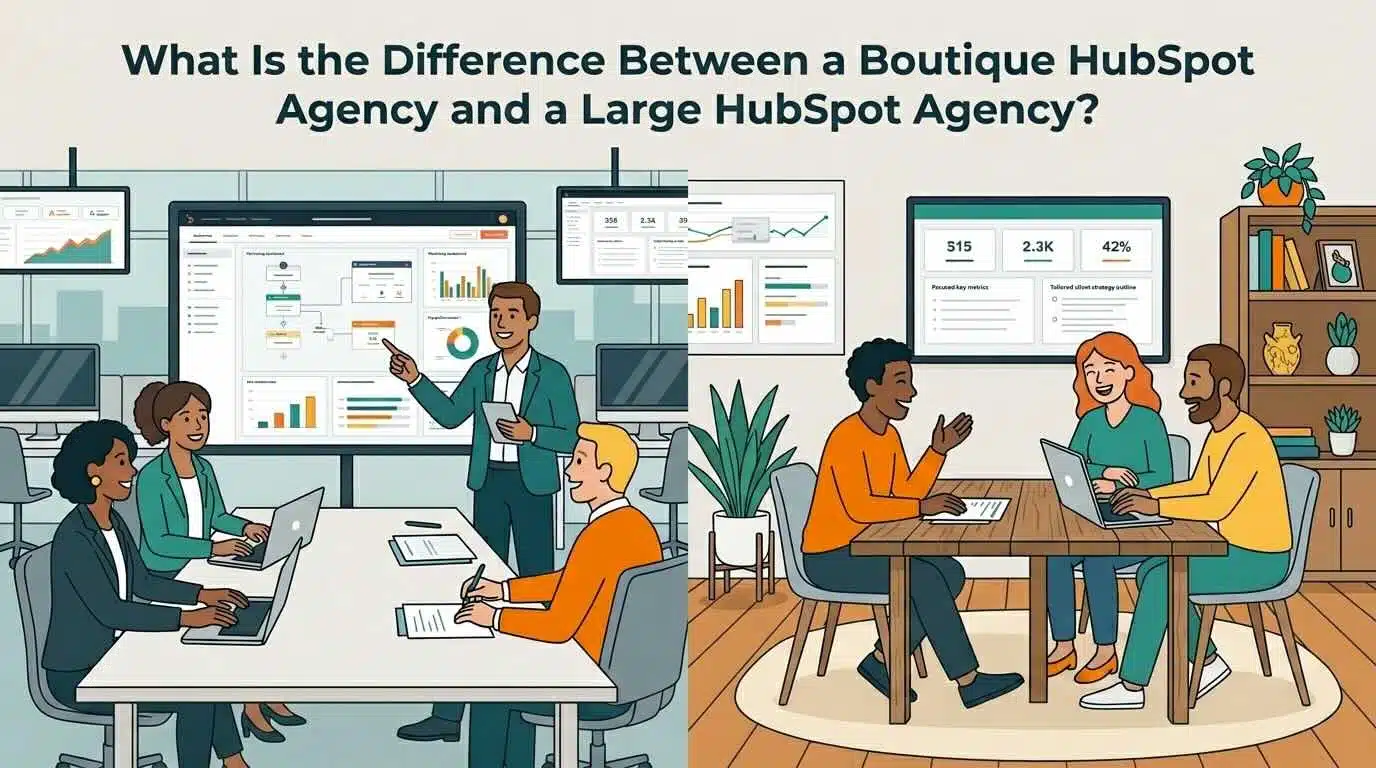
At first glance, the difference between a boutique HubSpot agency and a large HubSpot agency seems obvious: one is smaller, and one is bigger.
In practice, the more important difference is not size alone. It is how the work gets done.
That includes:
- who stays involved after kickoff
- how strategy moves into execution
- how quickly the team can adapt
- how communication works
- how much flexibility you really get
- whether the delivery model fits your business
That is why this decision is less about prestige and more about operating model.
If you want the broader cornerstone version of this topic, start with our full guide to large vs. boutique HubSpot Solutions partners. This article focuses more directly on the comparison itself and the practical differences buyers should weigh.
For background on HubSpot’s ecosystem terminology, you can also review the HubSpot Solutions Partner program and the HubSpot partner directory.
What Boutique HubSpot Agencies Tend to Look Like

Boutique HubSpot agencies are usually smaller, more specialized, and more senior-led.
That does not automatically make them better. It does mean the delivery model often looks different.
Common characteristics include:
- smaller teams
- closer access to strategists
- fewer layers between planning and execution
- narrower client rosters
- more flexibility in how work is scoped and adapted
- stronger specialization in a specific area, such as RevOps, CRM, lifecycle marketing, or content
In many boutique agency models, the people helping shape the strategy are also the people staying close to the work after kickoff.
That can create a tighter connection between decision-making and execution.
What Large HubSpot Agencies Tend to Look Like
Large HubSpot agencies often bring broader resourcing, more internal specialization, and more formal process.
Common characteristics include:
- larger teams
- more defined departments or functions
- broader service lines
- more layered communication structures
- more formalized workflows and documentation
- the ability to support larger or more complex accounts
That model can be a real advantage, especially when a business needs scale, cross-functional coordination, or broader execution support.
The tradeoff is that larger agency structures can also introduce more distance between strategy and delivery, depending on how the team is organized.
The Real Difference Is Not Size. It Is Structure.
This is the distinction buyers often miss.
A boutique agency is not better simply because it is smaller. A large agency is not better simply because it is bigger.
The more important question is how the agency’s structure affects:
- continuity
- speed
- accountability
- adaptability
- communication
- clarity
A small team may create faster decisions and tighter ownership. A larger team may create broader support and stronger process. Either can work well. Either can also be the wrong fit if the model does not match what your business needs.
Team Access and Senior Involvement
One of the most practical differences between boutique and large agencies is who you actually work with.
In many boutique agency models, senior strategists stay close to the day-to-day work. In larger agency models, senior involvement may still be strong, but it is worth understanding how it is structured and how handoffs work once the engagement begins.
This is not about assuming one model is better. It is about understanding who will actually be involved after the sale.
If you want to evaluate that more clearly, this article on how to choose a HubSpot partner walks through the decision framework in more detail.
Communication and Speed
The number of people involved in an account often affects how quickly things move.
Boutique agencies often have fewer layers, which can mean:
- faster answers
- quicker changes
- less internal coordination
- more direct communication
Large agencies may bring stronger process and documentation, but they can also require more coordination across roles and teams.
That does not automatically make them slow. It does mean speed can depend more heavily on account structure, internal process, and how the work is managed.
If communication style is a major factor for your team, these questions to ask before hiring a HubSpot agency can help you pressure-test the relationship before you sign. If you want a more direct side-by-side view, this article on the difference between a boutique HubSpot agency and a large HubSpot agency breaks down how the two models usually differ.
Flexibility vs. Standardization
Another common difference is how work gets adapted.
Boutique agencies often have more room to flex around:
- business model differences
- team realities
- shifting priorities
- unusual sales processes
- custom reporting needs
Large agencies often rely on more standardized processes, which can be helpful for consistency, training, and quality control.
The issue is not whether process is good or bad. The issue is whether the level of standardization helps your business or makes it harder to adapt.
For some teams, more structure is exactly what they need. For others, it creates friction.
Breadth vs. Focus
Large agencies often have the advantage when you need:
- more specialists
- broader technical coverage
- larger-scale execution
- more extensive support across channels or workstreams
Boutique agencies often have the advantage when you need:
- a tighter strategic relationship
- direct access
- focused expertise
- quicker decisions
- a team that feels more integrated with yours
This is one reason the better question is often not “Who is best?” but “Which model fits how we need to work?”
If you are still evaluating that broader question, this companion article on whether a big HubSpot partner is better can help.
What Buyers Often Get Wrong
A lot of companies do not choose the wrong agency because the team lacks capability.
They choose the wrong agency because they optimize for the wrong signals.
Those signals often include:
- size
- polish
- partner tier
- branding
- assumptions about responsiveness or senior access
Those factors are not irrelevant. They just should not outweigh the more practical questions about how the work actually gets done.
If partner status is shaping your decision more than it should, it helps to understand what HubSpot partner tier really means before treating it as a shortcut for quality or fit.
How to Think About the Choice More Clearly
A boutique HubSpot agency may be the better fit if you want:
- closer access to senior people
- faster iteration
- more flexibility
- a tighter working relationship
- focused expertise
- a more integrated-feeling team
A large HubSpot agency may be the better fit if you need:
- broader resourcing
- more formal process
- larger-scale support
- more cross-functional specialization
- enterprise coordination
- more structured delivery across a complex organization
This is why the best choice depends less on size and more on what your team needs most from the relationship.
Final Takeaway
The difference between a boutique HubSpot agency and a large HubSpot agency is not just about headcount.
It is about how strategy, communication, accountability, flexibility, and execution are structured.
A boutique model may be the better fit when you value speed, direct access, and tighter alignment. A larger model may be the better fit when you need scale, process, and broader specialization.
The goal is not to choose the agency model that sounds most impressive. It is to choose the one that matches how your business actually needs to work.
If you want help pressure-testing that fit, book a fit assessment or start with a HubSpot audit.