
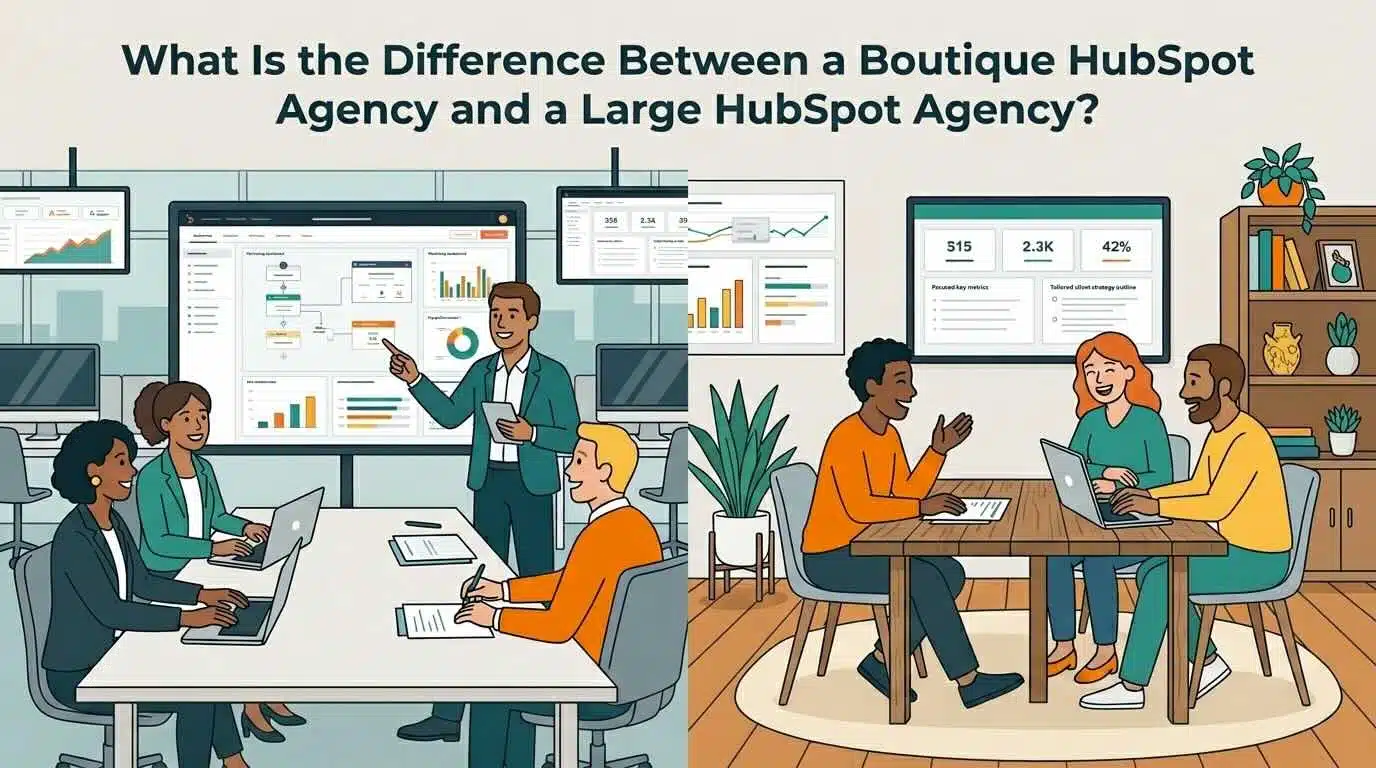
- What a HubSpot partner actually does
- The difference between boutique and large agencies
- Why delivery model matters more than many buyers realize
- When a larger partner may be the better fit
- How to evaluate partner tier more intelligently
- What to ask before you sign
The best HubSpot partner is not always the biggest one. It is the one whose delivery model fits your business, your team, and how you need to execute.
Choosing between a large and a boutique HubSpot Solutions Partner can feel deceptively simple. Many companies assume the safest path is to hire the biggest agency they can afford or default to a higher-tier partner because the logo, team size, or status feels reassuring.
That logic makes sense on the surface. It just does not always lead to better outcomes.
The truth is, HubSpot success usually has less to do with agency size and more to do with how the work actually gets done. The right partner is not necessarily the one with the biggest headcount, the flashiest badge, or the most polished sales process. It is the one whose delivery model fits your business, your team, and the way you need to execute.
For many mid-market and growth-stage companies, that is where boutique HubSpot agencies often have an advantage.
This guide breaks down the real difference between boutique and large HubSpot agencies, when a bigger partner may make sense, and how to choose a HubSpot Solutions Partner based on fit, execution, and results, not just reputation.
Key Takeaways
- Choosing a HubSpot Solutions Partner requires prioritizing delivery model over agency size or reputation.
- Boutique agencies often provide faster communication and greater senior involvement than larger agencies.
- Larger agencies can offer more resources and structure, but may introduce delays and distance in strategy execution.
- Evaluate potential partners by examining who will do the work and their communication processes.
- Understand your business needs to determine whether a boutique or large agency is the better fit for your HubSpot needs.
What Is a HubSpot Solutions Partner?
A HubSpot Solutions Partner is an agency or consultant that helps businesses with sales & marketing strategy, implementation, CRM setup, automation strategy, reporting, content, lead management, and optimization. They may be full service marketing agency or just focus on managed HubSpot services.
If you are researching options, the HubSpot Solutions Partner directory can be a useful starting point. It helps you compare firms at a high level, but it should not be the only filter you use.
HubSpot Solutions Partner program tiers can be helpful as a broad signal, but they are often over-weighted in the buying process. A tier can reflect a combination of partner growth, client success, and overall business performance indicators. It still does not tell you everything you need to know about fit. The team assigned to your account, the agency’s delivery model, and the way strategy translates into execution matter just as much. If tier is carrying too much weight in your decision, it helps to understand what HubSpot Solutions Partner tier really means before treating it as a proxy for fit.
In other words, tier can suggest scale. It does not guarantee quality of delivery for your specific engagement.
What Is the Difference Between a Boutique HubSpot Solutions Partner and a Large HubSpot Agency?
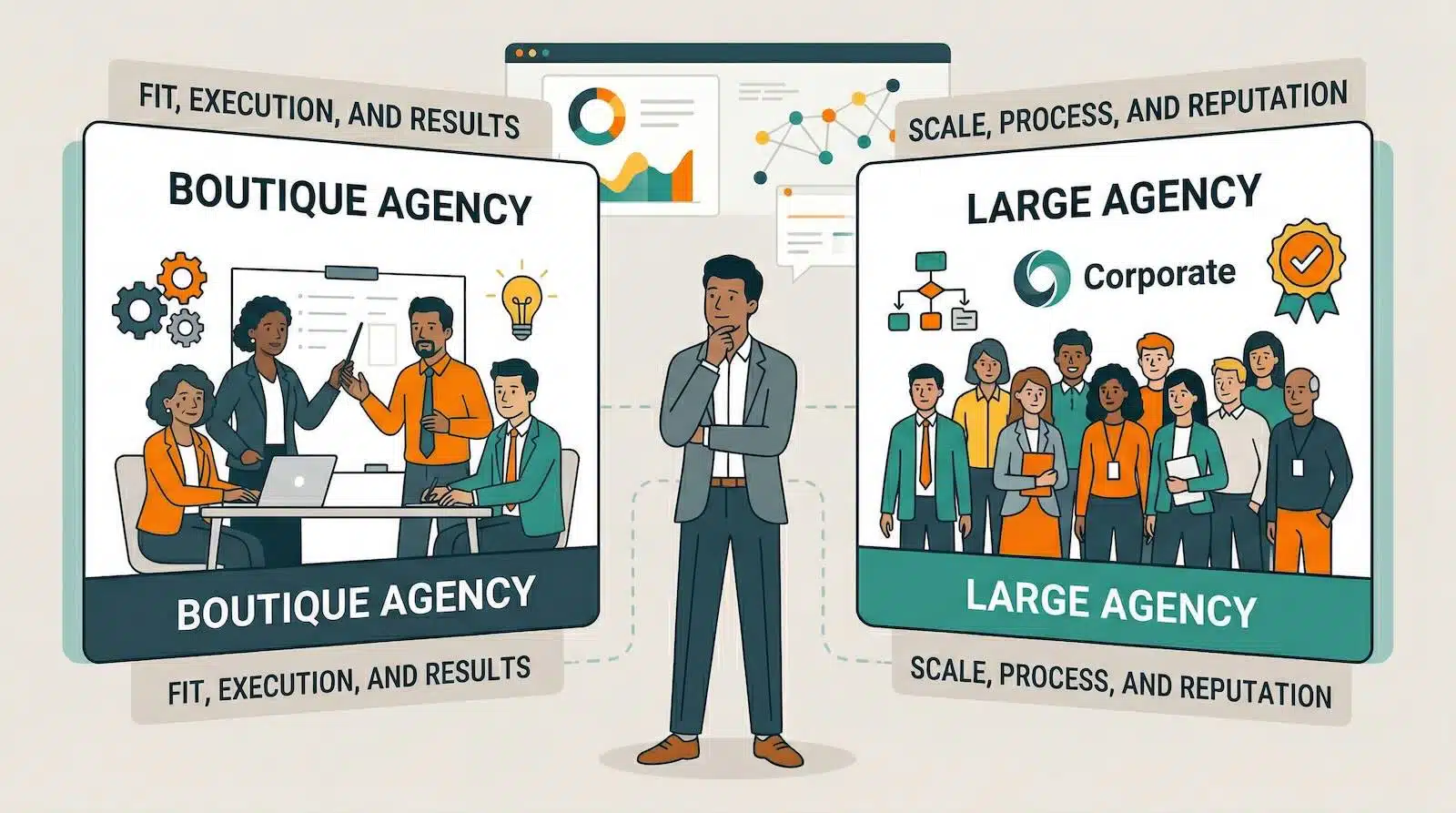
At a high level, the difference is not simply company size. It is operating model.

Boutique HubSpot Solutions Partner
Boutique agencies tend to have smaller, more senior-led teams. In many cases, the people shaping the strategy are the same people close to the actual work. They often serve fewer clients, specialize more narrowly, and keep communication more direct.
That usually means:
- more access to senior expertise
- less translation between strategy and execution
- faster feedback loops
- more flexibility in adapting to your funnel, process, and internal realities

Large HubSpot Agencies
Large HubSpot Solutions Partners usually bring broader service lines, more staff, and more standardized processes. That can be useful in the right environment, especially when the scope is large and complex.
That usually means:
- deeper bench strength across disciplines
- more formal processes and documentation
- more layered account structures
- more handoffs across teams
The Real Difference
In practice, one of the biggest differences is how closely strategy stays connected to day-to-day execution. Boutique agencies often keep senior expertise closer to the work. Larger agencies may bring more layered teams, which can create more distance between the people shaping the strategy and the people carrying it out. That does not make one model universally better than the other, but it does affect speed, continuity, and communication.
For a more direct side-by-side breakdown, see the difference between a boutique HubSpot agency and a large HubSpot agency
Large Agencies vs. Boutique HubSpot Solutions Partners at a Glance
Why Some Boutique HubSpot Solutions Partners Deliver Better Results
A boutique agency is not automatically better because it is smaller. It can be a stronger fit because its delivery model often creates conditions that support faster communication, clearer accountability, and tighter strategy-to-execution alignment.

Senior Talent Often Stays Closer to the Work
In many boutique firms, senior people are not just involved in the pitch. They also stay engaged in strategy, oversight, and sometimes direct delivery.
That can reduce the gap between what is discussed early in the relationship and what gets implemented over time.
By contrast, in more layered agency models, buyers should verify how senior leadership stays involved after kickoff and how responsibility is handed off across the team. One of the most common concerns in agency selection is paying for senior strategy but junior execution, especially when roles and ownership are not clear from the start.
Communication Is Faster and Clearer
More layers usually mean more lag. When communication has to move from account manager to strategist to specialist to developer and back again, things slow down. Context gets diluted. Small issues become larger than they need to be.
Boutique teams often remove some of that friction. You get fewer handoffs, clearer ownership, and faster iteration.
Strategy Is Often More Customized
Standardization can be helpful, especially when scope is broad or teams are large. The challenge comes when a process is too rigid for a company’s actual business model, sales motion, lifecycle stages, or reporting needs.
Boutique agencies often have more room to adapt strategy around those realities rather than applying a more uniform framework. That matters even more when your HubSpot instance needs stronger revenue operations alignment or a clearer lifecycle and handoff strategy.
Accountability Is Harder to Avoid
Smaller teams create visibility. There is less room to hide behind process, roles, or internal complexity. When things are not moving, it is easier to see why. When something works, it is clearer who made it work.

That kind of accountability matters more than most buyers realize.
Better Fit for Lean, Modern B2B Teams
Many B2B companies do not need an oversized agency machine. They need a HubSpot Solutions Partner that can think strategically, execute efficiently, and adapt quickly across marketing, sales, and RevOps to implement and optimize Sales Hub, Marketing Hub, Service Hub, Content Hub and more.
That is often where boutique partners shine. They are better aligned to teams that need precision, speed, and practical decision-making rather than layers of process.
Common Tradeoffs to Evaluate with Larger HubSpot Solution Partner Models
Larger agencies can be highly effective, especially when the work requires broader coverage, deeper specialization, or more formal coordination. At the same time, their operating model can introduce tradeoffs that buyers should understand before signing.
Layered Team Structures Can Create Distance
In some larger agency environments, the people leading the sales process are not always the same people most involved in day-to-day delivery. That is not inherently a problem, but buyers should understand how strategy, communication, and accountability will carry through once the engagement begins.
Process Can Improve Consistency but Also Add Friction
Structure is often one of the strengths of a larger agency. It can improve consistency, documentation, and quality control. The tradeoff is that more process can also slow adjustments, especially when a company needs faster iteration or more tailored execution.
Communication Layers Can Affect Speed
When communication has to move across multiple roles or teams, timelines can stretch and context can get diluted. For companies that need to move quickly, that added friction can matter. This is also one of the reasons HubSpot implementations fail after the agency handoff.
Account Prioritization Can Vary by Agency Model
In some agency models, responsiveness and access may vary based on account structure, team bandwidth, or scope. That is worth clarifying up front, especially for mid-market companies that want a more proactive strategic relationship. If some of these patterns feel familiar, these are often signs you chose the wrong HubSpot partner.

When a Large HubSpot Solutions Partner May Be the Better Fit
A balanced answer matters here.
There are cases where a large HubSpot agency is absolutely the right choice, and in some environments it may be the stronger option.
A bigger HubSpot Solutions Partner may be the better fit if you need:
- enterprise-wide rollout support
- complex cross-platform integrations
- multi-region or multi-brand execution
- a broader bench across many specialties
- highly structured delivery across a large stakeholder group
- substantial development capacity
If you are managing a larger stack with many HubSpot integrations, enterprise-level support may matter more than agency size alone.
In those scenarios, scale, process, and bench depth can be real advantages.
The point is not that large agencies are the wrong choice. It is that they are not automatically the right choice for every company. For many businesses, the better fit still comes down to how the work gets done, how quickly the team can adapt, and how closely strategy stays connected to execution. For a more balanced look, see when a large HubSpot agency is actually the right choice.
Is a Big Agency Better Than a Boutique HubSpot Partner Better?
Maybe you're wondering, "is a big HubSpot Partner better?" Sometimes. In the right situation, yes. In many others, not necessarily.
A big HubSpot Solutions Partner may bring more capacity, broader specialization, and more formal structure. That can be valuable. It does not automatically make the partner better for your business.
Larger agencies often win on breadth, process, and resourcing. Boutique agencies often win on focus, access, speed, and strategic continuity.
For many scaling companies, the better question is not, “Who is biggest?” It is, “Which partner model is most likely to help us make smart decisions and execute them well without unnecessary friction?”
If that is the question you are wrestling with, here is a more direct breakdown of whether a big HubSpot partner is better.
How Do I Choose a HubSpot Partner?
If you are evaluating HubSpot Solutions Partners, start with the delivery model, not the sales pitch.
1. Ask Who Will Actually Do the Work
Do not just ask who leads the account. Ask who is responsible for strategy, implementation, reporting, workflows, and optimization.
Meet the real team if possible.
2. Evaluate Strategic Depth
Can they explain how they think about revenue model, lifecycle stages, lead management, attribution, sales alignment, and operational friction?
Or are they staying at the level of tactics?
A strong partner should understand the system, not just the tools. In many cases, what looks like a HubSpot problem is really a CRM optimization or process alignment problem upstream.
3. Look Closely at the Execution Model
How many layers are involved? How quickly do requests move? Do you get access to the people making decisions? How is feedback handled?
Execution quality is not just about talent. It is about how work moves.
4. Prioritize Fit Over Tier
Certifications and tiers can be useful data points, but they should not decide the outcome.
Business model alignment, communication style, speed, and practical relevance matter more.
5. Pressure-Test Communication Early
The early buying process often shows you exactly what the relationship will feel like later.
If communication is already slow, vague, or overly polished without substance, do not assume it will improve after the contract is signed.
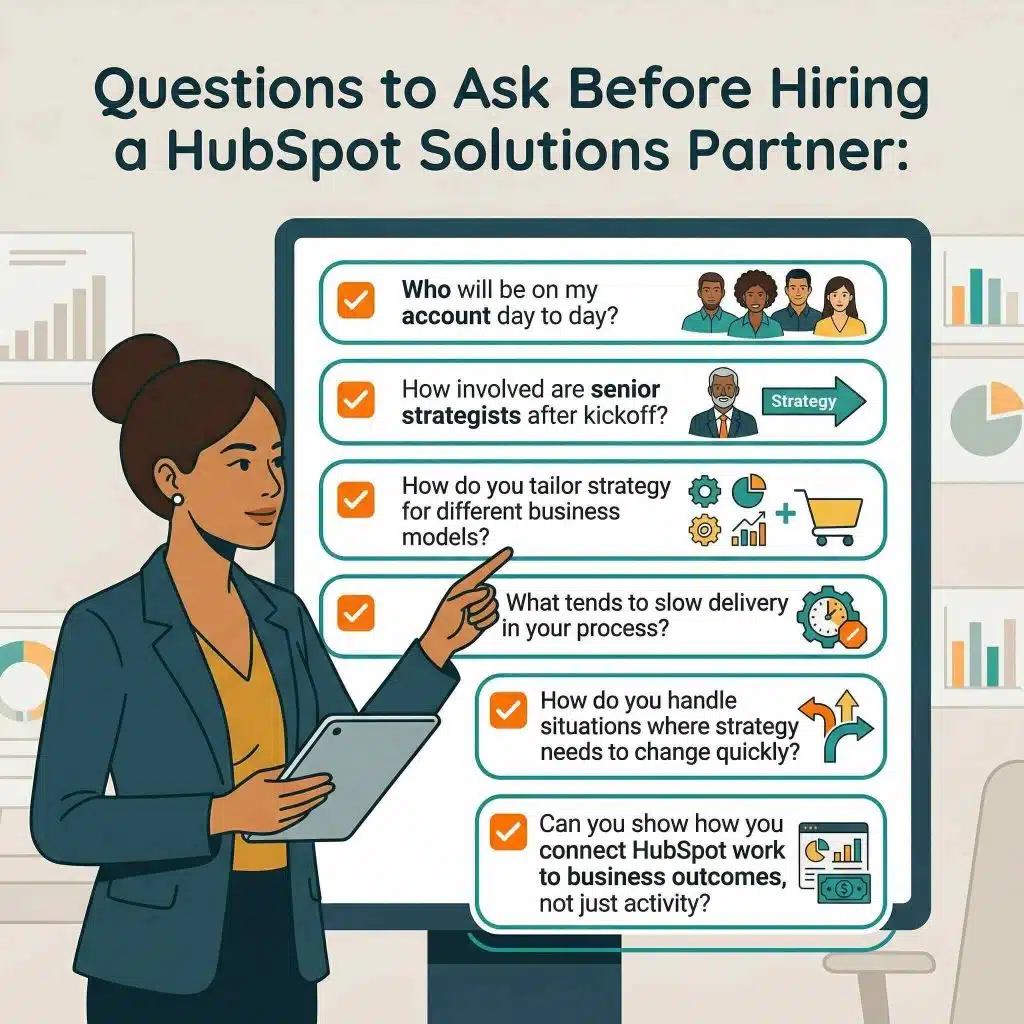
Questions to Ask Before Hiring
A few useful questions:
- Who will be on my account day to day?
- How involved are senior strategists after kickoff?
- How do you tailor strategy for different business models?
- What tends to slow delivery in your process?
- How do you handle situations where strategy needs to change quickly?
- Can you show how you connect HubSpot work to business outcomes, not just activity?
For a more practical checklist, review these questions to ask before hiring a HubSpot agency.
And if you are evaluating firms across different support models, it also helps to compare HubSpot partner vs. HubSpot consultant.
If you want another way to assess fit, you can also review our HubSpot partner profile as one example of how a firm presents its positioning, capabilities, and focus in the marketplace.
Which Type of HubSpot Solutions Partner Is Right for You?
A boutique HubSpot Solutions Partner may be the better fit if:
- you want direct access to senior people
- you need faster iteration
- your team values practical collaboration
- you want a tailored sales, success, or marketing strategy
- you care more about execution quality than agency scale
A large HubSpot agency may be the better fit if:
- your organization is highly complex
- you need enterprise coordination across many workstreams
- you require specialized resources at scale
- you are comfortable with a more layered operating model
If neither option seems right, that is useful too. In some cases, a consultant, fractional RevOps lead, or hybrid support model may make more sense.
Frequently Asked Questions
Choose a partner based on who will actually do the work in your HubSpot instance, how strategy connects to execution, how quickly the team can adapt, and whether their delivery model fits your business. Tier and size should be secondary filters, not the deciding factors.
Boutique agencies usually offer more senior involvement, fewer handoffs, and more tailored execution. Large agencies usually offer more scale, more structure, and broader bench strength. The best choice depends on your complexity and how you need work to get done.
Not by default. Bigger can mean more capacity, but it can also mean more process, more layers, and slower execution. The better partner is the one that best fits your goals, team, and operational needs.
Not necessarily. It may signal scale and strong partner performance at a business level, but it does not guarantee that your account will get the right team, right strategy, or right level of support.
That depends on scope. A consultant may be a good fit for focused strategy, audits, or interim leadership. An agency may be a better fit for ongoing execution across multiple disciplines. The deciding factor should still be fit and delivery quality.
Final Takeaway
Most companies do not struggle with HubSpot because they chose the wrong platform.
They struggle because they chose the wrong partner model.
If your business needs clarity, accountability, faster execution, and a team that stays close to the work, a boutique HubSpot agency may be the stronger choice. If your needs are broader and more operationally complex, a larger partner may be worth it.
The point is to make the decision based on how results happen, not how impressive the agency looks on paper.
If you are not sure whether you need a new partner or a reset, start with a HubSpot audit. You can also review client results or book a fit assessment to talk through what kind of support model makes the most sense for your business.