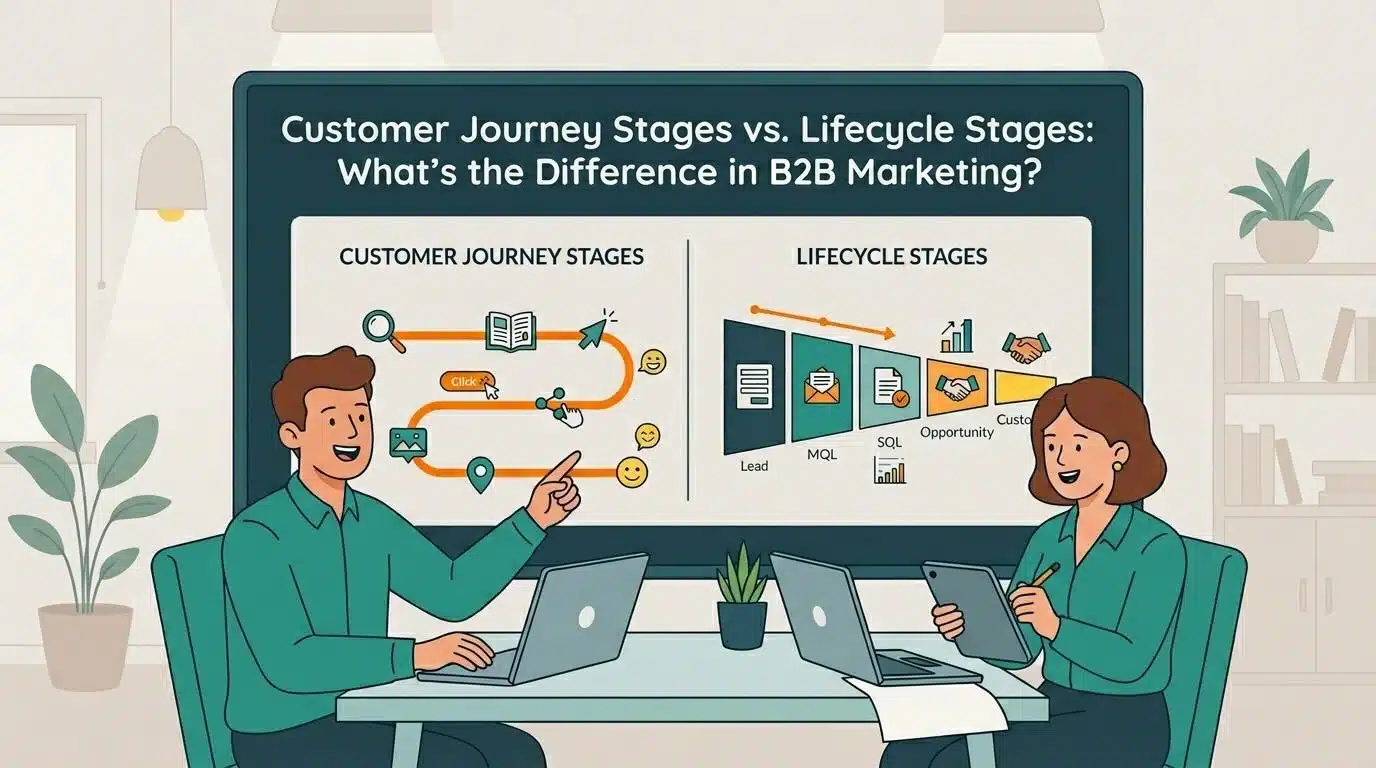
Many B2B teams use customer journey stages vs lifecycle stages interchangeably, but they are distinct. Confusing the two can disrupt your systems, reporting, and lead management.
While related, these concepts serve different purposes. Treating them as the same can disrupt your CRM setup, break automation, hinder lead handoffs, and reduce reporting accuracy.
This post explains each term, why confusion occurs, and how to use both frameworks together to improve marketing, sales, and customer growth. You will also find practical next steps and a checklist to help your team identify and address misalignment.
Quick Answer: What's the Difference?
Customer journey stages outline the buyer’s experience at each step, from awareness and consideration to decision, retention, and advocacy. The focus is on the buyer’s perspective.
Lifecycle stages are internal labels your business uses to track and manage contacts within your CRM and sales systems. They support sorting, automation, lead routing, and funnel measurement, focusing on internal processes.
Customer journey stages reflect the buyer’s experience, while lifecycle stages organize your internal processes.
What Are Customer Journey Stages?
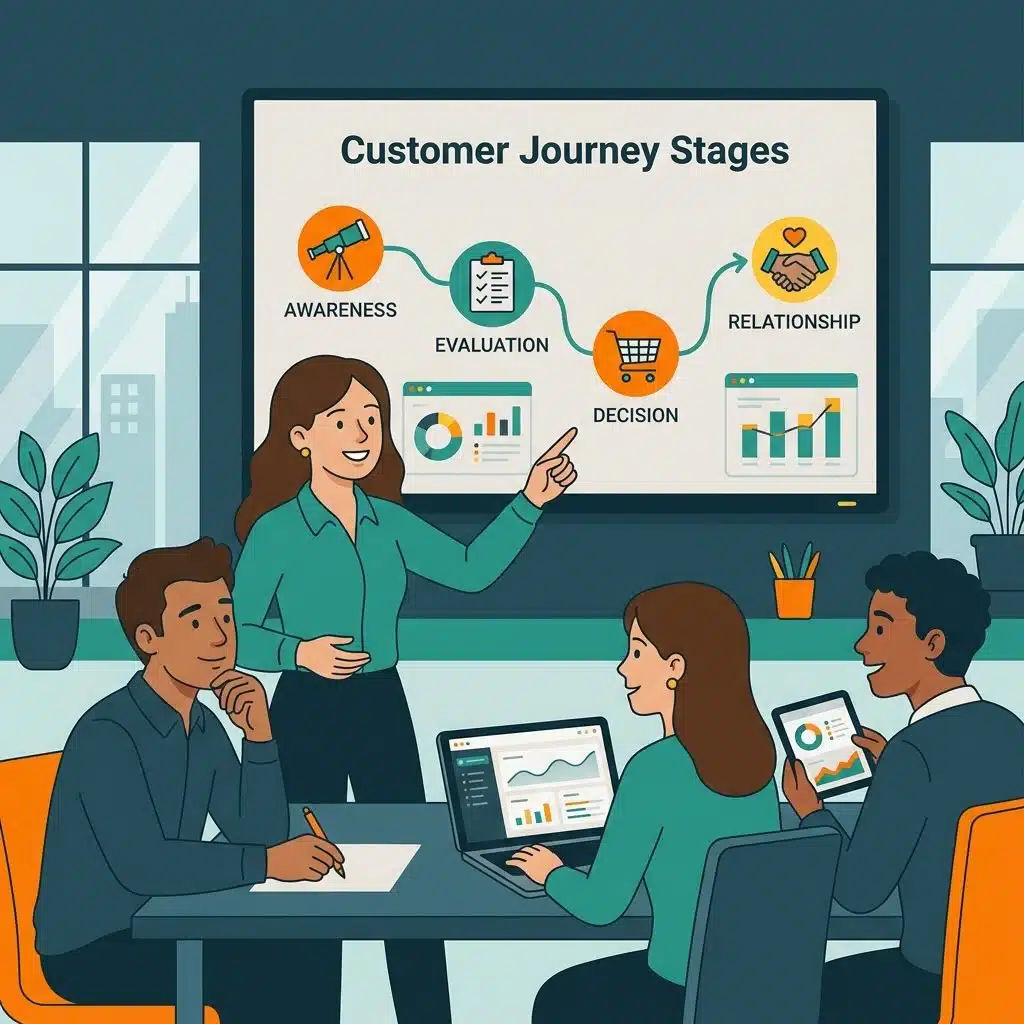
Customer journey stages represent the phases a buyer moves through as they become aware of a problem, evaluate solutions, make a decision, and continue the relationship after purchase.
Common customer journey stages in B2B include:
- Awareness: The buyer realizes they have a problem or opportunity.
- Consideration: They research potential solutions and evaluate options.
- Decision: They choose a vendor and move toward purchase.
- Retention: They use the product or service and derive value from it.
- Advocacy: They recommend the solution to others or expand usage.
These stages focus on the buyer, helping you identify their needs at each step, determine relevant content, and track changes in their actions over time.
Customer journey stages support planning for content, messaging, campaigns, and overall experience. They prompt you to consider what matters to the buyer now and what will encourage their next step.
What Are Lifecycle Stages?
Lifecycle stages are business-defined labels used to sort and manage contacts in your CRM. They indicate a contact’s position in your process, not their experience or perspective.
Common lifecycle stages in B2B include:
- Subscriber: Someone who opted in but has not engaged meaningfully yet.
- Lead: A contact who has shown interest but is not sales-ready.
- Marketing Qualified Lead (MQL): A lead who meets criteria for sales engagement.
- Sales Qualified Lead (SQL): A lead that sales has accepted and is actively working.
- Opportunity: A contact in an active sales process.
- Customer: Someone who has purchased.
- Evangelist: A customer who actively promotes your business.
Lifecycle stages address your company’s needs by managing workflows, automating tasks, routing leads, tracking conversions, and supporting funnel reporting.
They help clarify contact ownership, next steps, and progress tracking.
Customer journey stages vs lifecycle stages: key differences
| Dimension | Customer Journey Stages | Lifecycle Stages |
|---|---|---|
| Purpose | Understand the buyer's experience | Manage contacts operationally |
| Perspective | Buyer-centric | Company-centric |
| Ownership | Marketing, customer experience, content | Marketing ops, RevOps, sales ops |
| Use in CRM | Informational or segmentation | Structural and functional |
| Role in Automation | Informs messaging and content | Triggers workflows and handoffs |
| Role in Reporting | Tracks engagement and behavior | Tracks funnel progression and conversion |
While these frameworks overlap, they are not identical. For example, a buyer in the consideration stage is an MQL in your CRM, or someone in the decision stage is a lead if sales has not accepted them.
For example, a software company saw a spike in MQLs, but sales found these leads were not ready for engagement. The CRM advanced contacts to MQL status after viewing a demo video, regardless of their actual decision stage. This misalignment led to premature handoffs, low conversion rates, team frustration, and misleading reports.
Why B2B Teams Confuse Them
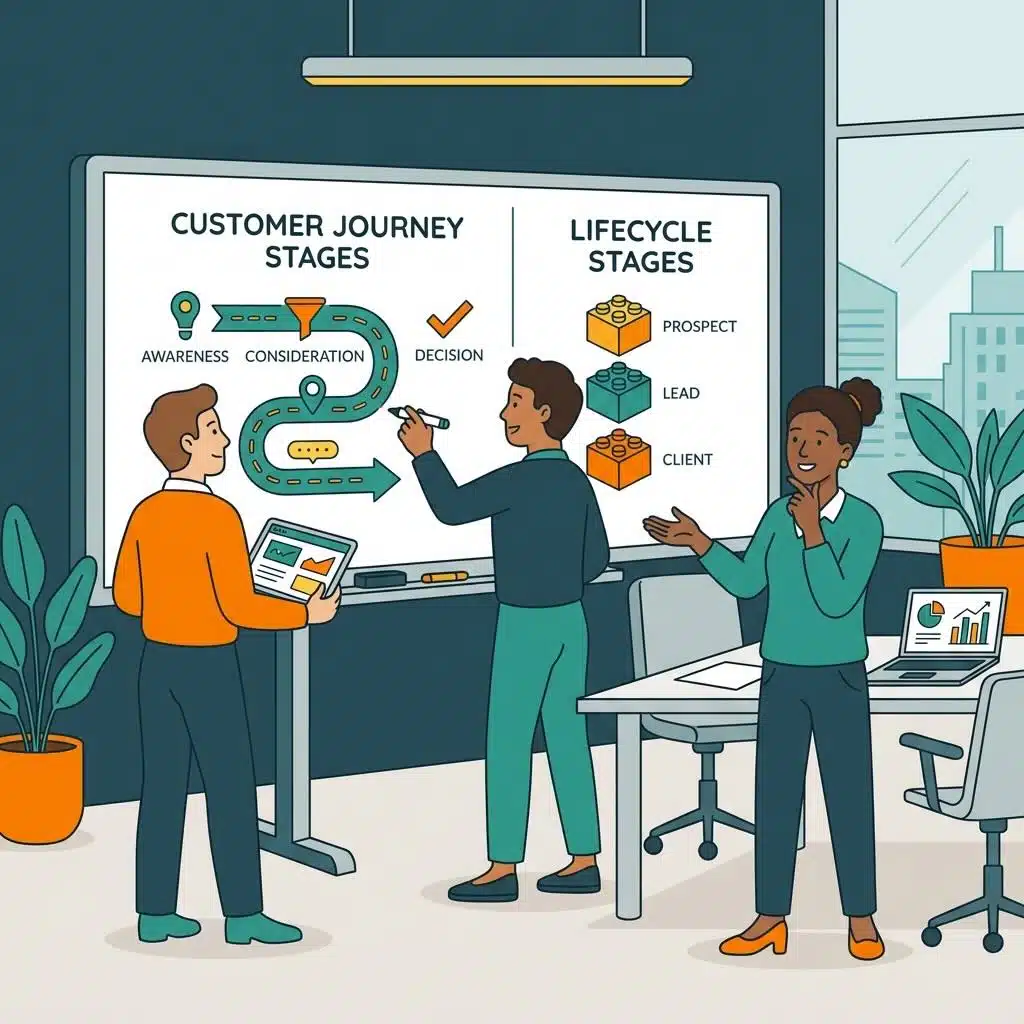
Confusion around customer journey stages vs lifecycle stages arises because both frameworks describe progression and use similar stage-based terminology. Many also visualize them as linear funnels.
Here are the main reasons people mix them up:
They sound similar. Labels like "awareness" and "consideration" appear in both models, though they mean slightly different things in different contexts.
CRM platforms can add to the confusion. According to HubSpot, the 'lifecycle stage' property in its CRM automatically advances prospects through predefined stages. For example, a prospect moves from Subscriber to Opportunity, and these stages move forward by default. While some teams adjust these stages to better match customer journey phases instead of the intended internal sales process, such changes may lead to complications down the line.
Marketing and sales often have different perspectives: marketing focuses on the buyer’s journey, while sales prioritizes pipeline stages and deals. If these models don't align, lifecycle stages become a compromise that does not fully serve either team.
Journey mapping workshops often do not align with CRM design. Teams may map the customer journey but fail to translate it into a functional lifecycle model, resulting in a journey map that does not match CRM operations.
Why the Difference Matters
When considering customer journey stages vs lifecycle stages, remember that if they are misaligned, the problems show up in predictable places.
CRM Structure Breaks Down
If lifecycle stages mirror every detail of the customer journey, you risk excessive stages, unclear definitions, and contacts that do not fit any category. Ignoring the journey limits segmentation and personalization.
Automation Logic Fails
Automation requires clear and consistent lifecycle stage definitions. If these are vague or too journey-focused, workflows fail, leads don't route correctly, nurture emails may not send, and handoffs stall.
Lead Handoffs Get Messy
Sales and marketing must agree on lifecycle stage definitions and transition criteria. If stages rely on subjective buyer sentiment rather than clear actions, handoffs become inconsistent.
Reporting Becomes Unreliable
Lifecycle stages form the foundation of funnel reporting. If they are unclear or inconsistently applied, conversion data becomes unreliable, and it is difficult to identify bottlenecks or effective campaigns.
Content Does Not Match Buyer Readiness
If your team develops content for customer journey stages but distributes based on mismatched lifecycle stages, messaging may not align with buyer needs. For example, an awareness-stage contact may receive decision-stage content if advanced to MQL prematurely.
Post-Sale Continuity Suffers
The customer journey extends beyond purchase, yet many lifecycle models end at 'customer.' Omitting onboarding, expansion, renewal, or advocacy stages limits visibility into post-sale experience and opportunities for retention and growth.
How They Should Work Together
These two types of stages don't have to be in conflict. Instead of thinking "customer journey stages vs lifecycle stages," consider how they are actually complementary and should work together.
The customer journey should guide how you set up. The customer journey should inform the design of your lifecycle stages. Understanding buyer progression from awareness to decision helps define MQL and SQL criteria, readiness indicators, and appropriate content or engagement for each stage. The customer journey exactly. They should:
- Reflect on how your business actually operates.
- Support automation, reporting, and handoffs.
- Be clear, measurable, and consistently applied.
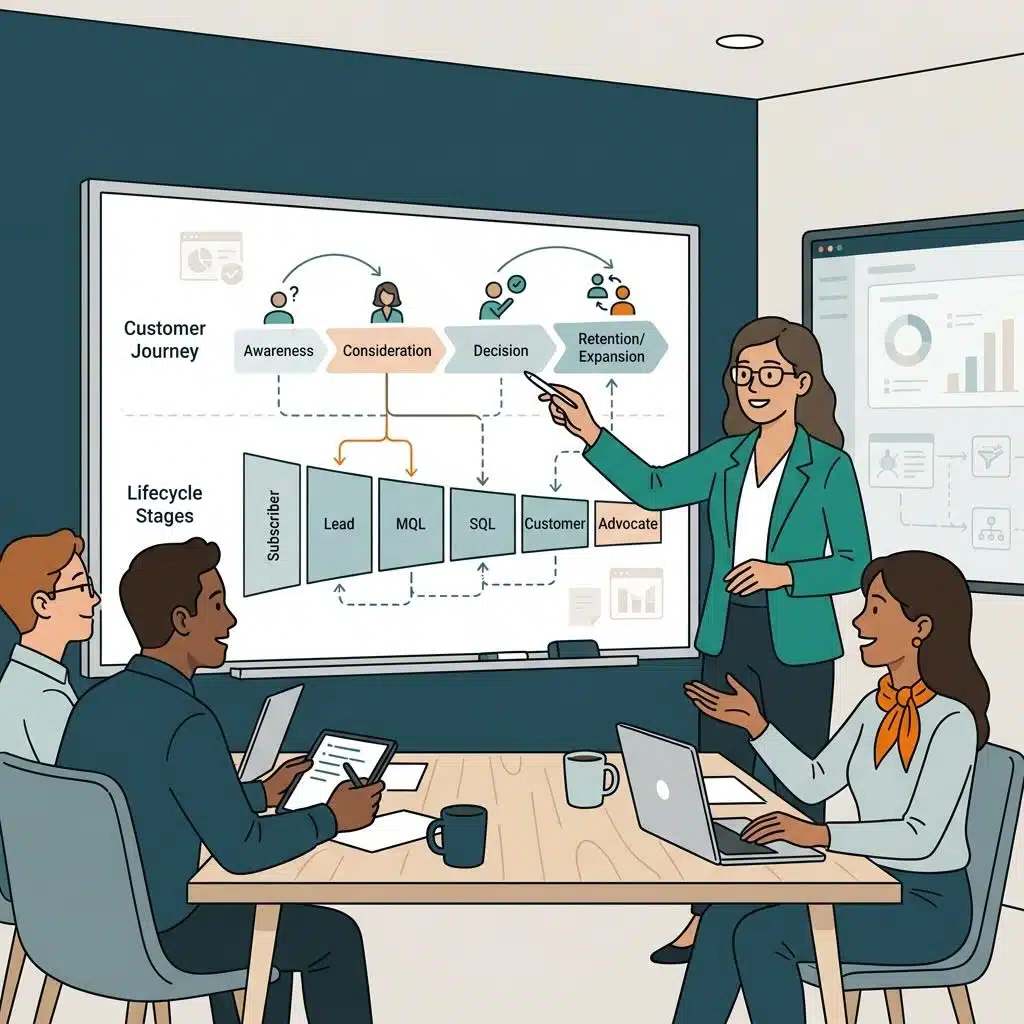
Here is how they should work together in practice:
Use customer journey stages to guide strategy. Develop content, campaigns, and messaging that address the buyer’s experience and needs at each step.
Use lifecycle stages to execute plans and measure outcomes. Configure your CRM, automation, and reporting based on lifecycle stages that align with internal processes. Ensure these stages are clear, consistent, and reflect marketing and sales collaboration.
Map the connection between the two frameworks. Identify how customer journey stages align with lifecycle stages, even if they do not match exactly. For example, a consideration-stage buyer may be a subscriber, lead, or MQL, depending on engagement and fit.
Establish clear definitions and progression criteria for each stage. Ensure marketing, sales, and operations understand these definitions, the actions that move contacts between stages, and how stages relate to the buyer’s journey.
Review your current journey and lifecycle frameworks, and facilitate cross-team alignment on definitions, criteria, and automation rules. Use structured meetings to review definitions, discuss pain points, agree on updates, and assign next steps. Schedule regular check-ins to maintain alignment and support business objectives.
Signs They're Misaligned
To check if your customer journey and lifecycle stages are working together, look for these signs:
If lifecycle stages end at "customer," you lose visibility into retention, expansion, and advocacy for post-sale contacts.
- Leads get stuck without distinct next steps if lifecycle stages lack specific criteria.
- Sales says MQLs aren't ready if their definitions don't match buyer readiness.
- Funnel metrics become unreliable if lifecycle stages are inconsistent or unclear.
- Content may not align with buyer needs if lifecycle stages trigger messaging that does not correspond to the buyer's journey.
- Automation becomes overly complex if lifecycle stages are too detailed or focused on the journey.
- If lifecycle stages end at "customer," you lose visibility into retention, expansion, and advocacy for post-sale contacts.
Final Takeaway
Customer journey stages and lifecycle stages are distinct and should not be treated as the same.
Customer journey stages provide insight into the buyer’s experience, while lifecycle stages support internal contact management. The objective is alignment, not uniformity, to enhance marketing, sales, and customer growth.
Proper alignment of these stages improves CRM performance, streamlines automation, simplifies handoffs, enhances reporting accuracy, and ensures content matches the buyer’s journey.
If you are unsure whether your lifecycle stages are properly configured or aligned with your customer journey, review them closely. Even minor misalignments can lead to significant issues over time.
Conduct a quick self-assessment: Review a recent lead handoff between marketing and sales for any confusion about lead readiness. Examine recent funnel metrics for unexpected drop-offs or discrepancies between reported MQLs and sales feedback. Identifying these signs can help determine if your journey and lifecycle stages are aligned or need updating.
Frequently Asked Questions
Customer journey stages describe the buyer's experience as they move from awareness to decision and beyond. Lifecycle stages are internal labels your business uses to classify and manage contacts in your CRM. Journey stages are buyer-centric. Lifecycle stages are company-centric.
No. They are related but serve different purposes. Customer journey stages focus on the buyer's perspective and experience. Lifecycle stages focus on how your business tracks, routes, and manages contacts operationally.
Customer journey stages should inform how you design your lifecycle stages. When you understand the buyer's journey, that knowledge helps you define what behaviors signal readiness, the content required at each stage, and how to structure your CRM and automation. But lifecycle stages do not need to mirror the journey exactly—they need to reflect how your business actually operates.
They get confused because both frameworks describe progression, both use stage-based language, and both are often visualized as funnels. However, CRM platforms also blur the line by using "lifecycle stage" as a default property that teams sometimes customize to reflect journey phases instead of operational stages.
No. Lifecycle stages should be informed by the customer journey, but they need to reflect your internal process, support automation and reporting, and align with how marketing and sales actually work together. After all, the goal is alignment, not perfect symmetry.
Lifecycle stages are properties in your CRM that classify contacts based on where they are in your operational funnel. They trigger automation, route leads, enable segmentation, and power funnel reporting. They help you answer questions like: Who owns this contact? What should happen next? How do we measure progress?
Misalignment creates problems in CRM structure, automation logic, lead handoffs, reporting accuracy, content relevance, and post-sale continuity. When misalignment occurs, leads stall, handoffs fail, metrics become unreliable, and messaging does not match buyer readiness.
When lifecycle stages do not reflect actual buyer readiness or journey progression, leads get routed too early or too late, content does not match where people are, and handoffs between marketing and sales break down. Instead, all of this creates friction that slows or stops conversion.
Customer journey stages should inform how you design your CRM structure and automation. After all, they help you understand what content, messaging, and engagement are needed at each phase, which in turn shapes how you define lifecycle stages, build workflows, and segment your database.
Lifecycle stages define when a lead is ready to move from marketing to sales and what criteria must be met for that handoff to happen. Clear, consistent lifecycle stage definitions make handoffs smoother and reduce friction between teams.
Both matter, but they serve different purposes. Customer journey stages guide strategy, content, and messaging. Lifecycle stages enable execution, automation, and measurement. You need both, and they need to be aligned.
Use customer journey stages to guide strategy and understand the buyer's experience. Use lifecycle stages to structure your CRM, automate processes, and measure funnel progression. Map the relationship between the two, align on definitions, and review regularly to make sure they continue to support how your business actually operates.
Ready to align your customer journey and lifecycle stages?
Take our free assessment to see how well your CRM, automation, and funnel structure support real buyer progression—and where misalignment might be costing you conversions.
Or explore our customer journey mapping template to start building a clearer picture of how buyers move through your funnel and how your systems should support them.
For more on how customer journey strategy connects to lifecycle marketing and revenue operations, read our guide on what is customer journey.