

Why ABM Campaigns Drive Higher ROI for B2B Marketing
ABM campaigns (account-based marketing campaigns) are targeted marketing strategies that focus resources on specific high-value accounts rather than casting a wide net. Unlike traditional lead generation, ABM treats each target account as a "market of one," providing personalized content, messaging, and outreach tailored to key decision-makers within those organizations.
What is an ABM campaign?
- A focused B2B marketing approach targeting specific high-value accounts
- Aligns sales and marketing teams around shared account goals
- Delivers personalized experiences across multiple touchpoints
- Treats accounts (not individuals) as the primary focus
- Aims to engage multiple stakeholders within target organizations
According to research from the ABM Leadership Alliance, 76% of marketers say ABM generates a higher ROI than any other marketing strategy. This isn't surprising when you consider that typical B2B purchase decisions involve six to ten different stakeholders, making personalized, account-level engagement crucial.
"ABM is not a magic bullet—it's a process, not a gimmick," say many ABM practitioners. It requires time, skill, and continuous iteration to master, but the results speak for themselves. Companies that have used ABM for at least one year attribute a 60% revenue increase to its implementation.
The beauty of ABM campaigns lies in their focus. Rather than generating hundreds of leads that may never convert, you're directing your energy toward accounts most likely to become valuable customers. This approach shortens sales cycles, increases deal sizes, and creates more consistent customer experiences.
Whether you're considering one-to-one ABM for your most strategic accounts, one-to-few for industry clusters, or one-to-many for broader targeting with light personalization, the principles remain the same: identify, engage, and convert high-value accounts through coordinated, personalized marketing and sales efforts.
What Are ABM Campaigns & Why They Beat Spray-and-Pray
Ever feel like your marketing efforts are like tossing confetti into the wind, hoping a few pieces land on the right people? That's essentially what traditional lead generation can be. ABM campaigns, by contrast, are more like hand-delivering personalized invitations to guests you're confident will attend your party.
The beauty of account-based marketing lies in its flipped approach to the traditional funnel. Instead of generating thousands of leads and qualifying them later (often wasting resources), you begin with pre-qualified accounts and focus your energy on engaging them meaningfully. This approach makes perfect sense in complex B2B environments where purchase decisions rarely rest with a single person.
ABM Defined – A Market of One
ABM campaigns treat each target organization as its own unique market. Rather than broadcasting generic messages in the hope that someone bites, you're crafting custom experiences for specific companies based on their particular challenges, goals, and buying journey.
What makes this approach so powerful is how perfectly it aligns with actual B2B buying behavior. Most enterprise purchases involve decision-making committees with six to ten different stakeholders, each bringing their own priorities and concerns to the table. By addressing these specific needs at the account level, you're much more likely to build consensus and move deals forward.
I love how one client described it: "Traditional marketing is fishing with nets, while ABM is fishing with spears." You're precisely targeting the exact fish you want rather than hoping to catch something valuable in a wide sweep.
ABM vs. Lead Generation & Inbound
While inbound marketing casts a wide net to attract many individual leads, ABM zeroes in on quality accounts that match your ideal customer profile. Here's how they compare:
| Aspect | Traditional Lead Gen/Inbound | ABM Campaigns |
|---|---|---|
| Target | Individual leads | Entire accounts |
| Focus | Volume of leads | Quality of accounts |
| Personalization | Persona-based | Account-specific |
| Sales alignment | Often siloed | Tightly integrated |
| Content | Broadly applicable | Highly custom |
| Measurement | Lead volume, MQLs | Account engagement, pipeline influence |
| Sales cycle | Variable | Often shorter |
| ROI tracking | Sometimes challenging | More direct attribution |
This doesn't mean inbound marketing isn't valuable! Many successful B2B companies use inbound as their foundation, then layer ABM campaigns on top for their highest-value opportunities. This creates a balanced demand generation approach where inbound attracts potential accounts organically, while ABM provides the focused attention needed to convert strategic targets. Learn more about Account-Based Marketing Explained in our comprehensive guide.
Core Benefits That Drive ROI
The evidence supporting ABM's effectiveness is pretty compelling:
Higher deal sizes naturally emerge when you focus on accounts with the greatest potential value and effectively engage multiple stakeholders. By addressing specific pain points across the buying committee, you build a stronger consensus for more comprehensive solutions.
Shorter sales cycles result from coordinated outreach and personalized account-based content marketing that addresses specific objections earlier in the process. According to research from the ABM Leadership Alliance, 76% of marketers report that ABM significantly improves customer relationships through this targeted approach.
Improved customer experiences come from consistent, account-specific messaging. When everyone in your target account receives relevant, personalized communications rather than generic marketing, they feel understood and valued.
Better sales and marketing alignment isn't just a nice-to-have with ABM—it's essential. This required collaboration breaks down traditional departmental silos, creating a unified approach to winning accounts.
Reduced wasted resources might be my favorite benefit. Instead of spending on broad campaigns that reach many unqualified prospects, your budget is allocated toward accounts most likely to convert, delivering an impressive ROI compared to traditional approaches.
More precise ROI measurement comes naturally with a defined set of target accounts, making it easier to track engagement and attribute revenue directly to your ABM efforts.

When & Where ABM Shines
Let's talk about where ABM campaigns truly shine – because while they're powerful, they're not a one-size-fits-all solution for every business situation.
Think of ABM like a precision instrument rather than a blunt tool. It delivers exceptional results when the conditions are right:
- Complex B2B sales environments with multiple decision-makers
- High-value products or services where the deal size justifies the investment
- Longer sales cycles that benefit from sustained, personalized engagement
- Industries where relationships and trust form the foundation of purchase decisions
- Markets where you can clearly identify and target your ideal customers
As one of our clients put it after implementing their first ABM program: "If your typical sale takes 12 months, expect ABM results on a similar timeline." This is crucial to understand – ABM campaigns aren't quick fixes but strategic approaches that align with your natural sales cycle.
Best-Fit Business Profiles
The magic of ABM campaigns happens when you target accounts that perfectly match your Ideal Customer Profile (ICP). This extends far beyond basic firmographics, such as company size or industry.
A truly robust ICP for ABM considers:
Revenue potential. Will this account generate significant value over time? The best ABM targets aren't just big companies but those with the potential for substantial ongoing revenue.
Strategic alignment. Does this account align with where your company is headed? Sometimes the best targets are those that help you break into new markets or verticals.
Cultural fit. Will this account work well with your team? Sometimes, the most profitable customers are those whose values and work style align with yours.
Technology stack. Are they using complementary solutions you integrate with? This can be a powerful indicator of both fit and buying readiness.
Growth trajectory. Companies in growth phases often have greater budget flexibility and a higher sense of urgency around solving problems.
Intent signals. Are they researching solutions like yours? Modern intent data can reveal accounts actively looking for what you offer.
Identify these high-potential accounts by analyzing existing customer data, market trends, and behavioral signals. This data-driven approach ensures your ABM efforts focus on accounts that are not just likely to convert, but to become valuable long-term partners.
Choosing 1:1, 1:Few, or 1:Many
Not all ABM campaigns require the same level of investment or personalization. There are three primary approaches, each with different resource requirements and use cases:
1. One-to-One ABM (Strategic ABM)
This is the highest-touch approach – the "white glove" service of the ABM world. You're typically targeting just 5-10 extremely high-value accounts with completely customized campaigns. Think custom content, executive engagement, and bespoke experiences.
This approach makes sense for enterprise deals with six or seven-figure potential, where the ROI justifies the significant per-account investment. The personalization here is extreme – content speaks directly to the specific challenges of each account.
One-to-Few ABM (ABM Lite)
This middle-ground approach targets 10-100 accounts that share similar characteristics. You're balancing personalization with scalability by creating content for clusters of accounts with common pain points or industry challenges.
It's perfect for mid-market opportunities with strong growth potential. You might create industry-specific microsites or role-based content that addresses everyday challenges within a specific vertical.
One-to-Many ABM (Programmatic ABM)
The most scalable approach allows you to target hundreds or thousands of accounts with lighter personalization. Using technology for personalization and targeting, you can maintain an account focus while reaching a broader market.
This approach leverages account-based advertising, website personalization, and dynamic content to deliver relevant experiences without the need for fully customized campaigns.
| ABM Type | Target Account Volume | Personalization Level | Resource Intensity | Typical ROI Timeline |
|---|---|---|---|---|
| One-to-One | 5-10 accounts | Extremely high | Very high | 6-12+ months |
| One-to-Few | 10-100 accounts | Moderate to high | Medium to high | 3-9 months |
| One-to-Many | 100+ accounts | Light to moderate | Low to medium | 1-6 months |
Most organizations don't jump straight into one-to-one ABM. Instead, they start with one-to-many or one-to-few approaches, then add one-to-one for their most strategic opportunities as they build ABM muscle. As one experienced practitioner advised: "Run a pilot program using one-to-many, then scale to one-to-few or one-to-one based on results."
The beauty of these tiered approaches is that you can mix them based on your account priorities and available resources, creating a balanced ABM portfolio that delivers both immediate wins and long-term strategic growth.
Planning & Launching ABM Campaigns Step-by-Step
Let's face it – successful ABM campaigns don't just materialize out of thin air. They're built through thoughtful planning, teamwork across departments, and a clear roadmap. Think of it as preparing for a journey where you need the right map, companions, and supplies before taking that first step.
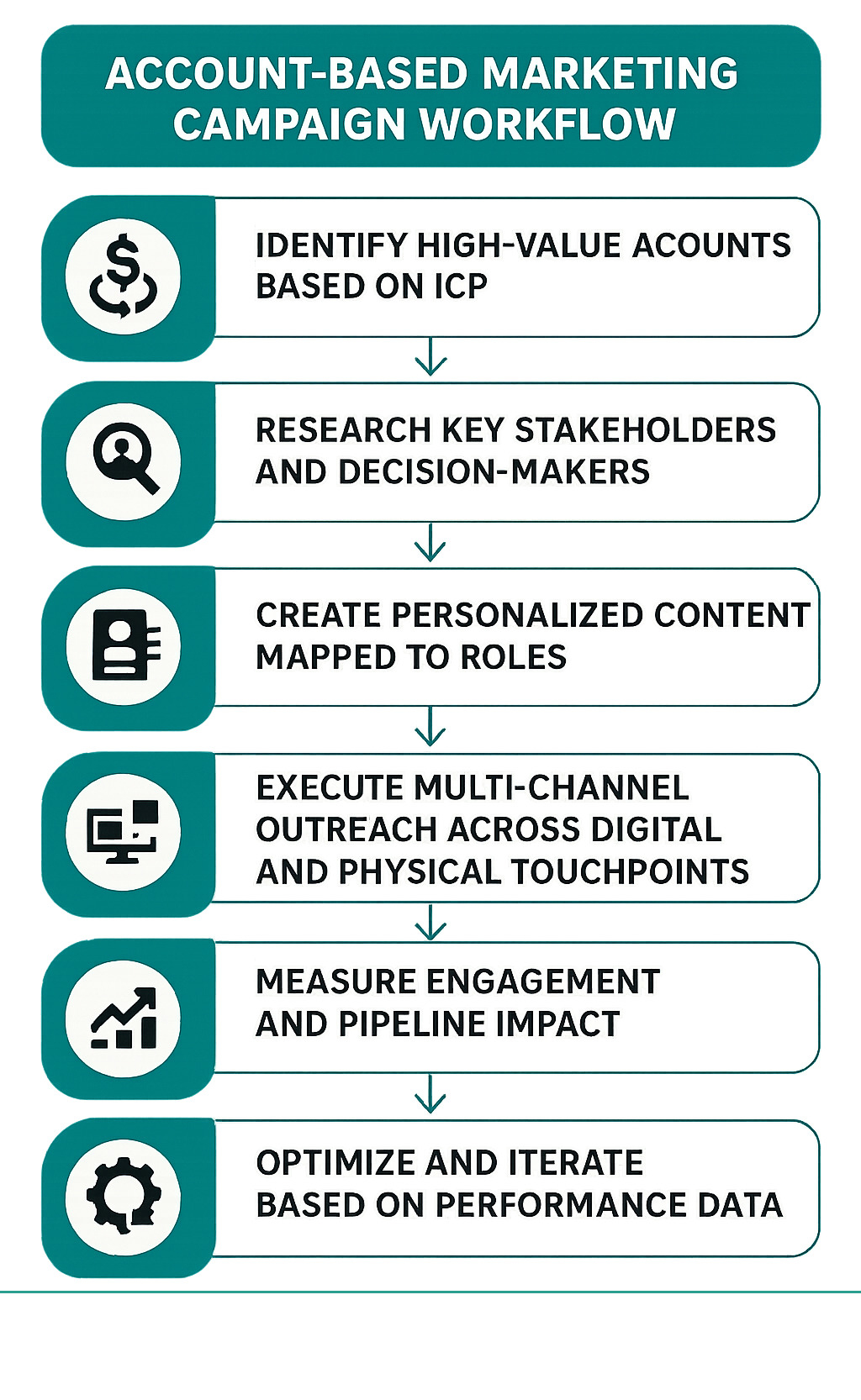
Build Your ICP & Target List
Everything starts with knowing exactly who you want to reach. Your Ideal Customer Profile (ICP) serves as the foundation that supports your entire ABM strategy.
Creating a solid ICP isn't complicated, but it does require digging into your data:
Look closely at your happiest, most profitable customers. What patterns emerge? Maybe they're all mid-sized manufacturing companies experiencing rapid growth, or perhaps they're enterprise healthcare organizations with specific tech stacks.
Get your sales and customer success teams involved in this process. They have invaluable insights about which accounts not only convert but stick around and grow with you. Their frontline experience can validate (or challenge) your assumptions.
Once you've documented your ICP characteristics, it's time to build your target account list. Quality matters more than quantity here.
Start with accounts already in your CRM that match your ICP, then layer in intent data to identify which ones are actively researching solutions like yours. Prioritize accounts that both fit your ICP and show buying signals, then segment them into tiers based on potential value.
Don't forget to run your final list by your sales team. If they don't believe in the accounts you've selected, your ABM efforts will face an uphill battle from the start.
Align Sales & Marketing for Success
If there's one thing that can sink an ABM campaign faster than anything else, it's misalignment between sales and marketing. When these teams work in harmony, magic happens: 67% of companies using ABM say their ABM program has led to better sales and marketing alignment.
Creating this alignment isn't just about occasional meetings. It requires shared goals, clear responsibilities, and regular communication. At The B2B Mix, we often facilitate alignment workshops that bring sales and marketing together to develop a unified strategy where everyone understands their role in the ABM process.
Set up weekly stand-up meetings focused specifically on target accounts. These quick check-ins keep everyone informed about account progress and ensure marketing efforts complement sales activities. Create systems for sharing account intelligence so insights from every interaction inform your next steps.
True alignment means shared success metrics. When both teams are measured on the same outcomes, collaboration becomes natural rather than forced.
Content Mapping & Personalization Engine
Content is the fuel that powers your ABM campaigns, but not just any content will do. You need relevant, valuable material that speaks directly to each account's specific challenges.
Start by mapping the key decision-makers at your target accounts. In B2B purchases, you're typically dealing with 6-10 stakeholders, each with different priorities. The IT director cares about implementation and security, while the CFO focuses on ROI and cost reduction.
Create a content matrix that maps these roles against buying stages. What information does a CTO need during awareness versus decision stages? What objections typically arise from procurement teams? This framework helps you identify content gaps and prioritize creation efforts.
Your personalization approach should match your ABM tier:
For your top-tier accounts (one-to-one), create fully custom content addressing their specific business challenges. This might include custom case studies featuring similar companies or custom ROI calculators using their actual numbers.
For mid-tier accounts (one-to-few), develop industry or segment-specific content with moderate personalization. Think industry benchmark reports or solution guides for specific verticals.
For broader targeting (one-to-many), use dynamic content that inserts account-specific elements into templates. HubSpot's Smart Content is perfect for this, allowing you to display custom messaging based on the visitor's company, industry, or previous interactions with your site.
Channel Mix & High-Impact Tactics
The most effective ABM campaigns don't rely on a single channel – they orchestrate multiple touchpoints that reinforce each other. Think of it as surrounding your target accounts with consistent, relevant messaging wherever they go.
LinkedIn advertising often serves as the cornerstone of ABM programs thanks to its precise company targeting capabilities. Create custom audiences based on your target account list and serve them content custom to their industry challenges.
Personalized email sequences that address specific account challenges can achieve higher open rates than generic campaigns. The key is making these feel like one-to-one communications, not mass mailings.
Direct mail might seem old-school, but physical items break through digital noise in remarkable ways. From branded notebooks to custom gifts that relate to your value proposition, tangible touchpoints create memorable impressions.
VIP events and executive dinners create personal connections that digital channels simply can't match.
Account-specific webinars that address the real challenges of your target accounts are highly effective for engagement. Tailoring webinar content to each account’s needs can drive higher attendance and deeper interaction than broad, generic sessions.
The magic happens when these channels work together.
Tech Stack & Automation Must-Haves
While personalization is at the heart of ABM campaigns, the right technology makes this approach scalable. You don't need every tool on day one, but certain components form the foundation of an effective ABM tech stack.
Your CRM system serves as the central hub that houses account and contact data. HubSpot CRM works beautifully for this, especially when paired with HubSpot Marketing Hub for personalized, triggered communications.
ABM-specific tools like HubSpot's ABM features provide account targeting, engagement tracking, and campaign orchestration capabilities. These help you monitor account progress and coordinate outreach across channels.
Intent data platforms like 6sense or Bombora identify accounts showing buying signals, helping you prioritize outreach to companies actively researching solutions like yours.
Account intelligence tools enrich your data with firmographics and technographics, giving you deeper insights into each target account's structure and existing technology stack.
At The B2B Mix, we help clients configure HubSpot for ABM success. This includes setting up target account lists, building engagement tracking dashboards, and creating automated workflows triggered by account behavior. We've seen how the right tech setup can amplify ABM results without requiring enterprise-level budgets.
Pre-Launch Checklist
Before taking your ABM campaign live, run through this pre-flight checklist to ensure you're set for success:
- Target account list finalized and validated with sales
- Key stakeholders identified within each account
- Account research completed and documented
- Content mapped to personas and buying stages
- Personalization strategy defined for each account tier
- Channel mix and campaign cadence established
- Tracking and measurement plan in place
- Sales and marketing roles clearly defined
- Technology platforms configured and tested
- Pilot accounts selected for initial launch
Starting with a pilot allows you to test your approach, gather data, and refine your strategy before scaling. If you're new to ABM, begin with just 10-20 accounts to prove the concept. This focused approach lets you learn what works while limiting resource investment until you've validated your strategy.
ABM campaigns are marathons, not sprints. The upfront planning pays dividends in more efficient execution and better results once you're up and running.
Measuring Success & Iterating for Continuous Lift
One of the most satisfying aspects of running ABM campaigns is seeing the clear connection between your efforts and business results. Unlike traditional marketing, where attribution can feel like guesswork, ABM gives you a direct line of sight from activity to outcome.
Engagement & Coverage Metrics
Before you notice the pipeline impact, you'll see changes in how target accounts engage with your brand. These early indicators tell you whether your strategy is gaining traction:
Account reach shows you what percentage of your target accounts have been exposed to your campaigns. This is your foundation – if they haven't seen you, they can't respond.
Account penetration measures the number of contacts you're engaging with each account. In enterprise sales, you'll want to connect with at least six stakeholders to build consensus. Think of this as your relationship breadth.
Multi-threading takes this a step further by tracking connections across different departments and roles. The more varied your relationships within an account, the more resilient your opportunity becomes if someone leaves or priorities shift.
When it comes to content engagement, look beyond simple views to engagement depth: how much time prospects spend with your materials, whether they return for more information, and which resources they download and share.
Pipeline & Revenue KPIs
While engagement metrics show progress, revenue metrics prove value. Here's where you'll see the real impact of your ABM campaigns:
Influenced pipeline tracks the total value of opportunities that your ABM efforts have touched. This broader view captures ABM's full impact, extending beyond direct attribution.
Is your sales cycle speeding up? Pipeline velocity measures how quickly target accounts progress through your funnel – often a key benefit of the personalized ABM approach.
Your win rate with ABM accounts compared to non-ABM prospects often tells a compelling story. When you're delivering highly relevant, personalized experiences, conversion typically improves.
Most companies also see larger deals from ABM accounts. Track your average contract value to quantify this lift.
For a complete picture, compare your customer acquisition cost (CAC) against projected customer lifetime value (CLV). While ABM may initially cost more per account, the higher conversion rates and larger deal sizes often deliver a superior ROI.
Using Insights to Optimize
The real magic happens when you use performance data to continuously refine your approach:
A/B test everything – from email subject lines to content formats to channel selection. Small improvements compound over time, especially when you're focusing on high-value accounts.
Monitor intent signals that indicate buying readiness. A sudden spike in research activity around specific topics or increased engagement from key decision-makers often precedes purchase decisions.
Don't be afraid to refine your target account list based on engagement data. Some accounts that seemed perfect on paper might show little interest, while others might engage enthusiastically despite not perfectly matching your ICP. Let the data guide your resource allocation.
The beauty of digital marketing lies in its ability to personalize content based on user behavior. When a prospect downloads a security whitepaper, follow up with related security content rather than generic materials. This responsive approach demonstrates that you're paying attention to their specific interests.
Finally, use engagement patterns to identify expansion opportunities within existing accounts. When users from new departments start engaging with your content, it might signal potential for additional use cases or product lines.
At The B2B Mix, we help clients set up dashboards that make these metrics accessible and actionable. Our goal isn't just to report numbers but to translate data into clear next steps that drive your B2B demand generation forward. By establishing this closed-loop system, you create a virtuous cycle where each campaign becomes more effective than the last.
Real-World Tactics & Examples That Inspire
Let's explore some ABM campaigns that didn't just work—they knocked it out of the park. These real-world examples showcase what happens when creativity meets strategy, helping you envision what's possible for your own ABM efforts.
Multichannel Outreach: RollWorks
Remember those prospects that seemed hot but suddenly went cold? RollWorks faced this common challenge and developed an ingenious solution with their "Over-the-Line" campaign.
Their approach combined the best of digital and physical touchpoints. First, they warmed up stalled Tier 2 accounts with targeted display ads. Then came the showstopper—custom direct mail kits featuring branded notebooks with client testimonials strategically placed every few pages. This tactile experience was reinforced with coordinated email follow-ups from sales reps and retargeting ads that echoed the same messaging.
The results speak volumes: appointment rates jumped from a modest 2.6% to an impressive 10.2%—that's three times more meetings! Even better, close rates improved by 15%. What made this campaign sing was the cohesive story told across multiple channels, creating a surround-sound effect that target accounts couldn't ignore.
Targeted Advertising: DocuSign
Docusign's ABM campaign demonstrates how personalization can be effective, showing us how it can work at scale. Instead of taking a one-size-fits-all approach, they recognized that different industries have unique e-signature challenges.
Their team created industry-specific landing pages addressing the distinct pain points of six key sectors. They paired these with personalized display ads for over 450 enterprise accounts, ensuring each industry saw messaging that spoke directly to their specific challenges. To maintain visibility, they implemented account-based retargeting that kept DocuSign top-of-mind throughout the buying journey.
The payoff? A whopping 59% of targeted prospects visited their site, driving a 22% increase in sales pipeline across all six industries. Page views shot up by 300%, while bounce rates dropped by 26%—clear indicators that relevant content keeps prospects engaged.
Creative Direct Mail: GumGum
Sometimes, getting a foot in the door requires thinking way outside the box. GumGum's approach to landing McDonald's as a client demonstrates the creative potential of ABM campaigns.
After researching the McDonald's CEO (their key decision-maker), GumGum created custom burger kits branded with the CEO's name. These kits included personalized "receipts" highlighting GumGum's media capabilities. To amplify the impact, they tagged the CEO on social media with images of the kit and coordinated immediate sales follow-up.
The result? They secured a meeting with the previously unreachable CEO, ultimately won the account, and generated significant industry buzz about their creative approach. This campaign demonstrates that when you show prospects you've done your homework and deliver something genuinely relevant (with a dash of creativity), even the most senior executives take notice.
VIP Events & Webinars
In-person and virtual events remain powerful ABM tools, as demonstrated by Salsify with their targeted roadshow strategy.
Salsify identified target accounts in the New York area and created a roadshow tailored to address regional retail challenges. Their team used personalized email and LinkedIn outreach to invite key stakeholders, setting an ambitious goal of 60 registrations from target accounts.
The response was nothing short of remarkable. Within just two hours of launching the campaign, they had 82 registrants, exceeding their goal by 22%. More importantly, they created a pipeline of qualified opportunities from a single well-executed event.
This aligns with broader industry trends, which show that many B2B buyers prefer webinars for vendor education. As a result, targeted events are a particularly effective ABM tactic when they address specific account challenges.
The common thread across these successful ABM campaigns is clear: deep account research, creative personalization, and coordinated multi-channel execution. They show that when you truly understand your target accounts and craft experiences that speak directly to their challenges, the results can be transformative.
At The B2B Mix, we help our clients design and execute these kinds of high-impact ABM programs, custom to their specific business goals and target accounts. The right mix of creativity, strategy, and execution can open doors you might have thought were permanently closed.
Frequently Asked Questions about ABM Campaigns
Starting an ABM campaign doesn't have to break the bank, but your investment should align with your approach and expected returns.
For one-to-one ABM targeting your most valuable prospects, expect to invest $5,000 to $25,000 or more annually per account. This higher investment makes sense when pursuing enterprise deals with six or seven-figure potential, where personalization truly pays off.
If you're leaning toward one-to-few Account-Based Marketing (ABM) strategies for industry clusters, budgets typically range from $1,000 to $5,000 per account annually. This middle-ground approach offers a nice balance of personalization and efficiency.
For broader one-to-many ABM strategies, you might spend just $500 to $1,000 per account annually while still maintaining some level of personalization at scale.
Our recommendation? Start small with a focused pilot of 10 to 20 accounts. This lets you test the waters, refine your approach, and demonstrate value before expanding. I've seen clients achieve impressive results with modest initial investments by being strategic about where they focus their efforts.
Your budget should always reflect your potential return on investment. A $10,000 investment makes perfect sense when pursuing a $500,000 deal, but might be excessive for smaller opportunities.
Patience is truly a virtue when it comes to ABM campaigns. The reality is that results typically align with your natural sales cycle, not marketing's preferred timeline.
In the first 1 to 3 months, look for early engagement signals, such as increased website visits from target accounts, content downloads, and social interactions. These indicators show you're on the right track, even if the revenue needle hasn't moved yet.
By months 3-6, you should start seeing mid-funnel progress, such as sales conversations, meeting requests, and new opportunities entering your pipeline. This is when sales teams typically begin to accept the ABM approach as they see tangible benefits.
The full revenue impact typically takes 6 to 12+ months or more to materialize, depending on your typical sales cycle length. Companies that stick with ABM for at least a year attribute a 60% revenue increase to its implementation, but that growth doesn't happen overnight.
Absolutely! Some of the most effective ABM campaigns we've seen come from nimble teams that focus on quality over quantity.
Small teams actually have a distinct advantage when it comes to personalization – you can provide authentic, human touches that larger organizations often struggle to replicate at scale. Your CEO might personally reach out to a target account's leadership, something that feels special in today's automated world.
Here's how to make ABM work without a massive team or budget:
Start narrow by focusing on just 5-10 high-value accounts rather than trying to boil the ocean. This concentrated approach enables meaningful personalization, even with limited resources.
Leverage the tools you already have. If you're using HubSpot, you already have powerful ABM functionality built in without needing to invest in additional platforms. We help clients open up these capabilities every day.
Focus on high-impact activities, such as personalized LinkedIn outreach, custom content that addresses specific account challenges, and coordinated touchpoints between marketing and sales. These approaches don't require enterprise technology but deliver impressive results.
The key isn't having the biggest tech stack or the largest team – it's being thoughtful about who you target and delivering value at every touchpoint.
Conclusion
ABM campaigns transform how B2B companies approach marketing in today's complex buying environment. Instead of chasing countless leads that go nowhere, ABM focuses your efforts where they matter most—on the accounts that will truly drive your business forward.
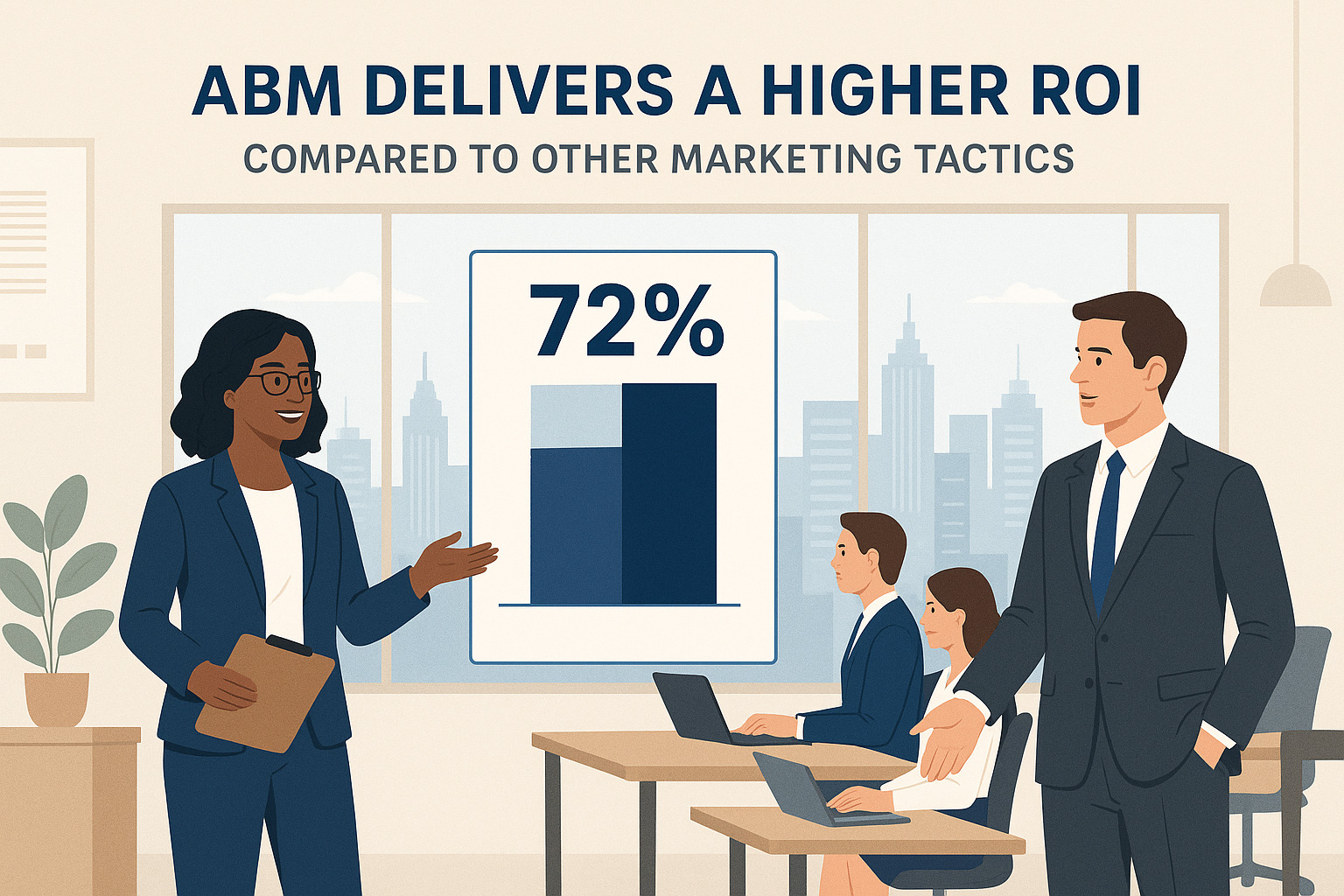
The results speak volumes: 72% of businesses implementing ABM report a higher ROI than any other marketing approach they've tried. When you consider this, it makes perfect sense. By aligning your sales and marketing teams around shared account goals, concentrating resources on your best opportunities, and delivering consistent, personalized experiences throughout the buyer's journey, you're setting yourself up for success.
Is implementing ABM easy? Not exactly. It requires thoughtful planning, genuine cross-functional collaboration, and a commitment to continuous improvement. But the payoff is worth it: larger deals, accelerated sales cycles, and more predictable revenue growth that you can build your business around.
At The B2B Mix, we've helped numerous B2B companies build and optimize their ABM campaigns using HubSpot. Our approach isn't complicated—we combine strategic account selection (finding the right targets), personalized content that actually resonates with decision-makers, and coordinated multi-channel outreach that engages your most valuable prospects where they are.
We understand that every B2B company faces unique challenges. That's why we don't offer cookie-cutter solutions. Whether you're just dipping your toes into the ABM waters or looking to take your existing programs to the next level, we provide hands-on, jargon-free expertise custom to your specific business goals and target accounts.
The beauty of ABM is that it's both strategic and practical—a rare combination in marketing. It acknowledges the reality of how B2B purchases occur today, involving multiple stakeholders and complex decision-making processes, and provides a framework for navigating that complexity successfully.
Ready to transform your marketing approach with a focused, account-based strategy that delivers measurable revenue impact? Let's talk about how The B2B Mix can help you build ABM campaigns that actually work.