What is content governance? Content governance is a structured framework of processes, roles, policies, and standards that guide how an organization creates, manages, publishes, and maintains content across all channels. It ensures consistency, quality, compliance, and alignment with business goals throughout the content lifecycle.
Content governance can be summarized as:
| Element | Description |
|---|---|
| Purpose | To maintain quality, consistency, and compliance across all content |
| Components | Roles, workflows, policies, standards, and guidelines |
| Benefits | Brand consistency, risk reduction, improved efficiency, better customer experience |
| Differs from | Content strategy (what/why) and content management (tools/technology) |
If you've ever published content that felt disconnected from your brand, struggled with inconsistent messaging across departments, or found outdated information lingering on your website, you've experienced the consequences of poor content governance.
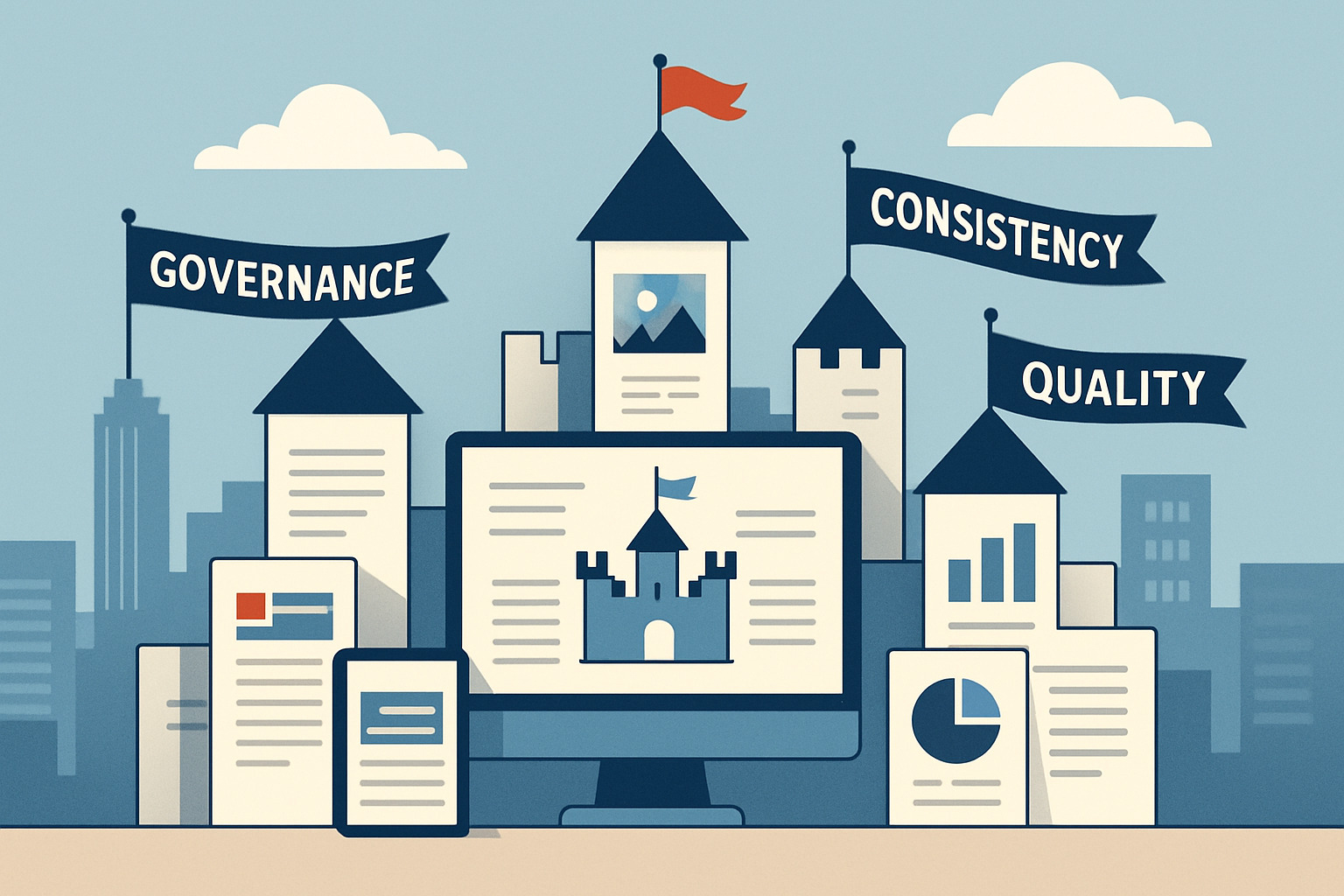
Think of content governance as the architectural blueprints for your content kingdom. While content strategy defines what you want to build and why, governance provides the detailed specifications that ensure everything is constructed correctly and maintained properly over time.
Without governance, content chaos reigns. With the proper framework in place, your content becomes a strategic asset rather than a scattered liability.
What Is Content Governance?
What is content governance? It's the backbone of organized content creation: the system of rules, roles, and processes that guide your content throughout its entire journey. From the initial spark of an idea to its eventual retirement, governance brings order to what might otherwise become a chaotic and inconsistent mess of messaging.
I like to think of content governance as an orchestra's sheet music. While each musician brings their individual talent and creativity, the sheet music ensures everyone plays in harmony rather than creating a chaotic jumble of competing sounds. Your content creators are those talented musicians, and your governance framework is the score that keeps them aligned.

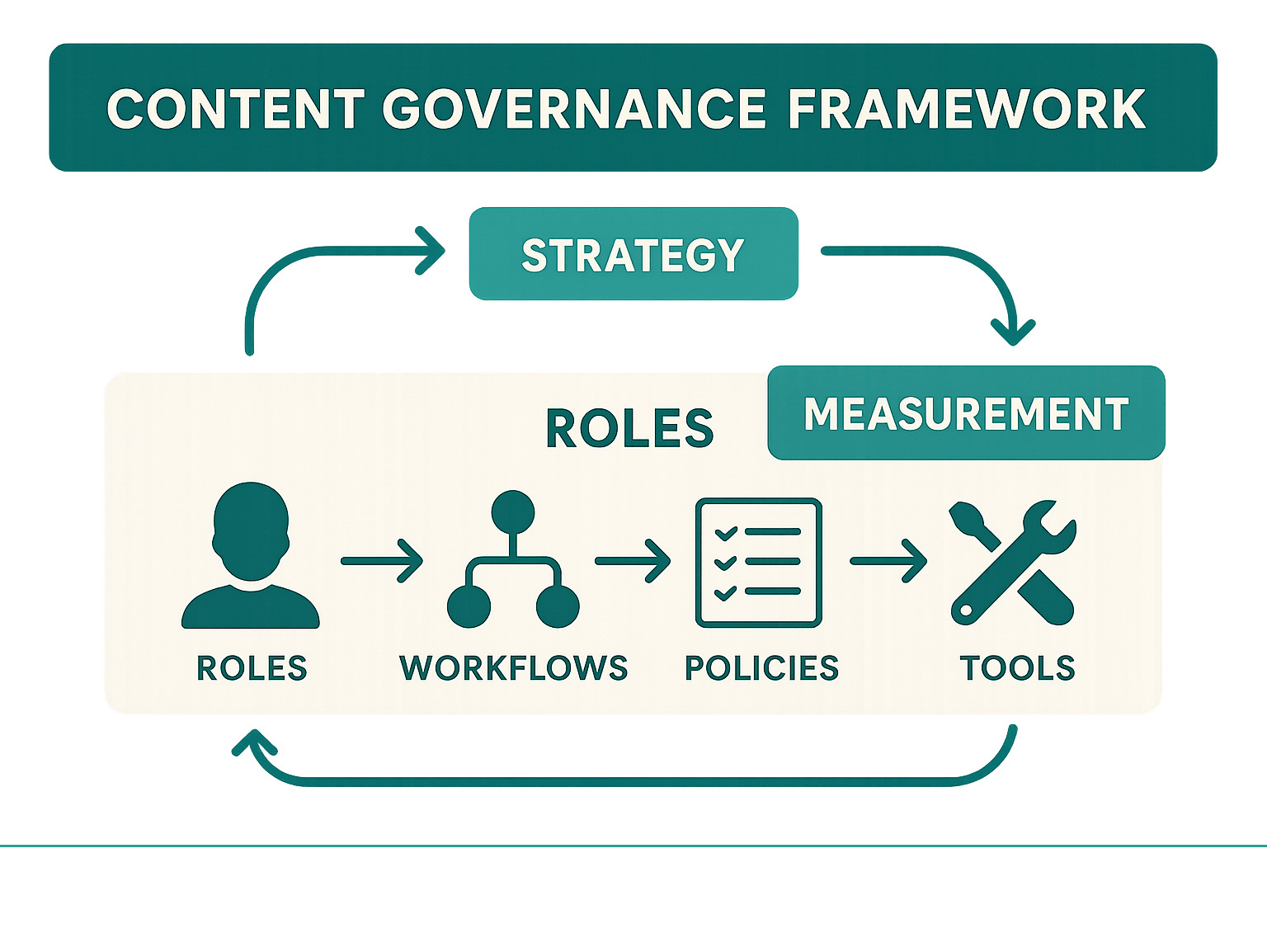
At its core, effective content governance encompasses several essential elements. You need clearly defined roles and responsibilities so that everyone knows who is responsible for creating, approving, publishing, and maintaining your content. You need documented workflows that outline how content progresses from concept to publication and beyond. Your policies and standards establish the rules that guide creation and quality, while guidelines and templates help maintain consistency across all channels. Finally, measurement and iteration processes let you evaluate what's working and continuously improve.
According to the six stages of the content lifecycle, content typically moves through planning, creation, review, publication, maintenance, and retirement. Good governance provides guardrails at every stage, ensuring everything remains on strategy and on brand throughout.
When it comes to implementing governance, most organizations choose one of three models:
Centralized governance involves all content decisions being reviewed by a single team, offering tight control but potentially creating bottlenecks. Decentralized governance distributes decision-making across departments, providing flexibility but risking inconsistency. Hybrid governance often strikes the sweet spot—a central team sets standards and guidelines, while departments maintain autonomy in execution within those parameters.
The right model for you depends on your organization's unique structure, size, and content needs. In our experience at The B2B Mix, many of our clients find that a thoughtfully designed hybrid approach offers the best balance of consistency and flexibility.
How Does "What Is Content Governance?" Differ From Strategy?
One question we hear frequently is how content governance differs from content strategy. Though closely related, they serve distinctly different purposes in your content ecosystem.
Content strategy defines the big-picture elements: what content you should create, why you're creating it, who it's for, and what business goals it supports. It's your content compass, pointing you in the right direction.
Content governance, by contrast, focuses on execution: how content will be created, who will handle each step of the process, what standards it must meet, and how it will be maintained over time. It's the detailed roadmap that helps you steer the journey.
To put it simply, content strategy is the "what and why," while content governance is the "how and who." Strategy sets your destination; governance provides the vehicle to get you there reliably and efficiently.
Why the Question "What Is Content Governance?" Matters in 2025
The importance of good content governance has grown tremendously in recent years, and in 2025, it's more critical than ever before.
For starters, content scale has exploded. Most organizations now produce exponentially more content across more channels than they did even five years ago. Without proper governance, this volume leads to inconsistency, duplication, and waste.
Multichannel publishing has become the standard expectation. Your content might appear simultaneously on your website, social media, email newsletters, mobile apps, voice assistants, and more, each with different requirements and constraints that need governance guidance.
With the rise of remote work, teams are increasingly distributed across locations and time zones. More people contributing to content from more places increases the need for clear, accessible guidelines that everyone can follow.
Compliance risks continue to grow as privacy regulations, accessibility requirements, and industry-specific rules create potential legal exposure if content isn't properly governed and reviewed.
As AI tools become increasingly prevalent in content workflows, governance becomes essential to maintain quality, brand consistency, and human oversight of machine-generated content.
Why Every Organization Needs Governance
Even if you're a small team, content governance isn't just bureaucratic overhead—it's a critical framework that delivers tangible business benefits.

Consistency Builds Trust and Recognition
Picture this: a potential customer visits your website, reads your blog, checks out your LinkedIn page, and then opens your email newsletter. If each touchpoint feels like it's coming from a different company, you've got a consistency problem.
According to research, consistent brand presentation can increase revenue by up to 23%. This level of consistency doesn’t happen by chance—it’s the outcome of strong content governance.
What is content governance? At its core, it's the framework that ensures your brand speaks with a single voice across all channels. When customers encounter your content consistently, it reinforces your brand identity, builds trust, and creates the familiarity that drives loyalty.
Quality Control Prevents Costly Mistakes
We've all seen it happen—an outdated product description that creates customer confusion, a compliance violation that leads to regulatory headaches, or messaging inconsistencies that leave prospects scratching their heads. These aren't just minor irritations; they're costly mistakes that damage your brand.
Content governance establishes quality standards and review processes that catch these errors before they reach your audience. Think of it as your content safety net.
The stakes are higher than you might realize. Without proper governance, you risk:
- Inaccurate information creating customer service nightmares
- Compliance violations resulting in regulatory fines
- Outdated pricing creating customer frustration
- Inconsistent messaging causing market confusion
- Accessibility failures excluding potential customers
That last point deserves special attention. Accessibility isn’t just a best practice—it’s essential for reaching all audiences and meeting legal requirements. Without clear governance to enforce accessibility standards, your content may unintentionally exclude people with disabilities and expose your organization to compliance risks.
Efficiency Reduces Waste and Duplication
"Wait, didn't we already create something like this last quarter?"
If that question sounds familiar, you're experiencing one of the classic symptoms of content chaos. Without proper governance, teams recreate existing assets, approval processes become bottlenecks, and measuring content performance becomes nearly impossible.
With proper governance in place, your content operation undergoes a transformation. Teams spend less time reinventing the wheel and more time creating high-value assets. Approval processes become streamlined and predictable. Resources are allocated more effectively. And most importantly, your content starts working harder for your business.
At The B2B Mix, we've seen how implementing even basic governance frameworks can dramatically reduce content production time while improving quality and consistency. For our B2B clients using HubSpot, this efficiency translates directly to faster campaign execution and better results without adding layers of bureaucracy that slow things down.
Crafting Your Content Governance Model
Building an effective content governance model isn't just about creating rules—it's about designing a framework that empowers your team while maintaining quality. Let's explore how to build a governance system that works for your organization, not against it.

Mapping Roles and Responsibilities
The foundation of good governance begins with clarity about who is responsible for what. Without this clarity, content initiatives can quickly become a game of hot potato—or worse, nobody takes ownership at all.
In effective content teams, everyone understands their lane. Your Content Strategist keeps the big picture in focus, ensuring everything aligns with business goals. Meanwhile, your Content Manager orchestrates the day-to-day workflow, ensuring projects stay on track and on time. The actual creation happens through your Content Creators—the writers, designers, and producers who bring ideas to life.
No content ecosystem is complete without Subject Matter Experts who ensure accuracy, Editors who polish for quality and consistency, and Legal/Compliance Reviewers who keep you out of hot water. On the technical side, your Content Publishers handle the mechanics of getting content live, while Content Analysts measure what works and what doesn't.
At The B2B Mix, we've found that a RACI matrix (Responsible, Accountable, Consulted, Informed) brings immediate clarity to content teams. Even when one person wears multiple hats—which is common in smaller organizations—defining these responsibilities prevents critical tasks from falling through the cracks.
Designing Repeatable Workflows
Think of workflows as the roadmaps for your content journey. Without them, every piece of content becomes a trip with an uncertain destination.
Two workflows deserve your immediate attention:
Your Editorial Workflow maps the life of content from initial concept through creation, review, publication, and maintenance. This isn't just about efficiency—it's about building predictability into your content process so teams can plan effectively.
Your Content Request Workflow brings order to the often chaotic process of fielding content needs from across the organization. This workflow helps you prioritize requests based on strategic value rather than who shouts the loudest.
Well-designed workflows include clear ownership at each stage, realistic timeframes, and specific approval criteria. They define what happens when content meets expectations—and importantly, what happens when it doesn't.
A thoughtful workflow strikes a balance between thoroughness and practicality. Too many approval gates can create bottlenecks, while too few can compromise quality. The sweet spot is different for every organization, which is why cookie-cutter workflows rarely succeed.
Establishing Policies, Standards, Guidelines
This is where you define what "good" looks like for your content. Without these guideposts, consistency becomes impossible, especially as teams grow or change.
Your Content Style Guide establishes the personality of your content through voice, tone, and writing conventions. Will you follow AP, Chicago, or MLA style? Will you use the Oxford comma? These seemingly small decisions shape how your audience experiences your brand.
Beyond words, your Brand Guidelines ensure visual consistency across all content touchpoints. Meanwhile, Accessibility Standards help you reach all potential customers, including the 15% of your audience who may have disabilities.
For many organizations, Legal and Compliance Requirements add another essential layer of governance. These aren't just bureaucratic hoops—they're protections against real business risks.
Content Types and Templates streamline creation while ensuring consistency, and Archiving and Retirement Policies prevent the all-too-common problem of outdated content lingering where it can confuse customers.
When choosing between governance models, consider your organization's unique needs:
| Model | Centralized | Decentralized | Hybrid |
|---|---|---|---|
| Decision-making | Central team | Distributed teams | Central standards, local execution |
| Consistency | High | Variable | Moderate to high |
| Speed | Can be slower | Typically faster | Balanced |
| Best for | Regulated industries, smaller teams | Fast-moving organizations, large enterprises | Most mid-size organizations |
| Challenge | Can become a bottleneck | May lead to inconsistency | Requires clear boundaries |
Most organizations evolve their governance approach over time. At The B2B Mix, we typically recommend starting with stronger centralized controls, then gradually shifting toward a hybrid model as teams internalize standards and processes.
Ready to assess your current content landscape? Our Content Inventory Audit Checklist provides a structured approach to determine what you have and identify governance gaps. And if you're working with limited resources, our guide on building a content team with limited resources offers practical strategies for distributing governance responsibilities without overwhelming your team.
Operationalizing Governance: Workflows, Tools & Metrics
Once you've mapped out your governance model on paper, it's time for the fun part—bringing it to life with practical workflows, smart tools, and meaningful metrics. This is where your content governance transforms from a nice idea into a living, breathing system.

Choosing the Right Tools
Think of your governance tools as the kitchen utensils that make cooking easier—you need the right ones for the job, but you don't need every gadget on the market.
Your Content Management System (CMS) forms the foundation of your governance toolkit. The best CMS for governance isn't necessarily the fanciest one, but rather one that supports your specific needs with features like role-based permissions, approval workflows, and content versioning.
Many of our clients find that HubSpot hits this sweet spot perfectly. Its intuitive approval workflows keep content moving while ensuring nothing goes live without proper review. Plus, its robust permissions system means your summer intern won't accidentally publish the CEO's draft blog post (we've all been there!).
Beyond your CMS, you'll want a thoughtful mix of collaboration tools that connect your team without overwhelming them. This might be as simple as a shared editorial calendar in Google Sheets or as robust as a dedicated project management platform. The key is finding tools that feel helpful rather than burdensome.
We're also seeing fantastic results with quality assurance tools that act like friendly editors looking over your shoulder:
- Readability analyzers that flag when you've gone too deep into industry jargon
- Accessibility checkers that ensure everyone can enjoy your content
- AI-assisted editing tools that catch inconsistencies in brand voice
As our Content Operations Framework Guide explores in depth, the goal isn't tool accumulation—it's finding the right balance of technology that reduces friction while gently enforcing your governance standards.
Measuring Success & Iterating
Governance isn't a "set it and forget it" affair—it's more like gardening, requiring regular attention and occasional pruning to thrive.
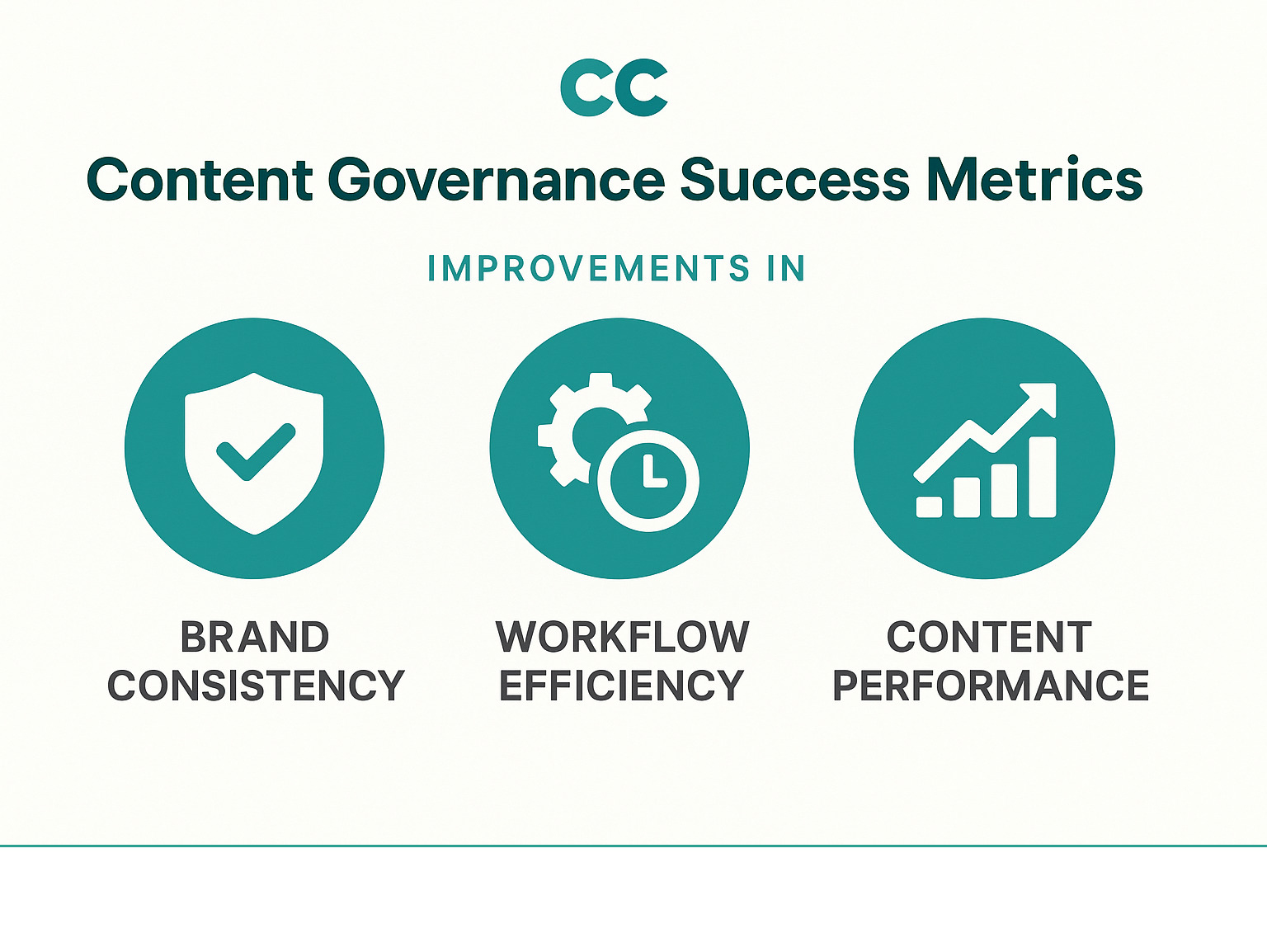
The most effective governance frameworks evolve based on what the data tells you. Start by tracking a mix of process metrics (like time to publication and approval rates), quality metrics (like style guide compliance), and performance metrics (like engagement and conversion rates).
But numbers alone don't tell the whole story. We recommend holding quarterly conversations with your content creators to gain a deeper understanding of their experiences. Are templates making their lives easier or creating frustration? Do they understand why specific approval steps are in place? These qualitative insights often reveal opportunities for improvement that metrics alone might miss.
From helping dozens of B2B companies implement content governance, we've found that success often comes down to a few practical approaches:
Start small and celebrate wins. Begin with one content type (such as blog posts) or channel, perfect your governance there, and then expand. This creates momentum and builds believers in your organization.
Make templates your secret weapon. Well-designed templates aren't just time-savers—they're governance enforcers in disguise, guiding creators toward consistency without feeling restrictive.
Automate thoughtfully. Use technology to handle repetitive governance tasks (such as checking for broken links), while keeping humans in charge of nuanced decisions (like tone appropriateness).
Focus on education, not enforcement. When people understand why governance matters—and how it enhances the impact of their work—compliance becomes a natural byproduct rather than a struggle.
The CMI webinar on content strategy offers additional insights on measuring governance effectiveness and making data-driven improvements.
The goal of governance isn't control for control's sake—it's creating a framework that empowers your team to create consistent, high-quality content without reinventing the wheel each time. When done right, governance should feel less like a traffic cop and more like a GPS—guiding you reliably toward your destination while still letting you enjoy the journey.
Conclusion
What is content governance? After our journey through this guide, we now understand it's the bedrock of content excellence—a structured approach that transforms how your organization creates, approves, publishes, and maintains content. It's what separates content chaos from content that consistently delivers business value.
Think of your governance framework as the constitution of your content kingdom. When implemented thoughtfully, it delivers real-world benefits that impact your bottom line:
Brand consistency becomes your norm rather than your aspiration. Quality issues and embarrassing errors become rare exceptions. Your team spends less time reinventing the wheel and more time creating impactful content. Legal and compliance risks shrink dramatically. And perhaps most importantly, your customers enjoy a seamless, cohesive experience with your brand across all touchpoints.
Governance isn't a "set it and forget it" project. It's a living system that grows and evolves in tandem with your organization. The most successful governance frameworks are those that adapt to changing business needs while maintaining their core principles.
At The B2B Mix, we've seen how proper content governance transforms marketing operations for our B2B clients. It's often the missing piece that helps companies fully leverage their HubSpot investment and execute digital strategies with consistency and confidence.
Whether you're taking your first steps toward formal content governance or refining an established framework, our team brings practical, jargon-free expertise to the table. We're real humans who understand the challenges of implementing governance in busy organizations, and we're committed to making the process painless and effective.
Ready to bring order to your content kingdom? Our Content Operations Framework Guide offers additional insights to help you get started. Or reach out for a conversation about how we can help build a governance framework custom to your unique needs.
The beauty of good governance isn't restriction—it's liberation. When your team has clear guidelines, efficient workflows, and consistent standards, they're free to focus on what they do best: creating remarkable content that drives meaningful business results.