
I get it. Nobody wakes up wanting to switch email platforms. It ranks somewhere between "switch business banks" and "redo the website" on the list of things you'll deal with later, when there's time. (There's never time.)
But if you're on Mailchimp, a recent story from late May sharpens the honest answer to a question worth asking right now: is Mailchimp still worth it for you? It's also a useful warning shot for any tool your business leans on.
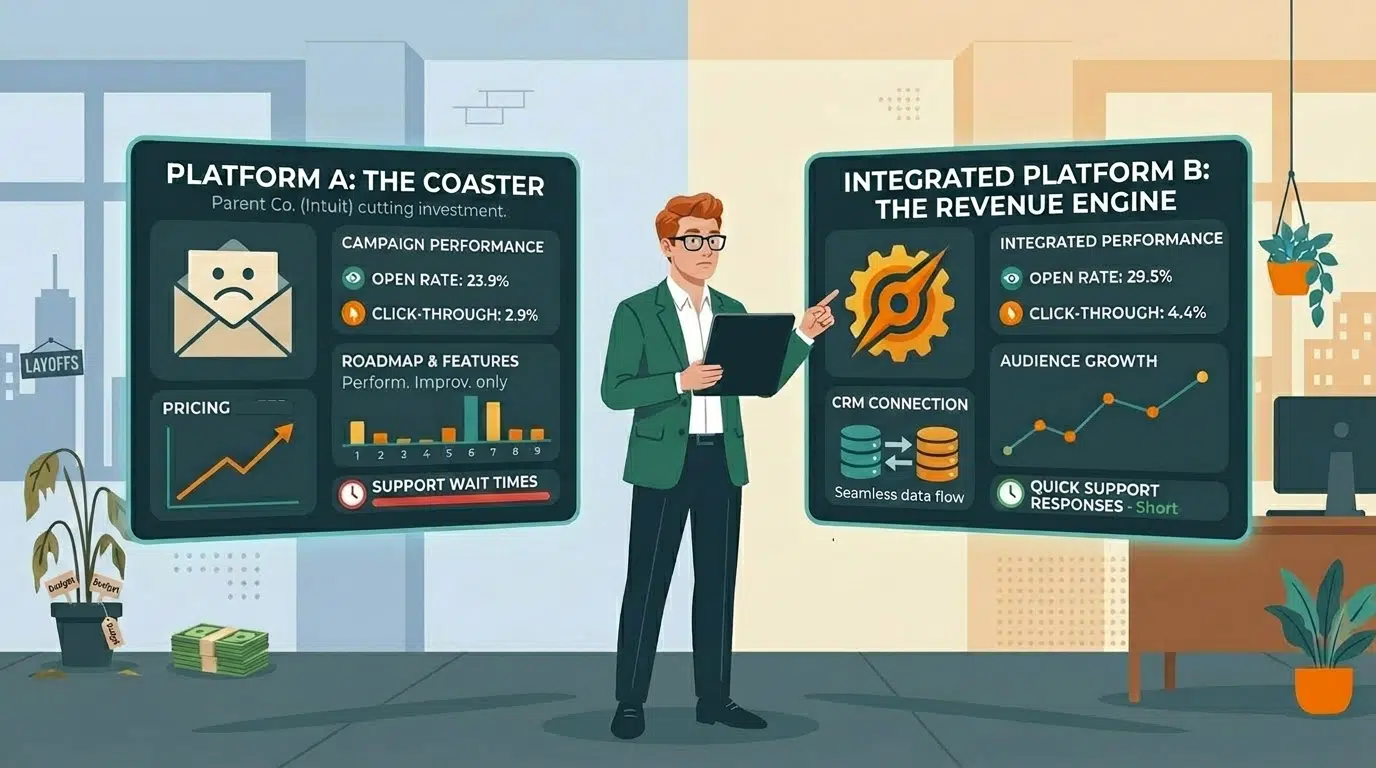
Here's the short version. Intuit, which owns Mailchimp, announced it's cutting about 17% of its workforce and, in the CEO's own memo, "reducing investments in areas including Mailchimp." On the earnings call, leadership was candid that they'd explored selling Mailchimp, couldn't get the price they wanted, and are now running it for profit rather than growth. (Reported by MarTech, May 22, 2026.)
To be clear, and this part matters: Mailchimp is not shutting down (at least, not of this post's publication). In fact, Mailchimp just shipped a big feature release back in February. If you send a simple newsletter to a stable list and you're happy with it, you can stop reading and go enjoy your day.
But "we're running it for cash, not growth" is a real signal. When a product stops being a company's growth bet, the roadmap usually slows, prices usually creep, and support usually thins out. That's not a Mailchimp thing. That's a software thing. And it's worth knowing how to spot it in any platform you depend on.
So here's the check.
Four signs your platform is coasting
The roadmap goes quiet. Are real features still shipping, or is it just "performance improvements" and reshuffled menus? One big release doesn't tell you much. The pace over the next two or three releases does.
Leadership talks about profit, not growth. This is the tell. When the people running a product start using words like "profitability" and "cash flow" instead of "growth" and "investment," they're telling you exactly where you rank. Mailchimp's parent company said the quiet part out loud. Most won't.
Pricing gets less friendly. Shrinking free tiers, quiet per-contact increases, features that used to be included sliding up a plan. (Independent reviewers have flagged Mailchimp's pricing as a sore spot for a while, with its entry paid plan landing well above several competitors. Those figures come from EmailToolTester and similar review sites, not from me, so treat them as a prompt to go check your own bill.)
The humans disappear. Layoffs, leadership departures, support tickets that take longer and resolve worse. You usually feel this one before you can prove it.
If you're nodding at two or more of these, you don't have an emergency. You have a reason to pay attention.
What to do if the answer is "yeah, it's coasting"
Do not panic-switch when determining is Mailchimp is still worth it. A rushed migration is how you torch your deliverability and lose a month you never budgeted for. Instead:
Audit what you actually use. Most teams use a fraction of what they pay for. Write down the features you'd genuinely miss. The list is usually shorter than you'd guess.
Be honest about the switching cost. Integrations, list hygiene, templates, and the week your team spends relearning everything. That cost is real, and it's the whole reason "good enough" tools survive long after they stop being good.
Ask the bigger question. Not "what's a cheaper Mailchimp," but "is my email even talking to the rest of my revenue engine?" If your email tool, your CRM, and your sales process live in three separate worlds and nobody's syncing them, the platform is the small problem.
That last one is where this gets relevant to what we do, so I'll just be straight with you. We're a HubSpot partner. For an established B2B company, a manufacturer, a distributor, a services firm, where email needs to connect to the CRM, the deals, and the handoff to sales, consolidating onto one system earns its keep. For a small, stable newsletter, it's overkill, and I'll tell you that for free. The right answer depends on where you actually are, not on what we happen to sell. Want to talk it over? We can book some time for a free conversation about switching from Mailchimp to HubSpot.
The move
If you've been ignoring a tool that's quietly stopped earning its spot, consider this your nudge. Pull up your platform, run it through the four signs, and look at your last three months of bills and releases with clear eyes.
Want a second set of eyes? We'll do a no-pitch email platform health check. Thirty minutes, we map what you've got against what your revenue engine actually needs, and you walk away knowing whether to stay put or start planning. No switch required, no obligation.

Go do the thing. Your future self, the one who didn't get caught flat-footed, will thank you.