
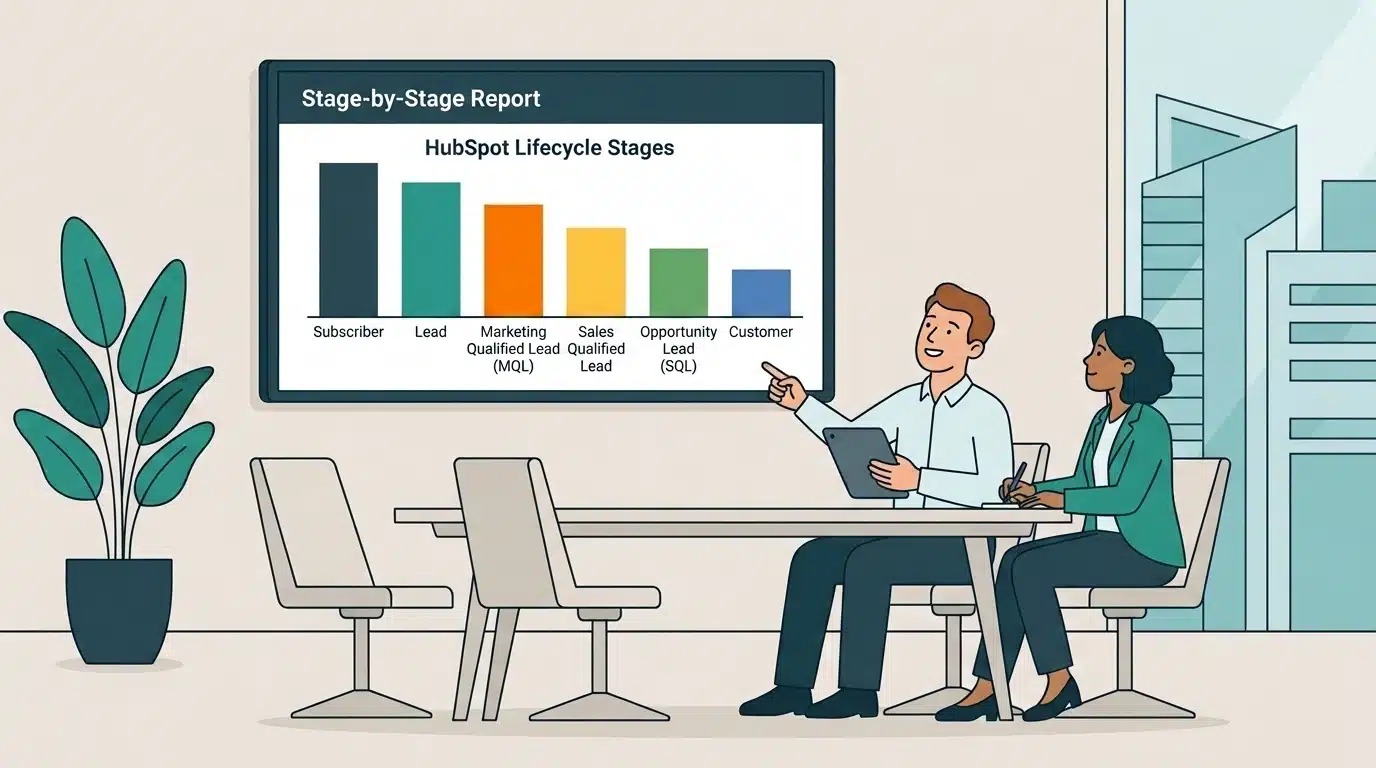
You know the meeting. Marketing's slide says MQLs are up. Sales's slide says pipeline is flat. Everybody stares at the two numbers for a beat, and then somebody says the thing that always gets said in that room: I think our lifecycle stages are wrong.
So, [insert drumroll], a project gets born. (You can probably insert an "ugh" here.)
Somebody gets charged with fixing lifecycle stages. Not an incompetent person. Not a bad admin. One person gets handed a task and makes the mistake of going off to do it by themselves.

They open up the HubSpot settings and add two new stages that are going to be game-changers. (If there were a HubSpot equivalent of "guitar face," that person would be making it with every damn keystroke.) And don't forget the elegant rename of "Evangelist" to "Raving Fan," because that sounds more like us. You know that's going to solve a lot of problems. Maybe even inspire someone to figure out the whole "world peace" thing, too.
Next, someone builds a workflow that takes three reams of paper to fully print out if you wanted to look at it on a wall. It'll move records along the new lifecycle stages (at least until it breaks). And finally, someone writes a service-level agreement that both teams nod at in a meeting. Six weeks later, marketing's slide says MQLs are up. Sales's slide says pipeline is flat.
The work got done. Competent people did it, on schedule, and the slides say exactly what they said before. That's what makes it maddening.
Lifecycle stages and an SLA (service level agreement) are two different instruments, and most teams reach for the first one when the problem lives in the second.
I wrote a while back about the fight where sales says the leads are junk and marketing says sales never calls, and how that argument boils down to one of three problems: visibility, definitions, or compliance. This is the follow-up. Lifecycle stages and a marketing-to-sales SLA are the two things people build to end that fight. Whether they work depends entirely on which of those three problems you actually have.
What HubSpot lifecycle stages decide for you, and what it flatly refuses to
Here's what you should know before you touch settings.
There are eight default HubSpot lifecycle stages, in this order: Subscriber, Lead, Marketing Qualified Lead, Sales Qualified Lead, Opportunity, Customer, Evangelist, and Other. You can rename them, reorder them, add your own, or delete the ones you don't use. Custom lifecycle stages are available on every plan, though you'll need Super Admin permissions to make the change.
A couple of behaviors surprise and irritate people.
HubSpot times everything for you.
Every stage, default or custom, gets its own calculated properties: Date entered and Date exited, plus latest time in stage and cumulative time in stage on Professional or Enterprise. That's your funnel velocity, sitting right there, free, whether or not anybody's looking at it. Most teams find out these properties exist at the worst possible moment: the next behavior.
The HubSpot lifecycle stage property moves forward, not backward.
HubSpot's documentation lists the tools this applies to: imports, form submissions, APIs, the Salesforce integration, and the Set a property value action in workflows and chatflows. None of them will move a record to an earlier stage. You have to clear the existing value first, then set the new one. Editing a single record by hand is the exception, which is worth knowing, because it means the backward move is the one thing you can't automate. So when a bad file import in August shoves four hundred records to Customer, recovery is a three-step job. Export the property history so you know where each record actually belonged, clear the stage, then re-import the correct values as an update.
That fixes your stages that got fudged up, but your reporting will still be messy. Not much you can do about it. The calculated properties don't clear when a record moves backward, so the date-entered timestamps from the bad import survive the entire cleanup. Your funnel still believes those four hundred people became customers in August.
That's the part that really chaps certain folks' hides. The forward-only rule exists to protect funnel reporting. So when the data is genuinely messed up, the fix and the damage are the same action. You corrected the issue and went on your merry way. But one quarter later, you're getting the third degree about why conversion spiked in a month that wasn't especially good.
We talked about import mishaps (or it could be a workflow goof, same boat, different river), but there is another issue you may grapple with when it comes to the whole forward-only process.
What if you really need to move backward?
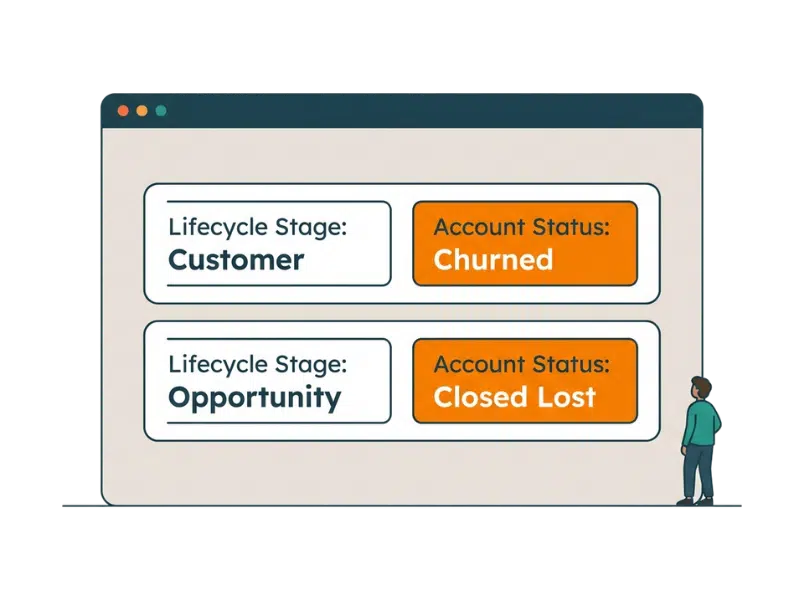
You may have a real business reason to move a company and its contacts back a stage. Churn, a cool-down period, a disqualified lead you want to nurture again. Here we aren't dealing with bad data; we want to represent a state change, but forcing it backward in the lifecycle stage property is reaching for the wrong tool. Leave the stage alone and carry the current state on a second property instead. Lifecycle stage: Customer; account status: Churned. Lifecycle stage: Opportunity; account status: Closed Lost. (You could, of course, use Deal criteria to arrive at the same answer with this scenario.) The HubSpot lifecycle stage keeps meaning "furthest point this record reached," which is what it's built to mean, and your funnel math survives.
HubSpot has a strong opinion about sequence and no opinion whatsoever about criteria. It will tell you, to the second, when a contact became a Marketing Qualified Lead. However, it will never tell you whether the contact should have become an MQL.
Your team decides stage criteria. No property in any CRM makes decisions on meaning or criteria for you. Which means every lifecycle project eventually enters a room where two teams have to agree on the details, and that's usually where these things stall.
Three questions that tell you which problem you have
Before you configure anything, run through these three questions in order. They take about twenty minutes.
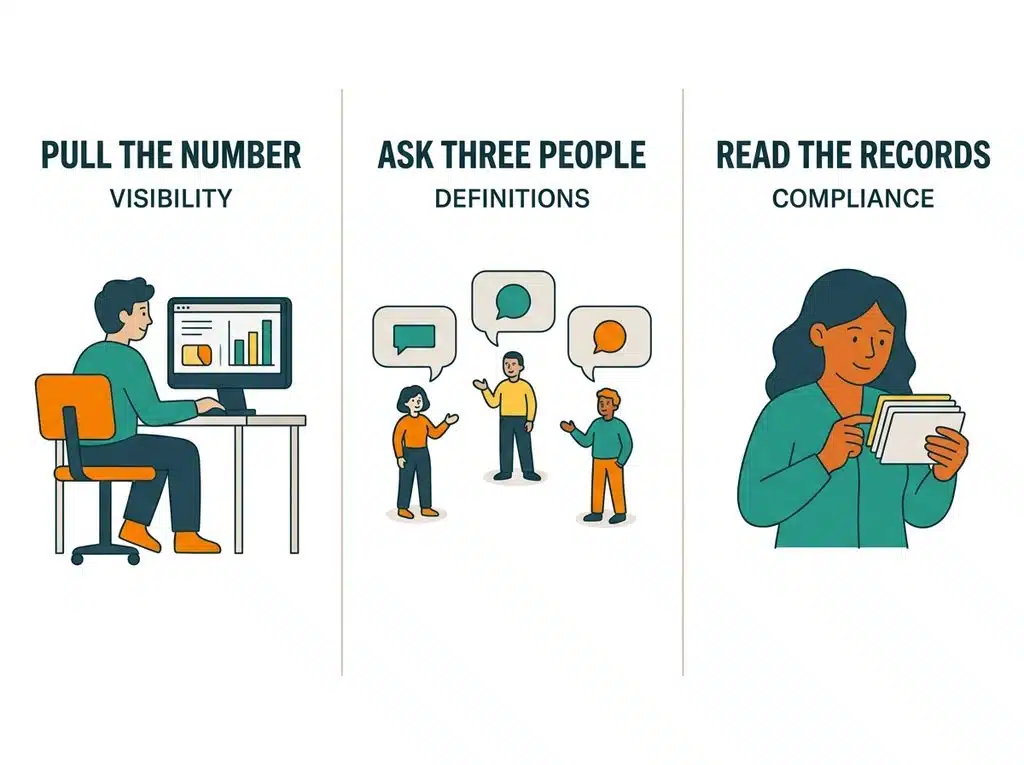
Run them against one stage boundary at a time. Every stage in your model has a definition, and every definition is a place two teams can quietly disagree. Pick the boundary that hurts.
For most companies, that's the jump from Marketing Qualified Lead to Sales Qualified Lead, so that's the one I'll work through here. If yours is Opportunity to Customer, or the Customer stage nobody updates after the deal closes, run the same three questions there. The mechanics don't change.
1. Can you pull the number at all?
Ask for a count of contacts who hit MQL last month, and how many of those got a first sales touch within a week.
If nobody can produce that count without a two-day export-and-VLOOKUP project, stop. I mean, I love a good Excel/Sheets formula as much as the next marketer, but you have to stop being so self-centered, you silly goose, and think about the team. Have an Excel nerd-out later. You have a visibility problem to deal with, and it comes first. Not because your definitions and your compliance seem fine. They might both be jacked up too. But you can't diagnose either one blind, and you can't hold anyone to a promise nobody can measure. Get to where someone can pull that number on demand, then come back and run the other two questions.
2. Does a written definition exist for that stage, and do three people give you the same one?

Ask your marketing lead, one sales rep (not the manager, a rep), and whoever runs the CRM what makes someone an MQL. Ask separately. Don't let them confer.
Three different answers mean you have a definition problem. This is different from having no definition. Usually there is one, written down somewhere, in a deck from two reorganizations ago, and each team has quietly gravitated to a version that makes their own numbers look reasonable. That drift is not dishonesty. Instead, it's what happens when a definition has no owner.
Here's how that drift shows in the numbers. The two teams aren't counting the same population.
Marketing reports how many records entered the MQL stage. Sales reports how many were worth a call, filtered their own way, in a view somebody on their team built last year. Both numbers are accurate. They describe different sets of people. That's why each side can defend its figure, and the argument still goes nowhere.
3. If a definition exists, does the data match it?
Let's say your marketing, sales, and CRM admin all have the same definition for MQL. Kudos! But now it's time for the gut check (and maybe a gut punch). Pull twenty records currently sitting at MQL. Read them. Do they meet the written definition?
If a good chunk of them don't meet the criteria, you have a compliance problem (cue the gut punch). You solve compliance problems with automations, permissions, along with a pledge from someone to review a report regularly. Rewriting the definition when your real issue is compliance is how teams end up on their third lifecycle model in two years, each one progressively more elaborate than the last, all of them ignored.
You can absolutely have more than one of these problems at once. A lot of teams do. The point is knowing which one you're spending the next month solving.
And when you're done, run the whole exercise again on the next boundary. The stages you're least likely to test are the ones after the sale, which is also where definitions tend to rot for years, because nobody's compensation depends on them.
Why the SLA usually fails
An SLA is supposed to fix problem two and problem three mentioned above. It's the written agreement about what a stage transition means and what each team does when it happens. In practice, most of them are a nicely formatted Google Doc (or a Word doc or SharePoint page for my Microsoft shops) that got signed in a meeting and never opened again.
A real service-level agreement has four parts. Count how many yours has.
A definition of the HubSpot lifecycle stage that both teams can apply to the same record and get the same answer. Not a philosophy. A test. If two people can read the same contact and disagree about whether it qualifies, you don't have a definition yet; you have a vibe.
A promise going both directions. Marketing owes something (volume, quality, a floor on both). Sales owes something back (speed to first touch, number of attempts, a disposition on every record).
If your SLA is one-directional, that's essentially just marketing agreeing to be graded, and sales knows it, which is exactly why nobody signs on with any real conviction.
Measurable actions. "Follow up promptly" is not measurable. "First touch within one business day, three attempts across five business days, disposition recorded either way" is measurable. You can argue about whether you're measuring the right things in the right ways, but number- or time-based goals limit arguments about whether expectations were met.
A feedback loop and a standing review. Almost everybody builds the loop and skips the review.
The loop is mechanical, and HubSpot will run it for you. Their documentation walks through the pattern: Trigger a task for the contact owner when Date entered Sales Qualified Lead is more than five days ago. Information gets back to the person who can still act on it.
The SLA review is the harder (more annoying?) part, and it's what keeps the agreement relevant. Both teams, on a schedule, looking at the same number. A definition with no owner drifts, and the review is where you notice that drift and make adjustments instead of arguing about it in a meeting nine months later. Somebody has to own that standing review sesh, or it won't happen. (If you don't have anyone who owns the connective tissue between sales and marketing, that's its own conversation.)
If your SLA has the first two parts and not the last two, it isn't an agreement. It's a memo.
The part you can't template
There are a hundred definitions of every lifecycle stage online. A blank framework would be useful. The ones you'll find are often already filled in, and what's filled in is somebody else's answer to a question about their business.
The blanks are the hard part, and they're yours. How long is your sales cycle? Does one person decide, or do you have to sell to a committee? What's a rep's real capacity for a maybe, given everything else on their plate this week? What is your business goal?
And then there's the question underneath all of this that isn't technical at all: who breaks the tie when there isn't total agreement?
When marketing says a record belongs in the next stage and sales says it doesn't, somebody has to rule. If the answer is "we'll discuss it," you don't have a process; you have an argument that meets every other Tuesday. Naming the arbiter in advance is uncomfortable, which is why it gets skipped, and it's the difference between an SLA that survives contact with a bad quarter and one that doesn't.
When we work with a client, we can build the instrument. We can sit in the room and run the conversation, and really that's often the most useful hour of the whole engagement. However, we can't overrule your VP of Sales, and you should be suspicious of any vendor who implies they can. Getting to agreement is a leadership call. Making the agreement enforceable through HubSpot is ours.
Get the Hand-off Worksheet Template
When you shouldn't do this project at all
Three situations where the honest answer is "don't."
Your teams already agree, and you just need to build the property. If marketing and sales genuinely apply the same definition and the only gap is that HubSpot doesn't reflect it, that's a Super Admin and an afternoon. Add the HubSpot lifecycle stages, wire the workflow, set the report. Don't hire anybody. Go do something harder.
Sales leadership won't sit in the room. If the head of sales can't or won't spend two hours defining it, don't run this project. You will build a genuinely good lifecycle model, sales will not follow it, and you will personally own the gap between the model and reality at the next QBR. That's a worse position than the one you're in now.
Your data can't support a measurement yet. Duplicate contacts, three systems that disagree, no reliable source of record. Build the SLA after the cleanup, not as a substitute for it. An agreement measured against bad data relocates the argument.
And one more, quieter one: if the last two lifecycle rebuilds were also going to fix this, the problem is probably not the model. It's that nothing changed about who's accountable for following it. A third rebuild will feel productive for about five weeks.
Where this leaves you with HubSpot lifecycle stages
If you ran the three questions, you know the problem, and that's most of the value. Visibility gets fixed with reporting. Definitions get fixed in a room. Compliance gets fixed with automation and someone reading a report on purpose.
None of those three is a lifecycle stage problem. Your stages are almost certainly fine. What's underneath them is the part nobody wrote down.
If you got through the questions and the answer is "definitions, and I'm the one who has to get sales to agree," that's the conversation we're actually good at. Not because we have a magic definition, but because a third party in the room changes the dynamic in a way that's hard to manufacture from inside the org chart.
Book a 30-minute call and tell us which of the three you landed on. If it's the one you can fix yourself, we'll tell you that too.

FAQ about HubSpot lifecycle stages
HubSpot's Lifecycle stage property ships with eight default options in sequential order: Subscriber, Lead, Marketing Qualified Lead, Sales Qualified Lead, Opportunity, Customer, Evangelist, and Other. You can rename, reorder, delete, or add to these on any plan, but you need Super Admin permissions to make the change.
Not by default. HubSpot's tools, including imports, forms, and workflows, will just advance the Lifecycle stage property. To set an earlier value, you have to clear the existing value first, either manually on the record or with a workflow, then set the new one.
Usually the default lifecycles are fine. And let's be honest, the labels are rarely the actual problem. Renaming, reordering, or adding stages is simple on any plan if you have Super Admin permissions. The harder part is determining what criteria move a record from one stage to the next, and that is a business decision the CRM doesn't make for you. Customizing the model before both teams agree on the criteria produces a more elaborate model that nobody follows.
Configured lifecycle stages and a service-level agreement (SLA) address different needs. Lifecycle stages capture what has occurred, while an SLA defines what should occur. An effective SLA outlines the definitions both teams use, the mutual commitments made, the specific measurable actions tied to those commitments, and identifies who is responsible for review. Without such an agreement, configuring stages alone leaves you without a clear, shared understanding of how teams should work together.
There's no universal answer, and templates give you someone else's. Each stage boundary depends on your deal size, sales cycle length, whether one person or a committee decides, and how much rep capacity you have for uncertain leads. The practical test works on any stage: two people should be able to read the same contact record and reach the same conclusion about whether it belongs there.