

TL;DR: Family business modernization won't kill your culture, but leaving your "how we do things here" stuck in three employees' heads might. The right systems document and scale your culture so it survives the next retirement, vacation, or generational handoff. Pick tools that fit where you're going, not the cheapest ones that fit where you are today.
You know that conversation where you pitch a system upgrade and someone in the room says, "that's not how we do things here"? Yeah. That one.
Maybe it's said with a sigh. Maybe with a story about how Uncle Don tried something like this in 1997 and it nearly tanked the company. Or, maybe just with the energy of someone who's seen too many shiny tools come and go.
Underneath that pushback is a real fear, and it's worth taking seriously: the worry that modernizing your sales and marketing operations will strip away the thing that actually makes your business yours. The relationships. The judgment calls. The way your top salesperson just knows when to pick up the phone instead of firing off an email.
I get it. (My sister Alanna and I run a family business too. We co-founded The B2B Mix®. We also grew watching our parents run one, and we both spent years inside another B2B family business during a next-gen transition that eventually ended in a sale. We've seen the politics from the inside. So this stuff isn't theoretical for us.)
But here's what I've watched play out across legacy business growth stories: the thing your team is afraid of losing? It's not actually as protected as they think it is. (PwC's 2025 US Family Business Survey found that succession planning has impacted 44% of US family firms in the past year. So a lot of you are facing the "what happens when the key people leave" question right now, whether you wanted to or not.)
Your culture is living in three people's heads
Right now, in most family-run and founder-led B2B businesses I work with, the "culture" is held in the heads of a handful of people. Your top rep who's been there 22 years. The customer service lead who knows every account like family. The founder who picks up the phone himself when the big customer calls.
That's beautiful. It's also fragile.
Because if any of those people retire, take an extended vacation, get sick, or, let's just say it, get hit by a bus... the culture wobbles. The new hire doesn't know that you always send a follow-up note within 24 hours. The new sales rep doesn't know which customers prefer a phone call over an email. The intern definitely doesn't know that Bob over at Acme Industries hates being called by his first name in writing but loves it on the phone. (Bob is a man of distinctions.)
Right now, your "how we do things here" is undocumented tribal knowledge. And tribal knowledge has exactly the lifespan of the people holding it.
What modern systems actually do (hint: not what you're afraid of)
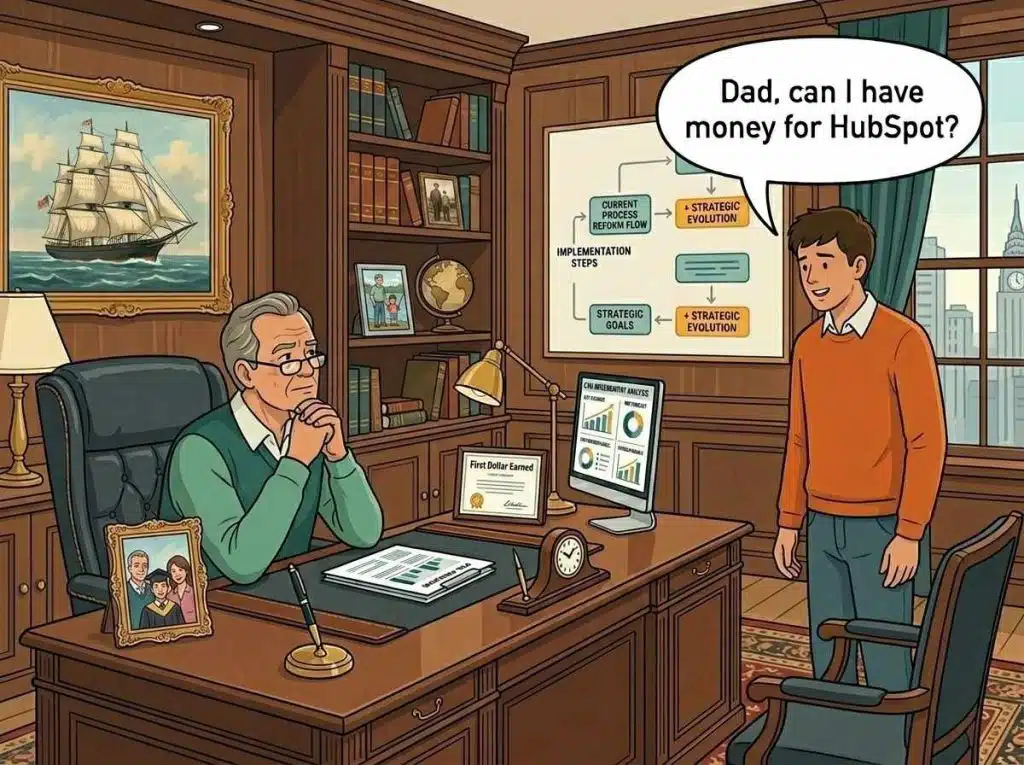
Here's the reframe I want to plant: a modern system isn't a personality transplant. It's a memory upgrade.
When you implement a well-thought-out ops platform like HubSpot, you're not replacing the way your team does things. You're writing it down so it survives.
- A documented sales process isn't "corporate." It's the playbook your top rep already runs in their head, now written down so the new hire can run it too.
- A lifecycle email program isn't "spam from a robot." It's the thoughtful follow-up your founder used to handwrite, now scaled so every customer gets the same care — not just the ones who get the founder's attention.
- A lead scoring system isn't "treating people like data." It's the gut feel your sales lead has spent 20 years developing, turned into a signal that even your newest team member can read.
And there's data behind this. KPMG's 2025 Global Family Business Report found that family businesses with strong governance frameworks are 43% more likely to outperform their peers. "Governance," in this case, includes exactly the kind of documented, repeatable systems we're talking about.
The system doesn't replace the magic. It catches the magic on the way down so it doesn't disappear when the people holding it move on.
(This is why I find the "automation kills authenticity" argument frustrating. Bad automation kills authenticity. Good automation protects it. Big difference.)
What's actually worth protecting (and what isn't)
OK, so if family business modernization done right protects your culture, then step one is being clear-eyed about what you're protecting.
This sounds obvious. It is not.
(Here's where I see family businesses get tangled up: they treat everything about how they currently operate as sacred. The lead handoff process that lives on Post-its? Sacred. The follow-up timing that depends on whether Steve had his coffee yet? Sacred. The fact that nobody has ever updated the customer's address in the system since 2014? Apparently also sacred.)
Not all of it is the culture. Some of it is just… stuff that happens to exist.
The work, before you change anything, is figuring out which is which.
In my experience, every family business has roughly three things that are genuinely worth protecting through a modernization project. The specifics are different at every company, but the categories are usually the same:
1. The customer relationship itself. The way your customers feel when they call you. The fact that they get a real human, fast. The fact that nobody's ever in a queue. Whatever the specific version is at your company — that's worth protecting. Hard.
2. The cultural style of how you sell. If your sales team's superpower is being conversational and casual instead of slick and scripted, that's not a quirk. That's the brand. A good system makes that easier to do consistently. A bad system tries to standardize it into something that sounds like every other vendor in the industry. (We're not interested in that one.)
3. The institutional knowledge that lives in your people. Your 22-year sales rep's mental map of every customer's preferences, history, and family situation. Your customer service lead's gut sense of when something's about to become a problem. The founder's nose for which deals are real and which ones are tire-kickers. This is the most valuable, most fragile, and most overlooked asset you have.
Notice what's not on this list: Your specific tools. Your current process. The way you've always done it. The forms you've always used. Those things might be perfectly fine, but they're not the culture. They're the implementation of the culture, and implementations can change without the underlying values changing one bit.
Before you touch a single piece of software, write down your version of the three above. Get specific. "We respond to every customer call within an hour, no exceptions" is specific. "We care about customers" is not.
Those three things become your filter. Every tool, workflow, and automation gets evaluated against them.
- Does it protect the relationships?
- Does it preserve the style?
- Does it capture the institutional knowledge?
If yes, green light. If no, change the implementation, not the values.
The cheapest tool is often the most expensive tool
Now, here's where a lot of family business modernization projects go sideways.
Someone, usually with good intentions and a tight budget, picks the cheapest tool on the market. The thinking goes: let's start small, see if it works, and we'll upgrade later if we need to.
I get the instinct. (Especially if your last "investment" was a fax machine that's still somehow in service.)
But here's what actually happens with the bargain-bin option:
- You outgrow it in 12–18 months. Then you have to rip it out and start over with the right tool, paying twice for the same job.
- Your team builds workarounds for the limitations. Now your "system" is half tool, half spreadsheet, half tribal knowledge again. Congratulations, you've reinvented the problem.
- The data doesn't travel. When you upgrade later, the history is messy or unmovable, and you're starting from scratch on the customer relationships you were trying to preserve in the first place.
- The team loses faith in modernization. "We tried that — didn't work" becomes the new "that's not how we do things here." You've made the next upgrade harder, not easier.
If you're going to bet the business on a system, bet on one that grows with you. The ROI conversation isn't about how much you save up front. It's about how much you don't have to spend rebuilding it in two years when you've outgrown the cheap option.
The right tool isn't the most expensive one. It's the one that fits where you're going, not just where you are.
What family businesses should actually modernize first
OK, so let's get tactical for a minute.
If you've decided to modernize, and you've defined what's worth protecting, the next question is: what do we actually fix first? Because the temptation — and I see this all the time — is to try to fix everything at once.
- New CRM.
- New marketing automation.
- New reporting.
- New sales process.
- New onboarding.
- New everything. All in 90 days.
Don't do that. (Please don't do that.)
The fastest way to kill a family business modernization project is to overload the team and the system at the same time. Adoption stalls, the founder loses confidence, and six months later everybody's quietly back on spreadsheets and grumbling that "we tried it and it didn't work."
Here's what actually moves the needle in the first phase, in priority order:
1. A real CRM that the team will actually use.
Not a database. Not a glorified Rolodex. A working sales tool that makes it easier to sell, not harder. The single most important word in that sentence is use. Adoption beats sophistication every single time. A simple CRM that the whole team logs into daily is more valuable than a fancy one that sits empty.
This is the foundation. Almost nothing else works without it.
2. A lead-to-revenue path that doesn't leak.
Inquiries get captured. Leads get qualified. Hand-offs between marketing and sales are visible. Nothing falls through the cracks because somebody forgot to forward an email.
Most family businesses I work with have two or three places where leads go to die. (Usually it's a shared inbox that nobody officially owns. Sometimes it's a "we'll get to it" pile on someone's desk. Once it was, I kid you not, a fax machine.) Find those leak points first. Fix them.
3. Reporting that tells you what's actually happening.
Not vanity dashboards. Not 14-tab spreadsheets. Three to five numbers that tell you whether the business is healthy: pipeline by stage, conversion rates, average deal cycle, win rate, and where deals stall.
If you don't know those numbers cold, every other decision is a guess.
Notice what's not on this priority list: AI everything, fancy attribution models, marketing automation that nobody understands, lead scoring algorithms with 47 inputs. Those are real tools, and they have real value — but they belong in phase two. (Or phase three. Or sometimes never.) The first 90 days is about getting the foundation solid.
You earn the right to do the fancy stuff by getting the basics right first.
A quick gut-check list
When you're evaluating tools (or partners helping you implement them) for legacy business growth, ask:
- Does it scale with you? If you double your team or your customer base in three years, does the tool still make sense, or does it cap out?
- Does it document what's already working? A good implementation starts by capturing your existing process, not overwriting it. (If a vendor wants you to change everything to fit their tool, run.)
- Does it preserve the human touch? Automation should free your team to do the high-value human work — calls, judgment calls, relationship building — not replace it.
- Will the data still be yours in five years? Lock-in is a real cost. Make sure your customer history, your reporting, and your institutional knowledge can travel.
What a good first 90 days actually looks like
So you've decided to focus on your family business modernization, you've figured out what to protect, and you've picked a sane place to start. What does the actual work look like?
In my experience, here's the realistic shape of the first 90 days. (Realistic, not idealized — the kind of plan that survives contact with an actual family business that's also, you know, running a real business while doing this work.)
Days 1–30: Discovery, documentation, and decisions.
Map the current sales process, including all the unwritten parts. Talk to the senior salesperson before you talk to anyone about a tool. Capture the institutional knowledge that lives in people's heads — write down the unwritten rules, the customer preferences, the "how we handle Bob" details. Decide on the three things you're protecting. Pick the platform.
(Tool choice should follow the strategy, not lead it. If a vendor is pushing you toward their tool before they understand your business, that's information.)
Days 30–60: Build.
Configure the CRM around the actual sales motion you just documented. Migrate the data — and clean it as you go, because dirty data going into a new system creates the same problems you were trying to solve, just with a fancier interface.
Train the people who'll use it. (This is the part most agencies skip. We don't, because skipping it is exactly how you end up with a $50,000 system nobody opens.)
Days 60–90: Adopt.
Run the new system in parallel with the old way for a few weeks. Catch problems early. Adjust. Don't pretend you'll get it perfect on day one — nobody does.
By day 90, if you've done this right, you should have:
- A working system the team is actually logging into
- Reporting that reflects reality
- Documented institutional knowledge that no longer walks out the door when someone retires
- Your culture, intact and now repeatable
Boring on the outside. Transformative on the inside.
(Also worth saying: month four is where most projects fail. Adoption is a six-month curve, not a 90-day kickoff. Plan for the long tail. Whoever's helping you with this should still be in the picture at month six, not waving from the rearview.)
Frequently asked questions about family business modernization
Automate the parts your customers don't notice; keep your humans on the parts they do. Routing leads to the right rep, sending meeting follow-ups, logging activity all automate-able. Picking up the phone when a long-time customer's behavior changes, handling a complicated negotiation, walking through a renewal… those are human jobs. The time saved on the first list is what gives your team room to do the second well.
Only if you let it. Modern systems don't have a personality of their own: They document and scale yours. A good implementation starts by capturing how you already do things (your follow-up timing, your customer touchpoints, your judgment calls) so the system protects your culture instead of overwriting it. The risk isn't the tool; it's the implementation approach. If a vendor wants you to change everything to fit their software, that's where culture loss happens.
Don't lead with the tool. Lead with what they're afraid to lose. Ask them which customer relationships, response times, or service moments they're most proud of, then show them how a system locks those things in for the next generation of employees, instead of letting that knowledge walk out the door when Sue from accounts payable retires. The pitch isn't u0022let's get more efficient.u0022 It's u0022let's make sure your legacy survives.u0022
Almost never. The cheapest option usually means a rip-and-replace project in 12 to 18 months, messy data migration, team workarounds that recreate the problem you were solving, and a team that loses faith in modernization because u0022we tried it and it didn't work.u0022 Pick a tool that fits where you're going in three to five years, not just where you are today.
ROI shows up in three places most owners don't measure: institutional knowledge you didn't lose when a key employee left, customers who didn't churn because the new rep knew their preferences, and new hires who became productive in weeks instead of months. The hard-dollar ROI (revenue lift, deal velocity, sourced pipeline) is real too. (Deloitte's family business research shows family businesses are heavily prioritizing internal talent strengthening as a long-term investment — which is exactly what good systems make possible.) But the soft-dollar ROI is what protects you during a generational handoff.
So what do you actually do with all this?
If your team is worried that modernizing will gut what makes you, that's a worry worth honoring. Don't dismiss it. Don't try to win the argument with a slide deck either. (Slide decks lose this argument every time. I have watched it happen.)
Instead, sit down with whoever's pushing back. Ask them, "What are you afraid we'll lose?" Listen. Take notes. Then build the case for family business modernization around protecting those specific things — the relationships, the response times, the customer-by-customer judgment calls.
That's not a bait-and-switch. That's the actual job.
Because family business modernization done right doesn't replace your culture. It makes it repeatable.
(Which, turns out, is a pretty good definition of growth.)
If you want help thinking through what family business modernization could look like at your organization—not a sales pitch, just a conversation—we'd love to talk. We do this work specifically with established B2B family businesses, and we've seen most of the patterns play out a few times. Book a 30-minute call → No deck, no commitment, no surprise invoices. Just a real conversation.
Further reading
A few specific pieces I'd recommend if you're sitting with a hesitant founder, partner, or parent who needs convincing:
- "How to Embrace Technology Innovation in Your Family Business" — Family Business Magazine on why digital transformation is now a top challenge for family enterprises
- "Transformational Women in Family Business 2025" — profiles of leaders modernizing legacy companies without losing them
- "Options for Exit: How to Transition with Confidence" — Eide Bailly on institutional knowledge loss and why documented systems matter during succession
- PwC's 2025 US Family Business Survey — the data on where US family businesses are right now, and where they're headed
- Everything You Need to Know About Marketing for Family B2B Businesses — broader companion piece on marketing strategy for family-owned B2B (succession messaging, content tactics, measuring ROI)