
OK, here's the issue with most "best ABM tools" lists: they're written for enterprise. The kind of teams with eight people in marketing ops, a dedicated ABM strategist, and a $200K platform budget nobody flinches at.
If you're a $5M to $100M B2B company, that's not your world.
Your real question isn't "which platform should we use." It's something more like: "Do we even need a separate ABM platform yet? And if we do, for what, and at what price point can we actually afford to find out?"
This guide is for you. We'll cover what HubSpot can already do for ABM (often more than people realize), where it stops being enough, the five categories of ABM tools to know, and a real comparison of nine platforms worth your attention in 2026, including which ones are realistic for mid-market and which ones will quote you a contract that makes your CFO cry.
What is ABM?
ABM (account-based marketing) is when your sales and marketing teams pick a defined list of high-value accounts, then coordinate everything (ads, content, outreach, sales follow-up) to land and grow those specific accounts. It's the opposite of casting a wide net and hoping. You pick the fish first, then build the hook for each one.
ABM tools are the software that makes that practical at scale. Without them, you're running ABM with spreadsheets and willpower. Which works for a handful of accounts and falls apart at fifty.
For more on building ABM programs that actually work, see our guide on ABM campaigns.
When HubSpot is enough (and when it isn't)
Most B2B companies in our buyer profile already have HubSpot, or they're considering it. So the practical first question isn't "which ABM platform should I evaluate." It's "wait, can HubSpot already do this?"
Spoiler: a lot more than people realize.
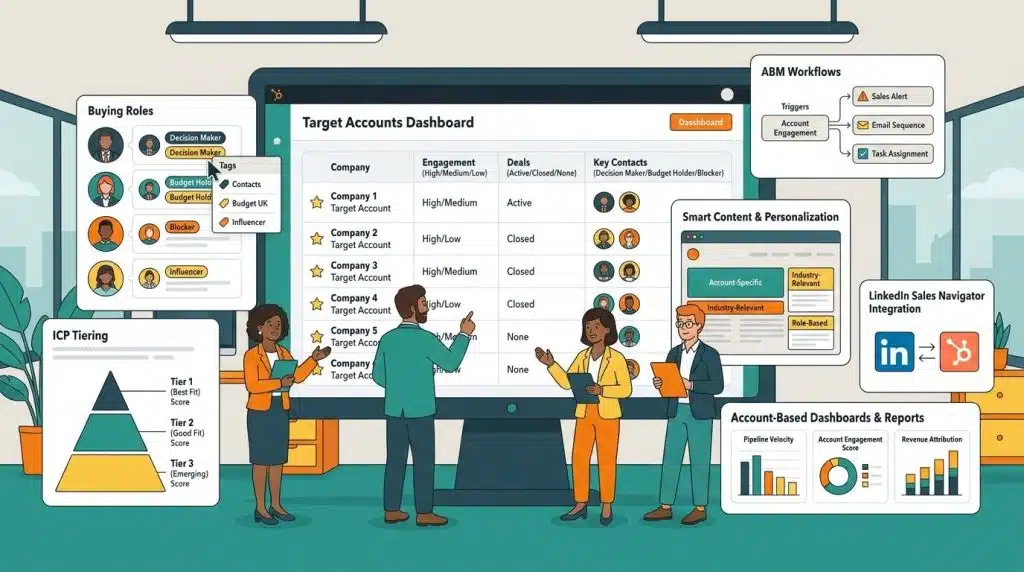
In HubSpot Marketing Hub Pro ($890/month) and Sales Hub Pro/Enterprise, you've got native ABM features:
- Target Accounts. Mark companies as target accounts. See them all in a dedicated dashboard with engagement, deals, and key contacts in one view.
- Buying roles. Tag contacts as decision makers, budget holders, blockers, and so on, so your team knows who they're really talking to.
- ICP tiering. Score and tier accounts by fit, with automated workflows that prioritize them.
- ABM workflows. Trigger sales alerts, email sequences, or task assignments based on account engagement.
- Smart content and personalization tokens. Show different web content and emails based on account, industry, or buying role.
- LinkedIn Sales Navigator integration. Pull LinkedIn data into HubSpot and run targeted LinkedIn campaigns from your account list.
- Account-based dashboards and reports. Pipeline, engagement, and revenue attribution at the account level, not just the lead level.
That's a real ABM toolkit. For most $5M to $50M B2B companies running their first or second ABM program with a list of 50 to 200 target accounts, it's enough. (And I'll go further: most teams who buy a separate ABM platform haven't fully used what HubSpot already gives them. Wrong order.)
So when does HubSpot stop being enough? A few real signals:
- You need third-party intent data, meaning you want to know which accounts are researching topics across the web, not just on your site
- You're running account-based display advertising at scale and need programmatic targeting beyond LinkedIn
- Your target list is large enough (500+ accounts) that you need predictive AI to prioritize who to focus on this week
- You're running coordinated multi-channel ABM (display + chat + dynamic web + outbound) and need orchestration across all of it
If none of those describe you, save the $50K and keep using HubSpot. If one or more does, keep reading.
The five categories of ABM tools (the fast version)
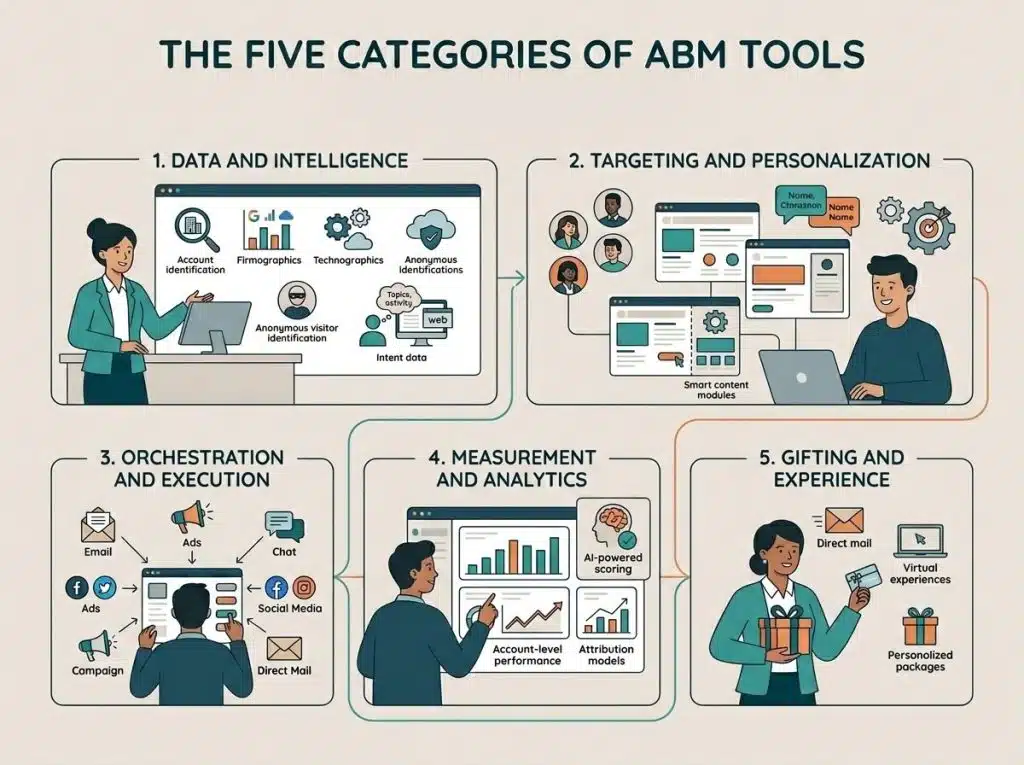
Most ABM tools fall into one of five buckets. You don't need all five, and definitely not all five from different vendors.
- Data and intelligence. Account identification, firmographics, technographics, anonymous visitor identification, and intent data (which accounts are researching topics like yours across the web). Your starting layer.
- Targeting and personalization. Dynamic web content, role-based messaging, smart content modules, email personalization triggers. Lets you speak differently to different accounts and roles without building 200 landing pages.
- Orchestration and execution. Multi-channel campaign automation: coordinating email, ads, chat, social, and direct mail from one place. Where your strategy actually runs.
- Measurement and analytics. Account-level dashboards, attribution, AI-powered scoring. Because traditional lead metrics break down with ABM.
- Gifting and experience. Direct mail, gift cards, branded experiences. The offline arm of ABM that breaks through digital noise when it's done well.
Two things to keep in mind. First, HubSpot covers a meaningful chunk of categories 2, 3, and 4 natively (see above). Second, you don't have to nail all five at once. Most of our clients start with category 1 (data and intelligence) layered onto HubSpot, then add others as their program matures. Crawl, walk, run — not sprint and crash.
ABM tools worth knowing in 2026
Here's where most listicles get lazy. They rate every tool as "great for marketing teams," all priced at "Contact Sales," with no real guidance on which one fits which type of company.
We're going to do this differently. Below: nine ABM tools worth knowing, with starting prices where they're public and what each one is actually best for. (And yes, I'm leading with HubSpot, because if you're our reader, it's probably already in your stack and the right starting point for your ABM program.)
| Tool | Best for | Starting price | HubSpot integration |
|---|---|---|---|
| HubSpot Marketing Hub | Native ABM for teams already on HubSpot: target accounts, buying roles, ABM workflows, dashboards, smart content | $890/mo Pro, $3,600/mo Enterprise | Native (it is HubSpot) |
| RollWorks (now AdRoll ABM) | Mid-market orchestration with account-based advertising; the most accessible third-party platform | $975/mo starter; $12K–$50K/yr full | Native, bi-directional |
| DemandScience (formerly Terminus) | Multi-channel ABM orchestration (ads, chat, web, email) for upper mid-market | ~$23K/yr median | Native |
| ZoomInfo Marketing | Data-heavy ABM with the strongest contact and intent data foundation | ~$15K/yr entry, $25K+ for ABM features | Native |
| 6sense | Predictive AI and intent data for larger mid-market and enterprise teams | $0 free tier (50 credits/mo); $35K–$300K+/yr paid | Native |
| Demandbase | Full-stack enterprise ABM with B2B-native ad platform | $24K–$100K+/yr (Vendr median $43K–$65K) | Native |
| Mutiny | Web personalization for ABM: different homepage experience by account or industry | Custom, typically $20K–$60K+/yr | Via Zapier/API |
| Sendoso | Gifting and direct mail at scale; absorbed Alyce and Postal.io | ~$20K+/yr (custom) | Native |
| Reachdesk | Gifting and direct mail with pay-per-redemption pricing | ~$20K+/yr | Native |
A few quick notes from the table
HubSpot's native ABM is the right starting point for most mid-market B2B teams. If you're not yet running an ABM program at all, don't go shop a $50K platform first. Build the program in HubSpot. Get sales aligned. Prove it works on a list of 50 accounts. Then, if you genuinely outgrow the native tools, you'll know exactly what you're missing and what you actually need to buy.
RollWorks (now AdRoll ABM) is the closest thing to "starter ABM" outside HubSpot. $975/mo gets you account identification, fit/intent/engagement scoring, and account-based advertising. For a $20M B2B company that wants to run real account-based ads without a six-figure commitment, it's the answer.
DemandScience absorbed Terminus in November 2024. If you remember Terminus from a few years back, it's now part of DemandScience's "ABX" platform. Mid-market accessible (~$23K/yr median), strong multi-channel orchestration, and worth a look if RollWorks feels too narrow.
6sense, Demandbase, and Mutiny are real but expensive. All three are excellent at what they do. None of them are realistic for a $10M B2B company on a normal marketing budget.
That said, 6sense's free tier is worth knowing about. It gives you 50 data credits per month at no cost, plus basic company and people search and a Chrome extension. It's not enough to run an ABM program on, but it's a useful, no-spend way to kick the tires on intent data and see what 6sense actually shows you. If you're curious, sign up for free before you book a demo for the paid plans (which start around $35K/yr and climb fast).
Sendoso has consolidated the gifting space. It acquired Alyce in early 2024 and Postal.io in 2025. If you're adding a gifting layer to your ABM program, Sendoso is the Goliath. Reachdesk is the leading alternative, with a pay-per-redemption pricing model that some teams prefer.
For more on choosing platforms that integrate cleanly with the rest of your stack, our guide on B2B marketing platforms walks through how to think about the layers.
How to pick an ABM tool without blowing the budget
Buying ABM software shouldn't feel like speed-dating every vendor in martech. A simple framework:
Map your top two or three pain points first. Examples: too many unqualified leads, no visibility into account engagement, clunky handoffs to sales. If a tool doesn't fix one of those, move on.
List the must-have integrations. If your CRM is HubSpot (or Salesforce), every tool in the table above integrates. Verify it's bi-directional and near real-time, not a once-a-day batch sync.
Bring users into the demo. Whoever's actually going to log in every day should sit in the demo and ask questions. Usability beats "cool features" every time.
Run a 30-day pilot on a small account list. 10 to 20 high-potential accounts. One use case, like website personalization or intent alerts. Measure one metric, like meetings booked, opportunities created, or deal velocity. Don't try to evaluate the whole platform on a pilot. You'll spend three months trying to evaluate everything and learn nothing.
Get a total-cost-of-ownership worksheet from the vendor before you sign. Ask for: software fees, onboarding fees, data fees, ad spend minimums, professional services costs, and any "credit" or "module" add-ons. Surprises here kill ROI faster than bad features.
Negotiate. ABM platform pricing is famously squishy. Discounts of 15 to 35% are common, especially at quarter-end or fiscal year-end. Bring competitive quotes. Don't sign the first offer.
For more on aligning your stack across sales, marketing, and service, our Definitive Guide to RevOps walks through the integration playbook.
Frequently asked questions about ABM tools
ABM tools are software platforms that help B2B sales and marketing teams identify, target, and engage high-value accounts. They typically combine some mix of account identification, intent data, targeting and personalization, multi-channel orchestration, and account-level reporting. Some are full platforms (like 6sense and Demandbase). Others are point tools handling one slice, like Mutiny for web personalization or Sendoso for gifting.
The honest answer: depends on what you've got and what you need. For most mid-market B2B companies between $5M and $100M revenue, HubSpot Marketing Hub Pro ($890/month) handles native ABM features well enough that you don't need a separate platform at all. If you outgrow that, RollWorks (now AdRoll ABM) is the most accessible third-party option starting at $975/month. 6sense and Demandbase are excellent but priced for enterprise.
Pricing ranges from "free with limits" (HubSpot's CRM is free, 6sense has a free tier with 50 credits/month) to $300,000+ per year for enterprise platforms. Realistic mid-market budgets:
Entry-level point tools (gifting, ABM advertising): $1,000 to $5,000/month
Full ABM orchestration platforms: $20,000 to $60,000/year
Enterprise platforms with predictive AI and full orchestration: $60,000 to $300,000+/year
That's just the platform. Don't forget implementation fees, ad spend, data fees, and any required RevOps headcount to operate the thing.
Often, no. HubSpot Marketing Hub Pro and Enterprise include real ABM features: target accounts, ICP tiering, buying roles, account-level dashboards, ABM workflows, smart content, and a bidirectional LinkedIn Sales Navigator integration. For a B2B company running its first or second ABM program with a list of fewer than 200 accounts, it's usually enough. Add a third-party platform when you specifically need third-party intent data, programmatic display at scale, or predictive AI for prioritizing a large account list. Not before.
The takeaway
Most "best ABM tools" lists rank everything as "great for everyone." Reality doesn't work that way.
The right ABM tool depends on three things: where you are with your ABM program (just starting? running one already?), what's in your existing stack (HubSpot? Salesforce? something else?), and what you can actually afford. Be honest with yourself on that third one.
For most $5M to $100M B2B companies, the smart play is to start with HubSpot's native ABM features, run a real program on 50 to 200 accounts, and earn the right to buy something more sophisticated by proving the program works first. Buying a $50K platform before you've nailed account selection and sales alignment is a great way to end up with a $50K platform nobody uses.