

Why Campaign Execution Is the Missing Link in Your Marketing Success
Campaign execution is the systematic process of implementing, coordinating, and optimizing marketing campaigns across multiple channels to achieve specific business objectives. It bridges the gap between strategic planning and measurable results through structured workflows, cross-functional collaboration, and real-time performance monitoring.
Key components of effective campaign execution include:
- Strategic alignment - Ensuring all activities support defined goals and KPIs
- Resource coordination - Managing budgets, timelines, and team responsibilities
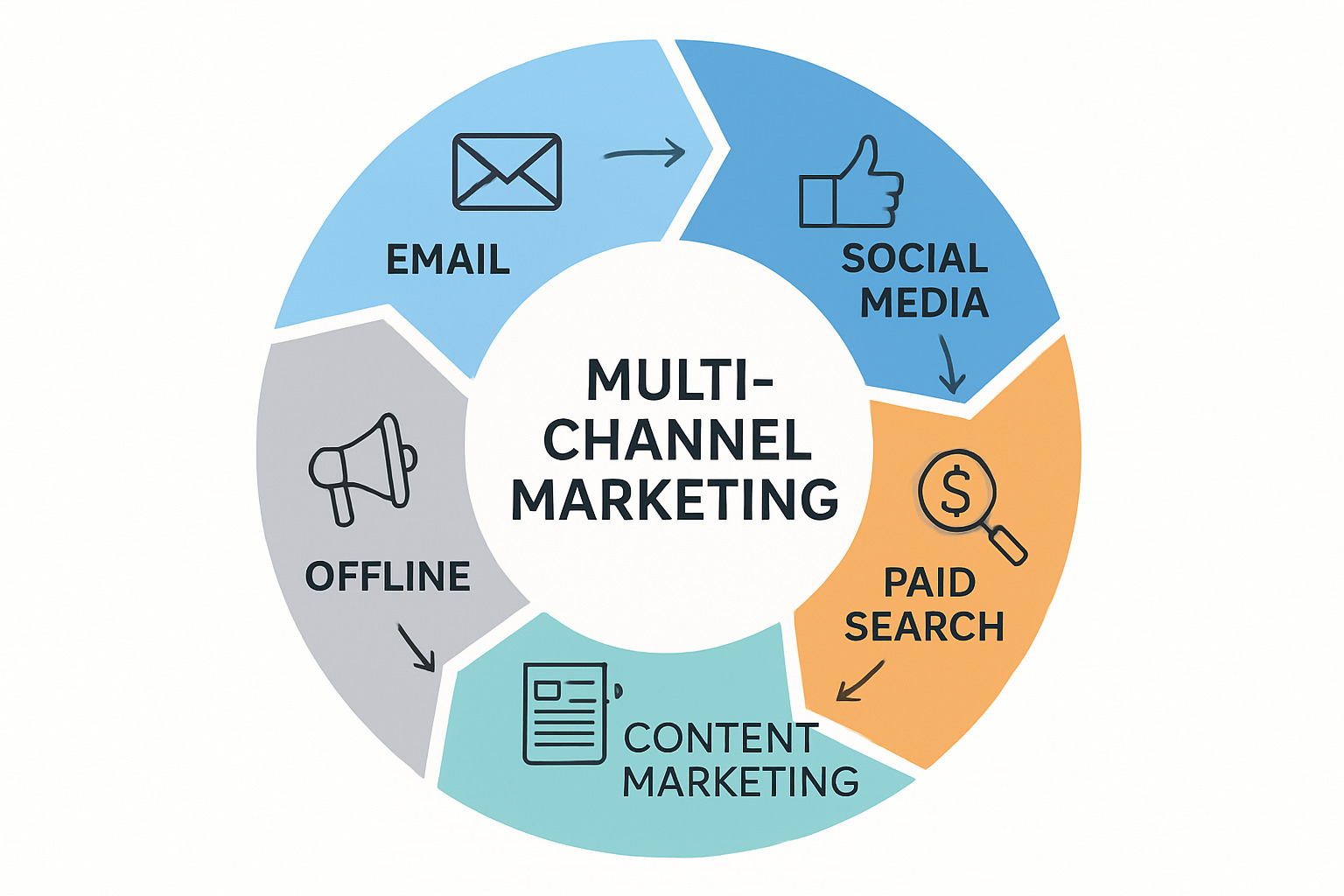
- Multi-channel orchestration - Coordinating messaging across email, social, paid media, and offline touchpoints
- Performance monitoring - Tracking metrics and optimizing campaigns in real-time
- Feedback loops - Capturing learnings to improve future campaign performance
Here's the reality: Most marketing teams still treat campaign execution as an afterthought—throwing together assets at the last minute, skipping quality checks, and wondering why their carefully crafted strategies fail to deliver.
Campaign execution isn't just about hitting "send" on your email blast or launching your Facebook ads. It's about creating a repeatable system that turns your marketing strategy into revenue-driving results. When done right, it ensures every touchpoint works together, every stakeholder knows their role, and every campaign teaches you something valuable for the next one.
The difference between companies that consistently hit their marketing targets and those that struggle often comes down to one thing: how well they execute their campaigns.
Campaign Execution 101: Why It Makes or Breaks Your Marketing
Here's the thing about marketing: you can have the most brilliant strategy in the world, but if you can't execute it properly, it's just expensive wallpaper. Campaign execution is what transforms your beautiful marketing plans from PowerPoint slides into actual revenue.
Think about it this way—strategy tells you what mountain to climb and why it's worth the effort. But execution? That's your map, your gear, and your step-by-step guide to actually reaching the summit without falling off a cliff.
Poor campaign execution is the number one reason why sales and marketing teams end up pointing fingers at each other instead of celebrating wins together. When campaigns lack transparent processes and defined objectives, marketing can't prove its worth, and sales get stuck with leads that go nowhere fast.
But alignment only happens when your campaign execution creates clear handoffs, shared goals, and measurable results that both teams can rally around.
What is campaign execution?
Campaign execution is the art and science of turning your marketing strategy into coordinated action. It's process orchestration at its finest—making sure every piece of your campaign puzzle fits together perfectly, from that first email to the final follow-up call.
This isn't about random acts of marketing. Effective campaign execution brings together cross-functional teams in a way that actually makes sense. Your designers know when assets are due, your sales team understands what messaging you're using, and your analytics person isn't scrambling to set up tracking at the last minute.
The magic happens through repeatable workflows that you can use again and again. Instead of reinventing the wheel every time you launch something new, you have proven systems that get better with each campaign you run.
How campaign execution differs from planning & strategy
A lot of marketers think planning and execution are basically the same thing. Spoiler alert: they're not, and mixing them up is like trying to build a house while you're still drawing the blueprints.
Planning and strategy live in research, big-picture thinking, and "what if" scenarios. You're diving deep into your audience, setting ambitious goals, and figuring out how much budget you'll need to make it all happen. It's the foundation work that has to happen first.
Campaign execution is where the rubber meets the road. You're managing timelines that actually matter, coordinating resource allocation in real-time, and creating those crucial feedback loops that tell you what's working and what needs to be fixed immediately.
The difference is like planning a dinner party versus actually cooking the meal, setting the table, and making sure your guests have a great time. Both matter, but execution is what your guests will remember.
Marketers who plan projects proactively are much more likely to report success. But here's the catch—even the best plans fall apart without solid execution processes to bring them to life.
Step-by-Step Framework to Execute Campaigns Like a Pro
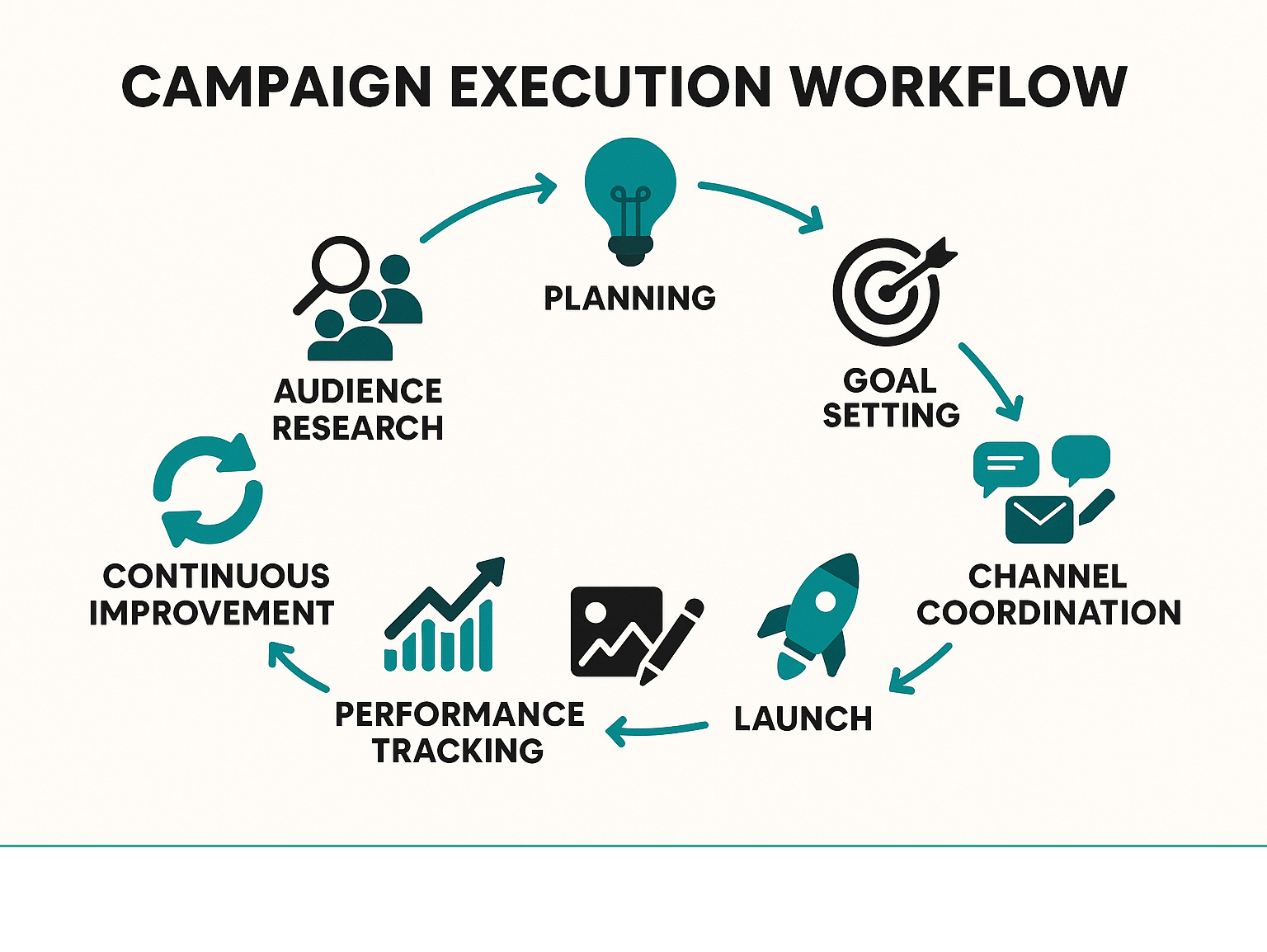
Successful campaign execution follows a systematic framework that ensures nothing falls through the cracks. Here's our proven approach that we use to help B2B companies nail their campaign execution every time:

The best campaign execution starts with rock-solid foundations. Before you touch a single creative asset or write one line of copy, you need to nail down your audience research and create detailed buyer personas that go beyond basic demographics. We're talking about understanding the real pain points that keep your prospects awake at 2 AM.
Smart segmentation comes next. Your database isn't just a list of email addresses—it's a goldmine of behavioral data that tells you exactly how to reach different groups. Whether you're segmenting by company size, industry, or engagement level, this step determines whether your message hits home or gets deleted.
Setting SMART goals might feel like Marketing 101, but you'd be surprised how many campaigns launch without clear, measurable objectives. Your goals need to be specific enough that anyone on your team can tell you exactly what success looks like. No more "increase brand awareness" fluff—we're talking concrete numbers tied to real business outcomes.
The RACI framework becomes your best friend during execution. When everyone knows who's Responsible, Accountable, Consulted, and Informed for each task, you eliminate those awkward "I thought you were handling that" moments that derail campaigns.
Creating creative assets within a structured workflow prevents the last-minute scrambles that plague most marketing teams. This means having clear approval processes, brand guidelines that actually get followed, and asset repositories where everyone can find what they need.
Multichannel coordination is where the magic happens. Your email campaign needs to work seamlessly with your social media push, your PPC ads, and even your offline events. Each channel should feel like part of the same conversation, not competing voices shouting different messages.
Marketing automation tools become the backbone of your execution, handling the repetitive tasks while you focus on strategy and optimization. But automation without strategy is just expensive chaos—you need clear triggers, workflows, and fallback plans.
Running campaigns in agile sprints keeps your team focused and allows for quick course corrections. Instead of launching a massive campaign and hoping for the best, you're constantly testing, learning, and improving. This approach mirrors the Content Operations Framework we use to help B2B marketers build scalable, repeatable processes.
The beauty of this framework is that it's repeatable and scalable. Once you've got these fundamentals down, you can execute campaigns faster, with better results, and fewer headaches. Your team will thank you, your boss will notice, and your prospects will actually engage with your content.
1. Audience & Goal Alignment
Here's the truth about campaign execution: if you don't know exactly who you're talking to and what you want them to do, even the most beautiful campaign will fall flat. It's like throwing a dinner party without knowing who's coming or what they like to eat.
Start by building detailed buyer personas that go beyond basic demographics. Yes, you need to know their job title and company size, but dig deeper. What keeps them awake at 2 AM? What's their biggest frustration with current solutions? Which channels do they actually check regularly (hint: it might not be the trendy new platform everyone's talking about)?
Understanding their buyer journey stage is crucial, too. Someone just realizing they have a problem needs different messaging than someone comparing vendors. Your campaign execution needs to account for these different mindsets and deliver the right content at the right moment.
When it comes to goal setting, specificity is everything. Use the SMART framework to make your goals Specific, Measurable, Attainable, Relevant, and Time-bound.
Instead of vague goals like "increase brand awareness," try something like "generate 500 new marketing qualified leads from our Q1 content campaign, with a target cost per lead of $50." Now that's a goal you can actually measure and optimize against.
Map your KPIs directly to business objectives so everyone understands how campaign success translates to company success. When your sales team sees how your campaign execution directly feeds their pipeline, suddenly everyone's on the same page.
2. Activate Channels: The Heart of Campaign Execution
This is where campaign execution gets exciting. You're not just posting on social media or sending emails—you're orchestrating a symphony where every channel plays its part perfectly.
The key is being strategic about your channel mix. Don't fall into the trap of trying to be everywhere at once. Instead, focus on where your audience actually hangs out and consumes information.
Email marketing remains the heavyweight champion of ROI, delivering strong returns for businesses that execute it properly. For B2B audiences, LinkedIn is often your best social bet, while paid search captures people actively looking for solutions. Content marketing builds long-term relationships and authority, and yes, direct mail and offline channels can still pack a serious punch for the right audience.
Budget allocation should follow data, not emotions. Start with channels that have proven themselves for your specific audience, then gradually test new ones. We've seen too many companies spread their budget like peanut butter across every possible channel, only to realize they're getting mediocre results everywhere instead of great results somewhere.
The magic happens when your channels work together. Your email nurtures the leads that your content marketing attracted, while your social media amplifies your best-performing content, and your paid ads retarget website visitors with relevant offers. That's true campaign execution.
3. Monitor & Optimize: Closing the Campaign Execution Loop
Here's where many marketers drop the ball: they launch their campaign and then basically pray it works. Professional campaign execution means staying actively involved throughout the entire campaign lifecycle.
Set up dashboards that give you both the big picture and the details. Track leading indicators like email open rates, click-through rates, and social engagement alongside lagging indicators like leads generated, pipeline created, and revenue attributed. Clear objectives are crucial for success, but objectives mean nothing without ongoing measurement.
A/B testing is your secret weapon, but only if you do it right. Effective A/B testing requires proper sample sizes and statistical significance. Test one thing at a time—subject lines, call-to-action buttons, landing page headlines—and let the data tell you what's working.
Build in regular check-ins and optimization sprints. Don't wait until the end of your campaign to see what happened. Weekly reviews let you catch problems early and double down on what's working.
After each campaign phase, run agile retrospectives with your team. Ask three simple questions: What worked well? What could be improved? What will we do differently next time? These conversations turn every campaign into a learning opportunity that makes your next campaign execution even stronger.
4. Capture Learnings & Feed the Next Campaign
Here's where most marketing teams drop the ball: they finish a campaign, celebrate the wins (or quietly move past the misses), and jump straight into planning the next one. But the savviest marketers know that campaign execution doesn't end when you hit your target numbers—it ends when you've captured every valuable lesson for next time.
Think of this phase as building your marketing team's institutional memory. Every campaign generates data goldmines that most teams accidentally throw away. What messaging made your audience stop scrolling? Which subject lines got opened? What creative elements actually drove clicks versus just looking pretty?
Create a simple knowledge base that doesn't require a PhD to maintain. We're talking about a shared document or database where you capture the stuff that really matters: which channels delivered the best ROI for different audience segments, what creative elements drove engagement, and yes, what processes caused those last-minute scrambles that had everyone working late.
Don't just document the successes. Your failures teach you just as much, if not more. Poor audience targeting leads to significant advertising waste—much of this occurs because teams repeatedly make the same targeting mistakes.
The goal isn't perfection—it's continuous improvement. Perhaps you've found that your audience responds better to video content on LinkedIn but prefers detailed written content in emails. Or perhaps you learned that your sales team needs lead scoring adjusted because the "hot" leads weren't actually ready to buy.
These insights become the foundation for smarter campaign execution next time around. Instead of starting from scratch, you're building on proven knowledge. Your campaigns become more effective, your team becomes more confident, and your results become more predictable.
The best part? This knowledge compounds. Each campaign makes the next one a little bit better, and before you know it, you're the team that consistently hits their targets while others are still guessing.
Tools & Tech Stack That Boost Execution
Let's be honest—choosing the right tools for campaign execution can feel overwhelming. Walk into any marketing conference, and you'll be bombarded with promises of "revolutionary" platforms that claim to solve all your problems. Here's the reality we've learned after years of helping B2B teams optimize their marketing operations: the best tool is the one your team actually uses consistently.
The magic isn't in having the most sophisticated tech stack—it's in creating seamless workflows where your tools communicate with each other, rather than making data silos that require manual work to reconcile. As we explain in our Marketing Operations Technology guide, integration and workflow alignment matter more than individual tool features.
Tool sprawl is real, and it's expensive. We've seen teams juggling fifteen different platforms when three well-integrated ones would deliver better results. Every additional tool adds complexity, training time, and potential points of failure in your campaign execution process.
Must-Have Execution Tools
Your project management platform serves as mission control for everything that happens in your campaigns. Whether you choose Teamwork, Asana, or Monday.com, this becomes your single source of truth for timelines, responsibilities, and progress tracking. Teams using project management software report significantly higher productivity compared to those still relying on email chains and shared spreadsheets.
CRM and marketing automation platforms like HubSpot or Salesforce become the backbone of your data strategy. This isn't just about sending emails—it's about creating a unified view of every prospect's journey from first touch to closed deal. Without this integration, your attribution reporting becomes guesswork, and your sales team gets frustrated with lead quality.
Analytics platforms help you understand what's actually working. Google Analytics remains essential, especially since Google dominates 92.49% of the search engine market. But don't stop there—layer in social media analytics, email performance tracking, and attribution modeling tools that help you see the complete picture.
Quality assurance tools prevent those cringeworthy moments when broken links or formatting issues reach your audience. Link checkers, email rendering tools, and organized asset repositories might seem like small details, but they're what separate professional campaign execution from amateur hour.
Governance, Security & Compliance
Here's where things get serious, and rightfully so. As your campaign execution becomes more automated and data-driven, governance isn't just a nice-to-have—it's essential for protecting your business and your customers' trust.
Role-based access controls ensure team members can only access the data and tools they need for their specific responsibilities. This isn't about being controlling—it's about reducing security risks and preventing well-meaning team members from accidentally breaking live campaigns or accessing sensitive customer information.
Data protection and PII redaction must be built into your workflows from the outset, not added as an afterthought. This becomes especially critical when you're handling enterprise customer data or operating in industries with strict compliance requirements. Customers expect companies to understand their unique needs and expectations, which requires collecting and using personal data responsibly.
The goal is to create systems that protect sensitive information while still allowing your team to execute campaigns efficiently. When governance feels like a roadblock, it usually means the processes need refinement, not elimination.
Metrics, Optimization, and Troubleshooting
Here's where campaign execution gets really exciting—watching your data tell the story of what's working and what needs a nudge. Think of metrics as your campaign's vital signs. Just like you wouldn't wait until you're feeling terrible to check your health, you can't wait until the end of a campaign to see how it's performing.
The best part? Today's tools make real-time optimization not just possible, but surprisingly straightforward once you know what to watch for.
Key KPIs to Track During Campaign Execution
The secret is focusing on metrics that actually move your business forward, not vanity metrics that look impressive in reports but don't pay the bills. We've seen too many marketing teams get excited about high email open rates while completely missing that their cost per lead is through the roof.
Click-through rates (CTR) tell you whether your message is hitting the mark. If people aren't clicking, either your audience targeting is off or your creative needs work. Cost per lead (CPL) shows you how efficiently your budget is working—this number should guide where you put your money next.
Pipeline contribution is where marketing proves its worth to the sales team. Track how your campaigns feed into actual sales opportunities, not just form fills. Return on investment (ROI) remains the ultimate scorecard, while attribution data helps you understand which touchpoints actually influence buying decisions.
Here's a pro tip: set up automated alerts for significant performance changes. When your email open rates suddenly drop 20% or your cost per click jumps dramatically, you want to know right away, not during next week's team meeting.
Using Data & Analytics to Optimize in Real Time
Modern campaign execution feels almost magical when you leverage real-time data properly. We've seen clients reduce their cost per acquisition by reallocating their budget to better-performing channels mid-campaign—something that would have been impossible just a few years ago.
Predictive analytics helps you identify which leads are most likely to convert, so you can focus your nurturing efforts where they'll have the most significant impact. Hitting digital marketing targets helps meet overall business goals, but this only works when you're targeting the right prospects with the right message.
Dynamic budget allocation based on performance data is a game-changer. If your LinkedIn ads are delivering qualified leads at $30 each while your Google Ads cost $75 per lead, shifting budget makes obvious sense. The key is doing it systematically with proper testing, not just reacting to daily fluctuations.
Real-time dashboards should show both leading indicators like email engagement and social shares, plus lagging indicators like actual revenue and pipeline creation. This gives you both early warning signs and ultimate success measures.
Common Pitfalls—and How to Avoid Them
Even experienced marketers stumble into predictable traps during campaign execution. The good news? Once you know what to watch for, these pitfalls are totally avoidable.

Scope creep is the sneaky campaign killer. You start with a focused plan, then someone suggests "just one more channel" or "one more audience segment." Before you know it, your budget is spread too thin and nothing performs well. Stick to your original plan or formally scope and budget any additions.
Tool sprawl creates chaos faster than you'd expect. Adding new tools without removing old ones leads to data living in multiple places that don't talk to each other. Before adding any new tool, ask yourself: "What existing tool will this replace?"
Mis-segmentation happens when you treat all prospects the same instead of tailoring messages to specific audience needs. Customers expect companies to understand their unique needs and expectations—generic messaging just doesn't cut it anymore.
Siloed data makes attribution impossible and prevents optimization based on complete information. When campaign performance data lives in multiple systems that can't communicate, you're essentially flying blind. Integration isn't just nice to have—it's essential for serious campaign execution.
The solution to most of these problems? Start with solid processes and resist the urge to complicate things just because you can. Sometimes the simplest approach is also the most effective.
Frequently Asked Questions about Campaign Execution
The honest answer? It depends on what you're trying to accomplish, but most B2B marketers underestimate the time needed for solid campaign execution. We've seen too many teams rush through the process and wonder why their carefully crafted strategy falls flat.
For most B2B campaigns, here's what we typically see work well: Planning and asset creation usually takes 2-4 weeks, especially if you're creating custom content or coordinating with multiple stakeholders. Don't shortchange this phase—planning represents a significant portion of campaign implementation effort.
Setup and testing needs at least a week. This includes building landing pages, setting up automation workflows, and running quality checks. Trust us, you want to catch broken links and typos before your audience does.
The active campaign period can range from 2-8 weeks depending on your goals. Lead generation campaigns often run shorter, while brand awareness or nurturing campaigns benefit from longer timeframes.
Finally, analysis and optimization takes 1-2 weeks. This isn't just pulling numbers—it's about understanding what worked, what didn't, and how to improve next time.
Our Content Operations Framework provides a structured approach that helps teams avoid the common trap of unrealistic timelines. The key is building buffer time for those inevitable "quick changes" that aren't actually quick.
Someone needs to be the "campaign captain"—the person who wakes up thinking about whether everything is on track and goes to bed knowing what needs to happen tomorrow. Campaign execution works best when there's clear ownership, even when the work is distributed across multiple team members.
In larger organizations, this role may be filled by a dedicated campaign manager or a marketing operations professional. They're the ones who live and breathe project timelines, know which stakeholders to nudge when assets are late, and can spot potential problems before they derail the campaign.
In smaller teams, this responsibility often falls to the demand generation manager or even the marketing director. The title matters less than the skills: your campaign owner needs project management abilities, a solid understanding of your marketing technology stack, and sufficient authority to make decisions when issues arise.
They don't need to write every email or design every landing page, but they absolutely need to ensure everything gets done on time and budget. Think of them as the conductor of your marketing orchestra—everyone else might be playing their parts beautifully, but someone needs to keep everyone in sync.
When a campaign isn't performing as expected, resist the urge to change everything at once. We've seen marketers panic and completely overhaul campaigns that just needed minor tweaks.
Start with your conversion funnel and work backwards. Check your landing pages first—are forms actually converting? Is your value proposition crystal clear, or are visitors confused about what you're offering? Sometimes the problem isn't your traffic; it's what happens when people arrive.
Next, review your traffic sources. Which channels are sending visitors who actually engage with your content? You might find that your social media clicks look impressive but don't convert, while your email traffic has a much higher engagement rate.
Then analyze your messaging. Does it address the actual pain points your audience faces right now? We often see campaigns that sound great in the boardroom but miss the mark with real prospects because they focus on features instead of problems.
Finally, test individual elements systematically. Try different subject lines, CTAs, or images—but test one thing at a time. Changing multiple elements simultaneously makes it impossible to know what actually improved performance.
Conclusion
Here's the thing about campaign execution: it's the difference between marketing teams that consistently knock it out of the park and those that are constantly scrambling to explain why their latest campaign didn't deliver.
You've probably been there—staring at disappointing results wondering what went wrong, even though your strategy looked brilliant on paper. The truth is, strategy without solid execution is just expensive wishful thinking.
Organized marketers are much more likely to report success. But here's what that really means in practice. It's not about having the fanciest tools or the biggest budget. It's about creating systems that work, teams that communicate effectively, and processes that are actually followed when deadlines start looming.
We've worked with dozens of B2B companies, and the pattern is always the same. The ones that nail their campaign execution don't just improve their current results—they build something much more valuable. They create predictable, scalable growth that doesn't depend on luck or heroic last-minute efforts.
The companies that get this right focus on a few key things. They
- Treat every campaign like a real project with clear owners and deadlines.
- Build feedback loops that capture what worked (and what didn't) for next time.
- Use data to make decisions while campaigns are running, not just after they're over.
- Choose tools that actually work together, rather than creating more work.
- Understand that execution is an ongoing skill, not something you figure out once and forget about.
Let's talk
If you're tired of campaigns that underperform or marketing results that feel like a roll of the dice, you're not alone. That's precisely why we built our practice around helping B2B companies streamline their marketing operations.
Ready to stop leaving results to chance? Our team specializes in helping B2B companies build the processes, tools, and team alignment needed for consistent marketing success. Learn more about our Marketing Operations Consulting and find out how we can help you execute campaigns that actually deliver.