

Why B2B Marketing Platforms Are Game-Changers for Revenue Teams
A B2B marketing platform is a single software hub that connects your marketing tools, data, and workflows so you can attract, nurture, and convert high-value prospects without drowning in spreadsheets or swivel-chair integrations.
What these platforms give you in a nutshell:
- Unified customer data pulled from every touchpoint (web, email, ads, social, events)
- Automated nurturing that spans channels and adjusts to real-time behaviour
- Account-level insights so sales and marketing see the same buying-group story
- Revenue attribution from anonymous first touch to closed-won deal
- Journeys orchestrated by AI—no more one-size-fits-all drip sequences
Why now? Modern B2B buyers do most of their research in the "Dark Funnel," touching dozens of channels before they ever fill out a form. If your tech stack can’t connect those dots, leads slip through the cracks, data quality tanks, and proving ROI turns into guesswork.
Companies that switch from fragmented tools to a unified platform report striking gains—think three times higher conversion rates or double-digit drops in customer acquisition costs. The catch: you must select the correct type of platform for your stage of growth and integrate it with realistic goals in mind.
The rest of this guide shows you how.
Why a B2B Marketing Platform Beats Piecemeal Tools

Tool sprawl isn’t just inconvenient—it’s expensive. Every disconnected system means extra log-ins, duplicate data, and hours lost to manual exports.
Hidden costs to watch:
- Productivity drain: Marketing teams lose up to a day a week just reconciling spreadsheets.
- Reporting delays: When numbers live in five dashboards, optimisation lags behind reality.
- Data decay: Updates in your CRM rarely sync perfectly with your email tool, creating duplicate or outdated records.
- RevOps friction: Sales, marketing, and customer success can’t agree on what a “qualified” lead looks like without a single source of truth.
- Compliance risk: Managing consent and data-retention rules across multiple apps is a privacy nightmare.
A unified B2B marketing platform solves these pain points with native integrations and a shared data model. Instead of fighting your stack, you finally have the bandwidth to plan campaigns, test new ideas, and partner with sales on revenue goals. For a deeper dive into integration benefits, see this breakdown of tech-stack best practices.
Non-Negotiable Features of Winning B2B Platforms
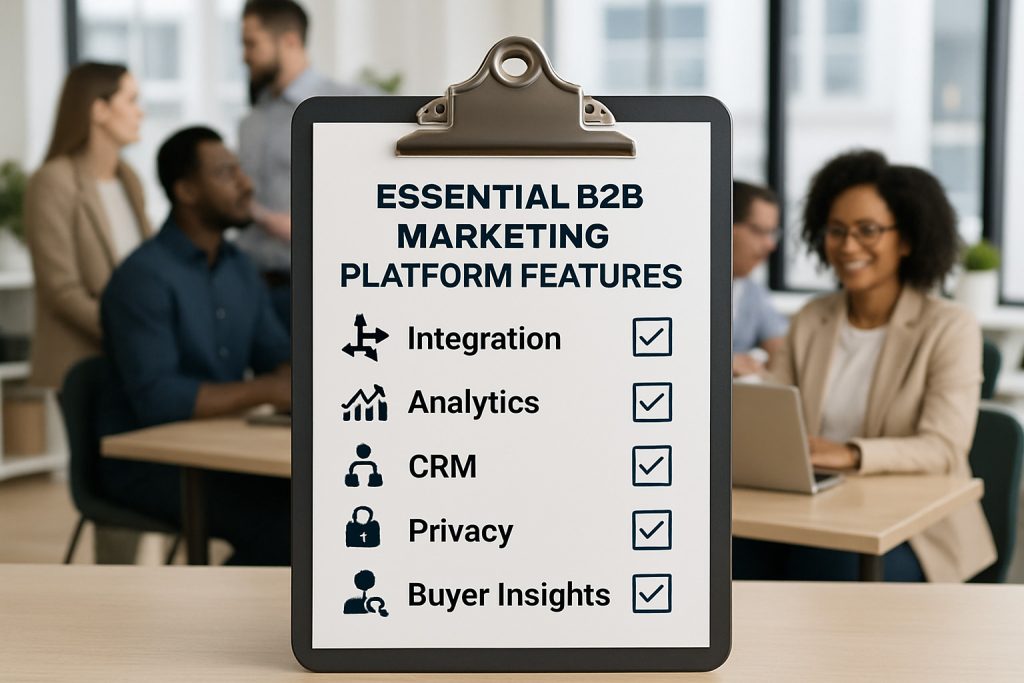
The market is crowded, but any platform worth its licence fee will nail the five capabilities below.
1. Real-Time Profiles & ICP Targeting
A first-party CDP snaps every click, open, and page view into one account record—then flags gaps in your buying-group coverage so you can reach the economic buyer, not just the form-filler.
2. Journey Orchestration & Lead Nurture
Look for multichannel workflows that trigger on behaviour, not timers. AI-weighted lead scores keep getting smarter as prospects interact with you.
3. Account-Based Personalization
Dynamic web content, email, and ads should adapt by account, persona, and intent signal, down to the pricing page visit that happened 30 minutes ago.
4. Revenue Attribution & Optimization
Multi-touch models (first, last, linear, time-decay, or AI) are table stakes. What matters is real-time dashboards that tie campaigns to pipeline velocity and average deal size.
| Model | Great For | Watch-Out |
|---|---|---|
| First-Touch | Brand awareness | Ignores nurture steps |
| Last-Touch | Direct-response offers | Misses early influence |
| Linear | Long cycles | Unrealistic equal weight |
| Time-Decay | Fast-moving deals | Undervalues early touch |
| AI | Complex journeys | Needs data volume |
5. AI & Automation Layer
True AI predicts next-best actions (content, channel, timing) and generates intelligent alerts—no more “FYI” pings that reps ignore.
Roundup: 5 Platform Categories That Actually Deliver Results
| Category | Core Use | Best For |
|---|---|---|
| Marketing Automation Engines | Email, forms, basic scoring | Early-stage teams scaling nurture |
| ABM Platforms | Account targeting & personalisation | Mid-market/enterprise chasing high ACV deals |
| Social Advocacy Suites | Employee sharing & social ROI | Firms that rely on thought leadership |
| Data & Attribution Hubs | Unified reporting & AI models | Mature orgs proving marketing’s dollar impact |
| AI Orchestration Layers | Real-time decisioning | Businesses ready for predictive everything |
Highlights by category:
- MAPs: Drag-and-drop email builders, GDPR-ready compliance, seamless CRM integration.
- ABM: Intent data plus dynamic web personalization. See Account-Based Marketing Explained.
- Social: Unified inbox and gamified employee advocacy leaderboards to boost engagement.
- Analytics Hubs: ETL pipelines, funnel velocity tracking, and AI-powered multi-touch attribution dashboards.
- AI Orchestration: Predictive lead routing, conversational email automation, and real-time dark-funnel insights.
Choosing, Integrating & Measuring Your B2B Marketing Platform
1. Start with a reality check. List your top three pain points (e.g., lead quality, manual reporting, unclear ROI). Weight platform features by how well they solve those issues—flashy AI can wait if basic email metrics are still fuzzy.
2. Bring every stakeholder to the table early. Marketing ops, sales, customer success, and IT should all help score vendors. When they co-own the choice, adoption skyrockets.
3. Vet vendors on outcomes, not demos. Ask for references that match your size and complexity. Dig into implementation timelines, roadmap focus, and hidden costs.
4. Roll out in phases.
- Phase 1 typically involves data migration and core email automation, which usually takes 4–8 weeks.
- Phase 2: Advanced segmentation and sales alerts.
- Phase 3 focuses on AI, web personalization, and deep attribution.
5. Measure what matters. Benchmark before you go live, then track:
- Short-term: email engagement, form-fill conversion, hours saved
- Mid-term: MQL-to-SQL rate, pipeline velocity, CAC
- Long-term: multi-touch ROI, CLV, sales cycle length
For RevOps alignment tips, read RevOps for B2B: What It Is and Why It Matters.
FAQ Snapshot
How long does implementation take? 4–8 weeks for basic automation; 3–6 months for enterprise-grade ABM or AI orchestration (data cleanliness is the make-or-break factor).
What about privacy? Leading platforms centralise consent, automate retention schedules, and keep audit trails—but you still need internal policies and training.
Fastest ROI metrics? Look at manual hours eliminated, lift in email/web conversions, and pipeline acceleration within the first 90 days.
Conclusion
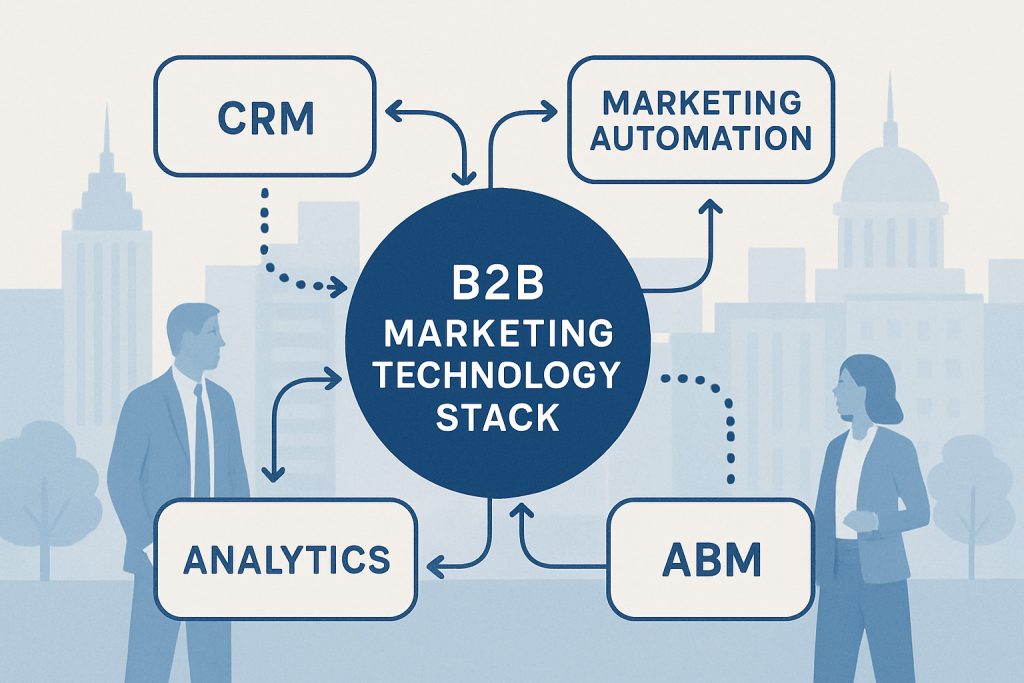
Fragmented tools stall growth. A well-chosen B2B marketing platform gives you unified data, happier revenue teams, and campaigns that actually move the needle. Start by fixing your biggest pain point, implement in bite-sized phases, and measure relentlessly. Need a sounding board? The team at The B2B Mix specialises in hands-on, jargon-free HubSpot optimization and platform strategy—reach out any time or explore our B2B digital marketing services.