
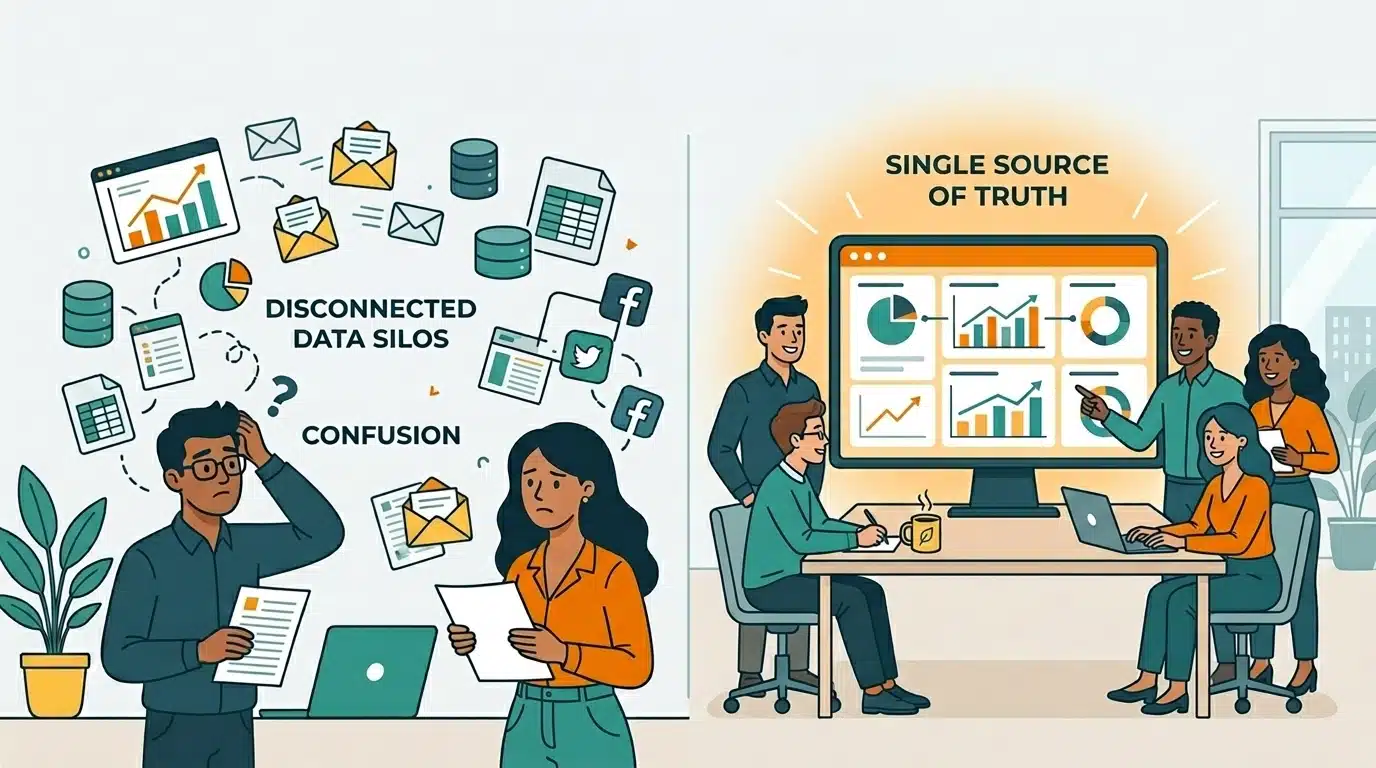
A single source of truth in a CRM means there is one trusted system where every contact, company, deal, and number lives, and everyone agrees it's correct. When you ask "how many open deals do we have?" or "where did this lead come from?", there is exactly one place to look and exactly one answer. No competing spreadsheets, no "let me check with Dave," no two reports that disagree. The CRM is the record everyone trusts and works from. Most established B2B companies don't have this, not because their software can't do it, but because their data, definitions, and habits never got aligned around a single system.
That's the whole idea. The rest of this page is what it looks like in practice, what goes wrong without it, and how to actually build one.
What is a single source of truth in a CRM?
It's a setup where one system holds the authoritative version of your customer and revenue data, and every team works from that system instead of their own copies. A true single source of truth has three things going for it:
- One record per real-world thing. One company is one company in the system, not three near-duplicates.
- Shared definitions. "Qualified lead" or "closed-won" means the same thing to sales, marketing, and service, because it's defined once.
- Trusted reporting. Numbers come out of that one system, so a report and a gut-check tend to agree.
The CRM doesn't have to be the only tool you use. It has to be the one that wins when two tools disagree.
What's the difference between scattered data and a single source of truth?
This is the gap a lot of companies live in. Here's the contrast:
| Scattered / duplicate data | Single source of truth | |
|---|---|---|
| Where the truth lives | Spread across the CRM, spreadsheets, inboxes, and people's memory | One trusted system everyone works from |
| Answering a question | Three people check three places and get three answers | One place, one answer |
| Definitions | "Qualified" means whatever the person typing it thinks | Defined once, applied consistently |
| Reporting | Reports get hedged, second-guessed, or rebuilt by hand | Reports are trusted enough to act on |
| Risk | Decisions made on numbers nobody fully believes | Decisions made on data the team stands behind |
| What breaks | Handoffs, forecasts, follow-ups, and trust in the system itself | Far less, because there's one version to maintain |
Scattered data isn't a moral failing. It's the natural result of a growing company bolting on tools and people faster than it aligned them. It just quietly taxes everything you do.
Why doesn't every B2B company have a "single source of truth"?
Because a single source of truth is a people-and-process problem wearing a software costume. The usual reasons:
- The CRM was set up fast and never finished. It works at 10% of what it can do, and the other 90% became spreadsheets.
- Nobody owns the definitions. Without an agreed meaning for each stage and field, the same data means different things to different people.
- Tools got added, not integrated. A new tool came in for a real reason, but it kept its own copy of the data, and now there are two truths.
- Reps protect their own systems. When people don't trust the official system, they keep private notes, and the official system gets worse, which proves them right.
This is especially common in established, founder-led B2B companies (manufacturers, distributors, service businesses) that grew on relationships and added software later. The business is real. The systems just never caught up.
What breaks when you don't have a single source of truth?
Quite a lot, and usually quietly:
- Forecasts you can't defend. The pipeline in the system doesn't match the pipeline in your reps' heads.
- Leads that fall through handoffs. Marketing thinks sales has it. Sales never saw it. Nobody's sure.
- Reporting that gets argued instead of used. Meetings spent debating whose number is right, not what to do about it.
- A business that depends on specific people. When the truth lives in someone's memory, that person can't take a vacation, and they definitely can't leave.
How do you build a single source of truth in your CRM?
The order matters. Buying more software first is the classic mistake. A workable sequence:
- Pick the system that wins. Decide which platform is the authority (for most of our clients, that's HubSpot). Everything else syncs to it or feeds it.
- Clean and de-duplicate. Merge duplicates, fix the obvious garbage, and get to one record per real-world thing.
- Define your terms once. Write down what each deal stage, lifecycle stage, and key field actually means, and get sales, marketing, and service to agree.
- Integrate, don't copy. Connect your other tools (ERP, marketing, support) so data flows into the one system instead of living in parallel.
- Build reporting on top of the clean foundation. Now the dashboards are worth trusting, because what's under them is real.
- Make it the habit. Adoption is the whole game. If the team doesn't work in it, it stops being the truth.
You don't get there by buying a better tool. You get there by aligning the data, the definitions, and the team around the tool you already have.
Frequently asked questions
It means one trusted place where your important data lives, so everyone gets the same answer to the same question. In a CRM, it's the system everyone agrees is correct for contacts, companies, deals, and revenue numbers.
No. A CRM only becomes a single source of truth when the data is clean, the definitions are shared, and the whole team actually works in it. Plenty of companies own a capable CRM and still run on spreadsheets and memory alongside it.
Usually because the CRM was set up quickly and never finished, no one owns the definitions, and new tools were added without being integrated. It's more often a process and ownership gap than a software limitation.
A CRM is the software. A single source of truth is a state you reach when that software holds the authoritative, agreed-upon version of your data and everyone works from it. You can have the first without the second.
Yes. HubSpot can serve as the authoritative system when it's properly implemented: clean data, defined stages and fields, integrated tools, and team adoption. The platform enables it; the setup and habits make it real.
It depends on how scattered the data is and how many tools are involved, but the foundational work (de-duplication, shared definitions, core integrations) is typically a matter of weeks to a few months, not years. Adoption is ongoing.