
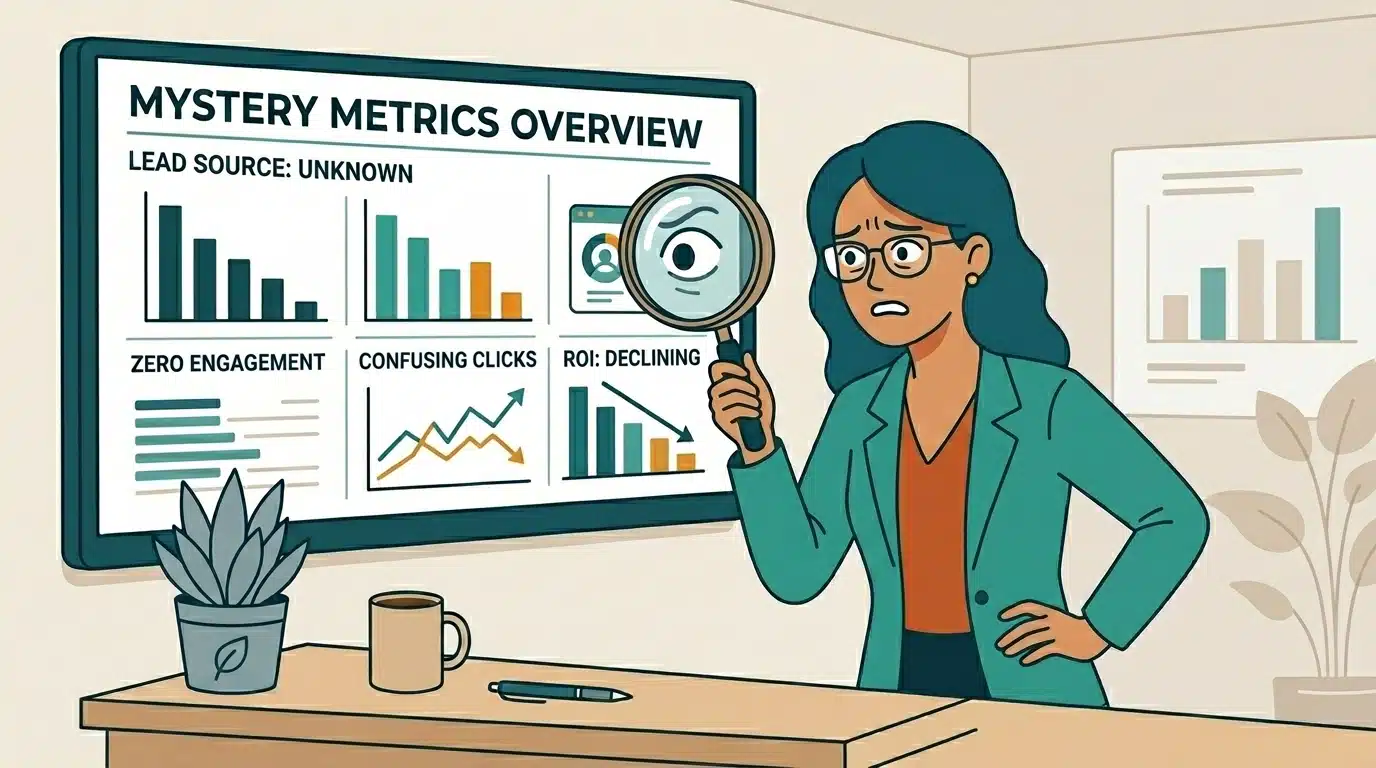
Here's a confession. OK. This isn't really my confession. It's a general issue we've seen upon multiple occasions when going into a HubSpot audit or optimization where CRM data quality is in question.
There's a number. Maybe it's your cost per lead. Maybe it's pipeline created, or win rate, or how many of last quarter's deals "came from marketing." It lives on a dashboard somebody built a while back, it looks clean, and you've repeated it so many times in board meetings and team huddles that it's basically furniture now.
And then one day, quietly, you stop believing it.
You don't say anything. You just notice that the number on the screen doesn't match what your gut knows about the business. So you start working around it. You ask your best rep what's really in the pipeline. Maybe you keep a side spreadsheet. You preface the number in meetings with "give or take." (We've all done the "give or take." It's the sound of a founder who knows.)
Nobody trained you to distrust your own systems. It happened on its own, one small wrong-looking number at a time.
Why good companies end up with numbers they can't trust
The frustrating part is that this almost never comes from one big, dramatic failure. It comes from a pile of small, boring CRM quality issues:
- Duplicates. The same company exists three times, so "number of accounts" is inflated and nobody's quite sure by how much.
- A property that means different things to different people. One rep marks a deal "Qualified" after a single reply. Another waits until there's a signed scope. Same field, two definitions, one useless average.
- Stuff that never made it in. The deal that closed on a phone call and got logged a week later, or not at all. The lead that came in through a form that quietly broke in March.
- A report built on a guess. Someone set up the dashboard fast, under deadline, mapped a field they weren't sure about, and moved on. That guess has been quietly feeding your board deck ever since.
None of these feel like a crisis on the day they happen. That's exactly why they survive. (Oof.)
What CRM data quality problems actually costs
Bad data isn't just an annoyance for the person who has to clean it up. It's expensive in ways that don't show up on an invoice:
- You make real decisions on fake numbers. You pour budget into the channel the dashboard says is working, when the truth is buried under a tagging mistake.
- Your team stops trusting the system, then stops using it. Why log the call carefully if the report's wrong anyway? And now the data's even worse. It's a doom loop.
- You lose the thing a CRM is supposed to give you: the ability to answer a simple question once, correctly, without three people checking three places.
Here's the part that matters for you specifically. When you can't trust the number, you become the source of truth. Every real answer has to run through your head. That's the opposite of building a business that can run without you, which I'm guessing is the whole point.
Where to start (you don't have to fix everything)
You don't need a six-month data overhaul to get the trust back. Start small:
- Pick the one number you repeat most. The one you'd be embarrassed to be wrong about.
- Trace it back to its source. Click into the report. What field is it pulling? Who fills that field in, and do they all define it the same way? You'll often find the leak in about twenty minutes.
- Write down what the number is supposed to mean. One sentence. If your team can't agree on the sentence, you found the real problem, and it isn't the software.
Clean data isn't glamorous. Nobody's putting "reconciled our deal stages" on a highlight reel. But it's the difference between a CRM that backs you up and one you've quietly learned to talk around.
Pick your number. Trace it. You'll feel the difference the next time someone asks you for it and you don't reach for the words "give or take."