

You're running more campaigns. Publishing more content. Generating more leads. But revenue growth is still stuck.
The instinct is to do more: launch another campaign, hire another SDR, increase ad spend. But what if the problem isn't volume? What if something deeper in your growth system is broken?
Many B2B companies spend months chasing symptoms while the real bottlenecks go undiagnosed. The result? Wasted budget, burned-out teams, and friction between marketing and sales that only gets worse.
This article will help you identify where your growth system is actually breaking down, and when diagnosis should come before more execution.
Why Stalled Growth Is Not Always a Lead Problem
When revenue flatlines, the default assumption is simple: we need more leads.
But only 2.9% of marketing qualified leads become revenue. That means for most B2B companies, the issue isn't top-of-funnel volume. It's what happens after the lead enters the system.
If you're generating 500 leads a month but converting 10, adding another 200 leads won't fix the underlying problem. You'll just have 700 leads going nowhere.
Growth bottlenecks are structural. They live in the gaps between systems, the handoffs between teams, and the misalignments that no single tactic can solve. And they're expensive: companies with aligned sales and marketing operations achieve 24% faster three-year revenue growth and 27% faster profit growth.
The companies that break through aren't necessarily doing more. They're diagnosing what's broken first.
What a B2B Growth Bottleneck Actually Is
A growth bottleneck is any point in your go-to-market system where momentum stalls, leads leak, or value gets lost.
It's not always obvious. You might see decent traffic, reasonable lead volume, and active pipeline. But underneath, the system is inefficient. Leads sit unworked. Opportunities stall at the same stage. Sales complains about lead quality while marketing defends their numbers.
These aren't isolated issues. They're symptoms of systemic problems: weak messaging, poor qualification, broken handoffs, or disconnected tools that don't talk to each other.
The challenge is that b2b growth bottlenecks don't announce themselves. They hide in conversion rates that look "okay," in pipeline that feels busy but doesn't close, and in teams that are working hard but not moving the number.
7 Common Bottlenecks That Slow B2B Growth
1. Unclear or Weak Messaging
If your messaging doesn't immediately clarify who you serve and what problem you solve, prospects bounce. Weak positioning creates friction at every stage. Visitors don't convert. Leads don't engage. Opportunities don't close.
When messaging is vague, your sales team has to work twice as hard to reframe the conversation. And by then, you've already lost momentum.
2. Poor Fit Between Offer and Audience
You're attracting leads, but they're not the right leads. Maybe your content speaks to a different persona than your product serves. Maybe your targeting is too broad. Either way, you're filling the funnel with prospects who will never buy.
This is one of the most common causes of marketing and sales misalignment. Marketing hits their lead targets. Sales complains the leads are garbage. The real issue is upstream: the offer and the audience don't match.

3. Leaky Conversion Paths:
Your website gets traffic. But forms don't convert. CTAs don't get clicked. Prospects drop off between the landing page and the thank-you page.
Average B2B lead generation conversion rates range from 2.3% to 5.5%. If you're below that range, you likely have friction in your conversion paths: too many form fields, unclear value propositions, or a user experience that creates doubt instead of confidence.
4. Weak Lead Follow-Up
Leads come in, but no one responds for 48 hours. Or the follow-up is generic and impersonal. Or it happens once, and then nothing.
Speed and relevance matter. Research shows that most B2B leads never become customers, and weak follow-up is a primary driver. If your response process is slow, inconsistent, or disconnected from what the lead actually cares about, you're losing deals before the conversation even starts.
5. Marketing and Sales Misalignment
Marketing generates leads based on one definition of "qualified." Sales works them based on another. No one agrees on what a good lead looks like, when a handoff should happen, or who owns what.
The data is stark: Forrester's 2024 research found that 82% of C-level executives believe their sales and marketing teams are working together effectively, while only 65% of frontline teams agree. That gap between perception and reality creates pipeline inefficiency, wasted effort, and revenue leakage.
6. Unclear Lifecycle Stages or Handoffs
Leads move through your funnel, but no one knows what stage they're actually in. There's no clear definition of when a lead becomes an MQL, when an MQL becomes an SQL, or when sales should step in.
Without defined lifecycle stages, the sales & marketing teams may work leads too early, ignore them too long, or pass them back and forth between sales and marketing. The result is a pipeline that looks full but doesn't convert.
7. Disconnected Systems and Reporting Gaps
Your CRM doesn't talk to your marketing automation platform. Your sales team works in one system while marketing reports from another. No one has a single source of truth, so every meeting starts with conflicting numbers.
When systems are disconnected, you can't see where leads are getting stuck. You can't measure what's working. And you can't fix what you can't see.
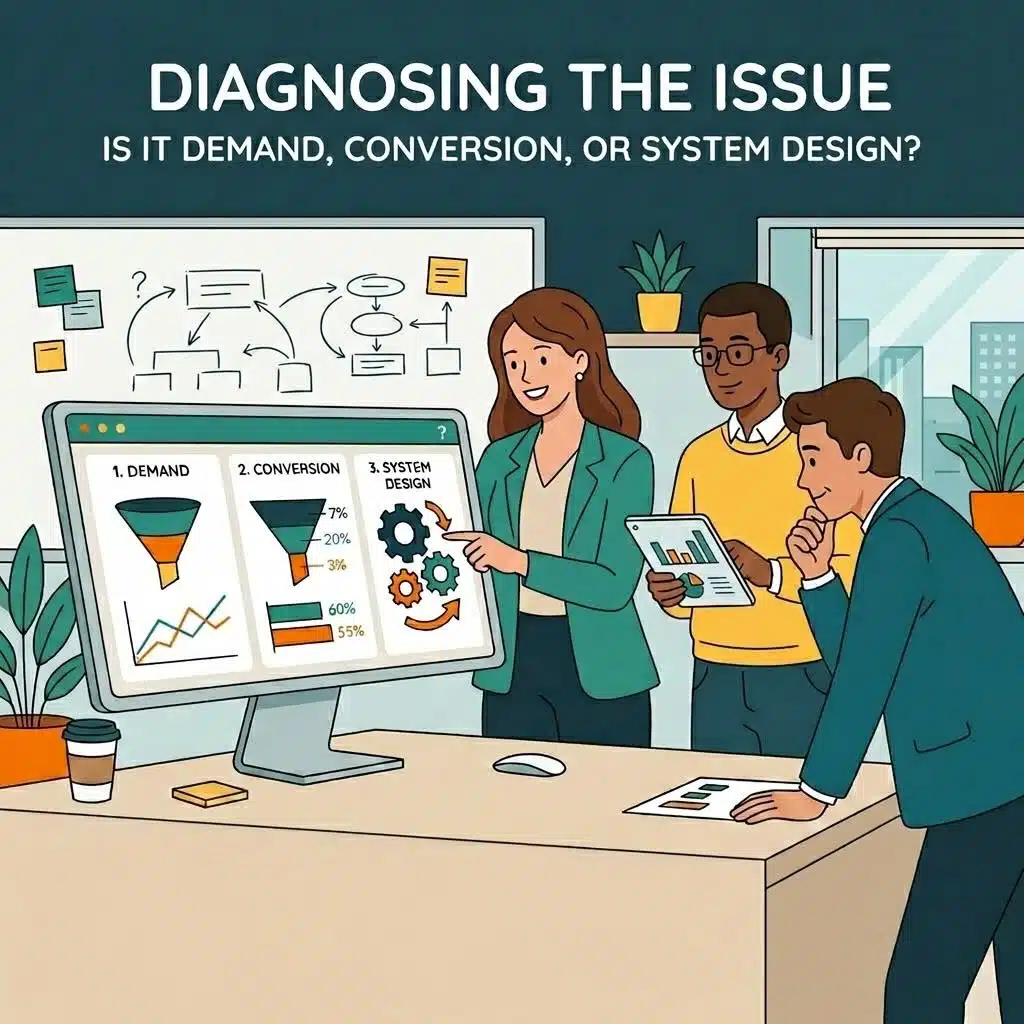
How to Tell Whether the Issue Is Demand, Conversion, or System Design
Not all growth problems are created equal. Here's how to tell what you're actually dealing with:
It's a demand problem if:
- Traffic is low or declining
- Lead volume is consistently below target
- You're not reaching your ideal buyers
When it's a conversion problem:
- Traffic is strong but leads are weak
- Form submissions are low relative to visitors
- Leads aren't engaging with follow-up
It's a system design problem if:
- Leads are coming in but not progressing
- Pipeline is full but deals aren't closing
- Marketing and sales are pointing fingers at each other
- You can't clearly explain what happens to a lead after it enters your system
Most B2B companies assume they have a demand problem when they actually have a system design problem. The difference matters, because the solutions are completely different.
Questions to Ask Before Investing in More Tactics
Before you launch another campaign or hire another rep, ask yourself:
- Do we have a clear definition of what a qualified lead looks like, and does everyone agree on it?
- Can we track a lead from first touch to closed deal without gaps in the data?
- Do our marketing and sales teams have aligned goals, or are they measured on different things?
- When a lead comes in, what happens next? Can we describe the process in detail?
- Are we losing deals because we don't have enough pipeline, or because pipeline isn't converting?
- Do we know where leads are getting stuck, or are we guessing?
If you can't answer these questions confidently, you likely have a bottleneck that more activity won't solve.
When It Makes Sense to Diagnose the System First
You don't always need a full diagnostic. Sometimes the answer is straightforward: you need more traffic, or your offer needs work, or your sales team needs training.
But if you're experiencing any of the following, diagnosis should come before execution:
- Revenue growth has stalled despite consistent lead volume
- Marketing and sales are misaligned on what's working
- You're spending more but seeing diminishing returns
- Pipeline is full but conversion rates are declining
- You've tried multiple tactics and nothing is moving the number
In these cases, the problem isn't what you're doing. It's how your system is designed. And no amount of new activity will fix a broken system.
A structured diagnostic helps you see what's actually happening: where leaks occur, where handoffs break, where messaging is weak, and where system disconnects occur. It gives you a clear picture of what to fix first, so you're not guessing or reacting.
What Comes Next
If you recognize these symptoms in your own business, you're not alone. Most B2B companies are running hard but not getting the results they expect. The issue isn't effort. It's clarity.
The Growth Systems Diagnostic is designed to help you see what's really limiting performance. It's a structured process that maps your current growth system, identifies the specific bottlenecks slowing you down, and gives you a prioritized roadmap for what to fix first.
Just know that It's not a sales pitch. It's a diagnostic. You'll walk away with a clear understanding of where your system is breaking and what to do about it.
If you're ready to stop guessing and start diagnosing, schedule a Growth Systems Diagnostic Fit Call. We'll talk through what you're seeing, where you're stuck, and whether a diagnostic makes sense for your situation.
You can also explore how HubSpot services can help you connect systems, improve visibility, and reduce friction across your growth engine.
Growth doesn't always require more. Sometimes it just requires seeing clearly.
Frequently Asked Questions
B2B growth bottlenecks are caused by structural issues in your go-to-market system, including unclear messaging, poor fit between offer and audience, leaky conversion paths, weak lead follow-up, marketing and sales misalignment, unclear lifecycle stages, and disconnected systems. These bottlenecks prevent leads from progressing through your funnel efficiently, even when lead volume appears healthy.
B2B leads fail to convert for several reasons: weak or slow follow-up processes, poor lead qualification resulting in wrong-fit prospects, misalignment between marketing and sales teams on lead definitions, unclear value propositions, and friction in conversion paths. Research shows that only 2.9% of marketing qualified leads become revenue, indicating that conversion problems are often systemic rather than tactical.
To identify B2B funnel bottlenecks, analyze conversion rates at each stage, track where leads stall or drop off, examine the time leads spend in each stage, review handoff processes between marketing and sales, assess data quality and system connectivity, and compare your metrics to industry benchmarks. Look for stages where conversion rates drop significantly or where leads accumulate without progressing.
Pipeline inefficiency is typically caused by poor lead qualification, unclear definitions of lifecycle stages, weak handoffs between marketing and sales, disconnected systems that create reporting gaps, inconsistent follow-up processes, and misalignment on what constitutes a qualified opportunity. These issues result in pipeline that looks full but doesn't convert at expected rates.
Your growth problem is likely a systems problem if: leads are coming in but not progressing through the funnel, pipeline is full but deals aren't closing, marketing and sales teams are misaligned or blaming each other, you can't clearly track what happens to leads after they enter your system, or you're spending more on tactics but seeing diminishing returns. Systems problems require diagnosis and structural fixes, not just more activity.
Marketing and sales misalignment is caused by different definitions of what constitutes a qualified lead, conflicting goals and metrics, poor communication and handoff processes, lack of shared visibility into the customer journey, disconnected systems and data, and unclear ownership of different funnel stages. Forrester research found that while 82% of executives believe their teams are aligned, only 65% of frontline teams agree, revealing a significant perception gap.
Diagnose B2B growth friction by mapping your entire customer journey from first touch to closed deal, measuring conversion rates at each stage, identifying where leads stall or leak, reviewing handoff processes and communication between teams, auditing system connectivity and data quality, analyzing the time leads spend in each stage, and comparing your performance to industry benchmarks. A structured diagnostic reveals specific bottlenecks so you can prioritize fixes based on impact.