
A while back, I wrote about building a personal brand voice document, so my content would stop sounding like every other yahoo on LinkedIn. (If you missed it, here's that post.) I wrote it as a marketer, for marketers.
Then a salesperson I know read it and basically said: "Cool. But what about us?"
Fair point. So here's what I should have said the first time: if you're in sales, you might need a voice doc more than I do.
Why does a sales rep need a personal brand voice doc?
Because your voice is the one thing AI can't copy on its own, and your unique touch can mean the difference between getting a reply and getting deleted.
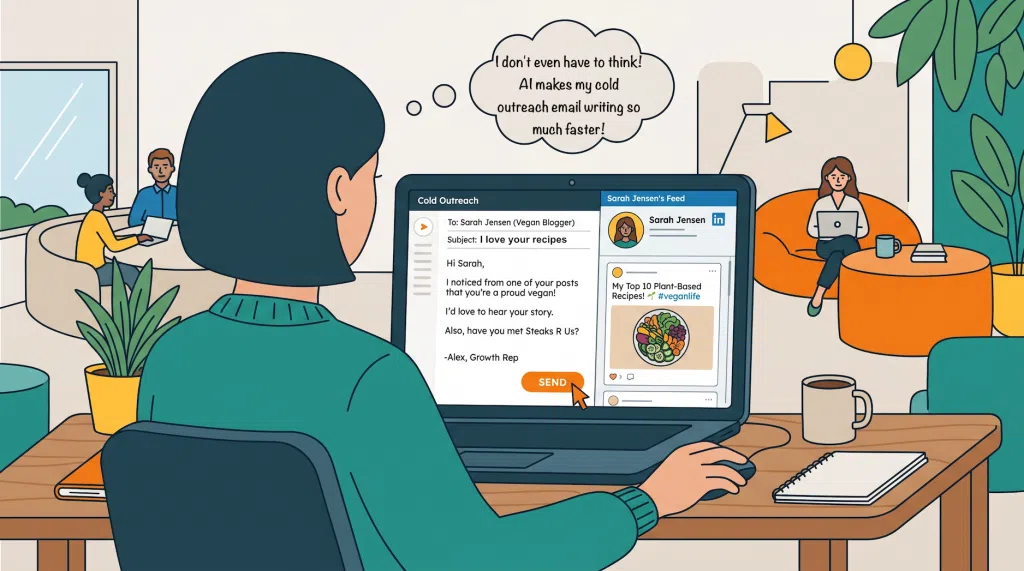
Picture your prospect's inbox. It's full. And a big chunk of it is AI-generated outreach that all sounds exactly the same: the "quick question" that is never actually quick, the "I noticed your company is scaling," and the one that makes me want to launch my laptop across the room, the fake-personalized opener. You know the move. Somebody scrapes one line off your LinkedIn or another social media platform, pretends to care about it for a sentence and a half, then pivots so hard you get whiplash. "I noticed from one of your posts that you're a proud vegan! I'd love to hear your story. Also, have you met Steaks R Us?" (Sure, Jan.) Buyers can smell that from a mile off, so they tune it out, or worse, they remember your name for all the wrong reasons.
Here's the part that matters, though. People don't actually hate AI. They hate when something feels like a robot wrote it. In a recent Bynder survey of 2,000 U.S. and U.K. consumers (reported by MarTech), 82% said they don't mind brands using AI to help write copy, as long as the piece still feels like a human wrote it. That's consumer research, not a sales study, but the instinct travels straight into your prospect's inbox: Nobody's mad that you used a tool. They're annoyed when your message reads like it rolled off an assembly line.
So the move was never "don't use AI." (I work with AI constantly. Working with it, not handing it the keys.) The move is to use it without letting it flatten the stuff that sounds like you. That's the entire job of a voice doc.
And you don't have much runway to get it right. Gartner's buying-journey research found buyers spend only about 17% of their purchase time meeting with potential suppliers, and that sliver gets split across everyone they're considering. So your connection note, your LinkedIn comment, your three-line follow-up are often the whole audition. If those sound like a template, well, you sound like a template.
"But I'm a relationship seller. Doesn't my voice take care of itself?"
Honestly? You're the person this helps most.
If your whole edge is that people like talking to you, then the moment you outsource your outreach to an AI tool (or another person) with no direction, you've handed away the exact thing that made you good. The warmth, the specific way you open, the joke you always make, the phrases that are unmistakably yours. AI will happily replace all of it with competent, polished mush that sounds like everyone else's competent, polished mush.
A voice doc isn't a script. It's a way to keep you in the loop even when you're not the one typing.
And let's be real: You're not always the one writing the words that go out under your name. An assistant cleans up your drafts, a sales enablement expert builds sequences that will send from your "from" line, an AI tool may be spitting out a first pass on a thought leadership post for LinkedIn. Every one of those is a chance for your voice to drift into someone else's idea of how you sound.
What goes in a sales rep's voice doc?
Most of the same building blocks I put in mine: the one-liner, the receipts, the words you'd never be caught saying. (The original post walks through the full anatomy.) But tilt it toward the surfaces you actually sell on:
- Your connection-request and DM style: How you open with a stranger. Do you reference something specific, lead with a question, keep it to two lines? Write down what "you" sounds like cold.
- Your follow-up rhythm: Short and punchy, or warm and a little chatty? The cadence of your nudges is part of your brand, and it's the first thing a template flattens.
- Your social selling voice: The way you comment, react, and show up in the feed. Social selling is a long game, and consistency is what makes people remember you before they ever need you.
- Your real tells: The phrases you reach for, the kind of humor you use (or don't), the sign-off that's yours. These are the fingerprints. Capture them so nothing automated can sand them off.
You don't have to write a novel. A page or two that nails how you actually sound is enough to keep AI, your SDR, and your enablement team from quietly turning you into Generic Sales Rep #4,000.
Because in a world where everyone's outreach is starting to sound the same, sounding like yourself isn't a nice-to-have. It's the pitch.
How can sales leaders build better social selling habits on their team?
Make the good habits easy, model them yourself, and give your reps two things: a voice doc and a steady supply of stuff worth sharing.
Here's the trap most teams fall into. A leader tells everyone to "be active on LinkedIn," and then either nothing happens, or worse, everyone starts posting the same AI-generated takes and the whole team blurs into one indistinct hum. Reps usually aren't dragging their feet because they're lazy. They're stuck because they don't know what to post, they're scared of sounding stiff, or they're convinced they have nothing original to say. All three are solvable, and mostly on you.
A few things that actually move the needle:
- Get every rep their own voice doc, SDRs included. One per person. It's the cheapest insurance against your whole team sounding like the same sequence tool. And for your SDRs cranking out volume, a voice doc does double duty: feed it to their AI tools and they draft outreach that sounds like a real person faster, instead of burning time fixing robotic first drafts or starting from a blank page. Sounding human and moving quick stop being a tradeoff.
- Stop demanding original thought leadership from everyone. Not every rep is going to write essays, and that's fine. Pretending otherwise just guarantees most of them post nothing at all.
- Teach content curation instead. This is the unlock, and it's the thing a sales enablement manager actually DM'd me about recently (hi, you know who you are). Curation is just sharing genuinely useful content from credible sources with your own point of view stamped on it. It keeps reps visible and helpful in the feed without forcing them to invent something brilliant every Tuesday. We put together a whole guide on how to curate content that walks through finding good material, adding your own angle, and not turning into a link-dumping hoarder.
And here's where it loops back to voice. A bare link with no comment is just noise in the feed. A link with "here's why this matters if you're dealing with X" in the rep's actual voice is social selling. The voice doc and the curation habit work together: one tells the rep how to sound, the other gives them something to sound off about. Take either one away and the other gets a lot harder.
So if you're leading the team, your job isn't to nag people onto LinkedIn. It's to hand them the tools and the air cover to show up as themselves, consistently, without burning out trying to be a content machine.
If your team's sequences and outreach have started sounding a little same-y, that's usually a systems problem, not a talent problem, and it's fixable. Here's how we help with sales enablement.
Frequently Asked Questions
Because a rep's voice is the one thing AI cannot copy on its own. Increasingly, the value plus unique humanness of your email helps determine whether outreach gets a reply or gets deleted. As buyers' inboxes fill with AI-generated messages that sound identical, the reps who still sound like real people stand out. A voice document keeps prospecting emails, LinkedIn activity, and social selling sounding consistently human, whether the rep writes them, an assistant or enablement person does, or an AI tool drafts them.
A sales voice document includes a one-liner that captures how the rep sounds, real examples of their writing, and a list of phrases they would never use. For sales specifically, it should also document connection-request and DM style, follow-up cadence, social selling voice, and personal tells like signature phrases, humor, and sign-offs. One to two pages is usually enough.
Yes, but only if the AI has direction. Without a voice document, AI tools default to generic, polished copy that sounds like everyone else's. Feeding the tool a voice document with real examples and rules lets it produce outreach that keeps the rep's distinct voice, which is what builds trust and earns replies. Also, don't forget to read for clarity and correctness. AI can hallucinate and make errors.
Sales leaders get the most traction by making good habits easy rather than mandating activity. That means encouraging each rep to create a personal brand voice document, so the team doesn't sound identical. You don't necessarily need original thought leadership from everyone, so teach content curation as a sustainable alternative. Curation lets reps stay visible and useful by sharing credible third-party content with their own point of view, which keeps them consistent on social channels without burning out.