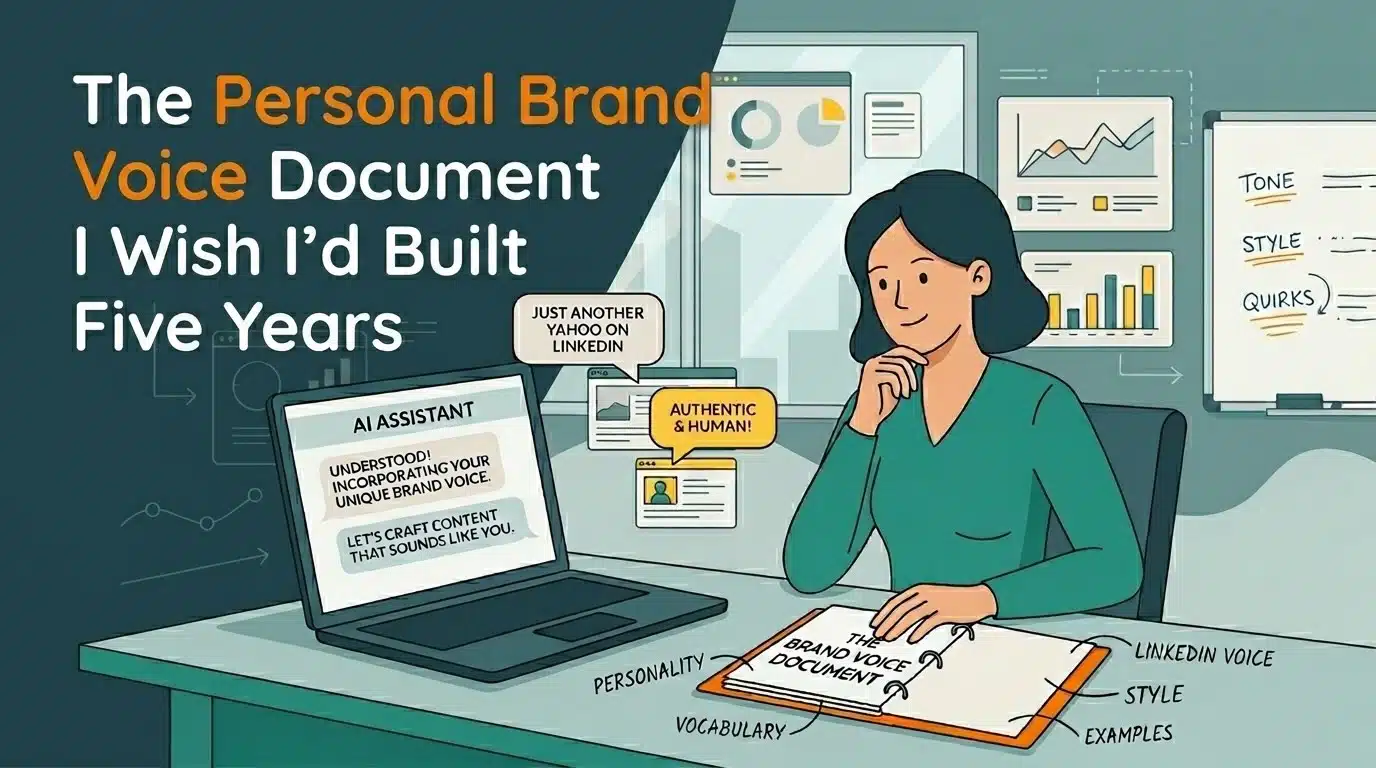
TL;DR: If you're letting AI write everything for you without giving it real direction, your personal brand is starting to sound like every other yahoo on LinkedIn. A personal brand voice document fixes that. Here's why I finally built mine, and what's in it.
Don't be me. Write a brand voice document before your personal brand starts sounding like every other yahoo, hustle bro, or "thought leader" on LinkedIn.
Yeah, yeah. It's easy to let AI write your stuff for you. SO EASY. But it's also lazy and does you a disservice if you don't make the effort to document your voice.
As things have gotten super busy for me and Alanna here at The B2B Mix®, I've let the old blogaroo slide a tad. I think there was a two (or three 😬) year period where I wasn't doing any writing. Yikes!
Then came along my friend, ChatGPT.
At first, I was resistant. How could AI possibly write better than a half-decent human writer? I felt pretty good with that approach and just paid freelancers to "figure it out" as far as my voice goes and write some posts for me. Meh.
Then AI started getting better. I was still stretched thin, but I took a stab at jotting down some brand voice ideas. I got some semi-decent posts, but I lost myself in the big scheme of things.
OK. That's a little over-dramatic. I didn't lose myself. However, our web presence certainly lost that "Stacy touch." So what did I do? I worked with Claude to create a better, more thorough personal brand voice document. In fact, that's why I'm writing this very post. Claude needed some recent content from (the real) me.
Why do you need a personal brand voice doc?
If you don't want your outsourced posts to sound like every other person on God's green internet, you need a voice doc. It doesn't matter if a freelancer, AI, or ouija board is writing for you. That person/entity needs to know how you sound, what you would say, and when and why you'd say those things. Otherwise, they may make you look dumb (or way smarter than you actually are. I'm talking to the person reading over your shoulder, not YOU. Tell that guy to buzz off.)
It doesn't matter if a freelancer, AI, or ouija board is writing for you. That person/entity needs to know how you sound, what you would say, and when and why you'd say those things.
This matters even more now that AI is writing everyone's first drafts. The brands and people who'll stand out are the ones whose AI-assisted content still sounds human because the AI has been given enough direction to capture what makes them.
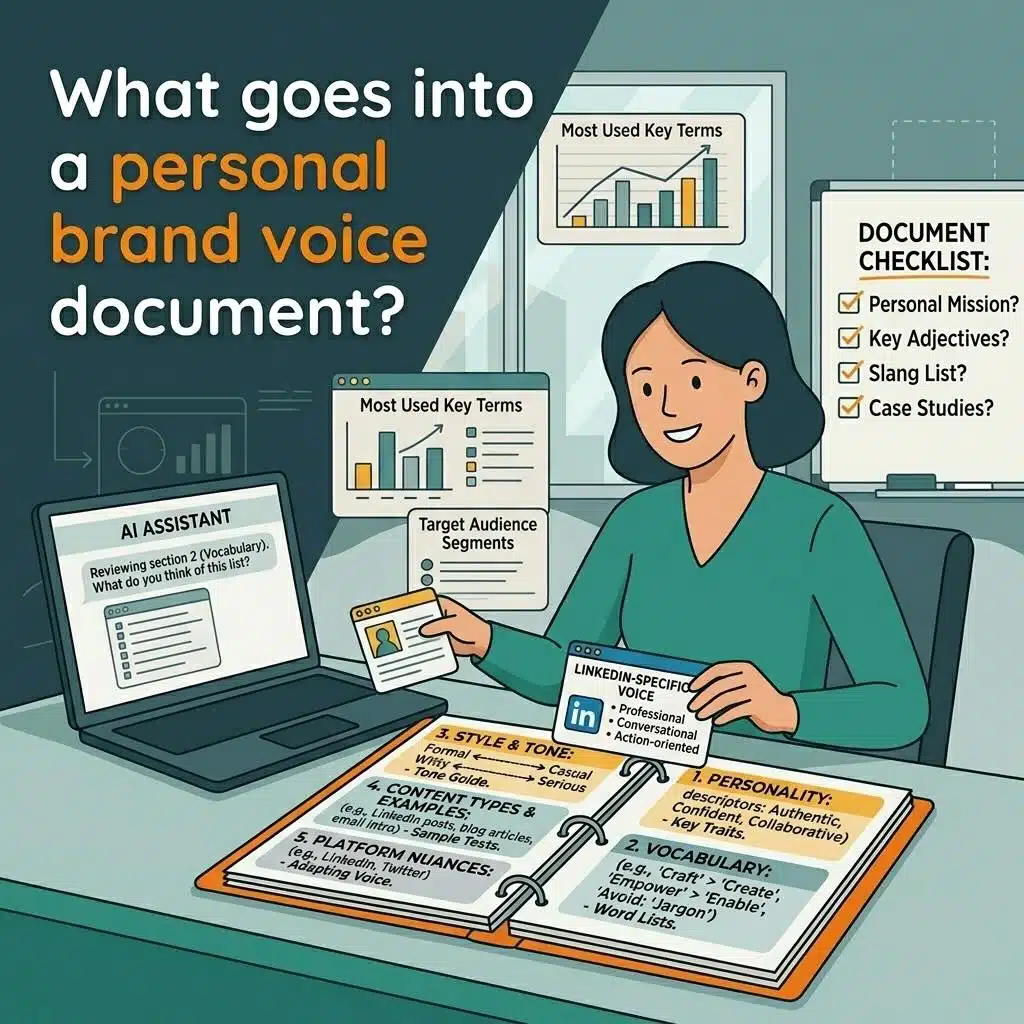
What goes into a personal brand voice document?
I don't know if anyone has created the ultimate personal brand voice doc for life, the universe, and everything. Maybe? If they have, it's probably just 42. But if they haven't, here's what I decided to capture in mine (with a little help from Claude):
The one-liner: A statement that's like the north star for your writing. Your writer or AI friend should gut-check everything against this one guiding truth.
Who is [your name]? Context for writers and AI to help them kinda step in your shoes or clack on your keyboard, so to speak. Helps them understand where you're coming from.
A voice fingerprint: The traits that make your writing sound like you:
- Your typical sentence structure and length
- How you structure your paragraphs
- Types of punctuation you use (I'm Team Oxford comma all the way, baby)
- Swearing (do you fudging use it in your writing or not???)
- And so forth
The receipts: Actual examples from your current and past writing samples. Provide different examples from a variety of channels, so they can understand how your tone might change based on audience or platform.
Words & phrases: Give your writer (human or AI) a list of words and phrases you use a lot. Not sure what those are? Run some of your recent emails, LinkedIn posts, Slack messages, and blog posts through AI to see what patterns it finds. Make another list of the things you would never say, too, so they don't have you sounding too "high falutin'" if that isn't your vibe.
Personality: A high-level idea of your personality (obviously). Are you funny? Empathetic? Are you an emo crybaby? Help the writer express your personality to the reading audience in an accurate way.
Quirks and such: Finally, provide a little window into your writing quirks. I like to use parenthetical asides. I use emojis as bullet points on LinkedIn because those ding dongs haven't added that to the posting options yet. (Aren't they owned by Microsoft? Hello! Word ring a bell? LOL) Do you use gifs (with a hard g, of course)?
Get your voice document in order
And this isn't only a marketing thing. If you're in sales, the same logic applies, maybe even more so. Every prospect's inbox is filling up with AI outreach that sounds identical, and the rep who still sounds like an actual person is the one who gets the reply. (I wrote a whole companion post on that: Why Every Sales Rep Needs a Personal Brand Voice Doc.) Same idea, different inbox.
Being and sounding human will be your advantage as more people begin to (lazily) use AI to write everything. You have to put in the work with AI. Build a relationship with it (yeah, it sounds kind of kooky, but that's a little like what it is). Document who you are so AI can remember it every time it works with you on a blog post.
Otherwise? You're just another voice that sounds like everyone else. And the whole point of a personal brand is that it's yours.
Frequently Asked Questions about Brand Voice Documents
A brand voice document is a written reference that captures how you (or your brand) sound in writing: your typical phrases, the words you'd never use, your sentence rhythms, your humor, and the rules that change across channels like LinkedIn, blog posts, or email. It's the cheat sheet you hand to writers, freelancers, or AI tools so they can produce content that actually sounds like you.
Without one, AI tools default to generic, polished mush: competent but indistinguishable from everyone else's AI output. A voice doc gives the AI specific receipts (real examples of your writing), vocabulary lists, and personality cues to work from. The result is content that sounds human and recognizably you, instead of like every other LinkedIn post written by a bot.
A style guide covers visual identity, logo usage, color palettes, and broad messaging principles. A brand voice document zooms in on how the writing sounds: sentence patterns, signature phrases, humor style, and channel-specific rules. They complement each other, but a voice doc is what writers and AI tools actually use day-to-day to draft content.
Long enough to be useful, short enough that someone will actually read it. Mine is around 8-10 pages with sections for the one-liner, voice fingerprint, real writing samples (the most important section), words I use and avoid, and channel-specific rules. If your doc is just a list of adjectives like warm, witty, professional, it's too short to be useful.
Yes! And it's actually one of the best uses of AI I've found. Feed it samples of your existing writing (blog posts, LinkedIn posts, emails, Slack messages), and ask it to identify patterns. It'll spot signature phrases and rhythms you didn't even realize you used. Just don't let AI invent your voice; let it help you document the one you already have.
Yes, and arguably more than marketers do. Sales reps live in inboxes and DMs that are increasingly full of AI-generated outreach that all reads the same, and buyers have learned to tune it out. A voice doc keeps your prospecting emails, LinkedIn comments, and social selling sounding like you, whether you're writing them yourself, handing them to an SDR, or running them through an AI sequencing tool. We cover the sales-specific version in the companion.