
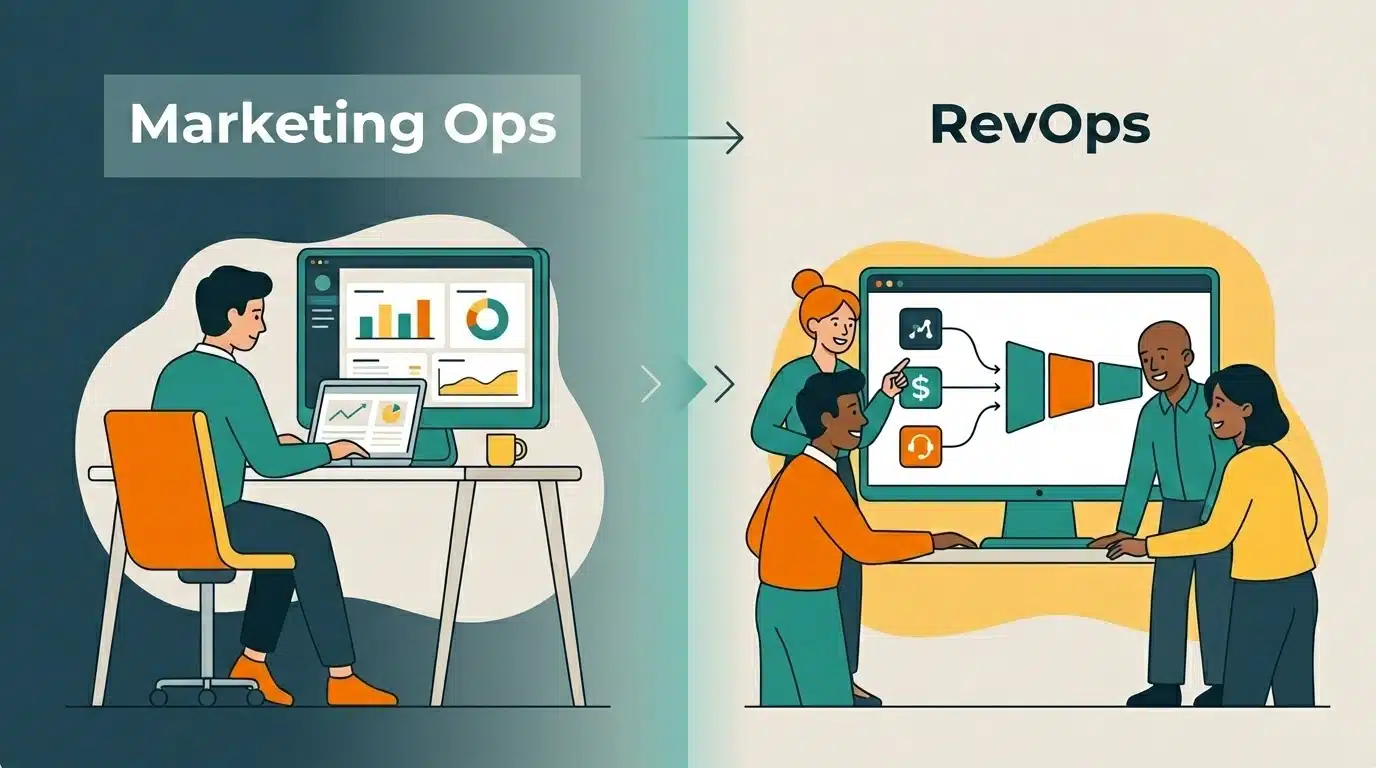
Short answer: Marketing operations (MOps) runs the engine behind your marketing: the campaign infrastructure, lead flow, data hygiene, and reporting that make marketing measurable. Revenue operations (RevOps) is bigger. It aligns the systems, data, and processes across marketing, sales, and customer service so your whole revenue engine works as one. The cleanest way to hold the difference in your head: marketing operations makes one department run well; revenue operations connects all three. Most companies start with marketing operations and grow into revenue operations as their go-to-market gets more complicated. Which one you actually need depends less on your headcount and more on where your revenue is leaking.
If you've ever watched sales and marketing argue about whose fault the pipeline is (while the reporting quietly disagrees with both of them), you've already met the problem these two functions exist to solve. Let's sort out what each one is, where they overlap, and how to tell which your company needs first.
What is marketing operations?
Marketing operations is the behind-the-scenes function that makes marketing actually run. It's the unglamorous, deeply important plumbing: setting up campaigns, scoring and routing leads, keeping the data clean, wiring up attribution, and building reports that answer real questions instead of just counting clicks.
Think of it as the difference between "we run campaigns" and "we know which campaigns produced pipeline." Marketing ops is what gets you from the first sentence to the second. Its scope stays mostly inside the marketing department: the marketing tech, the marketing data, the marketing numbers.
When marketing operations is missing or improvised, you get the classic symptoms: leads that never make it to a salesperson, a lead-scoring model nobody trusts, three reports with three different answers, and a marketing budget that's impossible to defend because nobody can connect it to revenue.
What is revenue operations?
Revenue operations zooms out. Instead of optimizing marketing alone, it aligns marketing, sales, and customer service around shared data, shared definitions, and shared goals. Gartner describes revenue operations as an end-to-end model that brings those functions together by aligning people, process, and technology across the full customer journey.
In plain terms: RevOps owns the handoffs. It's the function that makes sure a lead becomes an opportunity becomes a customer becomes a renewal, without falling into a gap between teams along the way. Those gaps are where most revenue quietly dies. A great lead that sales never calls. A closed deal that service was never told about. A renewal that slips because nobody owned the customer after the sale.
Marketing ops asks, "Is our marketing working?" Revenue ops asks, "Is our entire revenue process working, end to end?"
Marketing operations vs revenue operations: what's actually different?
| Dimension | Marketing Operations | Revenue Operations |
|---|---|---|
| Scope | Marketing department only | Marketing, sales, and service (the full revenue cycle) |
| Main job | Make marketing measurable and efficient | Make the whole revenue engine aligned and predictable |
| Owns | Campaign infrastructure, lead scoring, data hygiene, marketing attribution and reporting | Cross-team handoffs, shared lifecycle and lead definitions, unified reporting, system integration |
| Usually reports to | A marketing leader | A revenue or operations leader, or a cross-functional seat |
| Tools | CRM plus marketing automation and analytics | The full stack across CRM, sales, and service, plus the integrations and reporting that tie them together |
| The question it answers | "Is our marketing working?" | "Is our revenue process working from first touch to renewal?" |
Do marketing ops and revenue ops overlap?
Constantly. In practice, revenue operations usually grows out of marketing operations. A company gets its marketing engine running, realizes the bigger problem is the seams between teams, and expands the same systems thinking across the whole funnel.
At smaller companies, the overlap is nearly total: one person (or one small team) does both, because there isn't the volume to justify splitting them. The shared ground is data and reporting. The real distinction isn't turf, it's scope. Marketing ops perfects one lane. Revenue ops connects the highway.
Which one does your company actually need?
Here's the part most articles skip. You don't pick based on a magic revenue number. You pick based on where it hurts.
- If marketing is a black box (you spend money, you generate "leads," but you can't tie any of it to pipeline or closed revenue), your problem is marketing operations. Start there.
- If the pain lives between teams (sales says the leads are junk, marketing says sales doesn't follow up, the reports disagree, and good leads fall through the cracks during handoff), that's a revenue operations problem. No amount of better marketing alone will fix it.
For most established B2B companies in the $5M–$100M range, here's the honest version: you don't need to stand up a formal RevOps department with its own org chart. You need the outcomes RevOps produces. Aligned systems, clean handoffs, one source of truth everyone believes. You can get those without the title or the headcount.
And you probably already have a version of this person. It's whoever's quietly keeping HubSpot alive between their other forty jobs. The real question isn't whether the work exists. It's whether it's actually resourced or just improvised in the cracks. If you want help figuring out which gap is yours, our marketing operations and revenue operations consulting work starts exactly there.
How to get either one running without building a department
Your options come down to three, and they're the same whether the gap is marketing ops or revenue ops:
- Train someone internal. Slow, and once they're good at it, they tend to get recruited away.
- Hire a full-timer. A real senior ops hire is a six-figure commitment, and the person who's genuinely great at architecture, automation, and reporting is hard to find for a single mid-sized company.
- Get embedded help. A partner who does the work, builds the systems, and hands your team something they can run.
That third path is the one we live in. The B2B Mix® handles the marketing and revenue operations work inside your HubSpot: building the lifecycle stages, the lead routing, the cross-team agreements, and the reporting, then leaving you with a system your team can actually maintain. HubSpot is a genuinely great platform. It still needs someone to make it run on purpose. That's the part we own.
Marketing operations vs revenue operations FAQ
No. They get conflated because they share tools and people, but the scope is different. Marketing operations optimizes the marketing function. Revenue operations aligns marketing, sales, and service across the full customer journey.
You need the outcomes (aligned systems, clean handoffs, trustworthy reporting) more than you need the title or a dedicated department. Most companies your size get there by fixing marketing ops first, then connecting it outward to sales and service.
Sales operations focuses on the sales team: its process, tools, territories, and forecasting. Revenue operations spans all three go-to-market functions (marketing, sales, and service) and owns the connections between them.
At smaller companies, yes, and it's common. As volume and team complexity grow, the roles tend to specialize and split.
A marketing technologist is usually the person doing the hands-on marketing operations work: connecting the tools and building the workflows. That role generally lives inside marketing ops, and the skill set extends naturally into revenue ops as scope grows.
For most B2B companies, marketing operations comes first. It's the foundation. Revenue operations is what you build on top once your marketing engine is clean and you're ready to connect it to sales and service. When you're ready to go deeper on the full picture, see our definitive guide to RevOps for B2B. And if you'd rather just talk through where your systems stand, that's what our ops consulting is for.