
What Makes HubSpot's Content Optimization System Different
The HubSpot Content Optimization System (COS; now known as Content Hub) is an advanced content management platform that surpasses traditional CMS capabilities. It focuses on marketing performance, lead generation, and content effectiveness.
What is the HubSpot Content Optimization System?
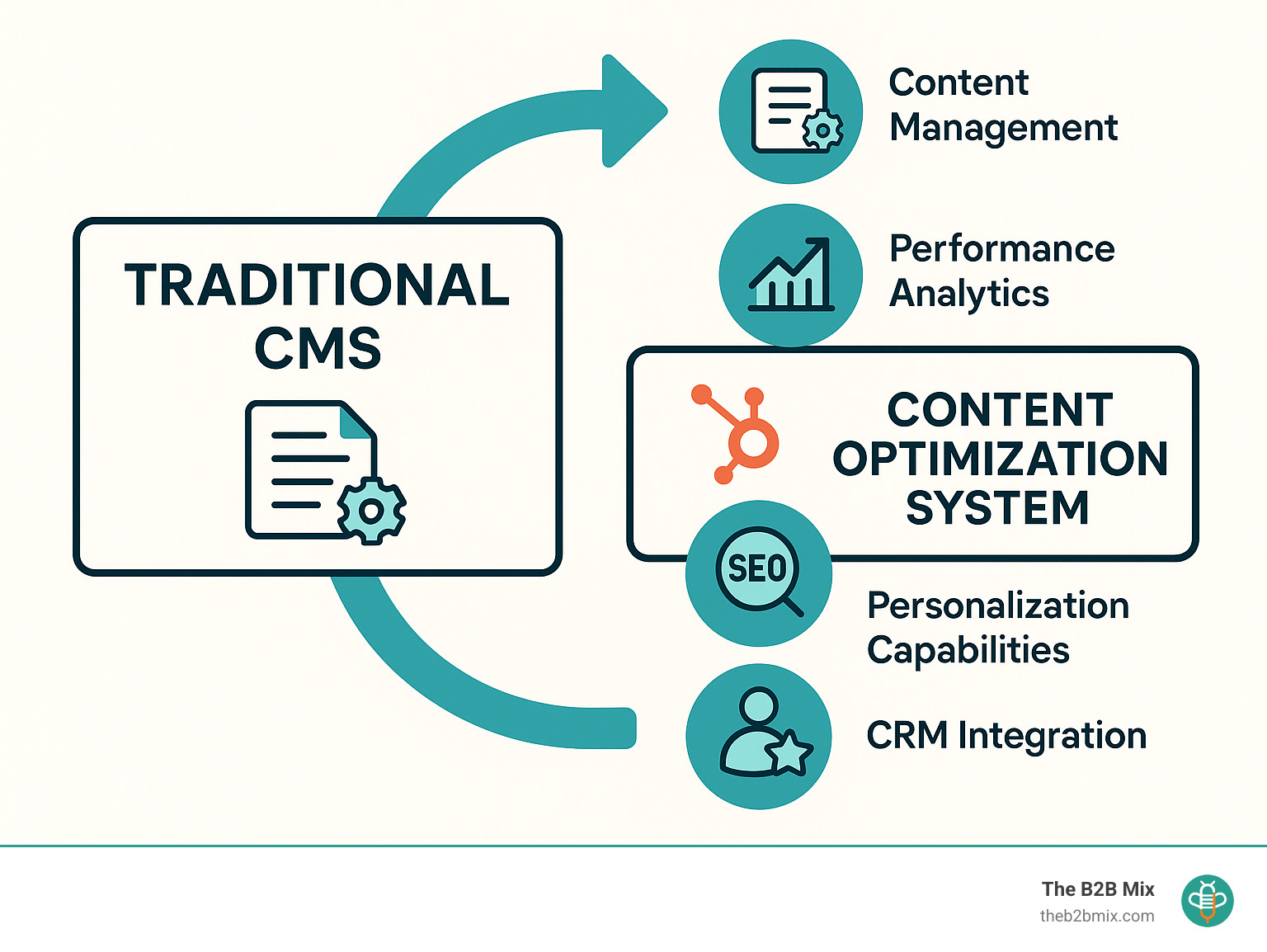
- A comprehensive platform that combines content management with marketing optimization tools
- Designed to create, manage, and optimize content across the entire customer journey
- Integrates seamlessly with HubSpot's CRM, marketing, sales, and service tools
- Includes built-in SEO tools, personalization capabilities, and performance analytics
When HubSpot introduced its Content Optimization System, it deliberately chose the term "optimization" instead of "management." The clear emphasis is on optimization. While traditional CMS platforms focus on publishing content, the COS is built to continuously improve that content's performance.
The COS stands out because it treats content as a living asset that requires ongoing refinement. When HubSpot began optimizing old content using their own system, they grew organic views on those posts. In fact, HubSpot organic views increased by an average of 106%, and more than doubled monthly leads from those pieces.
For marketers struggling with disconnected tools and underperforming campaigns, the integrated nature of the COS offers a compelling solution. Instead of juggling separate systems for website management, SEO, analytics, personalization, and lead capture, everything works together in one platform.
What Is the HubSpot Content Optimization System (COS)?
The HubSpot Content Optimization System isn't just another fancy acronym in the marketing world. It's a game-changer for how businesses approach digital content. Think of it as your marketing command center: a unified platform where website management, content creation, performance analytics, and lead generation tools all live together harmoniously, powered by HubSpot's robust CRM database.
Traditional content management systems are mostly concerned with getting your content published. The HubSpot Content Optimization System, however, accepts the full inbound marketing journey. It helps you attract visitors with compelling content, convert those visitors into leads, close deals with those leads, and delight your customers long after they've made a purchase.
What makes the COS truly special is how it puts your customer data to work. Every interaction—from a visitor's first click to their most recent support ticket—becomes valuable information that helps you understand which content resonates and why. This 360-degree view means you're never flying blind with your content strategy.
Why "Optimization" Beats "Management" for Modern Marketers
HubSpot didn't accidentally drop "management" in favor of "optimization"—this deliberate choice reflects a fundamental shift in modern marketing priorities.
Traditional CMSs focus on administrative convenience: they make publishing and organizing content straightforward. But when it comes to improving performance, personalizing experiences, or driving conversions? You're often left patching together separate tools or relying on manual processes.
The HubSpot Content Optimization System flips this model on its head by making optimization the star of the show. As Jean Pierre Barroilhet from Rankmi found, the right platform can transform your content strategy. Using the COS, his team created landing pages in under 5 minutes and saw a 35% increase in Marketing Qualified Leads by delivering country-specific content to their Latin American audience.
Today's marketers need content that drives results, not just content that exists. The COS delivers through:
- Smart AI recommendations that guide your optimization efforts
- Friction-reducing UX tools that smooth the path to conversion
- Automatic testing capabilities that continuously improve performance
- Dynamic content features that adapt to individual visitor behaviors
Evolution of the HubSpot Content Optimization System
The journey of the HubSpot Content Optimization System tells a story of continuous innovation. When HubSpot first introduced the COS in beta back in 2013, it represented their vision of what integrated marketing could look like in a content-first world.
Since then, the system has grown tremendously:
- 2013: The Content Optimization System makes its beta debut
- 2018: Major updates arrive for the drag-and-drop editor and template marketplace
- 2020: CMS Hub emerges with improved enterprise capabilities
- 2022: AI-powered content tools enter the picture
- 2024: Content Hub launches with advanced creation and optimization features
The most recent evolution came in April 2024 with Content Hub, bringing powerful AI tools like Content Remix, Brand Voice, and AI Blog Writer to the platform. These innovations reflect HubSpot's understanding that content isn't just static pages—it's a collection of adaptable assets that can be optimized and repurposed across multiple channels.
Throughout this evolution, HubSpot has stayed true to its promise of continuous improvement, regularly rolling out updates and new features—often without asking customers to pay extra. This commitment to innovation without constant upselling is part of what makes the HubSpot Content Optimization System such a valuable long-term investment for growing businesses.
HubSpot Content Optimization System: A Modern Approach
The hubspot content optimization system isn't just another content management tool—it's a complete rethinking of how content should work in today's marketing landscape. Instead of cobbling together a patchwork of plugins and separate platforms, HubSpot gives you everything in one seamless package.
Think about the relief of not having to worry about plugin conflicts, compatibility issues, or security patches. That's the beauty of this all-in-one approach. Your marketing team can focus on what matters—creating compelling content and driving results—rather than troubleshooting technical problems.
What makes this modern approach so powerful is how everything connects. Your content performance metrics flow directly into your CRM data, giving you a complete picture of how content influences the buyer journey. You can create, publish, analyze, and optimize content without ever leaving the platform. And with enterprise-grade security features built right in (including SSL, CDN, and continuous security monitoring), you can rest easy knowing your digital presence is protected.
Here's a clear look at how the COS compares to traditional content management systems:
| Feature | Traditional CMS | HubSpot Content Hub |
|---|---|---|
| Content Creation | Basic editors, often requiring HTML knowledge | Drag-and-drop editors, AI content generation |
| SEO Tools | Requires plugins, separate tools | Built-in keyword suggestions, on-page optimization |
| Personalization | Limited or requires custom development | Native smart content, personalization tokens |
| Analytics | Basic page views or requires integration | Full-funnel attribution, content performance metrics |
| Security | Self-managed, plugin-dependent | Managed security, SSL, WAF, CDN included |
| Scalability | Server management, performance tuning | Fully-managed cloud infrastructure |
| Marketing Integration | Separate marketing automation tools | Seamless integration with Marketing Hub |
As marketing becomes increasingly complex and data-driven, having a platform that handles the technical heavy lifting lets you concentrate on strategy and creativity—the aspects of marketing that actually drive results.
HubSpot Content Hub: HubSpot Content Optimization System for Marketers
Content Hub, the HubSpot content optimization system, was built with marketers' needs at its heart. Unlike platforms that seem to require a computer science degree to operate, HubSpot's Content Hub COS puts power in marketers' hands without the technical headaches.
What makes it so marketer-friendly? It starts with the intuitive drag-and-drop editors that let you create beautiful pages without writing a single line of code. The SEO tools are built into the content creation process. They guide you toward better optimization as you work rather than as an afterthought.
The fully-managed hosting removes another burden from your shoulders—no more late-night calls about server issues or performance problems. And perhaps best of all, you'll regularly get new features and improvements without additional costs or complicated upgrade processes.
I love how the platform prioritizes what matters to marketers. The SEO recommendations don't just give you a technical checklist—they actually help you focus on high-impact changes first. This practical approach saves valuable time and gets you better results faster.
In today's fast-moving marketing world, having a platform that works with you rather than against you isn't just nice to have—it's essential for staying competitive and responsive to market changes.
Core Features & Capabilities Marketers Love
The HubSpot Content Optimization System has become a favorite among marketing teams for good reason. It's packed with features that make content creation and optimization both powerful and accessible. Let's explore what makes marketers fall in love with this platform:
Drag-and-Drop Website Builder
Remember the days of waiting on developers to make simple website updates? The COS's visual editor puts an end to that frustration. You can create stunning, responsive pages without writing a single line of code.
The system uses a flexible 12-column grid that automatically adapts to different screen sizes—which is absolutely crucial in today's mobile-first world. Research shows that over 60% of digital content is now accessed via mobile devices in major markets, making this responsive design essential, not optional.
SEO Recommendations
What makes the HubSpot content optimization system, Content Hub, particularly special is that it makes SEO accessible to everyone. As you write content, the system provides real-time SEO suggestions right in the editor, prioritized by potential impact.
It's like having an SEO expert looking over your shoulder, gently guiding you toward better optimization without interrupting your creative flow. Even team members with zero SEO background can create search-friendly content consistently.
Smart Content
Here's where things get really interesting. Smart content blocks dynamically change based on who's viewing your page. Location, device type, lifecycle stage, list membership—all these factors can trigger different content experiences.
Imagine showing first-time visitors an introductory video while returning leads see a case study relevant to their industry. This level of personalization used to require complex development work, but with the COS, it's just a few clicks away.
Memberships
Need to create secure, gated content areas? The COS has you covered with its memberships feature. You can build password-protected resource libraries, customer portals, or personalized dashboards—all managed through the same system as your public website.
This unified approach means you're not juggling multiple platforms for different content experiences, saving time and reducing technical headaches.
AI Content Tools
The newest additions to the hubspot content optimization system are its AI-powered content tools, and they're game-changers for busy marketing teams:
AI Blog Writer helps you overcome writer's block by generating complete blog drafts based on your topic prompts. While the content always needs human review and refinement, it provides a solid starting point that can save hours of work.
Brand Voice ensures your content maintains a consistent tone, even when multiple team members are creating it. The system learns from your existing materials to capture your unique style.
Content Remix is perhaps the most innovative tool, automatically repurposing your content for different channels and formats. Turn that blog post into social media snippets, email content, or landing page copy with minimal effort.
These AI tools are particularly valuable for teams trying to scale content production without sacrificing quality or consistency.
Built-In SEO & Content Tools with Content Hub
The SEO capabilities of the HubSpot Content Hub go far beyond basic on-page suggestions:
Topic Clusters help you organize content strategically, building authority around key subjects with pillar pages and supporting content. This approach aligns perfectly with how search engines evaluate content relevance and authority today.
Keyword Explorer lets you research and track keywords without leaving the platform. It provides difficulty scores and search volume data to guide your content planning.
On-Page SEO Checklist offers real-time feedback as you create, covering everything from basic elements like title tags to more advanced considerations like internal linking structure.
What makes these tools truly powerful is their integration with your marketing data. You're not just optimizing for traffic—you can see which keywords drive actual leads and customers.
At The B2B Mix, we leverage these integrated SEO tools to help our clients build comprehensive B2B SEO strategies that drive qualified traffic and convert visitors into leads.
Personalization & Dynamic Experiences
Personalization is where the HubSpot Content Optimization System truly shines compared to traditional platforms. According to research from Sender, 96% of advertising professionals now use personalization in their marketing, and almost 9 in 10 report that customers expect personalized experiences.
The COS makes delivering on these expectations remarkably straightforward with features like:
Smart CTAs that adapt based on visitor characteristics—showing a "Request a Demo" button to new visitors but a "Schedule a Consultation" button to returning leads.
CRM Segments allow you to create audience groups based on any data in your CRM and deliver custom content to each. Company size, industry, past purchases—any attribute can trigger personalized experiences.
Personalization Tokens automatically display custom information like the visitor's name, company, or recent interactions across your website, landing pages, and emails.
Multilingual Pages make global content management simpler with built-in translation management and automatic language detection.
Security, Hosting & Reliability
The peace of mind that comes with enterprise-grade security and reliability shouldn't be underestimated. The HubSpot content optimization system includes:
SSL Certificates that are included and automatically renewed, keeping your site secure without manual intervention.
Global CDN ensures fast loading worldwide, which is critical for both user experience and search rankings.
99.99% Uptime provides enterprise-level reliability that keeps your digital front door open 24/7.
ISO Compliance meets international security standards, important for businesses with regulatory concerns.
Web Application Firewall protects against common attacks, keeping your site and data secure.
Automatic Backups with point-in-time recovery mean you can always roll back if something goes wrong.
This comprehensive approach to security means marketers can focus on creating great content rather than worrying about infrastructure. For B2B companies especially, where website downtime directly impacts lead generation and revenue, this reliability is invaluable.
Seamless Integration Across Marketing Hub, Sales Hub & CRM
The real magic of the HubSpot Content Optimization System isn't just what it can do on its own—it's how beautifully it plays with everything else in your HubSpot ecosystem. This integration creates a unified experience where your content, marketing, sales, and service efforts all work together like a well-rehearsed orchestra.

At the heart of this integration is HubSpot's shared CRM database—think of it as the central nervous system connecting everything. When someone interacts with your content—whether they're reading a blog post, filling out a form, or opening an email—that interaction automatically becomes part of their contact record. This creates a complete, living story of each person's journey with your brand.
As Patricia Portik, E-Marketing Manager at a HubSpot customer, puts it: "The biggest benefit of HubSpot is that all your data lives in it, you see the same customer information as the sales team and vice versa. It gives us a new level of confidence."
This shared intelligence opens up possibilities that don't exist with disconnected systems:
- Your marketing team can see exactly which content pieces resonate with qualified leads (not just driving traffic).
- Your sales reps walk into calls already knowing which resources a prospect has engaged with.
- Your service teams can recommend perfectly relevant content based on a customer's specific issues.
- And perhaps most importantly, your content team can measure the direct revenue impact of their work, not just pageviews or time on page.
Using COS Data Inside Marketing Hub
When the data from your HubSpot Content Optimization System flows into Marketing Hub, it transforms your ability to create personalized, timely marketing campaigns:
Email personalization becomes incredibly powerful when it's informed by web behavior. Imagine automatically tailoring email content based on which pages or blog posts someone has viewed. If a prospect has been reading about a specific feature, you can follow up with more detailed information on exactly that topic, without manually tracking their behavior.
Automated nurture workflows become smarter, too. When someone downloads your ultimate guide to industry trends, they can automatically receive a carefully curated series of related resources over the following weeks, all without manual intervention. The system knows what they're interested in and delivers accordingly.
Perhaps most valuable are the ROI dashboards that connect the dots from first content touch to closed deal. Instead of guessing which content investments are paying off, you can calculate the exact return on specific pieces, topics, or campaigns. This helps you double down on what's working and rethink what isn't.
Sales Enablement with COS Content
The HubSpot Content Optimization System doesn't just help attract leads—it helps close them too:
Deal stages and content work hand-in-hand in the HubSpot ecosystem. The system can automatically recommend relevant content based on where a prospect is in their buying journey. Early-stage prospects might receive educational resources that build awareness, while late-stage opportunities get case studies and implementation guides that address specific concerns.
Quotes pages let your sales team create personalized proposal pages that combine product information with custom messaging custom to each prospect's specific needs. These pages live in your COS, maintaining your brand consistency while giving sales the flexibility they need.
The content embed feature is a particular favorite among sales teams we work with. Reps can easily find and share relevant content directly from their CRM, tracking engagement to inform their follow-up strategies. No more hunting through folders for the right PDF or wondering if a prospect actually opened that case study.
Service & Commerce Touchpoints
The beauty of the hubspot content optimization system is that it extends beyond the traditional marketing and sales functions to support the entire customer experience:
Knowledge base integration helps service teams quickly link to relevant help articles when responding to customer inquiries. This improves resolution times and customer satisfaction while ensuring consistent information across all touchpoints.
Payment pages created in the COS can securely process transactions for products, services, or subscriptions while maintaining a seamless brand experience. These pages integrate directly with your CRM data, making it easy to track customer purchases and preferences.
For ongoing customer relationships, customer portals built with the COS can display personalized dashboards with account information, recent purchases, and recommended resources—all using the same platform that powers your public website.
This end-to-end integration across the entire customer journey is what truly sets the HubSpot system apart from traditional CMS platforms that focus solely on public-facing content. Instead of disconnected experiences managed by different teams with different tools, you get a cohesive ecosystem where content, data, and insights flow freely across departments.
Building, Updating & Scaling a COS Website
Building a website on the HubSpot Content Optimization System doesn't have to be complicated. In fact, it's designed to be accessible even if you don't have a team of developers at your disposal.
Whether you're launching a brand new site or revamping an existing one, the COS gives you multiple paths to success. You can browse the Theme Marketplace for professionally designed templates that just need your brand's touch, or use the intuitive Drag-and-Drop Builder to create custom layouts without writing a single line of code.
For teams with more specific needs, the Developer Framework provides the flexibility to build truly custom experiences. And if you're starting from scratch and feeling overwhelmed, the AI Website Generator can help you quickly generate website content based on simple prompts about your business.
Once your site is up and running, the COS really shines with its optimization tools:
Adaptive Testing automatically tests different variations of your pages to improve conversion rates without you having to manually set up complex experiments. Staging Environments let you safely test changes before publishing them to your live site. And Content Scheduling makes it easy to plan and coordinate content updates in advance – perfect for product launches or seasonal campaigns.
For companies moving from another platform, the built-in Migration Tools help simplify what could otherwise be a daunting process. These tools handle everything from content transfer to URL redirects, helping preserve your SEO value during the transition.
This blend of simplicity and power makes the hubspot content optimization system suitable for businesses at any stage – from startups building their first professional website to global enterprises managing complex digital experiences across multiple brands and markets.
From Wireframe to Launch on the hubspot content optimization system
Taking a website from concept to reality on the hubspot content optimization system follows a straightforward path that combines strategic planning with HubSpot's powerful tools.
The journey typically begins with Planning – defining your site structure, mapping out user flows, and establishing clear conversion goals. Next comes Design, where you'll either create custom wireframes and visual designs or select and customize a theme from the marketplace.
During the Development phase, you'll build out your templates and modules – or simply customize existing ones to match your brand. Then it's time for Content Creation, developing page content that's optimized both for search engines and for converting visitors into leads or customers.
The Integration step connects your forms, CTAs, and automation workflows to create a seamless experience. After thorough Testing across devices and browsers, you're ready for Launch – publishing your site and monitoring its performance.
What makes this process so much smoother in HubSpot is the array of tools designed to accelerate each step:
The AI Website Generator can jumpstart your content creation with drafts that you can refine, rather than staring at a blank page. Template Customization lets you modify existing designs rather than building everything from scratch. Governance Rules help you set permissions and approval workflows so the right people have the right level of access. And SEO Validation automatically checks your content against best practices before you publish.
At The B2B Mix, we've guided countless clients through this process, blending HubSpot's powerful tools with strategic guidance to ensure their websites drive real business results. For teams that need expert help at specific points in the journey, our On-Demand HubSpot Help service provides just-in-time support exactly when you need it.
Scaling Global & Multi-Brand Sites
As your business grows, your website needs often become more complex. Fortunately, the HubSpot Content Optimization System includes features specifically designed for managing global and multi-brand digital experiences.
The Multi-site Management feature is a game-changer for larger organizations. It allows you to run multiple websites from a single HubSpot account, sharing content, templates, and data where it makes sense while maintaining distinct branding and user experiences where needed. This creates a powerful "hub and spoke" model that reduces duplication of effort while preserving brand identity.
Permissions and Teams features give you granular control over who can edit different sections of your sites – crucial for organizations with multiple content contributors across departments or regions. This means your German marketing team can update their local pages without accidentally changing content for your Australian audience.
For global companies, Localization Tools make managing translated content much simpler. Built-in features for handling regional variations and automatic language detection help deliver the right content to visitors around the world, improving both user experience and conversion rates.
Brand Kits allow you to create and manage multiple brand identities with separate color schemes, typography, and design elements – all within the same account. This is particularly valuable for companies that manage multiple product lines or subsidiary brands.
These enterprise capabilities make the HubSpot content optimization system suitable for complex, global organizations without sacrificing the ease of use that makes it so valuable to marketing teams focused on driving results rather than managing technical complexity.
Analytics, Reporting & Continuous Optimization
The true power of the HubSpot Content Optimization System, Content Hub, becomes apparent in its analytics and reporting capabilities. Unlike standalone CMS platforms that provide basic page view metrics, the COS offers comprehensive insights into how your content influences the entire customer journey.

When you're investing time and resources into content creation, you deserve to know exactly how that content performs. HubSpot's analytics suite gives you that visibility with remarkable clarity.
The traffic analytics tools break down your site visitors by source, device, geography, and more. This helps you understand not just how many people visit your site, but who they are and how they found you – critical information for refining your marketing strategy.
What makes the HubSpot Content Optimization System truly special is its multi-touch attribution capabilities. Rather than simply counting page views, you can track how content influences conversions across the entire customer journey, from first touch to closed deal. The system offers various attribution models that can be customized to reflect your specific sales cycle, giving you a more accurate picture of content ROI.
The built-in A/B testing tools let you experiment with different versions of pages, CTAs, and forms to continuously improve conversion rates. There's something genuinely satisfying about watching your conversion rates climb after implementing insights from these tests!
One of my favorite features is the heatmaps and recordings functionality. These visual tools show exactly how visitors interact with your pages, revealing where they click, how far they scroll, and where they might get confused. It's like being able to look over your visitors' shoulders – without the creepy factor!
According to HubSpot's knowledge base, recent updates have expanded the traffic analytics tool to provide even more granular insights into content performance. The platform continues to evolve, giving marketers increasingly powerful tools to understand their audience.
Turning Insights into Action
Having mountains of data is only valuable if you can turn those insights into action – and that's where the HubSpot Content Optimization System really shines. The platform is designed not just to provide information, but to help you use it effectively.
Regular content audits become remarkably straightforward with HubSpot's analytics. You can quickly identify your star performers that deserve more promotion and your underperforming pieces that need improvement or retirement. Think of it as spring cleaning for your content – except you can do it any time of year!
The process of historical optimization—updating existing content based on performance data – becomes particularly powerful. This strategy helped HubSpot grow organic views by 106% on optimized posts. There's something deeply satisfying about breathing new life into older content and watching it climb the search rankings again.
Custom KPI dashboards let you track the metrics that matter most to your specific business goals. Whether you're focused on traffic growth, lead generation, or revenue influence, you can create visualizations that tell the story of your content's impact at a glance.
At The B2B Mix, we help clients implement data-driven content strategies through our Marketing Operations Consulting services. We've seen how powerful it can be when organizations not only collect the right data but actually use it to drive continuous improvement.
The beauty of the HubSpot system is how it creates a virtuous cycle: insights drive improvements, which generate new data, leading to further optimization. It's like having a content strategy that gets smarter over time – because it actually does!
Challenges, Limitations & Practical Workarounds
Let's be honest—no platform is perfect, and the HubSpot Content Optimization System is no exception. While it offers tremendous value, you'll want to go in with eyes wide open about potential problems you might face along the way.
First up is the learning curve. With so many features packed into one platform, it takes time to get comfortable with everything the COS offers. Even the most tech-savvy marketers might need a few weeks to really find their groove. HubSpot's Academy provides excellent free training, but you'll need to carve out dedicated time for your team to complete it.
Then there's the proprietary environment. HubSpot uses its own templating language called HubL, which is powerful but... well, it's not something your average web developer necessarily knows off the bat. If you're coming from WordPress or another common CMS, this represents a shift in how you'll approach customizations.
For companies with advanced development needs, you might occasionally bump into limitations. While the platform handles most common scenarios beautifully, truly unique or complex functionality might require specialized development work. The HubSpot CMS developer documentation is comprehensive, but for sophisticated custom projects, you may need to bring in developers with specific HubSpot expertise.
Finally, there's the migration complexity to consider. Moving an existing website—especially a large one with years of content and custom features—requires careful planning. You'll need to think about URL structures, redirects, and how to recreate your existing functionality in the HubSpot environment.
At The B2B Mix, we've guided dozens of clients through these challenges. The good news? None of these problems are impossible with the right approach and expectations.
When to Lean on Marketplace Apps & APIs
One of the smartest ways to overcome limitations in the hubspot content optimization system is to tap into its extensive ecosystem of integrations and extensions.
When you hit an integration gap with a system that doesn't have a native HubSpot connection, you've got options. The platform's robust APIs and webhook functionality let you build custom bridges between systems. We've helped clients connect HubSpot to everything from proprietary databases to niche industry tools.
Need to store specialized data that doesn't fit neatly into HubSpot's standard objects? Custom objects come to the rescue, allowing you to create custom data structures within the CRM. This is particularly valuable for industry-specific information or unique business models.
Webhook workflows are another powerful option when you need systems to talk to each other. These can trigger actions in external platforms based on what happens in HubSpot, or vice versa. For example, when a visitor downloads a specific resource, you might want to not only update their HubSpot record but also alert your product team in Slack.
With over 1,700 integrations in the marketplace and developer-friendly APIs for custom solutions, HubSpot's ecosystem is designed to grow with you. The platform may have boundaries, but they're remarkably flexible ones.
Budget & Licensing Considerations
Let's talk money—because yes, the HubSpot Content Optimization System is an investment. Understanding the value equation helps ensure you're making a smart business decision.
The free vs. starter vs. professional decision isn't always straightforward. The free CMS tools give you a taste of what's possible, but most businesses quickly outgrow them. Starter open ups essential marketing tools, while Professional brings in the more advanced personalization and optimization features we've discussed throughout this article.
When evaluating options, think about scalability—not just where your business is today, but where it's heading. The right plan should have room for you to grow without requiring a new implementation every six months. At The B2B Mix, we often help clients map out their digital maturity journey to make sure their HubSpot investment aligns with their growth trajectory.
The most important consideration is ROI modeling. Look beyond the sticker price to calculate potential returns based on improvements in lead generation, conversion rates, and operational efficiency. HubSpot reports that after one year, their customers typically see 114% more web traffic, 55% more deals, and 43% more tickets resolved—numbers that can translate to significant revenue impact.
The true cost includes not just the software but the people and processes around it. A slightly higher investment in the right platform can often save substantial costs in development time, maintenance headaches, and missed opportunities.
Frequently Asked Questions about the HubSpot Content Optimization System
Is the HubSpot content optimization system the same as Content Hub?
If you've been following HubSpot's evolution, you might be wondering about the relationship between these terms. Let's clear things up:
The HubSpot Content Optimization System (COS) was the original name for HubSpot's integrated website and content platform when it first launched. Over time, HubSpot refined both the platform and its terminology.
As the platform matured, HubSpot rebranded it as "CMS Hub" to better align with their other "Hub" products (Marketing Hub, Sales Hub, etc.). This wasn't just a name change—it came with expanded features and capabilities while maintaining the core optimization philosophy.
Most recently, in April 2024, HubSpot introduced "Content Hub," which represents the next evolution with powerful AI-driven content tools. Think of Content Hub as the COS grown up—same core principles of optimization, but with even smarter technology behind it.
The good news? If you loved what the original COS stood for—an integrated platform that actively helps improve content performance—you'll find that same DNA in Content Hub, plus exciting new capabilities that make optimization even more powerful.
How hard is it to migrate to COS?
"How painful will this migration be?" is often the first question we hear from clients considering the move to the hubspot content optimization system. The honest answer is: it depends on your starting point.
HubSpot has invested significantly in making migrations smoother through several helpful tools:
- Their Migration Tool can automatically transfer content from popular platforms like WordPress
- Built-in SEO Redirects preserve your hard-earned search rankings
- The Design Manager helps recreate your site's look and feel in HubSpot's framework
For a simple site with straightforward content, you might complete a migration in just a few weeks. More complex sites with rich content libraries, custom functionality, and numerous integrations typically take several months to migrate properly.
The factors that most influence migration complexity include:
- Your content volume (dozens vs. thousands of pages)
- Any custom functionality that needs rebuilding
- Complex integrations with other business systems
- SEO considerations and proper redirect mapping
At The B2B Mix, we've guided companies of all sizes through successful migrations. The key is having a clear strategy that prioritizes your most valuable content and critical functionality first, then methodically addresses the rest while minimizing disruption to your business.
What analytics come "out of the box" with COS?
One of the most pleasant surprises for new HubSpot content optimization system users is just how robust the built-in analytics are from day one—no additional configuration required.
Right out of the box, you'll have access to:
Traffic Analytics that show you exactly who's visiting your site, where they're coming from, what devices they're using, and how they behave once they arrive. This goes well beyond basic page views to give you actionable insights about your audience.
Content Performance metrics that evaluate each piece of content based on engagement (time on page, bounce rates) and effectiveness (conversion rates). This helps you quickly identify your strongest and weakest content.
Attribution Reporting that connects the dots between content engagement and business results. You can see exactly how your blog posts, landing pages, and website content influence lead generation and sales—something that typically requires complex integrations in other platforms.
Content Scoring that automatically evaluates the effectiveness of your content based on multiple factors, helping you prioritize optimization efforts.
What makes these analytics particularly powerful is their direct connection to your CRM data. Instead of seeing anonymous visitors, you can track identified contacts through their entire journey, from first blog visit to closed customer and beyond.
The system doesn't just show you numbers—it actually provides recommendations based on this data, suggesting specific optimization opportunities prioritized by potential impact. This guidance helps you focus your limited time on improvements that will drive the biggest results.
Conclusion
The HubSpot Content Optimization System represents a fundamental shift in how businesses approach digital content. It's not just another tool in your marketing stack—it's a complete reimagining of what content management should be in today's data-driven world.
By bringing together content management, marketing automation, CRM data, and performance analytics in one unified platform, HubSpot enables something truly powerful: a content strategy that continuously improves based on real results.
What I find most impressive about the HubSpot content optimization system is how it's evolved alongside changing marketing needs. From its initial launch to the recent Content Hub expansion, HubSpot has consistently improved the platform to help marketers not just create content, but make that content work harder with each passing day.
HubSpot Content Hub Benefits
For B2B marketers facing increasing pressure to deliver measurable ROI, this approach offers clear advantages:
Unified data means you can finally connect the dots between a blog post someone read six months ago and the deal they signed today. No more guessing which content actually drives business results.
Personalization capabilities allow you to deliver custom experiences to target accounts without needing a team of developers. When a manufacturing prospect and a healthcare prospect visit your site, they can each see the case studies and solutions most relevant to their industry.
AI-powered content tools help marketing teams scale their production without sacrificing quality. You can create more content in less time while maintaining a consistent brand voice across all channels.
Future-proof infrastructure grows alongside your business, with regular updates and new features included at no additional cost. The platform you invest in today becomes more valuable over time, not less.
At The B2B Mix, we've guided countless B2B companies through implementing and optimizing HubSpot's content tools. We've seen how the right approach can transform not just marketing metrics, but actual business outcomes.
Whether you're considering making the move to HubSpot or looking to get more from your existing implementation, our HubSpot Services can help you steer the complexities and achieve your marketing goals. We focus on practical, jargon-free support that delivers real results—not just fancy reports.
The future of content marketing isn't just about producing more content—it's about creating content that continuously improves its performance over time. With the HubSpot Content Optimization System, you have the integrated tools and insights to stay ahead in an increasingly competitive digital landscape.