
Generative Engine Optimization (GEO): How to Show Up in AI Search (And Know When You Do)
OK. A few weeks back, someone asked me, "how do you do AEO?" I know the term. (I read the same LinkedIn posts you do.) But I had to ask which definition they were using before I could answer. Because depending on who's saying it, AEO can mean three different things, GEO can mean two different things, and "AI search" gets used as a catchall for both.
So let's clear that up first. AEO and GEO are real. The acronym soup is also real. And if you're a B2B marketer trying to figure out whether to care about any of this, the short answer is yes, but probably not for the reasons LinkedIn is shouting about.
The 30-second version: AEO (Answer Engine Optimization) and GEO (Generative Engine Optimization) are the practices of optimizing content so AI engines like ChatGPT, Perplexity, Claude, and Google AI Overviews can find, understand, and cite it. The terms are used interchangeably enough that the distinction barely matters. What matters: structured content, original data, credible citations, and a way to measure whether AI engines are actually surfacing your work. The rest of this post walks through how.
What AEO and GEO actually mean
AEO stands for Answer Engine Optimization. The term predates the AI chatbot boom. It originally referred to optimizing content for answer-style results: featured snippets, "People Also Ask" boxes, Knowledge Panels. These days, most folks use it to include AI search experiences too (ChatGPT, Perplexity, Google AI Overviews, etc.).
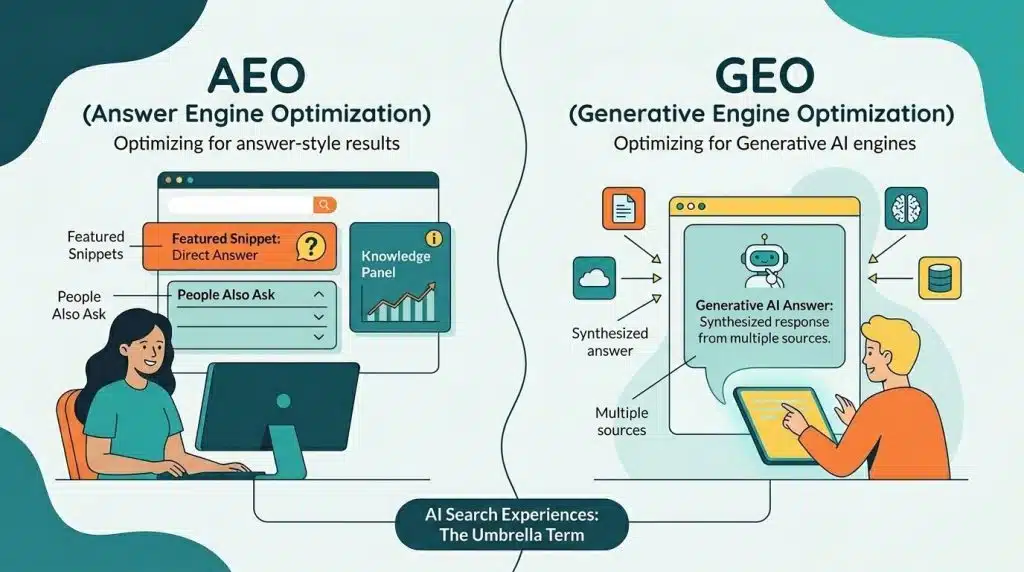
GEO stands for Generative Engine Optimization. It was formalized in a November 2023 research paper by researchers at Princeton, Georgia Tech, Allen AI, and IIT Delhi. (Yes, this is a real peer-reviewed academic concept now, not a LinkedIn invention.) GEO refers specifically to optimizing for generative AI engines, the kind that synthesize an answer from multiple sources rather than just listing links.
Some folks use AEO as the umbrella term and GEO as a subset. Others use GEO as the umbrella. And some use them interchangeably. You won't be wrong if you use them somewhat interchangeably, but you might end up in an LLM-flavored argument with someone on LinkedIn. (You've been warned.)
For the rest of this post, I'll use GEO when I mean generative AI specifically, AEO when I mean the broader "show up in answer-style results" idea, and "AI engines" as the friendly umbrella for both.
Why this matters right now
Why does this matter in 2026 specifically? Because AI engines have crossed the threshold from "fun toy" to "actual discovery channel for B2B buyers." The numbers that make this hard to ignore:
- ChatGPT has 800+ million weekly active users. That's more than the population of Europe. Some non-trivial slice of those folks are asking it questions your business should answer.
- Roughly 60% of Google searches are now zero-click. People get their answer without clicking any link.
- Princeton's GEO research found that optimizing for AI engines can boost visibility by up to 40%, and adding statistics specifically improves citation rate by 41%. (Aside: I find it delightful that the data-backed way to get cited by AI is to include more data in your writing.)
But here's the part that should actually catch your attention: that same Princeton study found lower-ranked pages benefit the most from GEO optimization. Pages at roughly position 5 saw 115% visibility improvement when optimized for AI engines. Top-of-page-1 traffic juggernauts barely moved.
Translation for B2B marketers: if you're not currently #1 for your category (and let's be honest, most of us aren't), the upside here is bigger for you than it is for the giants you're competing with. That's actually encouraging.
"Wait. Isn't this just SEO?"
Yes and no. (I know. Helpful.) AEO/GEO and SEO share a lot of DNA, but the signals AI engines weight are different enough that you can rank well on Google and still be invisible inside ChatGPT.
The honest answer is that AEO/GEO and SEO share a lot of fundamentals. Clear structure helps both. Original, well-cited content helps both. Authority and trust signals help both. The brands that win at one tend to win at the other.
But they're not identical. The signals AI engines lean on are different in a few important ways:
- Ranking and AI citation aren't always related. A page can rank #3 on Google and never get cited by Perplexity, or rank #15 and get cited every time.
- Direct, extractable answers matter more. AI engines lift sentences and paragraphs to compose answers. If your content buries the answer 800 words in, you're harder to lift.
- Source diversity matters. AI engines pull from Wikipedia, Reddit, YouTube, LinkedIn, and other sources Google doesn't always prioritize. One Profound study found Wikipedia accounts for 7.8% of ChatGPT citations and Reddit drives 6.6% of Perplexity citations.
- Schema markup carries more weight. Structured data has always been useful. It's now critical.
Bottom line: AEO/GEO doesn't replace SEO. It's an additional layer to think about, mostly compatible with your existing SEO work and mostly accelerated by it.
How to optimize for AI engines
Here's the practical version: seven moves, drawn from Princeton's GEO research plus what we've seen actually work in B2B engagements.
- Lead with the answer.
AI engines lift the first clear answer they find. Stop burying the lede. If the post answers "what is generative engine optimization?", paragraph one should answer that question, then everything after expands on it. (You'll notice I did this in the section above. Slow clap for me.)
- Add original statistics and data.
AI engines lift the first clear answer they find. Stop burying the lede. If the post answers "what is generative engine optimization?", paragraph one should answer that question, then everything after expands on it. (You'll notice I did this in the section above. Slow clap for me.)
- Cite credible third-party sources.
The Princeton study also found that pages with credible citations earned more AI engine love. (Yes, the irony of "to be cited, cite others" is not lost on me.)
- Use clear structure with extractable chunks.
Headers, lists, definition boxes, and FAQ sections give AI engines clean blocks of text to pull from. A wall-of-text post can have great info and still never get cited because the engine can't isolate a chunk to lift.
- Add schema markup.
Article schema is the bare minimum. FAQ schema, HowTo schema, and Product schema (where applicable) give AI engines explicit structured data to work with. Google's structured data documentation is the authoritative reference; schema.org is the spec.
- Build entity authority.
AI engines weigh things like author bylines, expert credentials, consistent author bios across the web, and mentions of your brand in other authoritative places. None of these are fast. All of them compound.
- Get mentioned where the AI engines look.
That means Wikipedia (if you can earn a legitimate entry), Reddit (in actual communities, not as a spammer), YouTube transcripts, LinkedIn long-form posts, and credible industry publications. Off-site presence is doing more work than ever.
A few honorable mentions: llms.txt is an emerging file format some sites are adopting to help AI engines understand site structure. It's not yet a primary signal for any major engine, but it's cheap to implement and worth experimenting with if you have technical bandwidth. Author bios with E-E-A-T markers (expertise, experience, authoritativeness, trust) matter more than they used to. Freshness signals (last-updated dates, recently-revised content) also help.
How to actually measure whether it's working
Here's the rough part. There is no Google Search Console for AI engines (yet). The official platforms either don't expose citation data at all (ChatGPT, mostly) or only partially (Perplexity shows sources; Google AI Overviews shows linked sources sometimes). So measurement is more manual than we'd all like.
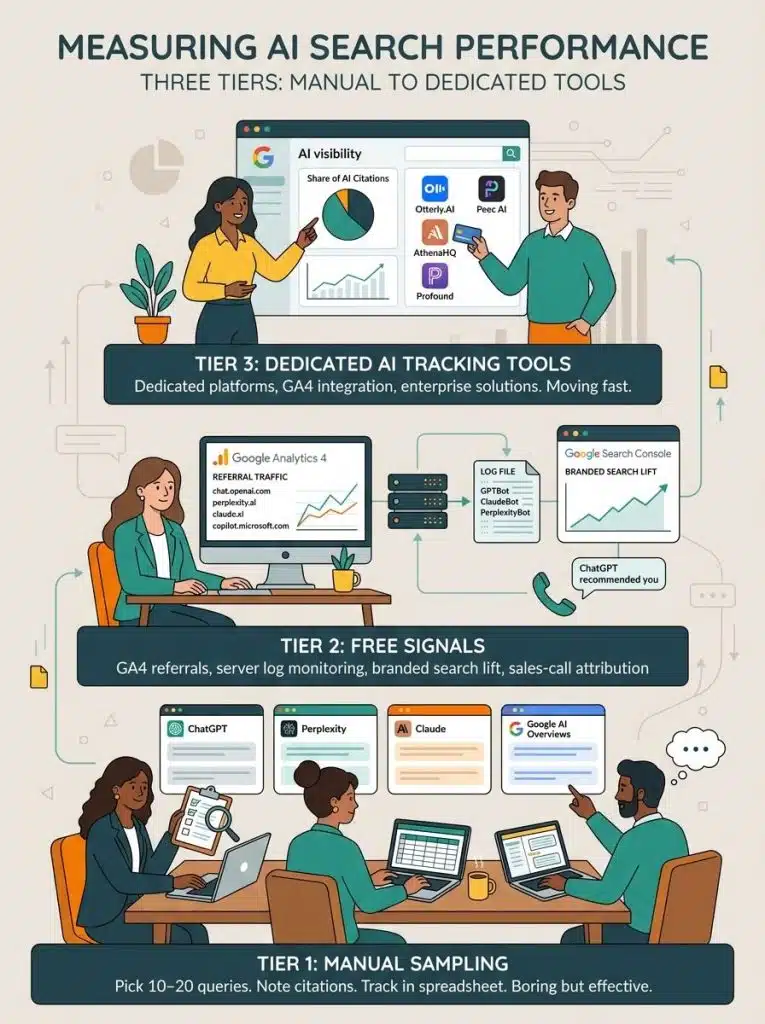
But it's doable. Three tiers, free to paid: manual sampling, free signals from your existing stack, and dedicated AI citation tracking tools.
Tier 1: Manual sampling (free, do this first).
Pick 10 to 20 questions your customers actually ask. (Get them from your sales team. They have them. They've been answering them for years.) Run those queries through ChatGPT, Perplexity, Claude, and Google AI Overviews. Note whether your site is cited, your competitor is cited, or someone unrelated wins the citation. Repeat monthly. Track in a spreadsheet. Boring but effective. Welcome to marketing.
Tier 2: Free signals from your existing stack.
- GA4 referral traffic: filter for chat.openai.com, perplexity.ai, claude.ai, and copilot.microsoft.com. Traffic from those sources means someone asked AI about something and clicked through. (Not all AI citations result in a click, but the ones that do are a real signal.)
- Server log monitoring: AI bot crawlers leave fingerprints. GPTBot, ClaudeBot, PerplexityBot, and similar are identifiable in server logs. If they're crawling your pages, you're at least eligible to be cited.
- Branded search lift in Google Search Console: if AI engines are surfacing your brand, you'll typically see downstream branded search bumps. This is the AI version of "people heard about you and Googled you."
- Sales-call source attribution: start asking "how did you hear about us?" and listen for "ChatGPT recommended you" as an answer. Alanna and I got our first one of those last quarter. It's wild every time.
Tier 3: Dedicated AI citation tracking tools.
A real category now, with prices from very cheap to very enterprise. Options worth knowing about in 2026: Otterly.AI (entry-level, around $29/mo), Peec AI (~$85/mo), AthenaHQ (~$295/mo, with GA4 integration), and Profound (enterprise, custom pricing, the G2 Winter 2026 AEO Leader). If you already pay for Ahrefs or Semrush, both now include AI visibility add-ons that are credible if not best-in-class. Quick caveat: this category is moving fast. By the time you read this, two new tools will exist and one of the above will have pivoted. Verify pricing and features before committing.
Where to start tomorrow
If you're tempted to do all of this at once, don't. (Voice of experience.) Here's a smaller starting move that actually works:
- Pick three pages that should be answering high-value buyer questions. Not your homepage. Not your About page. Actual content pages where someone might land while researching.
- Add Article and FAQ schema markup to each.
- Rewrite the first paragraph of each to lead with a direct, extractable answer to the page's core question.
- Add one statistic with a citation (real, sourced, not made up: AI engines also have memories).
- Run the page's core question through ChatGPT, Perplexity, and Google AI Overviews. Note who gets cited today as your baseline.
- Add those three pages to your content inventory audit under the AI Citations column and check again in 30 days.
That's it for a v1 motion. Do those six steps for three pages, see what moves in 30 days, then expand from there.
Frequently asked questions
Generative engine optimization (GEO) is the practice of optimizing your content so AI engines like ChatGPT, Perplexity, Claude, and Google AI Overviews discover, understand, and cite it when synthesizing answers. The term was formalized in a 2023 Princeton-led research paper and has become essential as AI search adoption grows.
(Answer Engine Optimization) is the broader term, covering optimization for any answer-style result, including featured snippets, "People Also Ask" boxes, and AI chatbots. GEO (Generative Engine Optimization) is specifically about optimizing for generative AI engines. The terms are often used interchangeably in practice.
No. GEO doesn't replace SEO. The two share a lot of DNA, including clear structure, original content, and authority signals. GEO adds a layer focused on getting cited by AI engines. Most B2B brands should treat GEO as additive to existing SEO work, not a replacement.
The Princeton GEO research identified the most effective tactics: lead with a direct answer, add original statistics, cite credible sources, use clear structure with extractable chunks, add schema markup, build entity authority, and earn mentions in sources AI engines reference frequently (Wikipedia, Reddit, YouTube, LinkedIn).
There's no Google Search Console for AI engines yet, so measurement happens three ways: manual sampling (running your target queries through AI engines and noting who gets cited), free signals from your existing stack (GA4 referral traffic from AI domains, server log monitoring for AI bot crawlers, branded search lift), and dedicated tracking tools like Otterly.AI, Peec AI, AthenaHQ, and Profound.
The main tools in 2026 are Otterly.AI (entry-level, ~$29/mo), Peec AI (~$85/mo), AthenaHQ (~$295/mo, with GA4 integration), and Profound (enterprise, the G2 Winter 2026 AEO Leader). Ahrefs Brand Radar and Semrush also offer AI visibility add-ons. The category is moving fast, so verify pricing and capabilities before committing.
The honest bit at the end
AEO/GEO is real and worth doing. But it's not the only thing worth doing, and the people on LinkedIn telling you SEO is dead are selling you something. The fundamentals (clear, useful, well-structured content from a credible source) still win. AEO/GEO is what gets that winning content surfaced inside AI engines, which is one channel among several.
If you've got a content engine that's pretty mediocre, optimizing it for AI engines isn't going to fix that. It might just get your mediocre content cited more, which... is a mixed blessing.
If you've got good content that's invisible inside AI engines? That's where the 40% lift in the Princeton paper actually shows up. And I'd bet most B2B brands are sitting right there: good work, no AEO scaffolding, low AI visibility.
The audit-then-act loop I covered in the content inventory audit post is the right order. Audit first. Find your best work. Add the AEO scaffolding to it. Measure. Expand.
If you want more posts like this — real tactics, no hype, the occasional Alanna rant about MailChimp — Alanna and I send a newsletter. Subscribe and we'll keep you posted.