

The Evolving Landscape of B2B Digital Marketing
Digital marketing in b2b business is the strategic use of online channels and technologies to promote products or services to other organizations rather than individual consumers. Unlike B2C marketing, it involves longer sales cycles, multiple decision-makers, and more complex purchasing processes.
Quick Answer: What is B2B Digital Marketing?
| Key Component | Description |
|---|---|
| Definition | Marketing of products/services to other businesses through digital channels |
| Primary Channels | Websites, SEO, content marketing, email, LinkedIn, PPC advertising |
| Key Differences from B2C | Longer sales cycles, multiple stakeholders, logic-driven decisions |
| Main Benefits | Precise targeting, measurable results, high ROI |
| Success Metrics | Conversion rate, CAC, CLV, ROAS, pipeline value |
The business landscape has fundamentally changed. Today's B2B buyers are spending more time on independent online research and less time meeting with potential suppliers. This shift means your digital presence must work harder than ever.
Modern B2B marketing requires a systematic approach that acknowledges this new reality.
The stakes are high. Companies with effective digital marketing strategies tend to grow faster and can be more profitable than those that don't invest in this area. With digital channels becoming increasingly important for B2B sales interactions, mastering this domain isn't optional—it's essential.
But there's good news: the digital change of B2B marketing brings unprecedented opportunities to target precisely, measure accurately, and optimize continuously. Whether you're looking to generate qualified leads, nurture prospects through complex buying journeys, or close more deals, the right digital strategy can transform clicks into contracts.
In this comprehensive guide, we'll walk through everything you need to know about building and executing effective digital marketing strategies for your B2B business—from foundational concepts to advanced tactics that drive real results.
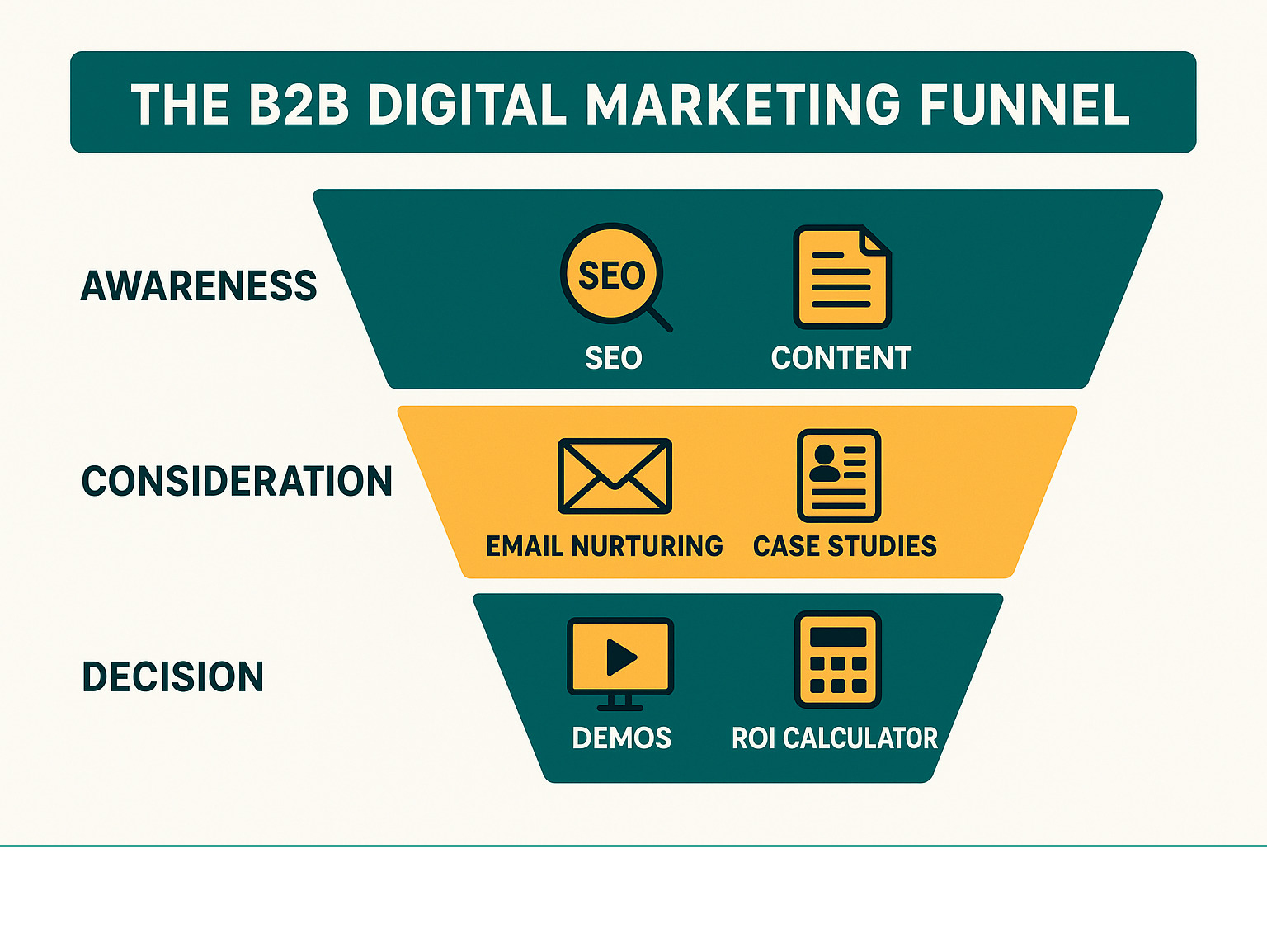
Digital marketing in B2B business terms to remember:
Why B2B Is Different: Foundations You Must Nail
Let's face it – digital marketing in B2B business plays by a completely different rulebook than B2C. If you've ever tried to apply consumer marketing tactics to your B2B strategy, you probably found this the hard way!
The B2B buying journey is naturally more complex, with longer sales cycles than the B2C buying journey. Why so long? Because B2B purchases typically involve multiple moving parts:
- A committee of multiple decision-makers (often with competing priorities)
- Significant financial investments that require careful consideration
- Potential impacts across the entire business operations
- Approval processes that zigzag through various departments

While someone might buy a pair of shoes online in minutes based purely on emotion, B2B decisions blend logic and emotion in fascinating ways. Your prospects are thinking: "Will this solution make me look good to my boss?" alongside "Does the ROI calculation make sense?" It's this mixture of personal and professional concerns that makes B2B marketing so nuanced.
The Shift From B2C Tactics to B2B Realities
Trying to apply B2C digital tactics directly to B2B situations can be like trying to fit a square peg in a round hole. Here's why they're fundamentally different:
Buyer Committees vs. Individual Purchasers: In B2B, purchase decisions often involve a group of stakeholders from various departments, each bringing unique goals and concerns. Your marketing must address the needs of every decision-maker at the table.
ROI Focus vs. Emotional Appeal: While that heartwarming commercial might sell consumer products, your B2B prospects need clear ROI calculations and business justifications. They're spending company money, not personal funds, and need to defend their decisions. That's not to say that B2B purchases are strictly rational, of course.
Extended Nurture vs. Quick Conversion: B2B relationships are marathons, not sprints. Depending on what you're selling, your prospects may need nurturing through multiple touchpoints over weeks or months before they're ready to commit, quite different from the "buy now" focus of B2C marketing.
Decision Fatigue Management: With so many stakeholders and information to process, B2B buyers often suffer from decision fatigue. The most successful B2B marketers simplify complex information and provide clear, consistent messaging that makes the buying process feel manageable.
Key Benefits of Going Digital in B2B
The digital revolution has transformed B2B marketing for the better, offering several game-changing advantages:
Precise Targeting is perhaps the biggest win. Digital channels let you zero in on specific decision-makers based on job title, industry, company size, and even behavioral signals. Remember when we had to hope the right person saw our billboard or trade magazine ad? Those days are thankfully behind us.
Measurable ROI makes defending your marketing budget much easier. You can track exactly how prospects interact with your content and what drives conversions.
Scalable Personalization means you can speak to different stakeholders simultaneously. Your CFO prospect sees ROI-focused content while your technical buyer gets deep-dive specifications – all automatically.
Lead Generation Efficiency is dramatically improved through digital channels. The days of cold calling as your primary lead source are fading fast.
Cost-Effectiveness is the cherry on top. Digital marketing approaches can be more cost-effective than traditional marketing strategies while generating more leads.
The science behind B2B decision-making shows that while logic drives the process, trust is what closes deals. Your digital marketing in B2B business strategy needs to address both – providing the hard data points while building genuine connections with your prospects across multiple touchpoints.
Building a Buyer-First Strategy for digital marketing in B2B business
Let's face it: successful digital marketing in a B2B business isn't about flashy tactics or jumping on the latest trends. It starts with something much more fundamental: truly understanding your buyers.
We're not talking about surface-level demographics here. We mean developing rich, nuanced insights about your target accounts and the real humans making decisions within them.
Companies that invest in systematic buyer research tend to grow faster and can be more profitable than those who skip this crucial step. That's a competitive edge you can't afford to ignore.
Identifying & Segmenting Your Target Accounts
Think of your Ideal Customer Profile (ICP) as the foundation of your entire B2B digital marketing house. Without it, everything else becomes shaky.
Begin by documenting the firmographic details that are most relevant: industry, company size, annual revenue, and geographic location. Focus on the characteristics that make a prospect most similar to your best existing customers.
Then, dig deeper with buyer personas. These detailed profiles should capture not just job titles but the day-to-day challenges and aspirations of key stakeholders. This is particularly important as millennials continue reshaping B2B buying. The workforce demographics are changing, with younger professionals increasingly involved in purchase decisions at their companies.
For high-value prospects, consider implementing even a "light" Account-Based Marketing (ABM) approach. Rather than casting a wide net, focus on 20-50 target accounts with detailed buying committee profiles. This focused strategy often yields dramatically better results than broader approaches.
Pay close attention to buying signals—digital actions that show a company is actively exploring solutions like yours. Tracking these behaviors helps you focus on accounts that are most likely ready to engage.
Crafting Content That Guides the Journey
Content can be your B2B buyer’s trusted advisor—guiding, educating, and building confidence at every step. To make an impact, your content must align with each stage of the buyer’s journey and address real business challenges. Today’s B2B decision-makers expect custom, insightful resources that speak directly to their needs.
At The B2B Mix®, we recommend following what we call the "20/80 rule" for content: allocate 20% of your effort to creating high-quality pieces, and then invest the remaining 80% in promoting and distributing that content. Even brilliant content fails when it doesn't reach the right audience.
Different journey stages demand different content formats. Early in the awareness stage, thought leadership articles and educational blog posts help establish credibility. As prospects move into consideration, case studies and detailed white papers demonstrate your expertise. By the decision stage, product demos and ROI calculators help seal the deal.
Want to dive deeper into content strategy? Check out our comprehensive B2B content strategy resource for more guidance.
Personalization for Multiple Stakeholders
A challenge in digital marketing in B2B business is addressing multiple stakeholders with very different priorities and concerns. The CTO, CFO, and end-users all care about different aspects of your solution.
Digital tools make personalization at scale possible. Role-based messaging allows you to address the specific concerns of technical evaluators separately from financial decision-makers. Dynamic content can transform your website experience based on visitor attributes or past behavior.
Your CRM becomes a personalization powerhouse when properly leveraged, enabling custom communications across every channel. And interactive tools like value calculators help prospects understand the specific benefits for their unique situation.
Generic, one-size-fits-all content rarely converts in today's B2B landscape. The more precisely you can speak to a prospect's specific situation, role, and challenges, the more likely they are to engage with your brand and ultimately choose your solution.
By building your strategy on this buyer-first foundation, you'll create digital marketing that resonates, engages, and converts – because it's fundamentally aligned with what your prospects actually care about.
Digital Marketing in B2B Business: Core Channels & Tactics That Convert
Now that you've established your buyer-first strategy, it's time to roll up your sleeves and dive into the channels that actually drive results. These aren't just theoretical concepts—they're the practical tools that transform interested prospects into paying clients.

High-Performance Websites — Your 24/7 Sales Rep
Think of your website as your hardest-working team member—it never sleeps, never takes vacation, and is often the first impression prospects have of your business. B2B buyers frequently visit a company's website when researching providers, so this digital storefront needs to stand out.
What makes a B2B website truly effective? It starts with the basics: lightning-fast loading (under 3 seconds or visitors bounce) and bulletproof security (that HTTPS lock icon matters more than you think). Your site should adapt beautifully to any device—after all, a significant portion of B2B research is now conducted on mobile devices.
Beyond the technical aspects, your website needs clear conversion paths. Visitors should never wonder, "What do I do next?" Strategic calls-to-action guide them naturally through their journey, while thoughtful content establishes your expertise without overwhelming them.
Interestingly, the modern B2B buyer often prefers a self-directed experience. Many want a sales-rep-free purchase process, particularly among younger buyers. Your website should respect this preference by offering clear information and self-service options where appropriate.
SEO & Content Hubs That Attract Qualified Traffic
When it comes to bringing qualified visitors to your site, digital marketing in a B2B business relies heavily on smart SEO. Many B2B companies find that SEO is a top lead generator—when done correctly, it delivers prospects who are already interested in what you offer.
Today's B2B SEO goes well beyond stuffing keywords into meta tags. The most successful companies build comprehensive content hubs that establish true topical authority. Rather than creating random blog posts, they develop interconnected content clusters that answer all the questions prospects might have about a particular subject.
Entity-based SEO has also changed the game. Google now understands concepts and relationships between topics, so your content needs to demonstrate genuine expertise in your field. This means covering related concepts and using the terminology that signals true industry knowledge.
Perhaps most importantly, successful SEO aligns with search intent. Are your prospects seeking educational information, comparing vendors, or ready to make a purchase? Your content should align with where they are in their journey, not just the keywords they typed.
For a comprehensive understanding of B2B SEO strategies, Backlinko's guide to B2B SEO offers excellent insights on building authority in your industry niche.
Email, Automation & Lead Nurturing Workflows
Email remains the quiet powerhouse of B2B marketing, delivering an impressive return on investment. But sending generic blasts to your entire list just doesn't cut it anymore.
Smart B2B marketers utilize automation to deliver targeted, personalized messages at the perfect time, based on prospect behavior. When someone downloads your industry report, visits your pricing page three times, or abandons a form halfway through, these actions trigger specific messages designed to address their exact situation.
Segmented drip campaigns keep your company top of mind without being annoying. Behavior-based triggers respond to actions that signal buying intent. Plain-text alternatives often outperform fancy HTML emails for specific audiences. And lead scoring helps identify which prospects are heating up and ready for sales outreach.
At The B2B Mix, we've seen clients transform their results by optimizing HubSpot for these sophisticated nurturing workflows. The technology is powerful, but the strategy behind it makes all the difference.
Curious how AI is changing content marketing, including email? Check out our guide on AI Content Marketing: What You Need to Know.
Social Media & Influencer Plays for B2B
Social media isn't just for B2C brands—it has become essential in B2B decision-making, with many buyers using social platforms before making a purchase. But the approach is quite different.
LinkedIn thought leadership stands at the center of most successful B2B social strategies. By positioning your executives and subject matter experts as industry authorities, you build trust that translates into business opportunities. This isn't about posting company news—it's about sharing valuable insights that help your prospects solve real problems.
Don't overlook the power of your own team, either. Employee networks on LinkedIn typically reach more people than your company page followers. A thoughtful employee advocacy program can dramatically extend your reach with authentic voices.
While mass-market influencers rarely make sense for B2B, partnerships with respected voices in your specific industry can open doors. These niche influencers might have smaller followings, but their recommendations carry significant weight with your exact target audience.
Paid Media: PPC, Retargeting & Geofencing
While organic strategies build long-term value, sometimes you need results now. That's where paid media comes in—and it can be remarkably effective when targeted precisely.
Search ads capture prospects actively looking for solutions like yours—the digital equivalent of opening your store exactly where customers are already shopping. LinkedIn advertising enables you to target specific job titles, industries, and company sizes with precision.
Retargeting keeps your brand in front of visitors who've shown interest but weren't quite ready to commit. And for high-value target accounts, account-based advertising through IP targeting or geofencing can put your message directly in front of decision-makers at your dream clients.
The investment can pay off handsomely—well-executed PPC campaigns can provide a positive return on investment. The key is continuous optimization: testing different messages, refining targeting parameters, and analyzing results to improve performance over time.
Measurement, Optimization & Tech Stack Essentials
Measuring what matters is where the rubber meets the road in digital marketing in B2B business. Without proper tracking and a smart approach to optimization, even the most brilliant strategy can fail to deliver results.
Choosing the Right Metrics for Each Funnel Stage
Think of your marketing funnel like a journey with distinct landmarks—each requiring its map to steer effectively:
At the top of the funnel, you're casting a wider net. Here, focus on awareness metrics such as website traffic growth, social engagement levels, the number of people who download your thought leadership content, and email open rates, which indicate whether your subject lines are resonating.
Moving to the middle of the funnel, the relationship deepens. Track metrics that indicate genuine interest, such as time spent on your site, whether visitors return for more, webinar attendance (do they commit to 30+ minutes?), and email click-through rates that signal a desire to learn more.
At the bottom of the funnel, it's all about conversion and business impact. This is where the metrics that matter to your CEO reside: conversion rates, sales-qualified lead counts, customer acquisition costs, return on ad spend, and the all-important customer lifetime value.
The most sophisticated B2B teams don't just look at last-click attribution. They implement multi-touch attribution models that show how different channels work together throughout the entire buyer journey, giving proper credit to that early-stage blog post that started the relationship months before the demo request.
Marketing Automation & CRM Integration
Your marketing tech stack is the engine room of your digital strategy. When your marketing automation platform and CRM system work in harmony, magic happens:
Lead scoring becomes your silent qualifier, automatically bubbling up the hottest prospects based on both who they are (demographic fit) and what they do (engagement behaviors). No more guessing which leads deserve sales' attention.
Workflow automation puts your nurture sequences on autopilot, delivering the right content at the right moment without anyone having to remember to press "send." At The B2B Mix, we've appropriately seen configured HubSpot workflows cut manual work by 60% while improving response times.
Data hygiene might not be sexy, but it's essential. Clean, accurate data across systems ensures your targeting and personalization actually work. Remember: personalization based on wrong data is worse than no personalization at all.
Sales and marketing alignment becomes real, not just a buzzword. When systems communicate with each other, the handoff from marketing to sales occurs smoothly, with complete context on the prospect's journey so far.
Continuous Improvement Loop
The most successful B2B digital marketers accept a culture of never being "done." They're constantly testing, learning, and refining:
Real-time dashboards give visibility into what's working across channels without waiting for monthly reports. When you can see performance shifting in real-time, you can make adjustments before it's too late.
Experimentation culture means running regular A/B tests on everything from landing pages to email subject lines to ad creative. The companies that grow fastest typically test elements regularly.
Micro-tests beat major overhauls. Rather than redesigning your entire website once a year, savvy B2B marketers test small changes frequently—a button color here, a headline tweak there—accumulating improvements over time.
Data-driven decisions replace gut feelings. When analytics guide your strategy adjustments, you stop throwing good money after bad tactics and double down on what's actually moving the needle.

At The B2B Mix, we've found that companies often have plenty of data—they're just not using it effectively. Our approach helps transform overwhelming spreadsheets into actionable insights that drive real growth.
Trends, Innovations & Real-World Wins to Watch
The landscape of digital marketing in b2b business continues to evolve rapidly. Staying ahead of emerging trends and innovations can give you a competitive edge.
Emerging Tech Shaping digital marketing in b2b business
Several technologies are changing how B2B companies connect with prospects and customers:
AI-Powered Content: AI tools are increasingly being used to create and optimize marketing content.
- Conversational Marketing: Advanced chatbots and conversational interfaces that qualify leads and answer questions 24/7.
Predictive Intent Analysis: Tools that identify buying signals before prospects explicitly express interest.
Self-Service Portals: Interactive platforms that allow prospects to explore solutions at their own pace, reflecting the preference of many B2B buyers for independent research.
Visual-First Storytelling: The shift toward video, interactive infographics, and other visual formats to engage busy B2B decision-makers.
Quick Case Highlights (Clicks → Contracts)
Real-world success stories demonstrate the power of effective digital marketing in B2B:
Content Marketing Excellence: Professional services firms have used targeted content to engage C-level prospects and generate pipeline revenue.
Social Listening Benefits: Tech vendors implementing social CRM solutions can capture valuable customer insights and sales opportunities.
Webinar-Driven Sales: Companies that utilize webinars as a direct channel to end-users have achieved significant sales results.
Frequently Asked Questions about B2B Digital Marketing
One of the most common questions we hear at The B2B Mix is about timing. Let's be honest – we all want results yesterday! However, digital marketing in B2B businesses requires patience alongside strategy.
Different channels mature at different rates:
For SEO, expect to wait 3-6 months before seeing significant improvements in organic traffic. This isn't because SEO moves slowly, but because building authority takes time. Think of it as planting trees rather than growing flowers.
With content marketing, most companies see a gradual build over 6-12 months before their program drives consistent leads. The good news? Once established, that content continues working for you 24/7.
PPC and paid social can deliver almost immediate visibility, sometimes within days of launching. However, the real magic happens over the first 3-4 months as we optimize campaigns based on real performance data.
For account-based marketing initiatives, you can typically expect to see improved engagement with target accounts within 30-45 days. However, the full pipeline impact usually takes 90-120 days to materialize, depending on your typical sales cycle length.
B2B purchase decisions involve multiple stakeholders and careful consideration – your digital marketing results will reflect this reality.
While every business is unique, different channels offer different potential returns:
Email marketing remains a strong performer in terms of ROI when executed effectively. This is why we place such a strong emphasis on building high-quality lists and crafting engaging sequences.
SEO delivers particularly strong long-term returns because it continues driving traffic long after your initial investment. Unlike paid media, which stops the moment you stop funding it, SEO keeps working for you.
Content marketing can generate more leads at a lower cost than traditional marketing approaches, making it particularly valuable for B2B companies with complex offerings that require education.
PPC advertising can provide positive returns when properly optimized, making it an effective way to target high-intent prospects.
That said, the highest ROI typically comes not from any single channel but from an integrated approach where your channels work together strategically. Your website captures search traffic, your content nurtures prospects, your email moves them through the funnel, and your paid media amplifies everything else.
In today's rapidly evolving digital marketing in B2B business landscape, standing still means falling behind. That's why successful B2B marketers typically allocate a portion of their digital marketing budget to testing new channels, messages, and tactics.
Think of this u0022innovation budgetu0022 as your marketing Ru0026D – it ensures you're continuously finding new opportunities while maintaining performance from your proven channels.
If you're starting with testing, begin more conservatively – perhaps 5-10% of your channel budget – and gradually increase investment as you validate results. The key is establishing a clear testing framework with defined success metrics so you can quickly identify what's working.
At The B2B Mix, we help our clients find the right balance between optimization and exploration. We've found that companies that maintain a consistent testing program consistently outperform those that stick exclusively with u0022what's always worked.u0022
Remember, the digital landscape is constantly changing. What worked brilliantly last year might be just average today. Regular testing keeps you ahead of the curve rather than chasing it.
Conclusion
Mastering digital marketing in b2b business isn't just about knowing the tactics—it's about embracing a mindset that recognizes the unique journey B2B buyers take. Throughout this guide, we've explored how building a buyer-first strategy, executing across the right channels, measuring meaningful metrics, and continuously refining your approach can transform those initial clicks into signed contracts.
The B2B landscape is shifting dramatically beneath our feet. Digital channels are becoming increasingly important for B2B sales interactions. This isn't just a trend, it's a fundamental reshaping of how business gets done. Companies that excel at digital marketing won't just have an edge; they'll be playing an entirely different game than their competitors.
At The B2B Mix, we've walked this path alongside countless B2B companies. We've seen the challenges of complex buying committees, extended sales cycles, and the pressure to demonstrate clear ROI. That's why we focus on practical solutions that deliver tangible results—optimizing HubSpot implementations, streamlining marketing operations, and executing digital strategies that actually work in the real world.
What sets our approach apart is our commitment to being both experts and humans. We speak plain English (not marketing jargon), provide hands-on support (not just theoretical advice), and focus on building strategies that align with how your business actually operates.
The results-driven mindset we champion isn't about chasing every shiny new trend. It's about finding the right mix of tactics that work for your specific business goals, buyer personas, and resources. It's about creating a continuous learning loop that improves over time.
Whether you're just starting to explore digital marketing for your B2B company or looking to elevate your existing efforts, this journey doesn't have to be overwhelming. With the right partner and approach, you can steer the complexities of the B2B landscape and create meaningful connections that drive business growth.
Ready to transform your approach to digital marketing? Learn more about our B2B digital marketing services and find out how we can help you achieve your business goals.
In today's digital-first business environment, success isn't about random acts of marketing: it's about building a coherent strategy that meets your buyers where they are, addresses their specific challenges, and guides them confidently toward a decision. The path from clicks to contracts may be complex, but with the proper roadmap, it's a journey your business can master.