

Your website is full of content that's either driving results or quietly dragging you down — but do you know which is which?
If you said "kind of?" — yeah, you're not alone. Most B2B marketing teams can name the three or four pages that consistently bring in leads, but the rest of the content library? Foggy. Some of it's old. Sometimes it's content that's never gotten traffic. Some of it's a near-duplicate of something else. And nobody's totally sure who wrote that 2019 white paper that's still gated behind a form.
That's where an SEO content audit comes in. It's spring cleaning for your website — not glamorous, but necessary. Done right, it tells you what to keep, what to update, what to merge, and what to politely show the door. Done in 2026, it also tells you how your content is performing in a search world that now includes AI engines like ChatGPT, Perplexity, and Google's AI Overviews — not just the traditional ten blue links.
Here's how to run one without losing your mind.
What is an SEO content audit?
An SEO content audit is a systematic review of every piece of content on your website to figure out what's helping your search performance, what's hurting it, and what's just sitting there taking up space.
Most audits boil down to three steps:
- Inventory — list everything you've got
- Analysis — measure how each piece is performing against your goals
- Action — decide what to keep, update, merge, or remove
The reason audits matter so much for SEO is something content folks call ROT — Redundant, Outdated, and Trivial content. Every site accumulates it. Statistics get stale, links break, search intent shifts under your feet, and that "definitive guide" you wrote in 2022 is now neither definitive nor much of a guide. ROT confuses search engines (and AI engines, but more on that in a minute), dilutes your topical authority, and quietly drags down the pages you actually want to rank.
Inventory vs. audit — know your starting point
These get used interchangeably. They shouldn't be.
Think of a content inventory as taking stock of your kitchen pantry — you're listing everything you have, no judgment, just a record. A content audit is checking each item to see if it's expired, still useful, or needs to be replaced.
The inventory answers: what do we have? The audit answers: is it any good, and what should we do about it?
According to Nielsen Norman Group, an inventory catalogs what you have, while an audit assesses quality and guides what to update, keep, or remove. (You need both, by the way. An audit without an inventory has blind spots; an inventory without an audit is just a list.)
If you don't have an inventory yet, start with our guide on website content inventory before you tackle the audit piece.
Why bother with a content audit?
Beyond the obvious "your content needs a checkup" answer, content audits deliver some real, measurable wins:
- Better SEO performance. Orbit Media found that bloggers who update older posts are 2.5 times more likely to report strong results. (Updating beats churning out new posts. Always has, probably always will.)
- Smoother user experience. Cutting redundant or confusing content makes it easier for visitors to find what they actually came for.
- Higher conversion rates. Optimizing high-traffic pages based on real data — not vibes — moves the needle in a way new content rarely does.
- Smarter resource allocation. You learn what's worth your team's time, and what isn't.
- Stronger brand consistency. Audits surface tone and messaging drift, especially on older content.
- Content gap identification. Adobe's Trust Report found that 71% of consumers say well-timed, personalized content significantly builds trust. Hard to deliver that with gaps in your buyer journey.
The B2B-specific kicker: Adobe also found that 61% of B2B buyers rate their B2C buying experiences as better than their B2B ones. Yikes. Content audits are one of the unsexy ways to start closing that gap.
When should you do an SEO content audit?
The answer: more often than you are right now.
The slightly more useful answer:
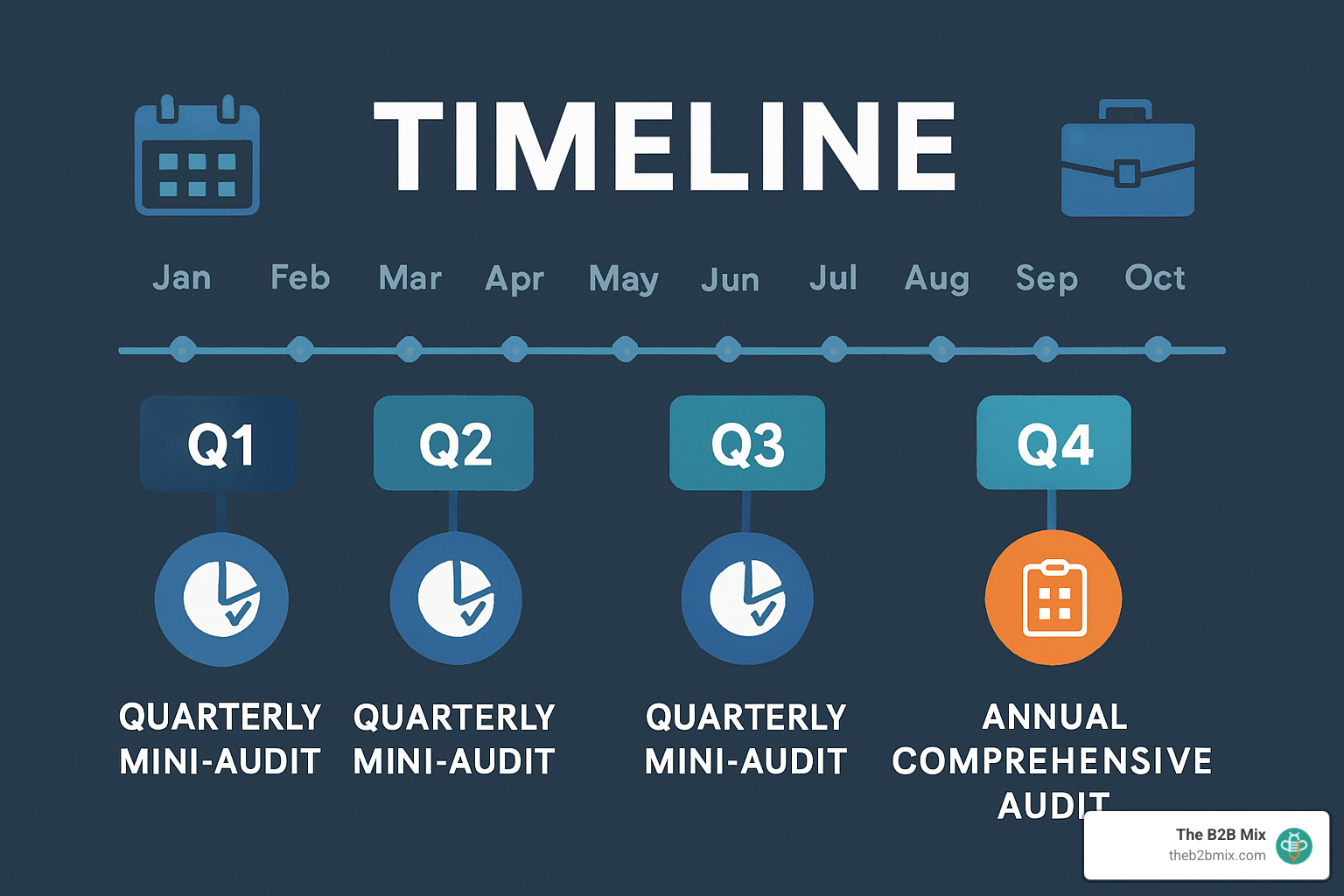
- Quarterly mini-audits — focus on high-traffic pages and recently published content. Catches issues early, takes a day or two.
- Annual comprehensive audits — a full ecosystem review. Spots patterns you can't see on individual pieces.
- Event-driven audits — before a website redesign, after a major Google algorithm update, after a strategic pivot, or when you're seeing concerning trends in your traffic.
A few specific triggers that should send you straight to your spreadsheet:
- You're planning a redesign (audit before you migrate, not after — trust me on this one)
- Organic traffic or rankings are dropping and you're not sure why
- You've launched new products, gone through a merger, or pivoted strategically
- It's been more than a year and you can't remember the last time anyone reviewed older content
Who should be involved?
Audits aren't a solo marketing project. The good ones include:
- Content strategists and marketers — drive the project, evaluate messaging and journey alignment
- SEO specialists — assess technical performance, keyword targeting, and search visibility
- Web developers — flag technical issues that need to be implemented
- Subject matter experts — verify accuracy (especially crucial in B2B, where outdated technical details destroy credibility fast)
- Sales reps — tell you what content actually resonates with prospects (their input is genuinely undervalued in most audit projects)
Defining roles up front is the difference between findings that ship and findings that end up in a spreadsheet nobody ever opens again.
Step-by-step: how to run an SEO content audit
OK, here's the actual process. Four phases.
Phase 1: Set goals
Without clear goals, you'll end up with a pile of interesting-but-not-actionable data. Use the SMART framework — specific, measurable, achievable, relevant, time-bound. "Improve the blog" isn't a goal. "Identify and optimize the 20 blog posts with the highest traffic but lowest conversion rates within 90 days" is a goal.
Most B2B audits focus on a mix of:
- SEO optimization (rankings, traffic potential)
- Content consolidation (eliminating ROT)
- UX improvements
- Conversion rate optimization on high-traffic pages
- Repurposing valuable older content into new formats
Phase 2: Pull the data
This is where audits live or die. The trick isn't gathering every metric. Instead, it's getting the right ones to make decisions.
- Google Search Console — export your Performance report (clicks, impressions, position, CTR, by query and by page). This will reveal cannibalization issues and pages ranking just outside the top 10 (your refresh candidates).
- Google Analytics 4 — Reports > Engagement > Landing Pages, exported for both 3-month and 12-month windows. Sessions, bounce rate, conversions.
- A site crawler — Screaming Frog is free under 500 URLs. Captures titles, metas, header structure, internal links, image alt text, and broken links.
- Backlink data — Search Console's free Links report works for most B2B sites. Helps identify "link magnet" content that's worth protecting.
Pull all of it into a single spreadsheet, page by page. (This will be ugly. That's fine. The spreadsheet is for you, not for show.)
Phase 3: Evaluate
Run each page through both quantitative and qualitative checks.
Quantitative:
- Traffic (3-month and 12-month trends)
- Engagement (time on page, bounce rate)
- Conversions or assisted conversions
- Rankings, impressions, and CTR
- Backlink count
Qualitative:
- Is the information still accurate?
- Does it match current search intent?
- Is the brand voice consistent with how you sound today?
- Is it readable, accessible, and inclusive?
Score each page on a simple scale — high/medium/low works fine — so you're not making purely gut-feel calls. Tools like Hemingway Editor and Grammarly help on the readability and inclusivity side.
Phase 4: Decide — keep, update, merge, or remove
Every page goes into one of four buckets:
- Keep — performing well, still accurate, still on-brand. Leave it alone.
- Update — has potential but needs refreshing (stats, examples, screenshots, internal links, schema).
- Merge — two or more pages targeting the same keywords. Combine into one stronger page, 301 redirect the others. (This fixes keyword cannibalization, which — full transparency — is the exact reason this very post exists. Two of our posts were quietly competing for the same SERPs. So... pay attention to this one.)
- Remove — outdated, irrelevant, no traffic, no backlinks. Either delete and let it 404, or 301 redirect to the closest-relevant page.
When pages currently ranking in positions 4 to 10 are usually your highest-leverage updates, you have a hidden-gem pattern is worth flagging. They're already on page one—small optimizations often push them into the top three.
Auditing for AI search visibility (the new layer in 2026)
Here's what's new in 2026 that wasn't part of content audits even a couple of years ago: AI search engines.
When someone asks ChatGPT, Perplexity, Google's AI Overviews, or Gemini a question, the AI pulls answers from across the web — and the sources it cites aren't always the same pages that rank highest in traditional search. Which means your "best practices" page can be ranking on page one of Google and still be invisible in AI results. (Welcome to the new game.)
A few things to add to your audit when you're thinking about AI search:
- Check Bing Webmaster's AI Search Queries report. Microsoft surfaces the queries that drove AI citations to your site. It's free, and most marketers haven't looked at it yet.
- Audit your content for question-answerability. AI engines pull from content that answers specific questions cleanly. Pages that lead with the answer (then explain) tend to get cited more than pages that build to the answer over six paragraphs.
- Add (or audit) FAQ schema. Question-and-answer formatting plus FAQ schema makes it dramatically easier for AI to extract and cite your content.
- Check your visibility in AI engines directly. Search a few of your priority queries in ChatGPT, Perplexity, and Gemini. Are you cited? Are competitors? What sources are showing up that aren't you?
This is its own developing practice (and a topic worth its own deeper post — coming soon). For now, treat AI search visibility as a fifth column in your audit spreadsheet, right alongside your traditional SEO metrics.
Tools for SEO content audits
A starter toolkit that won't blow your budget:
For HubSpot-powered teams, lean on the native analytics first. The integrated picture across marketing, sales, and service content tends to surface patterns that siloed tools miss. (We may be biased on this front, but the integration is genuinely useful.)
Frequently asked questions
Smaller sites (under 100 pages) — annually. Medium sites (100 to 1,000 pages) — every six months. Larger sites (1,000+ pages) — quarterly. After major Google algorithm updates, significant traffic drops, redesigns, or business pivots, do one immediately.
Your top 20% of traffic-driving pages, plus high-conversion landing pages. Then expand to pages ranking in positions 4 to 20 (the hidden gems) and pages with declining traffic over the past year.
Yes, but carefully. Pages with no traffic and no backlinks are safe to remove. Pages with backlinks should be 301 redirected to the closest-relevant page so you don't lose link equity. Always check the backlink profile before hitting delete.
Skipping the action step. Audits don't fail because the analysis was wrong. They fail because the spreadsheet gets shared, everyone nods, and then nothing happens. Assign owners, set deadlines, and put the updates on the editorial calendar — or you're doing very thorough busywork.
The takeaway
An SEO content audit isn't a one-and-done project. It's more like flossing — regular attention is what keeps things healthy. (And like flossing, most teams know they should do it more than they actually do.)
The teams that get the most out of audits aren't the ones with the most sophisticated tools. They're the ones who actually do the audit on a predictable cadence, make the decisions, and ship the changes. Best practices matter — but follow-through matters more.
If you'd rather not start from a blank spreadsheet, grab our Content Inventory & Audit Checklist — it'll give you the structure to run your first audit without missing the important stuff. And if you want help running yours (or just want a second set of eyes on your spreadsheet), as a B2B content marketing services team, we do this for a living.
Your future search rankings (and your future AI citations) will thank you.