
Account-based marketing benefits are changing how B2B companies approach their most valuable prospects. Instead of casting a wide net and hoping for the best, ABM treats each target account as a "market of one" - delivering personalized experiences that actually resonate with decision-makers.
The top account-based marketing benefits include:
- Higher ROI: Businesses using ABM consistently report higher ROI than other marketing campaigns
- Faster sales cycles: Ad-influenced accounts progress significantly faster through the sales pipeline
- Better alignment: Improved deal closing when sales and marketing teams sync around ABM
- Larger deals: B2B marketers report bigger deal sizes with ABM
- Improved retention: Better customer relationships through targeted engagement
- Resource efficiency: Focus budget on high-value accounts instead of broad campaigns
The shift toward ABM isn't just trendy—it's necessary. With consumers expecting personalized interactions and B2B buying committees growing more complex, the old "spray and pray" approach no longer works.
Why the timing is perfect for ABM adoption:
Modern buyers research independently before ever talking to sales. They expect vendors to understand their specific challenges and industry context. ABM addresses this by delivering relevant, timely content to the right stakeholders at each account.
ABM programs consistently report revenue growth, and the majority of B2B companies now have active ABM programs - showing significant growth in adoption over recent years.
How ABM Can Beat Traditional Lead Gen
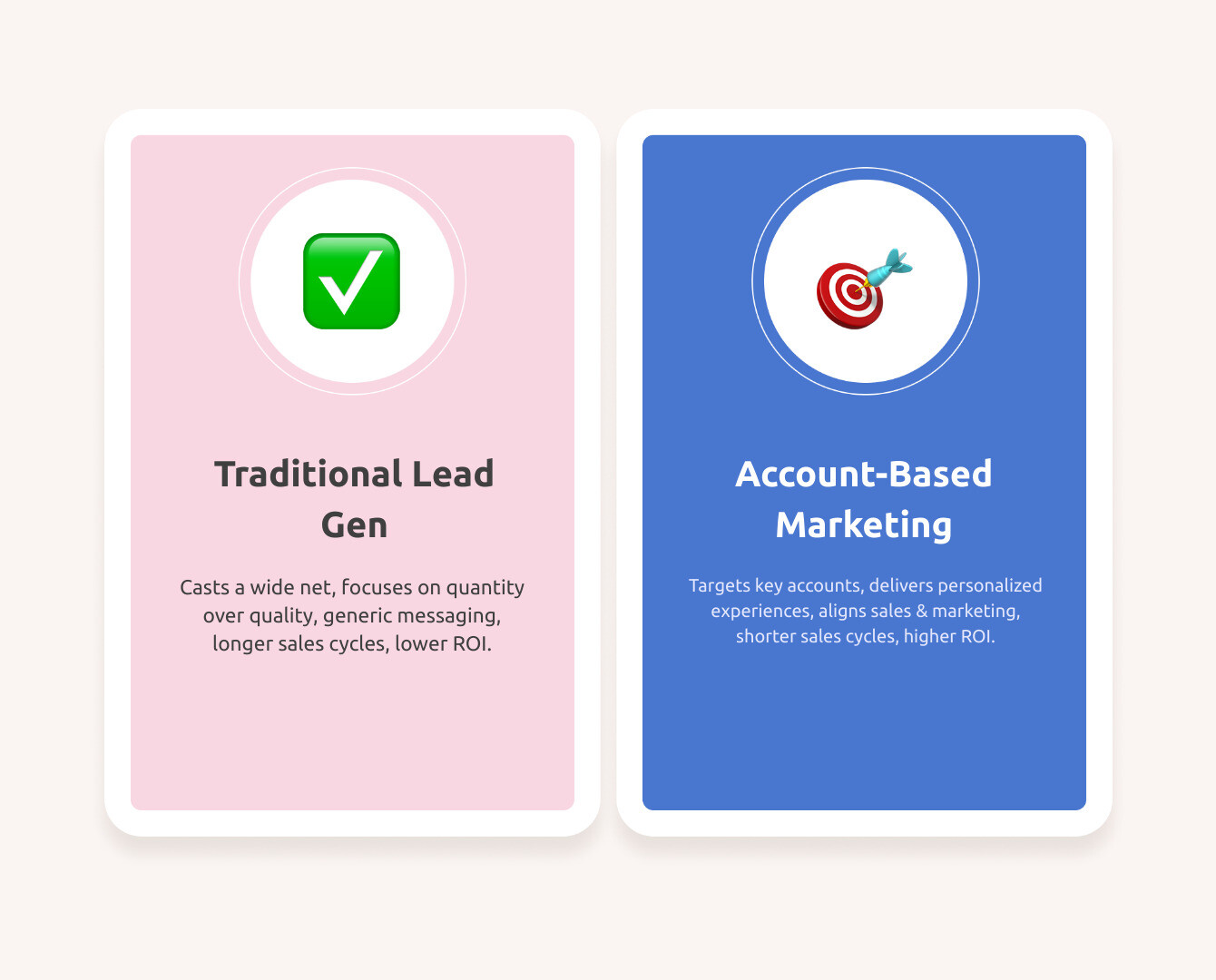
Traditional lead generation operates on a "more is better" philosophy: Generate as many leads as possible and let sales sort through them. ABM flips this approach entirely, focusing on quality over quantity by targeting specific high-value accounts from the start.
The fundamental difference is profound. While traditional marketing ends with identifying good-fit companies, ABM starts with them. This shift eliminates the preliminary prospecting work and ensures every marketing dollar targets accounts with genuine revenue potential.
Key advantages of ABM over traditional lead generation:
- Precision targeting: Focus resources on accounts that match your ideal customer profile
- Higher conversion rates: Significantly higher conversion rates for target accounts
- Better resource allocation: No wasted budget on unqualified leads
- Shorter sales cycles: Eliminate time spent nurturing poor-fit prospects
- Improved lead quality: Every "lead" is already pre-qualified as high-value
Account-Based Marketing Benefits for Alignment
One of the most significant benefits of account-based marketing is its ability to align sales and marketing teams around shared goals. When both teams focus on the same set of target accounts, conflicts over lead quality and follow-up disappear.
How ABM creates alignment:
- Shared Ideal Customer Profile (ICP): Both teams work from the same definition of perfect-fit accounts
- Common metrics: Success is measured by account engagement and revenue, not just lead volume
- Integrated data: Sales and marketing share the same account intelligence and engagement history
- Unified messaging: Consistent communication across all touchpoints
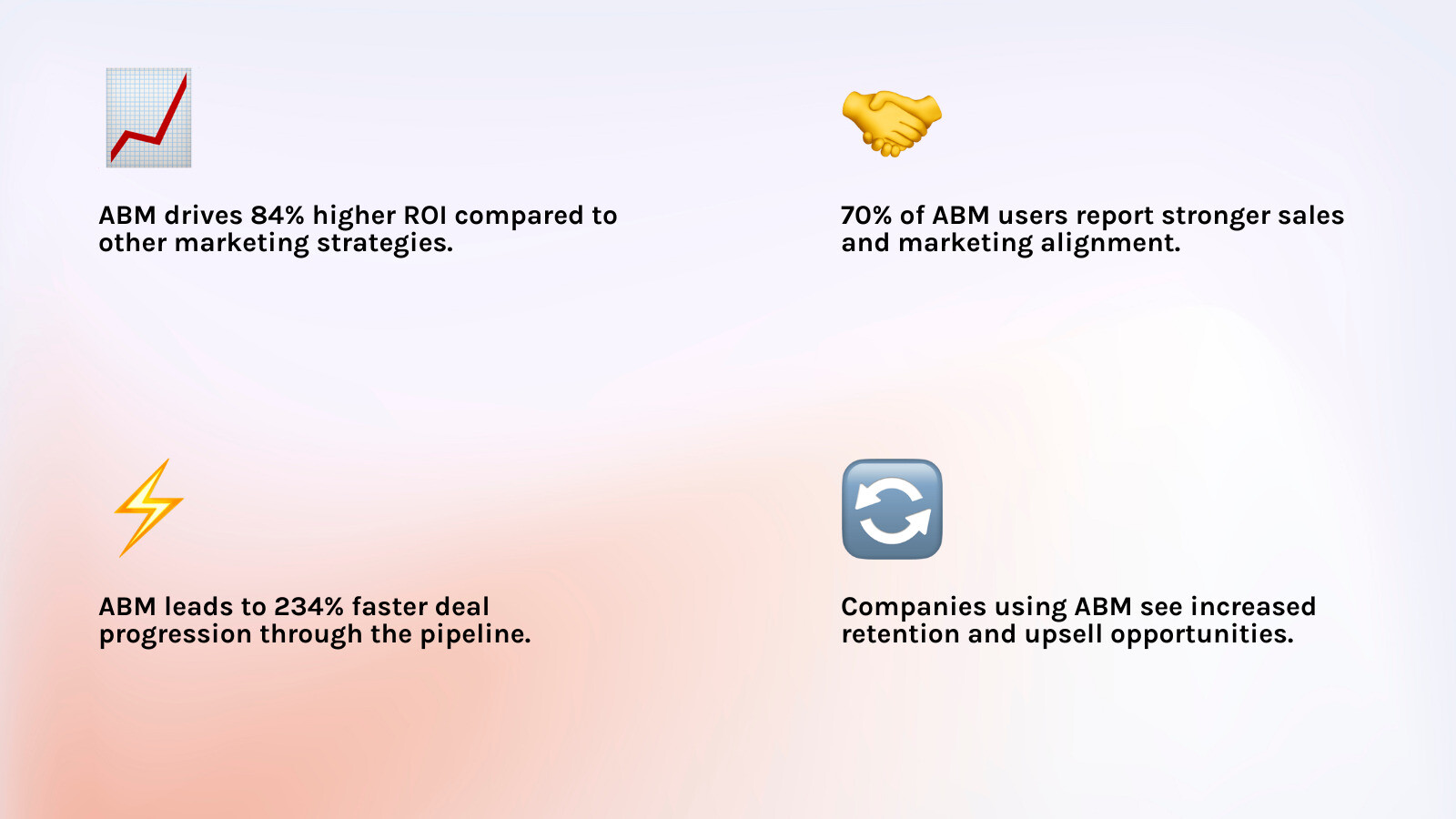
Research supports this: ABM users consistently report better sales and marketing alignment compared to non-ABM users. This alignment directly translates into better business outcomes.
Account-Based Marketing Benefits for Deal Velocity
ABM dramatically accelerates deal progression by focusing on accounts already showing buying intent. Instead of nurturing cold prospects for months, you're engaging with companies that have demonstrated interest in solutions like yours.
Ad-influenced accounts progress through the sales pipeline significantly faster than non-ad-influenced accounts. This acceleration happens because ABM targets accounts at the right time with the right message.
Why ABM speeds up sales cycles:
- Intent-based targeting: Focus on accounts showing buying signals
- Multiple touchpoints: Engage entire buying committees simultaneously
- Personalized content: Address specific pain points and use cases
- Coordinated outreach: Sales and marketing work together to move accounts forward
For more insights on optimizing your sales pipeline, check out our latest research on ABM pipeline acceleration strategies.
11 Game-Changing Account-Based Marketing Benefits
Let's dive deep into the specific advantages that make ABM such a powerful strategy for B2B companies. These benefits aren't just theoretical—they're backed by real data from companies that have successfully implemented ABM programs.
Account-Based Marketing Benefits for ROI
The ROI story for ABM is compelling. Businesses consistently report higher ROI than other marketing campaigns, and ABM consistently outperforms traditional approaches. This superior return happens because every dollar targets pre-qualified, high-value accounts.
Why ABM delivers superior ROI:
- Focused budget allocation: No wasted spend on unqualified prospects
- Higher deal values: Marketers consistently report larger deal sizes
- Better conversion rates: Target accounts convert at much higher rates
- Shorter sales cycles: Faster deals mean better resource utilization
Companies with mature ABM programs see even better results. Organizations that have been running ABM for over a year attribute the majority of their opportunities and revenue to ABM efforts.
Pipeline impact metrics:
- Companies report increased pipeline opportunities
- Improvement in MQL to SAL conversion rates
- Increase in pipeline opportunity value
- Increase in overall MQL volume
Account-Based Marketing Benefits for Customer Experience
Modern B2B buyers expect personalized experiences. With consumers expecting personalized interactions, ABM delivers exactly what today's buyers want - relevant, timely engagement that addresses their specific needs.
ABM transforms the customer experience by:
- Personalization at scale: Tailor content and messaging to each account's unique challenges
- Consistent touchpoints: Coordinate messaging across all channels and team members
- Relevant content: Address specific industry pain points and use cases
- Timely engagement: Reach out when accounts show buying signals
Companies delivering exceptional customer experiences see higher customer satisfaction and increased cross-sells. ABM makes this level of personalization possible even for complex B2B sales.
Customer retention also improves dramatically. Companies using ABM report significant improvement in reputation and customer relationships. This isn't surprising - when you treat each account as a market of one, relationships naturally deepen.
For more research on customer retention strategies, explore this scientific research on customer retention and trust-building.
Turning Benefits Into Reality: Building a Winning ABM Playbook
Understanding the benefits of account-based marketing is one thing; actually capturing them requires a systematic approach. Here's a five-step framework.

Step 1 – Select & Segment High-Value Accounts
Success starts with choosing the right accounts. This isn't about creating the longest possible list - it's about identifying companies with the highest revenue potential and best fit for your solution.
Account selection criteria:
- Firmographic fit: Company size, industry, location, and revenue that match your ICP
- Behavioral signals: Website visits, content downloads, and engagement patterns
- Intent data: Third-party signals showing active research in your category
- Strategic value: Accounts that could become reference customers or expand your market presence
Most organizations target between 20 and 200 accounts per sales rep, depending on deal size and complexity. The key is to start small and scale based on results.
Account tiering strategy:
- Tier 1: 3-5 "whale" accounts with the highest revenue potential
- Tier 2: 20-50 mid-market accounts with good fit and buying signals
- Tier 3: 100-200 smaller accounts for programmatic ABM approaches
Step 2 – Align Sales & Marketing Around Shared Data
The 67% improvement in deal closing rates when sales and marketing teams sync around ABM doesn't happen by accident. It requires deliberate alignment around shared tools, data, and processes.
Essential alignment elements:
- Integrated CRM and marketing automation: Both teams work from the same account data
- Shared dashboards: Real-time visibility into account engagement and progression
- Common definitions: Agreement on what constitutes a qualified account and opportunity
- Regular communication: Weekly alignment meetings to discuss account progress
We typically recommend implementing this alignment in HubSpot, where marketing automation, CRM, and reporting tools integrate seamlessly. This eliminates the data silos that often derail ABM programs.
Step 3 – Craft Hyper-Personal Content Journeys
Generic content kills ABM effectiveness. Each target account needs content that speaks directly to their specific challenges, industry context, and buying stage.
Personalization tactics that work:
- Video messages: Personalized videos mentioning the prospect's company and specific challenges
- Custom microsites: Dedicated landing pages featuring the prospect's logo and industry-specific content
- Dynamic email sequences: Messages that adapt based on engagement and account characteristics
- Stakeholder mapping: Different content for different roles within the buying committee
The key is balancing personalization with efficiency. Use templates and dynamic content to scale personal touches without overwhelming your team.
Step 4 – Orchestrate Multi-Channel Engagement
ABM works best when you coordinate touchpoints across multiple channels. This isn't about bombarding prospects - it's about meeting them where they are with consistent, relevant messaging.
Essential ABM channels:
- Targeted advertising: LinkedIn ads, display retargeting, and account-based advertising platforms
- Social selling: Personalized LinkedIn outreach and engagement
- Email sequences: Automated nurture campaigns with personalized elements
- Events and webinars: Exclusive experiences for target accounts
- Direct mail: Physical packages that break through digital noise
The most effective ABM programs use 3-5 channels simultaneously, with messaging coordinated across all touchpoints.
Step 5 – Measure, Learn, Iterate
ABM measurement goes beyond traditional marketing metrics. While lead volume matters less, account engagement and revenue impact matter more.
Key ABM metrics to track:
- Account engagement: Email opens, website visits, and content downloads at the account level
- Pipeline metrics: Opportunities created, deal size, and win rates for target accounts
- Revenue attribution: How much revenue comes from ABM-influenced accounts
- Relationship quality: Depth of engagement across the buying committee
The biggest challenge? 35% of ABM programs cite measurement as their top difficulty. This is why we recommend starting with clear KPIs and attribution models before launching campaigns.
For comprehensive support in implementing these strategies, explore our B2B digital marketing services designed specifically for ABM success.
Overcoming Common ABM Roadblocks
Even with clear account-based marketing benefits, implementation isn't always smooth. Many companies struggle with the same challenges. Here's how to avoid the most common pitfalls.

The three biggest ABM roadblocks:
- Misaligned target account lists: Sales and marketing disagree on which accounts to target
- Data quality gaps: Incomplete or outdated account information undermines personalization
- Unrealistic expectations: Expecting immediate results from a long-term strategy
Solutions that work:
- Start with a pilot program: Test ABM with a small number of accounts before full rollout
- Invest in data quality: Clean and enrich account data before launching campaigns
- Set realistic timelines: Plan for several months before seeing significant results
- Focus on alignment first: Get sales and marketing agreement on target accounts and processes
The companies that succeed with ABM treat it as a strategic change, not a tactical campaign. This means gaining leadership buy-in, investing in the right tools, and committing to the process for at least 12 months.
Frequently Asked Questions about Account-Based Marketing
What types of companies benefit most from ABM?
ABM works best for B2B companies with complex sales processes and high-value deals. Specifically:
- Mid-market to enterprise B2B companies: Those selling to other businesses with deal sizes over $10,000
- Complex sales cycles: Products or services requiring multiple stakeholders and longer evaluation periods
- High annual contract values: Where the cost of personalized marketing is justified by deal size
- Defined target markets: Companies with clear ideal customer profiles and identifiable target accounts
If you're selling low-cost products to small businesses, traditional lead generation might be more cost-effective.
How long does it take to see ABM results?
Realistic expectations are crucial for ABM success. Most companies see initial engagement improvements within 3-6 months, but significant revenue impact typically takes 6-12 months.
Typical ABM timeline:
- Months 1-3: Setup, account selection, and initial campaign launch
- Months 3-6: Engagement metrics improve, pipeline begins building
- Months 6-12: Revenue impact becomes measurable, programs scale
The key is tracking leading indicators (engagement, meetings booked, opportunities created) while waiting for lagging indicators (closed deals, revenue) to materialize.
Can ABM and inbound marketing work together?
Absolutely. The best B2B marketing strategies combine ABM's targeted approach with inbound marketing's broad reach. Here's how they complement each other:
Inbound marketing attracts unknown prospects:
- Content marketing builds brand awareness
- SEO captures search traffic
- Social media expands reach
ABM engages known high-value accounts:
- Personalized outreach to target accounts
- Account-specific content and campaigns
- Coordinated sales and marketing efforts
Think of inbound as filling the top of your funnel while ABM accelerates your most valuable prospects through it.
Conclusion
The benefits of account-based marketing are clear and compelling. With businesses consistently reporting higher ROI, revenue growth, and larger deal sizes, ABM delivers measurable results for B2B companies ready to invest in the approach.
The key benefits we've covered:
- Superior ROI: Focus resources on high-value accounts for better returns
- Faster sales cycles: Target accounts with buying intent progress significantly faster
- Better alignment: Sales and marketing teams work together more effectively
- Improved customer experience: Personalized engagement that modern buyers expect
- Larger deals: More valuable opportunities from targeted accounts
- Higher retention: Stronger relationships lead to better customer loyalty
The evidence is overwhelming: ABM isn't just hype, it's a fundamental shift toward more effective B2B marketing. Companies that adopt this approach consistently outperform those stuck with traditional lead-generation tactics.
Ready to capture these benefits for your business?
The transition to ABM requires strategic planning, proper tools, and expert guidance. At The B2B Mix, we specialize in helping companies implement successful ABM programs using HubSpot's powerful platform. Our hands-on, jargon-free approach ensures you see real results, not just fancy dashboards.
Whether you're just starting to explore ABM or looking to optimize an existing program, we can help you turn these benefits into reality. Learn more about our B2B digital marketing services and find out how we can accelerate your ABM success.
The question isn't whether ABM is worth the hype: it's whether you're ready to capture the competitive advantage it provides.